This site is supported by our readers. We may earn a commission, at no cost to you, if you purchase through links.

A snake can burn at 90°F or starve at 75°F. Same animal, same enclosure, different spot on the glass.
Most keepers blow it by treating the tank like a room. It isn’t. Corn snakes need a basking spot near 90°F and a cool retreat at 75-82°F. Ball pythons want 88-96°F on the hot side and 70-75°F on the cool end. Miss either number and your snake stops digesting, stops eating, or gets hurt.
Check surface heat with an infrared temp gun, air with a probe thermometer, and know the signs your snake needs more heat.
Even a small scrape can turn nasty in the wrong conditions, so an injured snake needs a simple, clean setup for housing an injured snake that keeps temperatures steady and surfaces smooth.
Learning how to heat a snake terrarium properly means building a gradient, not just plugging in a pad. You’ll set the right temperatures, pick a heater, and install it safely.
Table Of Contents
- Key Takeaways
- Set Your Snake’s Species-Specific Temperature Gradient
- Top 6 Snake Terrarium Heating Products
- Install Terrarium Heaters and Thermostats Safely
- Monitor Temperatures and Troubleshoot Heating Problems
- Manage Nighttime Heating and Power Outages
- Frequently Asked Questions (FAQs)
- What is the best way to heat a snake enclosure?
- How long can my snake go without heat?
- What temperature is too cold for a snake?
- Is 90 degrees too hot for a snake?
- How hot should my snake enclosure be?
- How do power outages affect snake terrarium temperatures?
- What substrate materials retain heat most effectively?
- How does enclosure size impact heating equipment requirements?
- Are there energy-efficient ways to heat a terrarium?
- Do snakes need UVB lighting in addition to heat?
- Conclusion
Key Takeaways
- Build a temperature gradient, not a uniformly warm tank: give your snake a hot spot and a cool retreat that match its species, such as 88–96°F and 70–75°F for ball pythons or about 90°F and 75–82°F for corn snakes.
- Put every heat pad or heater on a thermostat, mount it outside the glass with air space underneath, and cover no more than a third of the floor so your snake can always escape the heat.
- Verify temperatures yourself with digital probes on the basking surface and cool side, plus a daily infrared check, because cheap sensors drift and a gap under 10°F between zones means the gradient is failing.
- Plan for nights and power outages with proportional temperature control, a backup power source, and an emergency warming routine, since your snake can’t tell you it’s too cold.
Set Your Snake’s Species-Specific Temperature Gradient
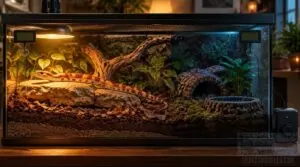
You can’t heat a snake terrarium well until you know what your animal actually needs. Start with species-specific ranges, because a corn snake and a ball python aren’t interchangeable.
Once you know your species’ ideal temperature range, this guide to choosing the right heating pad for snakes can help you pick a size and style that fits.
Corn snakes want a basking spot near 90°F (32°C) and a cool retreat zone of 75-82°F. Ball pythons run warmer, with a basking spot of 88-96°F and a cool side around 70-75°F. Rosy boas tolerate 90-95°F on the hot end.
Build a true temperature gradient, warm on one end and cool on the other. Research on rattlesnakes found that naturalistic thermal gradients reduce stress and give more reliable readings of thermoregulation than artificial laboratory setups. Your snake moves between zones to regulate itself. Constant hiding signals thermal trouble. Connect every heat source to a thermostat, and let nights dip slightly, but never below your species’ safe minimum. Verify with digital probes.
Top 6 Snake Terrarium Heating Products
You’ve set your target temperatures, so now it’s time to pick the gear that hits them. Every product below is a heat pad or under-tank heater, and each one needs a thermostat before it goes anywhere near your enclosure. Here are six options worth your money.
1. iPower 8×12 Reptile Heat Pad
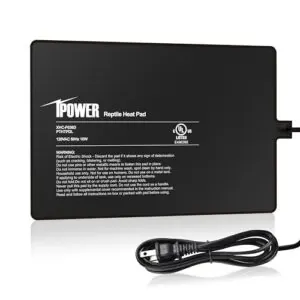
The iPower 8×12 Reptile Heat Pad is a simple, budget-friendly way to warm one side of a 30 to 40 gallon tank. It pulls 16 watts at 120V and comes with a 6-foot cord. Its PTC film spreads heat evenly, hitting about 86°F at 68°F ambient.
Here’s the catch. It has no built-in temperature control, so pair it with a thermostat. The 3M adhesive can peel after one to two months, so check it. Never trap heat on insulated surfaces.
| Best For | Reptile, amphibian, and small animal keepers with a 30 to 40 gallon tank who want an affordable way to warm one side of the enclosure and are willing to add a thermostat. |
|---|---|
| Heater Type | Heat pad |
| Temperature Control | None built-in |
| Mounting Method | 3M adhesive |
| Power | 16W, 120V |
| Pad Size | 8×12 in |
| Enclosure Fit | 30-40 gallon tank |
| Additional Features |
|
- Its PTC film spreads heat evenly, reaching about 86°F at 68°F ambient for reliable thermoregulation.
- The 3M adhesive backing, waterproof design, and 6-foot cord make it easy to attach and plug in.
- It also works for seed germination, bread dough rising, and home brewing, so it’s useful beyond the terrarium.
- It has no built-in temperature control, so you need an external thermostat for precise regulation.
- The adhesive can peel after one to two months of continuous use, so it needs regular checking.
- Mounting it where heat gets trapped, such as on insulated surfaces without elevation, creates a fire risk.
2. Aiicioo Under Tank Heater Thermostat
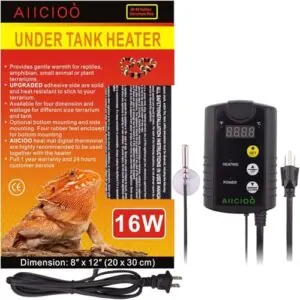
Want control? The Aiicioo Under Tank Heater Thermostat heat mat gives it to you.
Before you plug anything in, it helps to understand whether corn snakes really need under-tank heating, so you can set the thermostat probe and cutoff points with confidence.
Its three-button controller sets 68-108°F, and the display reads 32-140°F. Tape the probe flat against the glass for accurate probe placement, then check temperature calibration with a separate thermometer.
- Calm nights, no chilled snake.
- Certainty instead of guessing.
- Confident zoned heating.
- Quiet pride in your setup.
| Heater Type | N/A |
|---|---|
| Temperature Control | N/A |
| Mounting Method | N/A |
| Power | N/A |
| Pad Size | N/A |
| Enclosure Fit | N/A |
| Additional Features |
|
3. Tikaton Adjustable Reptile Heat Pad
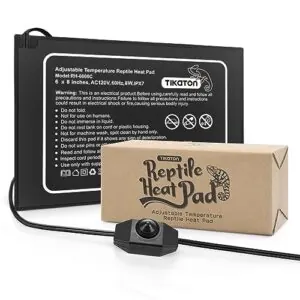
Prefer a simple dial over a digital controller? The Tikaton Adjustable Reptile Heat Pad puts a manual rotary switch in your hands.
Its 8W nichrome element runs on 120V and warms a 6×8 in pad, with 8×12 in (16W) and 8.5×18.5 in (24W) sizes for larger setups.
Use it on glass terrariums only. Wood, plastic, and acrylic enclosures are off limits, and the pad can discolor household furniture finishes, so don’t ever set the tank on a nice wooden dresser.
| Best For | Reptile, amphibian, or arachnid keepers with a glass terrarium who want simple, hands-on temperature control with a manual dial. |
|---|---|
| Heater Type | Heat pad |
| Temperature Control | Manual rotary dial |
| Mounting Method | N/A |
| Power | 8W, 120V (6×8 in) |
| Pad Size | 6×8, 8×12, 8.5×18.5 in |
| Enclosure Fit | Glass terrariums only |
| Additional Features |
|
- Manual rotary switch lets you adjust the heat without a digital controller
- Flexible PVC build with low energy consumption and an IPX67 waterproof rating
- Three sizes (6×8 in, 8×12 in, 8.5×18.5 in) fit small to larger setups
- Works on glass terrariums only, not wood, plastic, or acrylic enclosures
- Can discolor household furniture finishes if the tank sits on them
- Heating performance shifts with room temperature, so results vary outside the recommended range
4. BNLINK Reptile Heater Thermostat
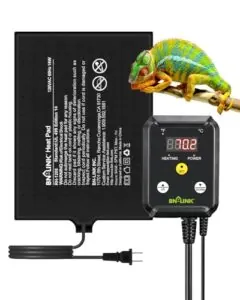
The BNLINK is the one to buy when you want control. You get a digital display in Fahrenheit or Celsius, plus LED lights that show power and heating status. Set it anywhere from 40 to 108°F, and the 6-foot probe cord reaches wherever you need it.
Pair it with a mat that covers only a third of the floor, and check whether heating mats are safe for snakes to keep a proper warm zone and cool retreat.
It’s built for glass tanks only, so don’t stick it to wood. Peel the adhesive backing, because full application may attach it permanently. Some keepers find it doesn’t run hot enough, so test first.
| Best For | Reptile keepers with 30–45 gallon glass terrariums who want a digital thermostat with precise temperature control and easy-to-read heating status lights. |
|---|---|
| Heater Type | Heat pad |
| Temperature Control | Digital thermostat |
| Mounting Method | Adhesive backing |
| Power | N/A |
| Pad Size | N/A |
| Enclosure Fit | 30-45 gallon glass |
| Additional Features |
|
- Digital display shows temperature in Fahrenheit or Celsius, with LED lights for power and heating status.
- Wide control range of 40–108°F, with a 6-foot probe cord that reaches wherever you need it.
- Comes with a suction cup probe and an adhesive-backed heating pad for secure installation.
- Designed for external placement on glass tanks only, so it won’t work on wood or other non-glass surfaces.
- Fully applying the adhesive backing may attach the pad permanently.
- May not get hot enough for some keepers’ expectations, so it’s worth testing first.
5. Pymeter Reptile Heating Pad
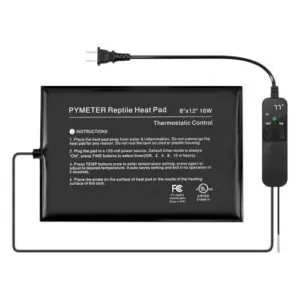
A heating pad with a built-in PID thermostat and timer, the Pymeter measures 12 x 8 x 0.2 inches and weighs 14 ounces. The nano traceless adhesive grips glass without leaving residue, so you can reposition it freely.
Set separate day and night schedules, and your snake gets belly heat for digestion on cue. It also suits turtles, lizards and frogs.
Know the catch. Some users report it never reaches the set temperature, and higher settings take a while. Verify every reading with a probe.
| Best For | Reptile and small pet owners who want a glass-mounted heating pad with a built-in thermostat and day/night timer for warm zones, hideouts, and belly heat. |
|---|---|
| Heater Type | Heat pad |
| Temperature Control | PID thermostat with timer |
| Mounting Method | Nano traceless adhesive |
| Power | N/A |
| Pad Size | 12x8x0.2 in |
| Enclosure Fit | Glass terrariums |
| Additional Features |
|
- Built-in PID thermostat aims for precise, consistent temperature control
- Nano traceless adhesive sticks firmly to glass and can be repositioned without leaving residue
- Integrated timer lets you set separate day and night heating schedules
- Some users report it never reaches the set temperature
- Higher temperature settings can take a long time to reach
- Feedback on temperature control reliability is mixed, so readings should be verified with a probe
6. Aiicioo Under Tank Heater
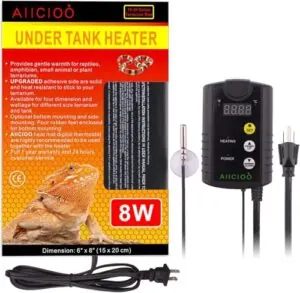
Say you’re housing a corn snake in a 20-gallon glass tank and need a warm side.
The Aiicioo Under Tank Heater measures 6 by 8 inches, runs on 120 volts, and draws 8 watts. It delivers steady heat between 104°F and 122°F. Rubber feet lift it off the surface, so heat escapes. Don’t cover it fully. Pair it with the included digital thermostat, which reads in Fahrenheit or Celsius.
Skip plastic, acrylic, or water tanks. Adhesion may weaken over time.
| Best For | Reptile, amphibian, and seedling keepers with a glass terrarium or aquarium who want steady, low-wattage heat on one side of the tank. |
|---|
- Provides steady heat between 104°F and 122°F
- Includes a digital thermostat that displays in Fahrenheit or Celsius
- Rubber feet allow heat to dissipate and make bottom mounting easy
- Not recommended for plastic, acrylic, or water tanks
- Adhesion may weaken over time on some surfaces
- Heat can build up if the pad is fully covered or the tank isn’t elevated
Install Terrarium Heaters and Thermostats Safely
Think of your heater as a race car engine and your thermostat as the driver’s foot. Heat source safety starts with control.
A heater is the engine and the thermostat is the driver’s foot, so real safety begins with control
Mount your heat mat on the outside of the enclosure, never inside, and leave air space beneath the tank. Running a ceramic heat emitter? Cage it, so your snake can’t touch it. Cover no more than one-third of the floor. Your snake needs a cool escape.
Probe placement matters most. Tape the probe to the warm surface where your snake rests, not on the heater itself. Secure it, or overheating follows.
Check that the heater’s wattage fits your thermostat’s rating, plug into a grounded outlet, and keep cords dry. Test everything for hours before your snake moves in.
Monitor Temperatures and Troubleshoot Heating Problems
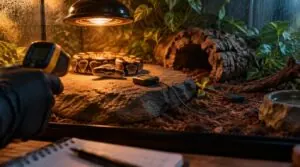
Don’t trust a heater you haven’t measured. Temperature monitoring is how you catch problems before your snake does.
Start with correct probe placement. Put one digital probe on the basking surface and another on the cool side substrate, never on the glass. Stick-on dials read wall air.
Build a temperature verification routine. Every morning, scan the enclosure with an infrared temp gun and compare it to your probes. Do a probe accuracy verification monthly, since cheap sensors lie.
Log your numbers for temperature drift detection. A gap under 10°F between warm and cool probes means the gradient is failing. A cool side above 80°F means your snake has no retreat. Hiding constantly or glass surfing? Too hot. Lethargic? Too cold.
Manage Nighttime Heating and Power Outages

Your house cools off at night, and your snake feels every degree. Plan for the night temperature drop before it happens.
Run a ceramic heat emitter or under-tank heat mat on proportional temperature control for steady thermal stability. Skip lights after dark.
When the power dies, act fast:
- Wrap the enclosure in towels or blankets.
- Keep it closed so heat stays in.
- Tape hand warmers to the lid, away from your snake.
- Set hot water bottles, wrapped in towels, beside the tank.
- Move the tank near a gas stove or fireplace.
Don’t wait for an outage to build an emergency heating backup. A small generator or server UPS keeps your thermostat alive. Battery-powered temperature monitoring tells you when to intervene.
Frequently Asked Questions (FAQs)
What is the best way to heat a snake enclosure?
Want a setup that actually works? Build a temperature gradient. Put a heat mat or overhead heater at one end, create a warm basking spot, wire in a thermostat, and verify probe placement every day.
How long can my snake go without heat?
Heat is your snake’s bank account; outages drain it. Without a warm basking zone, the thermal gradient collapses into one cool retreat zone. Adults tolerate days if temperature fluctuation stays above the critical thermal minimum.
What temperature is too cold for a snake?
Below 65°F, metabolism crashes in most snakes.
Know your species-specific ranges. Ball pythons need ambient air temperature above 75°F; that’s your critical thermal minimum. Keep a cool retreat zone, but always protect thermal comfort zones.
Is 90 degrees too hot for a snake?
Ninety degrees is a sauna, not a verdict. It suits ball pythons’ basking temperature but scorches corn snakes.
Check your thermal gradient, then fix temperature spike or thermal runaway in your snake enclosure heating setup.
How hot should my snake enclosure be?
Snakes need a 10–15°F gap between warm and cool ends. Build your thermal gradient around species-specific ranges: ball pythons: 88–92°F in the warm basking zone, 78–80°F cool. Corn snakes: 85–88°F basking spot. Run a thermostat.
How do power outages affect snake terrarium temperatures?
Once heat stops, your enclosure cools. Glass loses warmth quicker than wood or PVC because of lower thermal mass. Your temperature gradient collapses within hours. A backup UPS or portable power station protects thermal safety.
What substrate materials retain heat most effectively?
Slate and river stones win. Their high thermal mass gives thermal inertia, so warmth lingers after heaters cycle off. Skip insulative substrate like coir. Keep substrate depth under one inch for efficient substrate heat transfer.
How does enclosure size impact heating equipment requirements?
A heater sized for a 10-gallon tank will barely warm a 6-foot cage. Enclosure size impact is huge: bigger air volume means higher wattage, multiple heat sources, and zoned heating. Match heater wattage calculation to cubic footage, not footprint.
Are there energy-efficient ways to heat a terrarium?
Why heat the whole room when your snake only needs one warm spot?
Use zoned heating. A heat mat or under tank heating on one side boosts energy efficiency. Run a heater wattage calculation first.
Do snakes need UVB lighting in addition to heat?
Heat alone won’t cover diurnal snakes. They need UVB lighting for UVB synthesis of vitamin D Nocturnal species get it from prey. UVB won’t replace your snake enclosure heating setup, snake thermoregulation, or reptile thermoregulation.
Conclusion
Picture a ball python that refuses three meals in a row. The keeper swaps feeders, blames the snake, and never checks the cool end, which sits at 82°F instead of 75°F.
Knowing how to heat a snake terrarium properly fixes problems like that before they start. Pick a thermostat-controlled heater, verify every zone with a probe thermometer, and plan for outages. Your snake can’t tell you it’s too cold. Your thermometer can, so trust it.