This site is supported by our readers. We may earn a commission, at no cost to you, if you purchase through links.
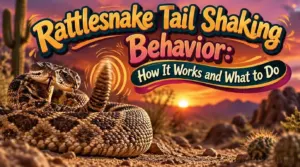
At four meters, a rattlesnake does something clever. Its buzz jumps from about 40 Hz to somewhere between 60 and 100 Hz, and your brain decides the snake is much closer than it is. You flinch, step back, and the snake gets exactly what it wanted: distance without a fight.
That trick sits at the center of rattlesnake tail shaking behavior, a warning system refined over millions of years. Nothing here is random noise. Every segment, muscle, and pulse fulfills a purpose, even in harmless snakes that fake it.
Know how the signal works, and you’ll know what it’s telling you to do.
Table Of Contents
- Key Takeaways
- Why Rattlesnakes Shake Their Tails
- How The Rattlesnake Rattle Works
- What Rattlesnake Tail Shaking Sounds Like
- Why Corn Snakes and Bullsnakes Shake Their Tails
- What to Do When You Hear a Rattlesnake Rattle
- Frequently Asked Questions (FAQs)
- What does it mean when a rattlesnake shakes its tail?
- Can you tell a rattlesnake’s age by its rattle?
- How fast do rattlesnakes shake their tail?
- Do rat snakes shake their tail like a rattlesnake?
- How did the rattlesnake rattle evolve over time?
- Do rattlesnakes ever shake their tails while moving?
- Can rattlesnake rattling last for hours continuously?
- How does rattlesnake population decline affect mimic snakes?
- Can rattlesnakes rattle immediately after they are born?
- Does a rattlesnakes age equal its number of rattle segments?
- Conclusion
Key Takeaways
- A rattlesnake’s buzz is a warning that it wants space, so when you hear it, freeze, find the snake with your eyes, and back away slowly rather than lunging at it or trying to kill it.
- The sound comes from a stack of hollow keratin segments that a fast-twitch tail muscle whips together in midair up to about 100 times per second, which is why it works even without touching the ground.
- Near four meters the buzz jumps from roughly 40 Hz to 60-100 Hz, tricking you into thinking the snake is closer than it is, and cold weather slows the rattle to about 23 Hz.
- You can’t trust sound alone or count segments to judge age, because harmless snakes like corn snakes and bullsnakes mimic the buzz in dry leaves, and each shed adds a segment while tips break off.
Why Rattlesnakes Shake Their Tails
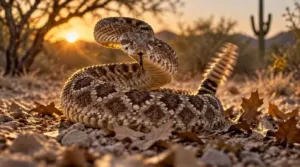
Every rattle you hear is a message, and Rattlesnake Tail Shaking Behavior Explained starts with a simple goal: avoiding a fight.
Even harmless pet snakes can mimic that warning, and this guide on why corn snakes rattle their tails explains how their softer rustle differs from a rattlesnake’s loud buzz.
The dry buzzing rattle works as an acoustic warning signal. Ancestors of rattlesnakes shook their tails long before rattles existed, and that vibration reliably meant a strike was coming. Predators learned the link between noise and danger. Even non-venomous species such as rat snakes and kingsnakes vibrate their tails in dry leaves to mimic rattlesnake warning sounds.
Sound isn’t the whole show. Tail vibration and body posture add visual threat, and that defensive posture teamwork makes your approach feel riskier to animals and people alike. Mechanisms Signals like these let a snake bluff instead of bite, saving venom and energy. Always respect that warning.
How The Rattlesnake Rattle Works
Your first clue is that the rattle isn’t a simple noisemaker, but a precision-built warning system. Three working parts make it run, and each one has a job you can learn to recognize. Here’s how they fit together, starting with the structure at the very tip of the tail.
Hollow Keratin Segments and Shedding
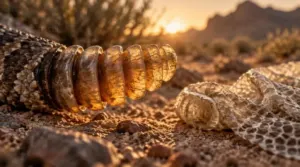
A rattle isn’t a toy you can pull apart. It’s a stack of hollow keratin segments, and each one starts forming under the old skin before shedding skin even begins.
Here’s what matters for you:
- Every skin shedding cycle adds exactly one segment.
- Interlocking segments strike each other to make the buzz.
- Keratin segment development follows growth, not age.
Specialized Muscles Power Rapid Tail Shaking
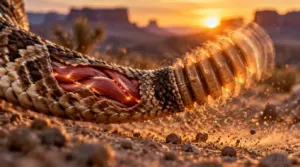
The rattle is just the instrument. Your real attention belongs on the caudal shaker muscle, built from supracostalis lateralis, iliocostalis, and longissimus dorsi on each side of the tail.
These fast-twitch muscles can keep that rattle going for hours, and if you want more surprising details about how rattlesnakes live and hunt, these fascinating rattlesnake facts with pictures are a great place to look.
| Muscle trait | Result |
|---|---|
| Fast switching | Rapid side-to-side motion |
| Mitochondria | Sustained rattling |
Each high-frequency contraction fires up to 100 times per second, and the snake sustains that tireless pace for minutes, even hours.
Sound Without Ground Contact
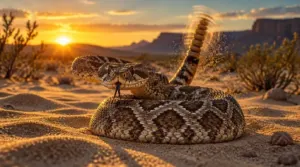
Your rattlesnake doesn’t need a stage. Sound Without Ground Contact works because the caudal shaker muscle whips the tail so fast that hollow keratin segments strike each other in midair, around 50 to 90 times per second. That’s why the dry buzzing rattle stays crisp on soft sand or loose soil.
Each new segment is added when the snake sheds, so how a rattlesnake’s rattle forms and develops explains why a rattle’s length is a poor guide to a snake’s age.
- Elevated tail: nothing touches the ground to dampen sound.
- Hollow segments: each collision resonates inside, sharpening the timbre.
- Frequency modulation: faster shaking blends clicks into one acoustic warning signal.
What Rattlesnake Tail Shaking Sounds Like
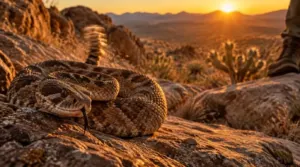
You’ve probably heard the rattle described as a buzz, a hiss, or a dry shake of seeds, but the real sound shifts with the situation. Two things change what reaches your ears: how close you are and how warm the snake is. Knowing both will help you read the warning before you act on it.
How Threats and Temperature Affect Rattling
Your approach speed sets the tempo. A rattlesnake performs constant threat assessment, and it answers a steady walker with frequency modulation, climbing toward 40 Hz.
If you notice a snake acting unusually defensive, it may be about to shed, and this pre-shed snake aggression guide explains why rattlers can react faster and more sharply.
Temperature matters too. A cold snake at 10°C buzzes near 23 Hz, while a warm one hits 100 Hz. That’s a seasonal acoustic advantage for you, and slowing down is your best threat deescalation tactic.
The Acoustic Illusion of Proximity
How does a snake sound closer than it is? Through acoustic proximity illusion, a masterclass in auditory deception. Tail vibration mechanics jump from about 40 Hz to 60-100 Hz at roughly four meters, overriding sound source clues from loudness.
- Slow rattle warns early.
- Fast burst fakes closeness.
- You misjudge distance.
- Defensive posture teamwork reinforces it.
- Step back and slow down.
Why Corn Snakes and Bullsnakes Shake Their Tails
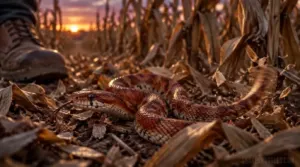
Picture a dry cornfield at dusk, leaves crackling underfoot, and a sharp buzz rising from the grass beside your boot. Your pulse spikes. But the maker of that sound has no rattle at all.
At dusk in a dry cornfield, a sharp buzz rises beside your boot, and the snake making it has no rattle at all
Corn Snake Tail Vibration works because the tip whips against leaf litter, and the dry debris does the noisy work. Bullsnakes do the same, and Bullsnake Rattlesnake Mimicry can sound startlingly convincing. It’s a bluff, and a smart one. Predators that avoid rattlers often back off, so the Batesian Mimicry Benefits are plain: harmless snakes borrow a dangerous reputation. Where rattlesnakes live nearby, the vibration lasts longer.
Tail Shape Differences give them away: a plain, tapered tip, never a rattle. Still, it’s a convincing defensive warning.
What to Do When You Hear a Rattlesnake Rattle
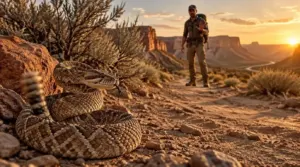
What’s the smartest move when that dry buzz cuts through the brush? Freeze. Your Snake Encounter Protocol starts with stillness, because the rattle is a warning, not an attack.
Find the snake with your eyes before you shift a foot. Back away slowly, keeping it in view. Treat 10 feet as your Safe Viewing Distance, since a calm retreat honors the snake’s Defensive Posture and lets it relax.
- Don’t lunge, poke, or try to kill it.
- Don’t wear headphones in snake country.
- Don’t rely on ice, tourniquets, or cutting a bite.
If a bite happens, remove rings and watches, then call emergency services instead of driving yourself. These Public Safety Guidelines work because Predator Deterrence is the rattle’s job.
Frequently Asked Questions (FAQs)
What does it mean when a rattlesnake shakes its tail?
When a rattlesnake shakes its tail, it’s sending a warning signal. The rattle is defensive behavior, a plea for space. It tells you the snake feels threatened, and it would rather deter you than strike.
Can you tell a rattlesnake’s age by its rattle?
No, and the rattle won’t help you guess. Each shed adds one keratin segment, and young snakes shed several times a year. Tips break off, too. Even the first button often disappears.
How fast do rattlesnakes shake their tail?
Your warning arrives as a blur, a heartbeat gone wild. Rattlers shake about 90 times per second, from 40 Hz in cold to 70–100 Hz in heat. An acoustic warning signal built on structural resonance.
Do rat snakes shake their tail like a rattlesnake?
No rattle, no buzz? Not quite.
Rat snakes use tail shaking as defensive behavior, and dry leaves turn it into an acoustic warning signal. That’s Batesian mimicry using predator learning cues, so don’t trust sound.
Rat snakes are just one of several non-venomous snakes that rattle their tails like a rattlesnake, so a buzzing in the leaves isn’t proof of danger.
How did the rattlesnake rattle evolve over time?
A whisper became a roar. Ancestral tail vibration gave selection raw material, and over 10 million years the Crotalus genus refined it through structural resonance and defensive posture cooperation.
Batesian Mimicry Benefits help harmless copycats.
Do rattlesnakes ever shake their tails while moving?
Rattle muscles fire about 50 times per second. Moving snakes rarely allow tail vibration, since stealth matters.
When threatened, muscle physiology takes over: a vertical tail position or horizontal tail movement joins defensive posture coordination.
Can rattlesnake rattling last for hours continuously?
You shouldn’t count on hours of nonstop rattling. Fatigue-resistant muscles sustain high-frequency contraction, but rattling frequency modulation tracks the stress and threat response, so tail shaking pauses and restarts. Long sounds rarely mean one snake.
How does rattlesnake population decline affect mimic snakes?
Lose the rattlesnake, and you lose the whole show. With population decline driven by human encroachment, mimics stop getting evolutionary reinforcement, so their tail vibration drops up to 20%. Predators forget the warning, and your gopher snake pays.
Can rattlesnakes rattle immediately after they are born?
No, newborn rattlesnakes can’t rattle. They’re born with a rounded prebutton, a keratin tip with no loose segment, so it stays silent. After their first shed, about a week later, your young rattlesnake gets a real rattle.
Does a rattlesnakes age equal its number of rattle segments?
Think of a rattle as a diary with torn pages.
No, segments don’t equal age. Each ecdysis adds keratin, yet snakes shed repeatedly and segments break off. Both Crotalus atrox and Crotalus scutulatus fool you.
Conclusion
Picture a dry ridge at dusk, heat lifting off the rocks, and a thin buzz of sound rising from the shadow of a ledge. That’s a warning, not an attack.
Understanding rattlesnake tail shaking behavior turns that sound from panic into information. The buzz means the snake wants space, and you can give it. Freeze, locate the sound, then back away slowly.
You don’t need to fear the rattle. Respect it, and everyone walks home.