This site is supported by our readers. We may earn a commission, at no cost to you, if you purchase through links.

A rattlesnake can strike, envenomate, and retract its fangs in under 100 milliseconds—faster than you can blink. That speed isn’t luck; it’s the product of millions of years refining fangs, venom, and heat-sensing pits into one of nature’s most efficient predatory systems.
Most people know rattlesnakes as something to avoid on a hiking trail, but there’s far more happening beneath that rattle than a warning sound. These reptiles navigate deserts through infrared vision, give birth to fully venomous young, and control rodent populations that would otherwise wreck crops and spread disease.
From folding fang mechanics to combat dances between rival males, these 27 fascinating facts about rattlesnakes with pictures reveal a creature built for survival at every turn.
Table Of Contents
- Key Takeaways
- Facts 1–6: Rattlesnake Anatomy, Fangs, and Rattles
- Facts 7–11: Heat Sensing, Hunting, and Feeding
- Facts 12–16: Warning Sounds and Defensive Behaviors
- Facts 17–22: Reproduction, Birth, and Lifespan
- Facts 23–27: Habitat, Ecology, and Human Safety
- Frequently Asked Questions (FAQs)
- What are some fun facts about rattlesnakes?
- How many hearts do rattlesnakes have?
- What is a funny name for a rattlesnake?
- How old is a 5 foot rattlesnake?
- How many different species of rattlesnakes are there?
- What is the average lifespan of a rattlesnake?
- How do rattlesnakes find their prey?
- Do rattlesnakes have any natural predators?
- Can rattlesnakes swim?
- How many rattlesnake species exist worldwide today?
- Conclusion
Key Takeaways
- A rattlesnake can strike, inject venom, and fold its fangs back in under 100 milliseconds, thanks to heat-sensing facial pits, hollow replaceable fangs, and a rattle built purely for warning, not attack.
- Newborn rattlesnakes arrive fully venomous and independent, with no parental care, since females give live birth after storing sperm and timing gestation to the best conditions.
- Rattlesnakes help control rodent populations that damage crops and spread disease, making them a valuable part of the ecosystem rather than just a trail hazard.
- Most snakebites happen when people corner or handle a rattlesnake, so keeping your distance and giving it room to escape is the best way to avoid one entirely.
Facts 1–6: Rattlesnake Anatomy, Fangs, and Rattles
A rattlesnake’s body is a masterclass in survival engineering, built from millions of years of evolutionary fine-tuning. Every fang, gland, and scale has a purpose, working together to help this predator hunt and endure. Here are five anatomical features that show just how impressive these reptiles really are.
If you’re curious how these traits stack up across the reptile world, this guide to snake species and their unique adaptations offers a deeper look.
Hollow, Replaceable Venom Fangs
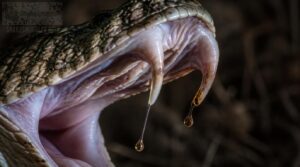
A rattlesnake’s fangs are living syringes, not fixed daggers. Each hollow channel carries venom under real pressure straight into tissue during a strike. Enamel gives them strength; the fang retraction mechanism folds them flush when idle.
What’s interesting? The fang replacement cycle never stops—new fangs grow behind old ones, pushing forward whenever a fang breaks or a snake sheds. This efficient venom delivery system is a key adaptation in hollow fang evolution.
Venom Glands Behind Eyes
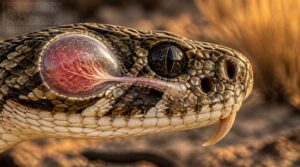
So where does that venom actually come from? Tucked behind each eye, beneath the jaw, sits a venom gland—a modified salivary gland encased in fibrous tissue. Secretory lobules manufacture toxic proteins, storing them until muscle contraction forces venom through the duct and into those hollow fangs. It’s a pit viper’s built-in pharmacy, primed for every strike.
Interlocking Keratin Rattle Segments
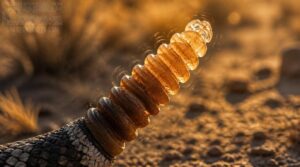
That built-in pharmacy needs a warning label, and nature delivered one at the tail tip. Each hollow, bony doughnutlike segment is pure alpha keratin, interlocking with the next through microscopic hooks and grooves. New segments grow with every shed, forming a percussive chain built for one job: acoustic deterrence.
- Hard keratin center
- Precision interlock
- Sequential growth
- Micro-roughness texture
- Sound-ready geometry
Rapid Tail Muscle Vibrations
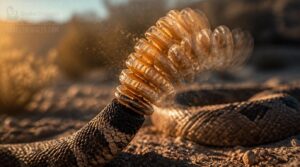
That segmented rattle would be silent without its engine. Specialized tail shaker muscles—fast-twitch fibers distinct from locomotor tissue—drive caudal vibration at 40 to 90 Hz, depending on temperature and species.
Minimal crossbridge cycling costs give tail shaker efficiency, so rattling for hours barely dents the snake’s energy budget. High mitochondrial density fuels rapid ATP turnover, sustaining this acoustic warning display far longer than muscle fatigue should logically allow.
Protective, Water-Saving Scales
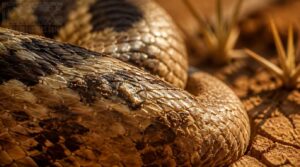
Desert life demands a body that wastes nothing, especially water. A rattlesnake’s scales carry a hydrophobic surface texture that beads moisture away, a key water conservation adaptation for arid environment survival.
- Reduced dehydration risk in scorching heat
- Faster recovery after rare rainfall
- Fewer trips exposed while seeking water
- Better odds through drought-stricken seasons
This moisture-resistant skin improves with each scale shedding efficiency cycle, keeping modified scales protective.
Facts 7–11: Heat Sensing, Hunting, and Feeding
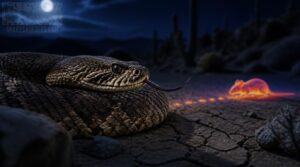
A rattlesnake’s real power isn’t just in its bite, it’s in how precisely it finds and captures its next meal. You’re about to see how heat sensors, patience, and split-second timing all work together in the hunt. Here are five facts that show exactly how these predators turn sensing into a meal.
Their heat-sensing pits work alongside other desert survival adaptations, a topic explored further in how rattlesnakes thrive in harsh desert climates.
Infrared-Sensing Facial Pits
Picture seeing in total darkness by heat alone. Rattlesnakes do it through paired facial pit organs between eye and nostril, a true thermal imaging system. The vascular pit membrane detects shifts as tiny as 0.001°C, relaying signals via the trigeminal pathway for rapid neural signal processing.
| Structure | Function | Sensitivity |
|---|---|---|
| Pit membrane | Heat detection mechanism | 0.001–0.01°C |
| Paired pits | Stereo thermal perception | Directional |
| Nerve network | Thermal vision relay | Milliseconds |
Patient Ambush Hunting
Why chase prey when patience does the work for you? As a true ambush predator, a rattlesnake relies on careful ambush site selection near rodent trails, then uses stealth movement techniques, scent control practices, and wind direction assessment to stay hidden.
This patient ambush hunting demands stillness—sometimes for hours—until unsuspecting prey wanders within striking range.
Lightning-Fast Accurate Strikes
Under 100 milliseconds—that’s all a rattlesnake needs from fixation to fang contact. Strike latency mechanics this quick rely on a tight muscular coordination sequence powering fang projection speed.
- Sheer, startling velocity
- Unnerving precision
- Split-second commitment
Jaw joint flexibility ensures prey impact timing stays deadly accurate, whether defensive strikes or ambush technique, making venomous fangs count on the very first strike.
Folding Fang Mechanics
A hinge, not a fixed blade—that’s the secret behind a rattlesnake’s fang deployment mechanics. An elastic tendon system snaps fangs forward mid-strike, then folds them back against the roof of the mouth.
| Phase | Fang Position | Function |
|---|---|---|
| Resting | Folded back | Safe swallowing |
| Strike | Forward | Venom delivery |
| Retract | Sheathed | Protection |
That sheath cuts friction, safeguarding this venomous weapon between strikes.
Venom Starts Prey Digestion
A rattlesnake’s meal starts cooking before it’s even swallowed. Hemolytic and myotoxic venom components trigger enzymatic tissue breakdown, while hyaluronidase acts as a spreading factor, ferrying enzymes deep into muscle.
Proteases churn out digestible fragments, boosting nutrient absorption once the prey’s gone. It’s biochemical efficiency: your average rattlesnake begins digestion long before its jaws finish the job.
Facts 12–16: Warning Sounds and Defensive Behaviors
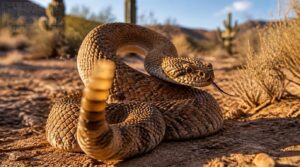
A rattlesnake’s survival doesn’t just depend on venom and stealth; it also depends on knowing how to avoid a fight altogether. From that iconic buzz to a well-timed strike, these snakes have a whole playbook for staying safe. Here’s what you’ll want to know about how they warn, hide, and defend themselves.
Rattling Warns Potential Threats
Before any bite, your ears get the warning. That buzzing comes from an audible deterrent mechanism—hollow keratin segments vibrating fast enough to signal "back off." Snakes control vibration frequency based on threat proximity, pairing the noise with an S-shaped posture.
This posture and sound combo amplifies the message, letting acoustic signaling do the talking before things escalate.
Rattle Length Cannot Determine Age
That warning rattle can’t tell you how old the snake is, so don’t count segments like tree rings. Each shed adds a segment, but segments wear out, snap off, or snag on brush. Growth rate varies with nutrition and climate, so shedding frequency changes unpredictably.
A short rattle might belong to a wise old survivor, not a button-toting newborn.
Camouflage Helps Avoid Detection
Age isn’t the only thing hiding in plain sight—so is the snake itself. Background matching blends tan, brown, and olive scales into rocky, sandy terrain. Disruptive patterning breaks up its outline with jagged blotches mimicking shadow and light.
Coloration adapts across grassland, woodland, and desert habitats. Staying motionless completes the illusion, letting predator avoidance work through stillness rather than speed.
Defensive Coiling and Striking
Stillness only works until a threat gets too close. Then the snake coils tight, using coil tension adjustments for a spring-loaded stance.
Escape route assessment happens fast—if cornered, strike acceleration mechanics kick in: lower jaw contacts first, upper jaw follows, all within half a second, conserving heat while poised to strike.
Seasonal Communal Denning
When temperatures drop, rattlesnakes don’t hibernate exactly—they brumate, gathering in rocky hibernacula for shared warmth.
Denning site selection favors south-facing crevices, where thermal buffering slows heat loss overnight. Communal denning cuts energy costs and offers predator avoidance advantage.
Garter snakes often rely on existing burrows rather than digging their own, a habit explained in more detail in this guide on whether garter snakes burrow underground.
Come spring, emergence timing syncs with rising temperatures, releasing snakes back into hunting grounds after months of dormancy.
Facts 17–22: Reproduction, Birth, and Lifespan

Rattlesnakes carry on a life cycle that’s every bit as dramatic as their bite. From courtship battles to birth, each stage reveals just how well-equipped these snakes are for survival. Here’s what you need to know about how they reproduce, grow, and endure.
Male Rattlesnake Combat Dances
Two rival males don’t bite—they wrestle. Rising nearly vertical, they twist and shove, each seeking grip to pin the other down.
- Bodies intertwine like grappling arms
- Rattles buzz low, signaling rivalry
- Contests can last over an hour
- Winner gains female access
- Loser retreats, avoiding injury
This combat dance settles dominance without venom, letting male rivalry play out safely each breeding season.
Internal Fertilization and Gestation
Once combat ends, mating begins—and rattlesnake reproduction gets biologically clever. Females can store sperm for months, timing fertilization to favorable conditions rather than immediate mating.
Inside her body, embryos develop ovoviviparously: eggs hatch internally, nourished by yolk while maternal tissues handle nutrient exchange. Hormonal regulation governs growth pace.
Gestation runs 90–180 days, shaped by temperature and species—patience built into every rattlesnake’s reproductive cycle.
Live Birth Reproduction
No egg-laying, no nest-guarding—rattlesnakes skip straight to the main event.
After that 90–180 day gestation, females deliver live young in a single event, litters ranging from just two to over 20 depending on species and maternal health.
Newborns weigh 4–14 grams and arrive fully formed.
It’s a high-stakes reproductive cycle, prioritizing quality over quantity.
Venomous, Independent Newborns
No training wheels here: baby rattlesnakes arrive with fully venomous fangs and zero parental guidance. Mom slithers off; siblings scatter within days.
- Functional venom glands work from birth
- Neonatal venom control allows precise dosing
- Independent hunting onset begins almost immediately
- Strikes land with adult-level accuracy
- Dispersal prevents sibling competition
Nature hands these newborns a loaded weapon and expects them to survive alone.
Newborn rattlesnakes enter the world armed with venom, fangs, and no guidance but instinct
Growth Through Repeated Shedding
A snake never stops growing, so its skin has to keep up. Each shedding cycle—or ecdysis—forms fresh skin beneath the old, splitting near the mouth for clean removal.
Younger rattlesnakes molt every 4–6 weeks; adults, less often. Molting costs energy but removes parasites, sharpens scales, and fuels territory expansion, letting rattlesnakes grow bigger, hunt wider ranges, and live longer.
Facts 23–27: Habitat, Ecology, and Human Safety

You’ve learned how rattlesnakes are built and how they reproduce, but where they live and how they fit into the wider world matters just as much. Their role stretches far beyond their own survival, shaping predator-prey balances and even brushing up against your own backyard.
Here’s what you need to know about their habitat, their ecology, and how to stay safe if you cross paths with one.
Diverse North American Habitats
Rattlesnakes thrive across strikingly different landscapes, from Sonoran cactus flats to Mojave rock scrub. Desert adaptations let them conserve water efficiently.
In cooler climates, mountain refuges and Great Basin sagebrush host specialized populations, while grassland edges and wetland corridors support others.
Sadly, habitat loss threatens many populations, spurring conservation efforts including population monitoring and captive breeding to maintain ecological balance.
Natural Rattlesnake Predators
Even a well-defended reptile has enemies. Hawks and eagles strike from above, while ground hunters like coyotes and badgers ambush from below.
Surviving these threats becomes even harder for protected species like the California red-sided garter snake, whose small wild populations can’t afford additional pressure from illegal collection.
- Kingsnakes constrict, resisting venom entirely
- Coyotes deliver crushing bites
- Roadrunners disrupt strikes on the ground
- Owls hunt silently at night
- Juveniles face the highest risk
Rodent Population Control
Predators aren’t the only ones keeping rattlesnake numbers in check with prey. As a prime predator of mice, voles, and ground squirrels, a single snake can consume dozens yearly, easing pressure that traps and bait stations alone can’t match.
This natural role complements integrated pest strategies, where habitat reduction, trap placement, and monitoring rodent activity work alongside—not against—the natural world’s own rodent control.
Conservation Threats and Protection
That rodent-control service comes with a cost, though: bulldozers don’t care how many mice a snake eats.
Habitat fragmentation from roads and development can cut ranges by 25%, isolating populations. Add in rattlesnake roundups, illegal collection, and needless killing from fear, and you get real pressure on wildlife conservation—one wildlife corridor at a time helps reverse it.
Safe Human Encounters
Since most bites happen when people corner or handle a venomous snake, the fix is simple: maintain safe distance, avoid sudden movements, and give it an escape path.
- Freeze, don’t flee wildly
- Read warning displays like coiling or rattling
- Wear protective clothing on trails
- Supervise children and pets closely
Antivenom research keeps improving outcomes, but prevention beats treatment every time.
Frequently Asked Questions (FAQs)
What are some fun facts about rattlesnakes?
Nature’s own maracas with a venomous bite: rattlesnakes vibrate their tails 40–60 times per second, pack venom potency that varies by species, and rely on evolutionary adaptations like heat-sensing pits to hunt after dark.
How many hearts do rattlesnakes have?
Just one—but it’s clever. This three-chambered heart has two atria and a partially divided ventricle, letting rattlesnakes separate blood flow, feed comfortably as ectotherms, and keep coronary arteries nourishing every beat during a strike or swallow.
What is a funny name for a rattlesnake?
Like a snake with its own gramophone, a rattlesnake earns names like Rattle Rocket or Hissterical Hank — playful nods to its acoustic signaling, that unmistakable buzzing rattle warning curious hikers to keep their distance.
How old is a 5 foot rattlesnake?
A five-foot rattlesnake usually falls between 2 and 6 years old, depending on species and growth rate. Habitat quality, prey abundance, and shedding frequency all influence growth, so size alone can’t pinpoint exact age—snakes may live 10 to 20 years overall.
How many different species of rattlesnakes are there?
Counting rattlesnake species is a bit like herding cats through tall grass — you rarely land on the same number twice. Depending on the taxonomic source, scientists recognize 33 to 36 species, split mostly between genus Crotalus and Sistrurus.
What is the average lifespan of a rattlesnake?
In the wild, rattlesnake lifespan usually spans 10 to 20 years, depending on species and habitat. Timber and prairie rattlesnakes often reach In captivity, with steady food and veterinary care, individuals can surpass 30 years—far outliving their wild counterparts.
How do rattlesnakes find their prey?
Darkness holds no secrets from a rattlesnake’s face. Heat sensing pits detect body heat from warm prey, while flicking tongue tips sample scent trails.
This multi-sensory verification—thermal contrast plus chemical cues—guides ambush site selection and pinpoints movement before the strike.
Do rattlesnakes have any natural predators?
Yes — kingsnakes, immune to venom, top the list, alongside hawks, owls, coyotes, and foxes. These predators target vulnerable juveniles most often, driving natural selection and shaping the defensive behaviors rattlesnakes rely on for survival.
Can rattlesnakes swim?
Rattlesnakes swim capably, using lateral body undulation and tail propulsion to cross rivers or ponds. They keep their heads elevated for breathing, relying on aquatic movement mainly to reach dry land or escape predators, not to hunt.
Their dual approach to water movement — gliding along the surface or dipping briefly below — is explored in depth at how rattlesnakes navigate water using surface swimming and submersion.
How many rattlesnake species exist worldwide today?
Like a taxonomist’s abacus that never stops clicking, current tallies put roughly 33 to 36 recognized species worldwide across genera Crotalus and Sistrurus, mostly Americas-wide.
Ongoing taxonomic revisions and conservation status assessments keep adjusting this species count estimate.
Conclusion
Respect is earned, not given—and few creatures teach that lesson better than the rattlesnake. These 27 fascinating facts about rattlesnakes with pictures reveal an animal engineered by evolution, from infrared-sensing pits to folding fangs, built not to terrorize you but to survive beside you.
Give a rattlesnake room, and it repays you with silence. Understanding its biology replaces fear with genuine respect, turning a dreaded trail encounter into a rare glimpse of nature’s most refined survivor.