This site is supported by our readers. We may earn a commission, at no cost to you, if you purchase through links.
A snake that eats one of the most toxic vertebrates in North America and mostly survives the experience deserves more attention than it usually gets. The California red-sided garter snake (Thamnophis sirtalis infernalis) resists tetrodotoxin from Pacific newts through sodium channel mutations baked into its genetics, a trick no field summary captures.
It’s a subspecies, not a full species, and that distinction matters more than most guides acknowledge. Color patterns shift dramatically across the Coast Ranges and Sierra Nevada foothills, making misidentification easy. The taxonomy, regional variation, habitat, and behavior covered here give you the tools to know what you’re looking at.
Table Of Contents
- Key Takeaways
- California Red-Sided Garter Snake Taxonomy and Identification
- California Red-Sided Garter Snake Range, Habitat, and Subspecies Overlap
- Behavior, Activity Patterns, Brumation, and Defense Strategies
- Diet, Toxic Newt Resistance, and Ecological Role
- Reproduction, Lifespan, Threats, and Conservation Status
- Frequently Asked Questions (FAQs)
- What are the ideal terrarium size and setup?
- How often should they be fed in captivity?
- Are they venomous or pose any risks as pets?
- What is their typical lifespan in captivity?
- Can different subspecies be housed together in captivity?
- Can they be kept as pets legally?
- What are their main predators in the wild?
- How do they survive winter in cold climates?
- Do they have any venom or defensive secretions?
- What animals commonly prey on this snake?
- Conclusion
Key Takeaways
- The California red-sided garter snake can eat highly toxic Pacific newts and survive because genetic mutations in its sodium channels block the newt’s tetrodotoxin — though at high enough doses, the toxin can still be lethal.
- Color patterns vary so dramatically across its range that reliable identification requires scale row counts and molecular data, not just a glance at the red markings.
- Habitat fragmentation from urbanization has severed riparian corridors by up to 60% in some California watersheds, making landscape connectivity the single biggest factor in whether isolated populations can persist.
- Despite no federal listing, it holds Species of Special Concern status under California state law, meaning wild collection requires permits and captive-bred animals from licensed breeders are the only legal option for hobbyists.
California Red-Sided Garter Snake Taxonomy and Identification
Getting the ID right on Thamnophis sirtalis infernalis takes more than a quick glance at the red markings. A few key features — scientific classification, color variation, scale structure, and lookalike subspecies — separate a confident ID from a guess. Here’s what to look for.
Scientific Name and Classification
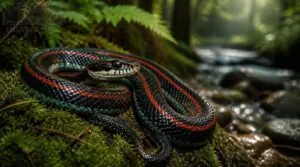
The California Redsided Gartersnake (Thamnophis sirtalis infernalis) belongs to Colubridae, one of the most species-rich snake families, within the genus Thamnophis. Three classification points that matter:
Its wider-ranging ancestry and distinct genetic profile are explored in depth in this California Red-Sided Gartersnake species profile, which traces how infernalis diverged from its parent species over time.
- Thamnophis sirtalis infernalis is a subspecies, not a distinct species.
- Older Nerodia assignments are now fully synonymized under Thamnophis sirtalis.
- Molecular markers anchor subspecies limits far more reliably than color patterns alone.
Color and Regional Variation
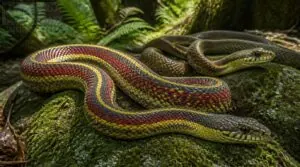
Those molecular markers matter because color variation in the California Redsided Gartersnake is genuinely unreliable for identification alone.
The red flank band averages 8–15 mm in northern populations but narrows southward.
In coastal California wildlife, individuals trend gray-green dorsally; inland snakes shift brownish-olive.
Eastern Sierra populations show a dorsal stripe pattern with an orange lateral hue tied to geographic variation.
Size and Scale Features
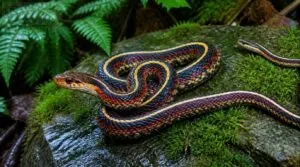
Color unreliability aside, size and scalation give you steadier ground. Adults rarely reach 3 feet in length, with the dorsal stripe pattern persisting across size classes.
Their modest adult size pairs with consistently patterned scales to make identification more reliable, as outlined in this guide to dragon snake size, scalation, and field identification.
Smooth scales in 21-23 rows at midbody replace the keeled dorsal scales and 19 rows at midbody you’d find on related taxa. Keel scale morphology is absent. This scale row count distinguishes dragon snakes clearly from lookalikes — a detail worth cross-referencing in a North America snake field guide when working through an ID in the field.
It’s an ovoviviparous species, bearing live young.
Similar California Gartersnakes
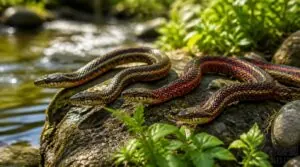
Those scale rows help, but range overlap will complicate your field ID. Several taxa share territory with Thamnophis sirtalis fitchi:
- Red lateral stripe absent in the Valley Gartersnake
- T. s. tetrataenia (San Francisco Gartersnake) shows bolder, broader red
- South Coast Gartersnake has a reduced dorsal stripe
- Pattern continuity, not color alone, separates forms
- Scale row counts confirm when coloration misleads
California Red-Sided Garter Snake Range, Habitat, and Subspecies Overlap
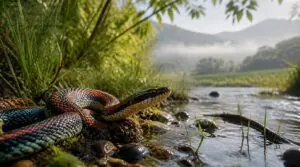
Trace the California Red-Sided Garter Snake’s distribution along the Coast Ranges and Sierra Nevada foothills and you’ll find it tightly coupled to riparian corridors, wet meadows, and moist edge habitats below 1,500 m. Thamnophis sirtalis infernalis is largely a western California resident, though habitat connectivity breaks down fast where roads and agriculture fragment lowland mosaics.
Fragmented populations also tend to show suppressed breeding success, making an understanding of snake reproductive cycles and breeding frequency especially relevant when assessing whether isolated T. s. infernalis colonies can sustain themselves over time.
The messiest part of its range is the contact zone. In the Sierra Nevada foothills and southern Cascades, range map intergradation produces intermediate phenotypes that resist clean identification, and genetics are often the only reliable arbiter. Subspecies taxonomic revision hasn’t fully resolved these boundaries; pure lineage limits remain contested, and admixture is likeliest near range edges where climatic shifts have reshuffled distributions.
Behavior, Activity Patterns, Brumation, and Defense Strategies
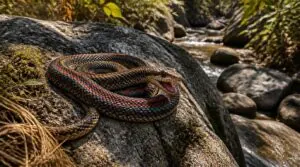
During late morning through mid-afternoon, you’ll find this snake at its most active, basking on sun-warmed rocks before launching into foraging bouts. Diurnal activity peaks in warm months, then tapers sharply as autumn temperatures drop. Replicating this rhythm in captivity means matching those peak-light hours with a quality reptile basking heat lamp UVB setup that cycles alongside natural daylight.
Brumation begins when daytime highs slip below 65°F. The snake retreats to rock crevices or underground shelters until spring warmth signals emergence, often in synchronized groups.
When cornered, it doesn’t bluff quietly. Expect defensive musk release, tail-shaking to mimic rattlesnakes, and body-flattening to appear larger. Near water, aquatic escape behavior kicks in fast. For anyone who works with or relocates these snakes, reptile snake handling gloves offer a practical buffer against both musk and unpredictable strikes during those frantic defensive moments.
- Watching one freeze, flatten, and vibrate its tail is genuinely unnerving
- The musk smells surprisingly awful
- It vanishes underwater with almost no warning
- Habitat connectivity determines whether populations survive in fragmented landscapes
Diet, Toxic Newt Resistance, and Ecological Role
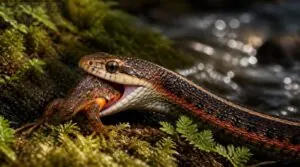
Think of this snake as a walking arms race. Its diet is opportunistic, taking amphibians, fish, small mammals, and invertebrates, with prey size and diversity scaling up as individuals grow.
The real story is toxic newt resistance. Where Pacific newts (Taricha torosa) occur, these garters eat them confidently, relying on mutations in voltage-gated sodium channels that blunt TTX binding. It’s impressive biochemistry, but not infinitely so. Tetrodotoxin resistance has limits: older Taricha carry enough toxin to overwhelm some individuals, and how those costs vary across life stages remains genuinely uncertain.
California garter snakes resist Pacific newt toxins—but not infinitely; some Taricha are still deadly enough to win
Its ecological role runs deeper than you’d expect. As a generalist mesopredator bridging aquatic and terrestrial food webs, it shapes amphibian community structure across montane and chaparral systems.
Reproduction, Lifespan, Threats, and Conservation Status
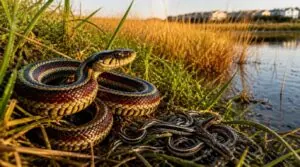
How Thamnophis sirtalis infernalis reproduces, how long it actually survives, and what’s pushing its populations into decline tells you as much about California’s shifting ecosystems as it does about the snake itself.
The sections below work through four interconnected aspects of its biology and conservation profile, starting with reproduction and ending with legal standing. Each one’s worth understanding whether you’re tracking these snakes in the field or trying to make sense of why some populations are quietly disappearing.
Mating and Live Birth
This species is ovoviviparous, not oviparous. After spring brumation, males track pheromonal mating cues to find receptive females. Sperm storage capability lets females delay fertilization for weeks. Fascinating reproductive biology:
- Males grapple for copulatory access
- Litters contain 6 to 26 neonates
- Gestation spans 2 to 3 months
- Neonates measure 9 to 13 cm
- Neonate growth rate peaks in year one
Lifespan and Survival
Wild individuals rarely make it past 4–6 years, with predation, drought, and disease acting as the main filters. Reproductive females pay the highest price; multiple broods each season drain the fat reserves needed for strong overwinter survival.
Meeting proper captive care requirements pushes captive snake lifespan well beyond that. A well-sized garter snake enclosure terrarium kit gives keepers control over temperature, humidity, and hide placement — the exact variables wild snakes can’t rely on.
Consistent habitat restoration efforts extend the same strength to wild populations.
Habitat Loss and Threats
Habitat fragmentation from urbanization has severed riparian corridors across California’s coast ranges, cutting connectivity by up to 60% in some watersheds.
Climate change impact on snowpack shrinks cool-season stream refuges, while drought pushes snakes into thermally stressful microhabitats.
Invasive bullfrogs and feral cats compound pressure wherever coastal wetlands contract, and together these stressors make conservation status assessment a genuine priority.
Legal and Conservation Status
Those mounting pressures pushed T. s. infernalis onto the California Department of Fish and Wildlife’s special animals list as a Species of Special Concern, with threatened status under state law. No federal listing exists.
If you’re doing fieldwork, wildlife permits are non-negotiable for relocation or research, and any credible conservation status assessment rests entirely on state agencies to enforce. Thorough documentation of observations — ideally in a waterproof field herpetology notebook — strengthens any permit application and supports the data quality state agencies rely on.
Frequently Asked Questions (FAQs)
What are the ideal terrarium size and setup?
Don’t settle for 20 gallons; go with a 36" x 18" x 18" terrarium setup. Topsoil-sand substrate helps with thermoregulation in snakes, modest reptile enclosure humidity prevents dehydration, and dedicated hides ease the snake shedding process.
How often should they be fed in captivity?
Feed juveniles every two to three days with feeder fish or nightcrawlers to fuel their rapid growth. Adults do well on a five-to-seven-day schedule; always adjust based on prey size and natural seasonal appetite shifts.
Are they venomous or pose any risks as pets?
They’re nonvenomous and harmless to humans. A defensive bite causes only minor local irritation at worst. Your real concern in reptile pet care is Salmonella transmission, so wash your hands thoroughly after every handling session.
What is their typical lifespan in captivity?
Like most colubrids, captive lifespan usually runs around 10 years under average reptile pet care. Dialing in precise thermal gradients, proper humidity, and a consistently clean feeding schedule routinely pushes longevity well past 17 years.
Can different subspecies be housed together in captivity?
Co-housing subspecies like Thamnophis sirtalis infernalis with close relatives is technically possible but carries real hybridization and disease transmission risks. Quarantine new arrivals first, monitor behavior closely, and separate at the first sign of aggression.
Can they be kept as pets legally?
Wild-caught individuals require CDFW wildlife permits, making collection effectively off-limits for most hobbyists. Captive-bred animals from licensed breeders are your legal option, but always verify that their documentation confirms lawful acquisition before you buy one.
What are their main predators in the wild?
Everything wants to eat them. Hawks, owls, and raccoons hunt from above and below, while coyotes and badgers ambush basking individuals near burrow edges. Being a habitat generalist in California wetlands multiplies these threats considerably.
How do they survive winter in cold climates?
They enter brumation below 16°C, clustering in communal hibernacula like rodent burrows and rock crevices. Metabolism drops dramatically, living entirely off stored fat reserves. On mild days, brief emergence allows basking and rehydration until spring.
Do they have any venom or defensive secretions?
No. These are fully nonvenomous snakes with no venom apparatus. When threatened, they may release musk gland secretion from cloacal glands, but that’s the extent of it.
What animals commonly prey on this snake?
Think of it as running a dangerous gauntlet every single day. Red-tailed hawks and great horned owls take adults from above, coyotes and raccoons work the ground, and domestic cats add suburban pressure on juveniles.
Conclusion
Picture a crimson-striped snake gliding through coastal marsh grass, belly full of toxic newt and entirely unbothered by it. That’s the california red-sided garter snake in one image: striking coloration backed by genetic resistance that most field guides never take the time to explain.
Know the regional color variation, respect the subspecies taxonomy, and trust the behavioral patterns covered here. Confident identification isn’t luck. It’s the reward for understanding what’s actually happening under those scales.