This site is supported by our readers. We may earn a commission, at no cost to you, if you purchase through links.

Most people assume rattlesnakes belong in dry, rocky terrain. Finding one gliding across a river stops them cold. It shouldn’t.
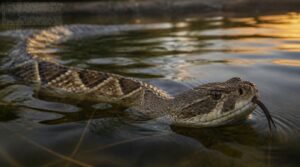
Can a rattlesnake swim? The answer is yes, and they cross water more often than most people realize. The same lateral body movement that propels them across sand works on the surface of a moving stream.
Understanding how they move through water, why they enter it, and what that means for your safety clears up a lot of unnecessary anxiety. The myths surrounding swimming rattlesnakes carry more danger than the snakes themselves.
Table Of Contents
- Key Takeaways
- Can Rattlesnakes Swim? Yes, They Can
- How Rattlesnakes Swim Through Water
- Why Rattlesnakes Enter The Water
- Can Rattlesnakes Bite While Swimming?
- Rattlesnake Swimming Myths, Debunked
- Frequently Asked Questions (FAQs)
- Can a rattlesnake bite you while it’s swimming?
- What snake swims the fastest?
- Is there a snake that can’t swim?
- Will a rattlesnake chase a human?
- Do rattlesnakes swim?
- Can you escape a swimming rattlesnake?
- Are rattlesnakes dangerous in water?
- Do rattlesnakes drink water?
- Can rattlesnakes bite you underwater?
- What if you spot a rattlesnake in the water?
- Conclusion
Key Takeaways
- Rattlesnakes are capable swimmers that use the same side-to-side body motion on water as on land, and they can stay submerged for up to 45 minutes under survival pressure.
- They enter water for practical reasons — crossing between habitats, hunting prey near shorelines, cooling down, or escaping predators — not to chase or threaten you.
- A swimming rattlesnake can still bite and deliver full venom on contact, so distance and calm movement are your best protection near water.
- Common myths like "head shape reveals venom" or "water neutralizes a bite" are dangerously wrong — only hospital-administered antivenom treats a rattlesnake bite effectively.
Can Rattlesnakes Swim? Yes, They Can

Yes, rattlesnakes can swim — and they’re better at it than most people expect. Understanding how they move through water, how long they can stay under, and why they cross it in the first place changes how you think about encountering one near a lake or stream. Here’s what you need to know.
From venom mechanics to swimming behavior, rattlesnake swimming facts and water safety tips cover the details that make a real difference when you’re near water in snake country.
Surface Swimming Versus Brief Submersion
Rattlesnakes rely on two distinct modes of aquatic locomotion: surface swimming and brief submersion.
- Surface swimming keeps the head up for breathing and detecting nearby movement
- Brief submersion cuts visibility to predators crossing open water
- Water temperature and current strength shape which approach they use
What you’ll usually see near water is surface swimming. Submersion trades air access for stealth.
How Long They Stay Underwater
Most submersion periods are brief. Snakes that stay underwater surface within 2 to 5 minutes near foraging zones. That’s enough to cross a stream or duck under cover.
| Situation | Typical Duration | Limiting Factor |
|---|---|---|
| Foraging near water | 2-5 minutes | Prey access |
| Stream crossing | 2-5 minutes | Habitat needs |
| Predator evasion | Up to 10 minutes | Threat level |
| Flood escape | 30+ minutes | Survival pressure |
| Captive maximum | ~45 minutes | Metabolic ceiling |
Breath control and low metabolic rate drive this oxygen conservation. The apneic diving response controls longer holds, with captive snakes documented past 30 minutes. Their breathholding capacity tops out near 45 minutes. Much like students who improve data interpretation skills over time, understanding snake physiology requires moving beyond surface-level observation to examine the fundamental mechanisms at work.
Water Crossings Are Usually Temporary
Once a snake finishes crossing, it doesn’t linger for long. Water crossings are brief by design, usually wrapping up within minutes before the snake returns to dry land.
Floods shift that pattern considerably. If you spot a rattlesnake near water during heavy rain, a flooded burrow likely forced it there. Snakes need to swim until they finally reach stable ground.
How Rattlesnakes Swim Through Water
Rattlesnakes are surprisingly capable swimmers, and the way they move through water is worth understanding. Their technique comes down to a few key physical mechanics working together seamlessly. Here’s how each part of their body plays a role.
Side-to-Side Body Undulation

Watch how a wave travels down a rope. That’s lateral undulation, the engine behind rattlesnake aquatic locomotion:
Those same S-shaped body waves that ripple through water are a masterclass in efficiency—explore the full science behind snake lateral undulation and movement patterns.
- Muscles fire in a sequential wave, head to tail
- The body curves side-to-side in a continuous winding motion
- Widest bending occurs near the midsection, then tapers
- Undulatory swimming frequency adjusts to water resistance
- The tail stabilizes the forward swim path
Scales Generate Forward Thrust

Each scale acts like a scale micro fin, gripping water and turning lateral movement into forward thrust. Scale stiffness varies to make water grip thrust work best at each phase of the stroke.
Ventral scale drag stays low as belly scales align to keep motion smooth. Tiny cavities between overlapping scales trap water, adding cavity water propulsion with each S-shape bend.
Tail Steering and Direction Control

Think of the tail as a built-in rudder. Each S-shape bend sends a lateral wave down the full body, and the tail tip adjusts its curvature to redirect water flow precisely.
Tail muscle control allows slight pivoting, widening or narrowing the turning radius as needed. That steering responsiveness stays balanced with forward propulsion, keeping movement smooth even in shifting currents.
Head Position While Swimming
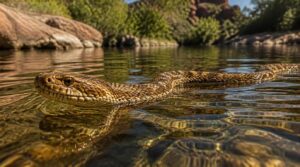
A rattlesnake keeps its head aligned with the spine while swimming, reducing drag a lot. This neutral position keeps the body smooth through each S-shape wave.
The head stays above the water surface to breathe, with a slight downward tilt protecting the airway. That alignment also helps buoyancy control, letting the snake float and move efficiently without disrupting the water surface.
Limits in Strong Currents
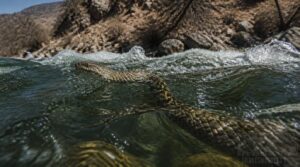
Strong currents impose real limits. When flow speed exceeds 0.8 meters per second, rattlesnakes usually turn back or seek a land detour rather than push through. Turbulence disrupts their lateral undulation, cutting forward progress by around 15 percent. The energy cost rises sharply, so crossing becomes a calculated decision, not a reflex.
Rattlesnakes treat fast currents as a calculated risk, turning back when the energy cost outweighs the crossing
Why Rattlesnakes Enter The Water
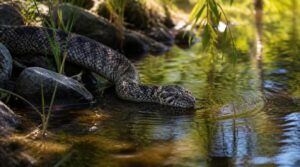
Rattlesnakes don’t enter water on a whim — there’s always a reason driving them there. Their behavior follows a clear logic tied to survival, and once you understand it, a sighting near water makes a lot more sense. Here’s what’s actually pulling them in.
Crossing Between Habitat Patches
Water isn’t a destination for rattlesnakes; it’s a route. If you spot one near a riverbank, it’s most likely crossing to reach habitat patches on the other side, not hunting you.
Patch isolation forces these crossings when patches sit too far apart. Snakes may use stepping stone patches along riparian corridors to break the journey and reduce overall exposure risk.
Foraging Near Water Sources
Prey concentrates near water. During dry spells, waterholes pull rodents, lizards, and amphibians into the same narrow strip, giving rattlesnakes a reliable hunting window.
Five reasons water edges attract rattlesnakes for foraging:
- Rodents visit daily to drink
- Amphibians cluster at dawn and dusk
- Emergent vegetation provides ambush cover
- Prey density peaks during drought
- Flooding opens new feeding pockets along banks
Cooling During Hot Weather
As an ectothermic species, a rattlesnake has no internal mechanism to cool down. It relies on thermal refuge seeking, moving into shade or shallow water when ground temperatures rise. Thermoregulation is the driver.
If you’re outdoors during peak heat, wearing light clothing and timing activity for early morning can reduce your chances of crossing paths with a snake doing exactly that.
Escaping Predators or Disturbance
Predator evasion pulls rattlesnakes into water too. When a coyote, hawk, or kingsnake closes in, a rattlesnake may slip below the surface and use aquatic vegetation as cover, staying submerged long enough to avoid detection entirely.
Human disturbance triggers the same response. Hikers, dogs, or passing vehicles can push a snake toward water just as effectively as any natural predator.
Leaving Flooded Burrows
Sometimes the snake doesn’t choose the water. Flood waters can fill a burrow fast, forcing a push upward through floodwater escape routes and out into the open.
After surfacing, post-flood movement is purposeful and fast. They stay low, scanning for threats, then move quickly toward brush and dry ground, restoring habitat connectivity through natural shelter seeking behavior.
Can Rattlesnakes Bite While Swimming?
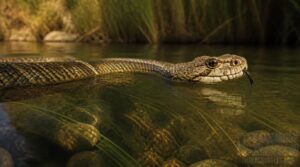
Yes, rattlesnakes can bite in water — and that’s the part most people don’t expect. Being in a lake or river doesn’t put you out of reach. Here’s what you actually need to know, from warning signs to what to do if things go wrong.
Bites in Water Are Possible
Rattlesnakes can and do bite in water. This isn’t a rare edge case. Venom delivery works exactly the same whether a snake is on land or partially submerged.
Watch out for these dangers:
- Wet conditions don’t stop venom
- Bites can happen at various depths
- Water ripples can hide a strike
- Snakes bite defensively, not aggressively
- Immediate medical help is critical
Swimming May Limit Strike Range
Water changes the physics of a strike. As rattlesnakes swim, drag and buoyancy reduce strike range underwater, cutting effective reach to roughly two-thirds of what’s possible on land. Water resistance dampens the force behind a lunge, and head alignment in the water restricts lateral reach.
These aquatic limitations are real, so don’t assume distance means safety.
Warning Signs Near Water
Near shorelines, your senses matter most. A sudden rustle in the reeds, a mud slick on a flat rock, or disturbed vegetation near the bank are all warning signs that rattlesnakes are close.
Some people detect a faint damp, musky odor before seeing one swim past. Footprints or drag marks in soft mud often trace recent predator evasion routes toward water.
Keeping a Safe Distance
In the water, your personal safety always starts with calm and distance. Spotting a swimming rattlesnake doesn’t mean panic. Follow these five steps to stay safe:
- Back away slowly and avoid sudden motions.
- Give the snake a clear escape path.
- Alert your group members quietly, without shouting.
- Stay at least six feet away.
- Move deliberately and calmly until it passes.
Emergency Steps After a Bite
If a bite happens, call emergency services immediately. Don’t wait for symptoms. Keep the victim calm and still, since movement speeds venom through the body. Remove tight clothing and jewelry before swelling starts. Gently wash the bite area, then immobilize the limb at or below heart level. Skip the snakebite kit. Only hospital-administered antivenin works.
Rattlesnake Swimming Myths, Debunked
Rattlesnakes carry a lot of baggage — most of it fictional. From campfire stories to social media clips, the myths around these snakes in water have taken on a life of their own. Here are five of the most common ones, and what actually holds up when you look at the facts.
Myth: Rattlesnakes Cannot Swim
This myth has no basis in fact. Rattlesnakes are capable swimmers, using lateral body undulation to move through water. Their aquatic abilities are well-documented:
Beyond swimming, rattlesnakes have other remarkable traits, and these fascinating rattlesnake facts with pictures explain how their venom glands and hollow fangs work together.
- Surface swimming keeps the head raised to breathe
- Brief submersion allows deeper water crossings
- Lung structure helps buoyancy and gas exchange
- Captive observations recorded submersion beyond 30 minutes
The swim capability proof is clear.
Myth: They Chase Swimmers
Rattlesnakes don’t chase swimmers. Chasing behavior is simply a myth.
| Common Belief | Observed Reality |
|---|---|
| They swim after people | They cross to reach land |
| Water makes them bold | Movement is passive |
| They pursue swimmers | They retreat when startled |
| Splashing triggers attacks | Defensive responses only |
Back away slowly. The snake is crossing, not chasing.
Myth: Water Neutralizes Venom
Some people assume water washes venom away or weakens it somehow. That’s not how venom works. Venom stays active in your blood and tissues regardless of immersion.
- Antivenom is the only treatment
- Water immersion won’t neutralize toxins
- Hydration helps health, not venom removal
- Timely medical care determines outcomes
- Venom potency isn’t reduced underwater
Seek emergency care immediately.
Myth: Every Swimming Snake Rattles
Fixing the venom myth sets the stage for another common assumption: that you’ll always hear a rattlesnake before it’s close.
Not every snake rattles, especially in water. Rattling requires tail movement against a hard surface. Submerged or swimming, that sound simply won’t carry. A rattlesnake crossing a river moves in near silence.
Myth: Head Shape Proves Venom
Silence on the water doesn’t mean safety, and neither does a snake’s head shape.
The idea that a triangular head means venomous is widespread, but it’s wrong. Some harmless species flatten and widen their heads when threatened. Some venomous snakes have rounded heads. Head shape simply isn’t a reliable test.
Fangs and venom glands determine the threat, not the silhouette.
Frequently Asked Questions (FAQs)
Can a rattlesnake bite you while it’s swimming?
Yes, a rattlesnake can bite while swimming. It strikes defensively if stepped on or grabbed. Water reduces reach slightly, but venom delivery remains effective on contact. Keep your distance.
What snake swims the fastest?
The yellow-bellied sea snake holds the title. Its paddle-shaped tail drives it through open water at roughly 2 miles per hour, with a sleek body that slices cleanly through currents.
Is there a snake that can’t swim?
Virtually every snake species can swim. No snake is truly incapable of moving through water. Even land-dwelling species use lateral body undulation to cross streams when needed, relying on natural buoyancy to stay afloat.
Will a rattlesnake chase a human?
No, rattlesnakes won’t chase you. They’re ambush predators, not pursuit hunters. When threatened, they rattle, then retreat. Defensive strikes create distance, nothing more. Give one space, and it disappears.
Do rattlesnakes swim?
They swim with surprising ease, gliding through water in a rhythmic side-to-side wave. They enter water to forage, cool down, and escape predators on land. Spot one swimming? Back away slowly and give it space.
Can you escape a swimming rattlesnake?
Give it a wide berth. If you spot one swimming, stay calm and move away slowly. They enter water to escape predators or cross habitat, not to chase you. Distance is your safest exit.
Are rattlesnakes dangerous in water?
Yes, rattlesnakes are dangerous in water. A venomous snake will still bite if it feels cornered, and venom potency doesn’t weaken. Keep a safe distance, avoid splashing, and seek emergency care immediately if bitten.
Do rattlesnakes drink water?
You might think a desert predator never needs a drink. Rattlesnakes do, though. They harvest rain droplets directly off their dorsal scales, lap from standing pools after storms, and also absorb moisture through skin contact.
Can rattlesnakes bite you underwater?
Rattlesnakes can bite underwater if you provoke or startle them near the water’s edge. Water resistance reduces their underwater strike distance, but a venomous bite still delivers full venom. If bitten, seek immediate medical care.
What if you spot a rattlesnake in the water?
Stay calm if you spot one in the water. Back away slowly, avoid splashing, and let it pass. Rattlesnakes swim to escape predators or find prey, not to bite. Observe quietly and alert others nearby.
Conclusion
Picture a rattlesnake moving silently across a sun-warmed river, its body curving in slow, steady waves, rattle lifted just clear of the surface. That image is real, and it happens far more often than most people ever stop to realize.
Can a rattlesnake swim? It can, and knowing that replaces blind fear with something far more useful: clear awareness. They enter water with purpose, not aggression.
Stay calm, keep your distance. That’s all it takes.