This site is supported by our readers. We may earn a commission, at no cost to you, if you purchase through links.

Your ball python sits comfortably at 55-60% humidity, then needs 70-80% the week it sheds. Your green tree python wants 70-80% every single day. Now add a living enclosure that has to stay damp without turning to swamp.
That’s the tension in bioactive care. Substrate performs best at 20-30% moisture by volume, pothos supplies up to a quarter of your humidity, and springtails and isopods won’t survive a dry spell. Overshoot, and you’ll face waterlogged soil and slimy walls.
The right humidity control systems for bioactive setups solve both problems at once. Here’s how seven of them perform.
Table Of Contents
- Key Takeaways
- Bioactive Humidity Requirements for Pet Snakes
- 7 Humidity Control Systems for Bioactive Setups
- Choosing Systems by Enclosure Size and Budget
- Installing Humidity Controls, Substrate, and Drainage
- Maintaining and Troubleshooting Bioactive Humidity Systems
- Frequently Asked Questions (FAQs)
- Conclusion
Key Takeaways
- Start with your snake’s species, since ball pythons need 55-60% humidity (70-80% when shedding) while green tree pythons need a steady 70-80%, and your substrate should stay at 20-30% moisture so your plants and cleanup crew thrive without waterlogging.
- Choose a misting system that matches your enclosure size and budget, favoring fine-mist units like the MistKing v5.0 kits for bioactive setups because their tiny droplets raise humidity without soaking the substrate, and expect durability problems with cheaper units.
- Build the enclosure from the bottom up with a drainage layer, mesh, and 2-3 inches of substrate, install your misting system before adding plants, and let everything run for several days before your snake moves in.
- Keep humidity stable by rinsing the reservoir weekly, using a calibrated hygrometer at snake level, and adjusting your misting cycles to the readings, lengthening them below 60% and shortening them if the substrate stays soaked.
Bioactive Humidity Requirements for Pet Snakes
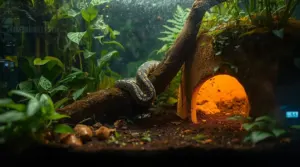
Moisture needs vary more between snake species than most keepers expect, so your humidity control plan should start with the animal, not the gear. Ball pythons do best at 55-60% ambient humidity, with spikes to 70-80% during a shed. Corn snakes prefer 65-75%, and green tree pythons need a steady 70-80%.
For a closer look at species-specific ranges and where to place your hygrometer for accurate readings, see this snake tank humidity levels guide.
Every snake species has its own thirst, so let the animal you keep decide how you build your humidity setup
Your bioactive materials do part of the work. Keep the substrate at 20-30% moisture by volume, and let live plants like pothos add 15-25% of the enclosure’s humidity. Adjust your misting cycle during sheds. Cleanup crews such as springtails and isopods also need moisture to survive, which is why bioactive enclosures suit humid species better than arid ones.
Balance it with ventilation systems covering 5-10% of the surface area. Use a humid hide at 80-90%, and run two hygrometers, one in the air and one in the hide, to catch gaps over 10%.
7 Humidity Control Systems for Bioactive Setups
The right humidity system keeps your enclosure steady without you hovering over it with a spray bottle.
Below, you’ll find seven options, from simple foggers to fully programmable misters, so you can match a humidity control system to your setup.
As you read, think about your enclosure’s size, your snake’s needs, and how hands-on you want to be.
1. Moistenland Reptile Mister System
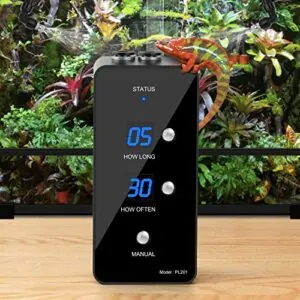
A two-nozzle setup like this one gives you timed, hands-off misting for a snake enclosure without the cost of a premium system. Each 360° adjustable nozzle lets you aim spray at the substrate or the plants. The timer runs sprays up to 5 minutes, with intervals from 1 hour to 30 days.
There’s no built-in tank, so the 16ft hose draws from a bottle or bucket. Expect some noise at night, and mixed reports of units failing within six months.
| Best For | Snake, gecko, or frog keepers who want an affordable, timed misting setup and don’t mind supplying their own water bottle or bucket. |
|---|---|
| Weight | 520 g |
| Dimensions | 1.8″D x 2.2″W x 4.5″H |
| Material | ABS plastic |
| Water Source | External reservoir via 16ft hose |
| Timer Control | Timer, up to 5-min spray |
| Durability Concerns | Some units fail within six months |
| Additional Features |
|
- Two 360° adjustable nozzles let you aim the mist at the substrate or plants for full coverage.
- The timer offers sprays up to 5 minutes long, with intervals from 1 hour to 30 days.
- The included hose and nozzles let you set it up yourself in about 10 minutes.
- There is no built-in water tank, so you need a separate bottle or bucket for the 16ft hose to draw from.
- It can be noisy, which may bother you at night.
- Reports on mist consistency and durability are mixed, and some units have failed within six months.
2. Zoo Med Repti Fogger Ultrasonic Humidifier
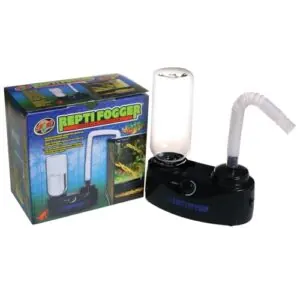
Where the Moistenland mister soaks, this one fogs. It’s a compact ultrasonic unit with an adjustable fog output dial, so you can raise humidity without drenching the substrate or heating the enclosure.
The one-liter bottle screws onto a no-spill valve, which makes refilling easy. At 3.7 lbs, it needs a full base and a floating safety shut-off to run.
Watch the valve, though. A stuck one chokes the fog, and some units fail within weeks. Pair it with a Zoo Med HygroTherm for tighter control.
| Best For | Keepers of tropical amphibians, reptiles, and invertebrates, such as dart frogs, chameleons, and hermit crabs, who want to raise terrarium humidity with a fine fog instead of soaking the substrate. |
|---|---|
| Weight | 3.7 lbs |
| Dimensions | 10.1″D x 6.2″W x 9.8″H |
| Material | Ceramic base, blue housing |
| Water Source | 1-liter screw-on bottle |
| Timer Control | N/A |
| Durability Concerns | Some units fail within a week or month |
| Additional Features |
|
- Adjustable fog output dial lets you raise humidity without drenching the enclosure or heating it
- One-liter bottle screws onto a no-spill valve, making removal and refilling easy
- Works with the Zoo Med HygroTherm controller for precise environmental control
- Needs a full base and a floating safety shut-off to run
- A stuck no-spill valve can choke the fog output
- Some units fail within a week or month, and the rheostat durability is a concern
3. Exo Terra Monsoon Solo II Misting System
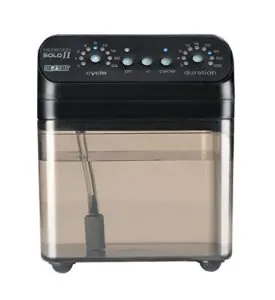
Where the fogger drifts, this one rains. The Solo II is a programmable mister, so you set the interval and duration, then let it run.
Since the nozzle extension reaches two enclosures, it pairs well with a humidifier for small snake enclosures if you keep a few compact setups.
A 36.25 PSI pump pushes water through pressure-resistant tubing to one flexible nozzle, with room to add a second. The 1.5-liter reservoir holds a decent supply, though some keepers find it runs dry too soon.
Reliability reports are mixed, with complaints about uneven spray. Watch spray patterns weekly and adjust your cycle if it sputters.
| Best For | Reptile and amphibian keepers, or greenhouse growers, who want a programmable, hands-off way to keep humidity up in a small to medium enclosure. |
|---|---|
| Weight | 1 kg |
| Dimensions | 5.51 x 5.51 x 6.5 in |
| Material | Plastic and metal |
| Water Source | 1.5-liter reservoir |
| Timer Control | Programmable intervals and durations |
| Durability Concerns | Mixed long-term reliability reports |
| Additional Features |
|
- Programmable misting lets you set the interval and duration to fit your enclosure’s needs.
- A 36.25 PSI pump delivers consistent water pressure and supports up to two nozzles.
- The 1.5-liter reservoir and pressure-resistant tubing make it suitable for terrariums and greenhouses.
- Customer reports on reliability and long-term performance are mixed.
- Some users find the 1.5-liter reservoir runs dry too soon for extended use.
- Spray performance can be inconsistent, and some users question the value for the money.
4. MistKing Advanced Misting System v5.0
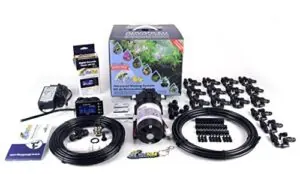
A high-pressure pump is what sets this kit apart. It pushes water at up to 125psi, which breaks it into a fine fog that hangs in the air before settling. Model MKAMS5-125-300 ships with a 24V adapter that works on 110V input, an ST-24 timer, and a 3/8" reservoir filter. You also get 35 feet of 1/4" tubing and 15 feet of 3/8" tubing.
Zoos and botanical gardens use it, and it suits arboreal species well. Don’t push it past what it’s built for: it isn’t ideal for 15-20 nozzles. Tighten the reservoir bulkhead carefully, since overtightening can strip it.
| Best For | Reptile and amphibian keepers, greenhouse hobbyists, and educational or public-garden setups who want a high-pressure system that creates a fine fog to boost humidity and mimic frequent natural rainfall, especially for arboreal geckos, chameleons, and amphibians. |
|---|---|
| Weight | N/A |
| Dimensions | N/A |
| Material | N/A |
| Water Source | External reservoir with bulkhead |
| Timer Control | ST-24 timer included |
| Durability Concerns | N/A |
| Additional Features |
|
- The pump reaches up to 125psi, producing a fine fog that hangs in the air before settling.
- It comes ready to set up, with a 24V adapter that works on 110V input, an ST-24 timer, a 3/8" reservoir filter, and 35 feet of 1/4" tubing plus 15 feet of 3/8" tubing.
- Zoos, botanical gardens, and educational institutions use it, and it suits arboreal species well.
- It isn’t recommended for systems needing 15-20 nozzles unless absolutely necessary.
- The number of nozzles it can support depends on how complex your system is, so larger setups may be a challenge.
- The reservoir bulkhead must be tightened carefully, since overtightening can strip it even with the redesign.
5. MistKing Starter Misting System v5.0
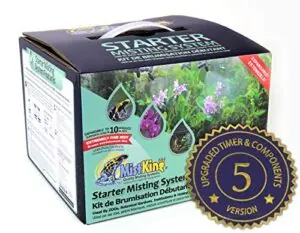
Droplets this small hang in the air instead of soaking your substrate, and that’s the main reason this kit suits bioactive setups. It produces a 50 micron mist, so the springtails and plants in your enclosure get humidity without waterlogging.
The kit includes a 24-volt pump, power adapter, reservoir bulkhead, filter, tubing and an upgraded timer built to handle power outages. You can expand to 10 nozzles later.
Check the box on arrival, since some buyers report missing parts, and expect a fiddly setup.
| Best For | Reptile and amphibian keepers, especially those with arboreal geckos, chameleons, or bioactive enclosures, who want a fine mist that raises humidity without waterlogging the substrate and who may want to add more nozzles later. |
|---|---|
| Weight | N/A |
| Dimensions | N/A |
| Material | Metal |
| Water Source | External reservoir with bulkhead |
| Timer Control | Upgraded timer included |
| Durability Concerns | N/A |
| Additional Features |
|
- Produces a very fine 50 micron mist that hangs in the air, keeping humidity up without soaking the substrate, so plants and springtails do well.
- Expandable up to 10 nozzles, so you can start small and grow the setup.
- Comes with everything needed to start, including the 24-volt pump, power adapter, reservoir bulkhead, filter, tubing, and an upgraded timer built to handle power outages.
- Limited to 10 nozzles, so larger setups would need an Ultimate or Advanced model.
- Some customers report missing parts, especially the misting assembly, so you should check the box when it arrives.
- Some customers find setup unnecessarily complicated, so expect it to be fiddly.
6. Zoo Med Reptirain Automatic Mister
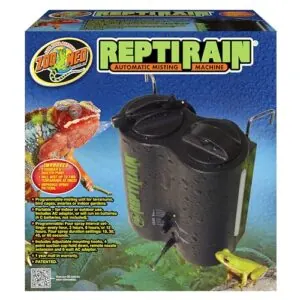
Say you’ve got a 4-foot bioactive setup for a ball python, and you’re tired of hand-misting every morning before work. This unit takes that chore off your plate.
It’s programmable, with spray intervals of every hour, 3, 6, or 12 hours, and durations of 15, 30, 45, or 60 seconds. It runs on a 6 watt AC adaptor or 4 C batteries (not included).
Be realistic, though. Some owners report units failing within 30 days, and the output can be a steady stream rather than a fine mist.
| Best For | Reptile, amphibian, or bird keepers who want to automate regular misting in an indoor enclosure or garden and are comfortable keeping an eye on a unit that may not last long. |
|---|---|
| Weight | 1.07 kg |
| Dimensions | 14 x 5 x 10 cm |
| Material | N/A |
| Water Source | N/A |
| Timer Control | Programmable intervals and durations |
| Durability Concerns | Some units stop within 30 days |
| Additional Features |
|
- Programmable intervals of every 1, 3, 6, or 12 hours and durations of 15, 30, 45, or 60 seconds
- Runs on the included 6 watt AC adaptor or on 4 C batteries (not included), and its portable design allows indoor or outdoor use
- Automates humidity control for terrariums, aviaries, and indoor gardens
- Some users report the unit stops working within 30 days
- Output is often described as a steady stream rather than a fine mist
- Durability complaints include units breaking on first use or shattering when handled
7. REPTI ZOO 800ml Portable Mister Fogger
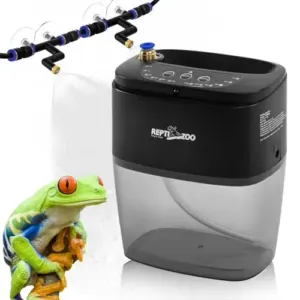
Say you’ve got a 4x2x2 foot tropical snake enclosure, and your hygrometer keeps dipping below 60% overnight. This 800ml unit from REPTI ZOO (model TR08NB) can help. Its two 360-degree nozzles let you aim mist where you need it, and the timer remembers its settings after a restart.
It mounts outside, so it saves interior space. The catch is reliability. Some owners report leaks and breakdowns within weeks, so test it before trusting it.
| Best For | Reptile and amphibian keepers or rainforest plant growers who want an external, timer-controlled mister to hold humidity steady in a mid-sized terrarium, and who don’t mind testing it closely before relying on it. |
|---|---|
| Weight | 0.64 kg |
| Dimensions | 5.5 x 3.2 x 6.6 in |
| Material | N/A |
| Water Source | 800ml top-fill tank |
| Timer Control | Built-in timer with memory |
| Durability Concerns | Breakdowns within weeks |
| Additional Features |
|
- Two 360-degree adjustable nozzles let you aim the mist exactly where it’s needed.
- The built-in timer remembers its settings and restarts automatically.
- It mounts outside the enclosure, so it saves interior space.
- Some owners report leaks during operation.
- Some units have broken down within weeks, which raises durability concerns.
- Noise complaints exist despite the quiet operation claims.
Choosing Systems by Enclosure Size and Budget
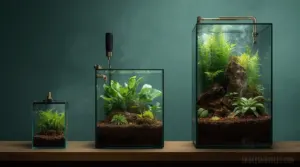
Pick the wrong system and you’ll either drown a small tank or leave a large one bone dry.
Start with enclosure size. Under 20 gallons, stick to units that push out less than 0.5 GPH, or the substrate will erode. For 20 to 50 gallons, aim for 0.5 to 1.5 GPH. Past 50 gallons, you’ll likely need several nozzles to keep a humidity gradient.
Your budget narrows things further:
- Under $50: a basic fogger like the REPTI ZOO 800ml suits small setups.
- $50 to $150: an automated misting system with a timer, such as the Reptirain.
- Over $150: modular kits like MistKing v5.0 for large builds.
- Any budget: choose brass or stainless parts and a reservoir over 2L.
That last point saves money over time.
Installing Humidity Controls, Substrate, and Drainage
Build from the bottom up, because every layer depends on the one beneath it. Start with 2.5 to 3 inches of rinsed clay pebbles or hydro balls, and drop an airline tube or PVC pipe into one corner so you can drain excess water later without disturbing anything.
Next, lay fine vivarium mesh across the drainage layer, then add 2 to 3 inches of substrate. Mix in leaf litter and bits of wood to feed your cleanup crew.
Install automated misting before any plants go in. Aim nozzles away from electronics, and keep reservoirs and tubing outside the enclosure.
Water the plants in. The drainage layer should fill slowly, and water must never touch the mesh. Let everything run for several days before your snake moves in.
Maintaining and Troubleshooting Bioactive Humidity Systems
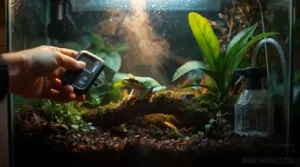
Even a well-built bioactive setup needs steady upkeep to keep humidity stable. Below, you’ll find three maintenance and troubleshooting areas to check, starting with the water and hardware that feed your system. Work through them in order and you’ll catch most problems before your animal or your plants notice.
Cleaning Reservoirs and Preventing Mineral Clogs
A neglected reservoir is the most common reason a misting setup fails, so build your routine around it.
- Empty and rinse the tank weekly, and more often in warm rooms.
- Scrub walls to remove slime, since rinsing alone won’t.
- Use RO or distilled water to slow scale.
- Soak nozzles in 1:1 vinegar monthly.
Checking Sensors and Adjusting Humidity Cycles
Once the reservoir is clean, check that your readings are honest. Set a digital hygrometer on top of the substrate at the enclosure’s middle, where your snake actually lives, and calibrate it every six months with the salt method (75% RH after 24 hours).
Then watch daily. If you’re below 60%, lengthen your humidity cycles. If the substrate stays soaked, shorten them.
Correcting Waterlogging and Poor Airflow
Even perfect sensor readings can’t save you from soggy soil. If the bottom layer smells sour or water pools, act fast.
- Drain the false bottom so the reservoir stays at 2-3 inches.
- Cut misting runs until topsoil dries slightly between cycles.
- Open low intake and high exhaust vents to restore airflow.
Healthy snakes and thriving plants depend on all three.
Frequently Asked Questions (FAQs)
Do live plants need different misting than snakes?
Does one misting routine really suit both? Not quite. Plants need root-level moisture and damp foliage, while your snake needs steady ambient humidity and a dry, clean substrate to avoid scale rot.
Can bioactive humidity systems work with desert species?
Yes, they can, as long as you keep moisture local. In an arid bioactive setup, run a humid hide and a damp substrate pocket, then leave the surface dry. Use short misting pulses, never fixed cycles.
How does room temperature affect enclosure humidity?
When your room warms up, your enclosure’s air warms too, and warmer air holds more vapor. Without added moisture, relative humidity drops. A 10°C rise roughly halves it, so your hygrometer can fall while misting stays unchanged.
What happens to humidity during power outages?
When the power cuts out, your misters and foggers stop, and humidity starts sliding within 3 to 5 minutes. A deep substrate of 3 to 4 inches holds the line longer, often stretching viable humidity to 2 to 4 hours.
Conclusion
Picture a 4x2x2 foot enclosure with a ball python, running a mister at 6 a.m. and 6 p.m. for 30 seconds each. Humidity climbs to 60%, the substrate stays near 25% moisture, and the springtails keep grazing.
That’s what the right humidity control systems for bioactive setups deliver, steady numbers. Match the system to your enclosure size, check your sensors weekly, and adjust cycles by season. Get that rhythm right, and the enclosure runs itself.
- https://www.neherpetoculture.com/vivariumenviro_control
- https://thriveecosystems.com/blogs/advice-and-everyday-activities/why-your-terrarium-is-losing-humidity-and-how-to-fix-it
- https://naturalenemies.com/news-and-information/humidity-ventilation-mold-in-bioactive-reptile-enclosures-getting-the-balance-right-