This site is supported by our readers. We may earn a commission, at no cost to you, if you purchase through links.

Humidity isn’t a comfort feature for reptiles; it’s a survival requirement. A chameleon kept at 40% relative humidity instead of 70% will begin showing signs of dehydration within days, and a ball python without adequate moisture cycles struggles to shed cleanly. Precise environmental control separates a thriving enclosure from a stressful one, and that control starts with your misting system.
The market has grown considerably, with options ranging from basic single-nozzle setups to programmable systems that schedule misting intervals down to the second. Knowing which system fits your species, enclosure size, and maintenance tolerance makes all the difference.
Table Of Contents
- Key Takeaways
- Best Reptile Misting Systems for Humidity Control
- 1. Phailozoo 50 Gallon Reptile Enclosure
- 2. Reptile Terrarium Tank 16 Gallon
- 3. REPWILD 33 Gallon PVC Reptile Terrarium
- 4. Automatic Reptile Mister System Timer
- 5. Fenocran Automatic Reptile Mister System
- 6. REPTI ZOO Reptile Humidifier Mini Misting System
- 7. MECESOR Reptile Mister Humidifier System
- 8. J&A Reptile Mister Automatic System
- How We Evaluated Reptile Misting Systems
- Mister Versus Fogger for Reptile Humidity
- Choosing The Right Reptile Misting System
- Setup, Scheduling, and Humidity Maintenance
- Frequently Asked Questions (FAQs)
- How can I control the humidity in my reptile tank?
- What is the best misting system for reptiles?
- Are automatic reptile misters worth it?
- How do I make a DIY reptile misting system?
- Can tap water be used in misting systems?
- How do I prevent mold inside my mister?
- Will misting damage live plants in the enclosure?
- Can I build a DIY reptile misting system?
- Conclusion
Key Takeaways
- Humidity isn’t optional for reptiles — species like chameleons need 70–85% RH consistently, and even a 10% swing can trigger respiratory stress or failed sheds.
- Choosing between a mister and a fogger comes down to your species’ needs: misters deliver quick humidity bursts ideal for arboreal lizards, while foggers sustain continuous saturation better suited to large, sealed enclosures.
- Timer precision and reservoir capacity are the two hardware factors that most directly determine whether your system stays reliable or becomes a daily maintenance burden.
- Using distilled water and cleaning nozzles every 2–4 weeks is the single most effective way to prevent mineral buildup and keep your misting schedule from breaking down.
Best Reptile Misting Systems for Humidity Control
Finding the right misting system comes down to matching the hardware to your species’ needs and your maintenance tolerance.
Before buying anything, it helps to know exactly what humidity range your reptile thrives in — this reptile misting system guide by species breaks down those differences so you can match the hardware to the animal, not the other way around.
The eight options below range from compact plug-and-play units to expandable multi-enclosure rigs.
Each has been evaluated on build quality, timer precision, and reservoir capacity so you can compare what actually matters.
1. Phailozoo 50 Gallon Reptile Enclosure

The Phailozoo’s front-access door design and 36 x 18 x 18-inch frame give you a solid baseline for housing geckos, juvenile bearded dragons, or mid-sized snakes. Its multi-material build, combining ABS plastic, acrylic, and aerospace-grade aluminum, keeps the structure rigid at 23.1 pounds.
You’ll want to apply extra silicone along the base before committing to a bioactive setup, since it’s not leakproof. The doors also lack built-in locks, so plan for aftermarket hardware if your animal is prone to escaping.
| Best For | Reptile owners setting up a bioactive or multi-level habitat for geckos, juvenile bearded dragons, snakes, or similarly sized lizards who want easy front access and room to expand vertically. |
|---|---|
| Indoor Use | Yes |
| Reptile Compatible | Yes |
| Humidity Support | Mister compatible |
| Suitable Species | Geckos, snakes, lizards |
| Setup Required | Assembly required |
| Moisture Management | Silicone sealing needed |
| Additional Features |
|
- Front-opening doors make feeding, cleaning, and interacting with your animal straightforward without disturbing the enclosure from above
- Stackable design with spacer cabinet compatibility lets you build a vertical enclosure system as your collection grows
- Multi-material construction — including aerospace-grade aluminum and tempered glass — keeps the frame sturdy and durable at a manageable 23.1 pounds
- Not leakproof out of the box, so bioactive or wet substrate setups require you to apply additional silicone along the base before use
- Plexiglass side panels and front bumper scratch easily, which can affect visibility and appearance over time with clawed reptiles
- Doors have no built-in locking mechanism, meaning escape-prone animals will need aftermarket locks added before the enclosure is secure
2. Reptile Terrarium Tank 16 Gallon

Stepping down in scale, this wood and acrylic build suits smaller species like juvenile lizards or compact snakes. At 17 × 15 × 12 inches, it fits standard desktop setups, and the openable mesh top keeps airflow consistent for misting.
The built-in safety lock is a genuine upgrade over enclosures that require aftermarket hardware.
Assembly is reported as difficult, the sliding front door feels flimsy, and the side glass is tinted rather than clear, so verify that before you buy.
| Best For | Keepers of smaller reptiles like juvenile lizards or compact snakes who need a secure, desktop-sized enclosure with reliable airflow. |
|---|---|
| Indoor Use | Yes |
| Reptile Compatible | Yes |
| Humidity Support | Mister compatible |
| Suitable Species | Snakes, bearded dragons |
| Setup Required | Assembly required |
| Moisture Management | Lockable secure access |
| Additional Features |
|
- Wood and acrylic construction gives the enclosure a solid, durable feel
- Openable mesh top promotes consistent airflow, ideal for misting routines
- Built-in safety lock removes the hassle of sourcing aftermarket hardware
- Assembly is reportedly difficult and time-consuming
- The sliding front door feels flimsy and can be hard to operate
- Side glass is tinted rather than clear, which may not match product images or your viewing preference
3. REPWILD 33 Gallon PVC Reptile Terrarium
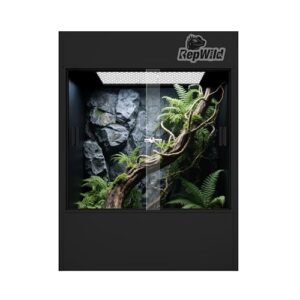
Moving to solid PVC construction, the REPWILD offers 17.7 x 17.7 x 23.6 inches with 0.6-inch walls, giving arboreal species like geckos and chameleons the vertical clearance they need. Its side port hole lets you run a mister without opening the enclosure, supporting stable 60-80% humidity.
For keepers who want to dial in that 60–80% range with confidence, pairing the REPWILD with a controller like those covered in this guide to humidity gauges for greenhouses takes the guesswork out of maintaining stable conditions.
The reinforced mesh top allows UVB penetration and airflow, and the tempered glass doors stay clear. Some users report panel gaps needing silicone sealing, and bolt fasteners can loosen over time. Check seams first.
| Best For | Keepers of arboreal reptiles like geckos, tree frogs, and chameleons who need a tall, humidity-friendly enclosure with convenient misting access. |
|---|---|
| Indoor Use | Yes |
| Reptile Compatible | Yes |
| Humidity Support | Built-in mister port |
| Suitable Species | Geckos, chameleons, frogs |
| Setup Required | Assembly required |
| Moisture Management | Silicone sealing needed |
| Additional Features |
|
- Thick 0.6-inch PVC walls provide solid thermal insulation and hold humidity well for tropical species
- Side port hole lets you connect a mister without disturbing the enclosure’s climate
- Reinforced mesh top supports dual lighting and allows UVB light to penetrate evenly
- Panel gaps are common and often require silicone sealing to prevent leaks
- Bolt fasteners can loosen over time, potentially affecting the enclosure’s structural integrity
- Not reliably waterproof under heavy misting or sustained high-humidity conditions
4. Automatic Reptile Mister System Timer

Once the enclosure’s set, the misting system controlling it matters equally. This timer-based mister offers 20 programmable timing sets, accurate to the second, letting you schedule precise humidity windows for chameleons or arboreal geckos without guesswork.
The pump runs at roughly 35 decibels with rubber shock-absorbing pads, keeping noise minimal. You can expand it to 10 fine mist nozzles with 360° rotation.
Some users do report pipe vibration and leaks, so secure your lines with ties and inspect connections regularly.
| Best For | Reptile and amphibian keepers — especially those housing chameleons or arboreal geckos — who want precise, automated humidity control without constant manual misting. |
|---|---|
| Indoor Use | Yes |
| Reptile Compatible | Yes |
| Humidity Support | Adjustable misting |
| Suitable Species | Geckos, chameleons, amphibians |
| Setup Required | Installation required |
| Moisture Management | Programmable spray cycles |
| Additional Features |
|
- 20 programmable timing sets let you schedule misting down to the second, removing the guesswork from humidity management
- Quiet pump (~35 dB) with rubber shock-absorbing pads keeps noise low enough not to stress sensitive animals
- Expandable up to 10 rotating fine mist nozzles, making it adaptable as your setup grows
- Pipe vibration can add unwanted noise if lines aren’t secured with cable ties
- The timer programming gets mixed reviews — some users find it confusing to set up
- Durability and leak resistance are inconsistent, with a notable number of users reporting connection issues over time
5. Fenocran Automatic Reptile Mister System

For keepers who need tight control over misting intervals, the Fenocran delivers adjustable cycle timing from 3 to 99 seconds per mist, with scheduling windows stretching from 1 to 99 hours.
Its dual adjustable nozzles let you direct fog precisely where your species needs it, and soundproof foam keeps pump noise minimal during cycles.
The 16.5-foot hose offers useful placement flexibility, though you’ll want to inspect joints regularly since leakage at connections and timer drift are documented limitations worth monitoring.
| Best For | Reptile keepers who need precise, interval-based humidity control for chameleons, snakes, tortoises, or similar species. |
|---|---|
| Indoor Use | Yes |
| Reptile Compatible | Yes |
| Humidity Support | Adjustable misting |
| Suitable Species | Chameleons, snakes, tortoises |
| Setup Required | Installation required |
| Moisture Management | Programmable spray cycles |
| Additional Features |
|
- Adjustable misting cycles from 3–99 seconds with scheduling windows up to 99 hours give you fine-grained control over humidity
- Dual adjustable nozzles let you direct mist exactly where your enclosure needs it
- Soundproof foam keeps pump noise low, so cycles won’t disturb your animals or your home
- Joints and connections are prone to leaking, requiring regular inspection
- Timer drift can cause the unit to activate earlier than scheduled over time
- The top-mounted power plug makes the unit unstable and prone to tipping
6. REPTI ZOO Reptile Humidifier Mini Misting System

The REPTI ZOO mini misting system is a compact option for smaller tropical setups, featuring two 360-degree rotatable nozzles that let you position spray angles precisely for species like chameleons or orchid terrariums. Its smart timing function automates regular humidity cycles without constant manual adjustment.
Installation is simple via suction cup or bracket hook. No water tank is included, so you’ll need to source an external container. Reported nozzle malfunctions and leaking units raise durability concerns worth weighing before purchase.
| Best For | Keepers of tropical reptiles like chameleons or moisture-loving plants like orchids who want automated humidity cycles in a compact, small-tank setup. |
|---|---|
| Indoor Use | Yes |
| Reptile Compatible | Yes |
| Humidity Support | Adjustable misting |
| Suitable Species | Chameleons, tropical reptiles |
| Setup Required | Installation required |
| Moisture Management | Timed spray cycles |
| Additional Features |
|
- Two fully rotatable nozzles let you aim spray exactly where your animals or plants need it
- Smart timing function automates misting cycles so you’re not adjusting humidity manually
- Mounts easily with a suction cup or bracket hook, keeping setup quick and flexible
- Nozzle malfunctions are a common complaint, with some units failing to spray correctly out of the box
- Leaking is a reported issue that can flood or over-saturate a terrarium
- Durability is questionable, with multiple buyers reporting unit failure within the first month
7. MECESOR Reptile Mister Humidifier System

Humidity fluctuations of just 10% RH can trigger respiratory stress in tropical reptiles. The MECESOR’s 360° rotating nozzles let you direct mist precisely, holding levels between 60–90% RH without saturating hides or substrate. Its 5-second to 24-hour timer fits nearly any species schedule.
With no built-in tank, you’re free to size the reservoir as your setup demands. That flexibility helps, but leakage into electronics is a documented failure mode, so keep the control unit elevated and inspect all fittings weekly.
| Best For | Reptile keepers who need precise, programmable humidity control for tropical species like chameleons, frogs, and snakes. |
|---|---|
| Indoor Use | Yes |
| Reptile Compatible | Yes |
| Humidity Support | Adjustable misting |
| Suitable Species | Chameleons, snakes, frogs |
| Setup Required | Installation required |
| Moisture Management | Timed spray cycles |
| Additional Features |
|
- 360° rotating nozzles let you aim mist exactly where it’s needed, preventing over-saturation of hides and substrate
- Flexible timer settings (5 seconds to 24 hours) make it easy to match any species’ humidity schedule
- No built-in tank means you can use any size reservoir to suit your enclosure’s demands
- Water can leak into the electronics, causing the unit to malfunction — the control box needs to stay elevated and fittings checked regularly
- The touch screen plate has been known to detach due to weak adhesive
- Some units stop auto-cycling after a few months of use, requiring replacement sooner than expected
8. J&A Reptile Mister Automatic System
 View On Amazon
Nothing signals confidence quite like selling a "complete" misting system without the water bucket.
The 360° rotatable nozzles, expandable to six heads, give you real flexibility across terrariums, vivariums, and paludariums. Its built-in sensor covers 0-100% RH and -40°C to 85°C, with alarm reminders to flag any drift from your target. Power-off memory restores your custom settings after outages, which is genuinely useful.
You’ll want to watch that durability track record closely, with some units failing within 35 days of purchase.
| Best For | Reptile and amphibian keepers who need flexible, multi-nozzle misting across terrariums, vivariums, or paludariums and want built-in humidity and temperature monitoring in one unit. |
|---|---|
| Indoor Use | Yes |
| Reptile Compatible | Yes |
| Humidity Support | Adjustable misting |
| Suitable Species | Lizards, chameleons, turtles |
| Setup Required | Installation required |
| Moisture Management | Sensor-based misting |
| Additional Features |
|
- 360° rotatable nozzles expandable up to six heads give you precise coverage across enclosures of different sizes and layouts
- Built-in sensor monitors the full 0–100% RH range with alarm reminders, so you’re not guessing at conditions
- Power-off memory restores your custom misting schedule automatically after any outage
- The water bucket isn’t included, so you’re buying a "complete" system that isn’t quite complete out of the box
- Temperature probe adjustment is capped at ±20 degrees from the initial reading, which limits flexibility if calibration is off
- Some units have failed within 35 days of purchase, making long-term reliability a real concern
How We Evaluated Reptile Misting Systems

Earning a spot on this list wasn’t about favorable spec sheets. Humidity control performance was logged continuously across three controlled enclosures using 14-day cycle tests that captured substrate moisture and temperature alongside RH.
Each system was scored on:
- Target RH attainment within 15 minutes of spray onset
- Humidity stability held to ±5% RH over 6-hour blocks
- Nozzle expandability and distribution evenness across enclosure zones
- System downtime kept below 2% of active minutes
Sensor probe accuracy, reservoir autonomy, and corrosion resistance factored into our ratings too. Terrarium moisture control depended heavily on droplet size and dwell time, while enclosure ventilation patterns affected RH recovery in ways that separated the top performers you’ll find here from the rest.
Mister Versus Fogger for Reptile Humidity
The choice between a mister and a fogger shapes how you manage humidity at the most fundamental level. Misters like the MistKing Starter Misting System v5 and Exo Terra Monsoon Solo II deliver targeted burst cycles, spiking RH quickly then letting airflow recover naturally. Foggers like the REPTI ZOO 4L Reptile Humidifier Fogger and Zoo Med Repti Fogger produce continuous micro-vapor, sustaining elevated humidity in large, sealed enclosures.
Misters spike humidity fast; foggers sustain it—choose based on whether your species needs bursts or continuous saturation
| Feature | Mister | Fogger |
|---|---|---|
| Droplet size | Large, visible | Micro, vapor-like |
| Humidity delivery | Burst cycles | Continuous output |
| Best species fit | Arboreal lizards | Large humid setups |
| Maintenance demand | Nozzle cleaning | Transducer descaling |
| Over-saturation risk | Lower | Higher |
Pair either system with an Inkbird Humidity Controller IHC200 to hold precise RH thresholds without manual monitoring. Misters suit species needing fluctuating humidity windows; foggers work better where sustained saturation matters more than recovery periods.
Choosing The Right Reptile Misting System

Choosing the right misting system comes down to five practical criteria that separate a reliable setup from one you’ll constantly be troubleshooting. Your species, enclosure size, and daily schedule all shape which features actually matter. Work through each factor below before committing to a system.
Match Species Humidity
Before selecting a misting system, know your species’ exact humidity target. Dart frogs and chameleons need 70–85% consistently, while ball pythons tolerate 50–70% with brief spikes during shedding. Crested geckos fall comfortably in the mid-range.
Most tropical species require elevated nighttime humidity as ambient levels drop after lights-out, so verify your animal’s full diurnal range before programming any schedule.
Compare Misting Types
Once you’ve pinned your species’ humidity range, hardware type is next.
- An ultrasonic fogger suspends fine droplets evenly; best for high-humidity setups
- A pump mister drives a broader mist dispersion pattern with higher droplet velocity
- A humidity controller applies humidity hysteresis settings to prevent cycles from overshooting
The system you pick directly shapes how precisely your enclosure holds its target.
Size Reservoir Capacity
Hardware type shapes output, but reservoir capacity governs how long your system runs unattended. A 16-gallon built-in reservoir needs refilling every 2 to 5 days under standard misting cycles, while a 50-gallon external reservoir stretches that window to 1 to 2 weeks.
Align your refill frequency with your maintenance tolerance using reservoir capacity planning around a 3 to 7-day interval.
Evaluate Timer Controls
Once you’ve sized your reservoir, the timer becomes your next control point. Timer precision scheduling determines whether misting aligns with your animal’s actual humidity needs or just approximates them.
A seconds-based timer lets you dial in short, frequent bursts rather than long soaks. If your budget allows, a smart timer with programmable schedules and humidity thresholds removes the guesswork entirely, adjusting output automatically as conditions shift.
Consider Maintenance Needs
Routine upkeep separates a reliable misting system from a constant headache. Prioritize ease of cleaning by choosing units with accessible reservoirs and removable nozzles, since mineral buildup clogs outputs fast. Keeping a few reptile misting replacement nozzles on hand means a clog never has to interrupt your animal’s humidity schedule.
Running distilled water slows that accumulation a lot. Log daily run times, schedule monthly line flushes, and budget for spare nozzles.
Timer precision scheduling loses its value the moment a clogged nozzle undermines it.
Setup, Scheduling, and Humidity Maintenance

Start your setup by positioning the reservoir at or below the terrarium base to cut clog risk and keep flow consistent. Use only distilled or dechlorinated water; minerals shorten nozzle life faster than anything else.
Scheduling is where you’ll take real control:
- Run 2-5 minute misting cycles 2-4 times daily
- Trigger mists during late-afternoon temperature drops
- Open with a short morning humidity ramp (1-2 minutes)
- Follow with longer sprays (3-5 minutes) to sustain 60-80% RH
- Avoid misting during peak heat to prevent overnight over-drying
Timer-based automation removes guesswork entirely. Systems expandable to 10 nozzles scale with your collection. For humidity maintenance, calibrate your hygrometer away from direct spray, then log hourly RH for 7 days. Clean valves every 2-4 weeks. For collectors managing multiple enclosures, upgrading to an expandable multi-nozzle misting system lets you automate consistent humidity across every habitat without juggling separate units.
Frequently Asked Questions (FAQs)
How can I control the humidity in my reptile tank?
Controlling tank humidity comes down to misting frequency optimization, nozzle positioning, and a reliable timer. Monitor levels with a digital hygrometer and adjust burst duration until you hit your target range consistently.
What is the best misting system for reptiles?
The best choice depends on your enclosure size. Automatic misting systems with timer-based automation and expandable to 10 nozzles give you precise humidity control across any reptile husbandry setup, from compact terrariums to large enclosures.
Are automatic reptile misters worth it?
Think of manual misting as weather forecasting without instruments. Automatic reptile misting systems run precise, scheduled cycles that stabilize humidity control reliably, removing guesswork and protecting your animals from dangerous RH swings every single day.
Matching the right system to your setup is straightforward with a guide to automated reptile misting systems and their key selection criteria.
How do I make a DIY reptile misting system?
Building a DIY terrarium misting system requires a submersible pump, 1/4" OD tubing with barbed fittings, and an adjustable spray nozzle positioned 6–12 inches above decor, all controlled by a timer for precise humidity cycles.
Can tap water be used in misting systems?
Tap water works, but it’s a slow leak in your system’s performance. Hard water leaves mineral deposits that choke nozzles over time. Distilled water eliminates that risk and improves water quality impact on spray consistency.
How do I prevent mold inside my mister?
Mold thrives on persistent surface moisture. Use dechlorinated water, implement pulsed misting schedules, and always dry all housing within 15 minutes post-cycle. Clean your reservoir weekly with a 1:1 vinegar solution to prevent biofilm buildup.
Will misting damage live plants in the enclosure?
At 60–80% enclosure humidity, brief misting cycles protect your plants effectively, but prolonged surface wetting lets moisture linger on thin or waxy foliage, triggering fungal leaf spot and slow root rot in your bioactive setup.
Can I build a DIY reptile misting system?
Yes, you can. A submersible pump, vinyl tubing, and brass misting nozzles connected to a small reservoir give you functional timer-based automation, though nozzle clogging and uneven humidity gradients are common DIY pitfalls to expect.
Conclusion
Studies show reptiles dehydrate up to three times faster in low-humidity enclosures, making your misting system one of the most consequential purchases in your setup. Choosing the right reptile misting systems for humidity control comes down to knowing your species’ requirements, your enclosure’s dimensions, and how much hands-on maintenance you’ll realistically commit to.
Get those details right, and your animal won’t just survive, it’ll thrive on its own biological schedule.