This site is supported by our readers. We may earn a commission, at no cost to you, if you purchase through links.

Ball python humidity isn’t optional gear—it’s a daily requirement. Your reptiles live in a world of microclimates, and that hotspot 60–70% targets shed with precision, not guesswork.
The three misting options chart a clear path: strong Exo Terra systems for steady 60–80% with quiet operation, compact REPTI ZOO setups for space-conscious tanks, and timer-driven units when automation is non-negotiable. Pair with a reliable reservoir size, correct pump pressure, and a humidistat placed 1–2 inches below the lid to keep the data honest.
Expect maintenance beats luck: keep tubing clean, check timers, and verify distilled water use for mineral-free humidity. Your ball Python’s comfort, controlled.
Table Of Contents
Key Takeaways
- Humidity targets for ball pythons hinge on hotspot 60–70% during shedding and 50–60% ambient, with hatchlings needing steadier 60–70% in smaller enclosures
- Three main misting approaches: strong Exo Terra systems for 60–80% with multiple nozzles, compact REPTI ZOO systems for small spaces, and timer-driven setups for automation
- Key setup and maintenance: use distilled water, keep tubing clean, place humidistat 1–2 inches below lid, calibrate with hygrometer weekly
- Misting frequency should align with enclosure size and lifecycle stage (1–2 daily cycles 5–15 seconds; 2–3 cycles during shedding), and monitor readings to prevent oversaturation or mold
Top 3 Ball Python Misting Systems
Three sentences introducing the Top 3 Ball Python Misting Systems, setting expectations for the list that follows.
1. Exo Terra Monsoon Multi II Mister
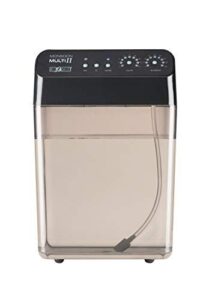
The Exo Terra Monsoon Multi II Mister delivers steady humidity with a 4.5 bar pump, ensuring consistent misting across 60–80% targets.
It uses up to 6 adjustable spray nozzles and an 8 L reservoir for extended operation, supporting 6–12 mist cycles per hour.
The Cavachew system’s 8 L reservoir and six-nozzle array enable longer misting cycles with customizable durations for efficient humidity control, as described in the linked guide.
Ideal for 40–60 cm enclosures when nozzles sit 8–15 cm above substrate; adjust output to protect basking zones.
Expect 28–40 dB noise; maintain with distilled water and monthly descaling to prevent mineral buildup.
| Best For | Reptile, amphibian, and small greenhouse owners who need programmable, directional humidity control for medium-sized enclosures. |
|---|---|
| Timer | Yes |
| Misting | Yes |
| Nozzles | 6 |
| Reservoir | 8L |
| Power | Pump |
| Coverage | LargeArea |
| Additional Features |
|
- Programmable timer and 8 L reservoir support extended, automated misting cycles.
- Up to six adjustable nozzles allow targeted coverage across an enclosure.
- 4.5 BAR pump and leak-proof tubing provide consistent pressure and secure connections.
- Some users report that pump reliability can decline over time.
- Spray quality may occasionally be uneven or produce a straighter beam rather than a fine mist.
- Requires distilled water and regular descaling to reduce mineral buildup.
2. REPTI ZOO 2.2L Reptile Mister System
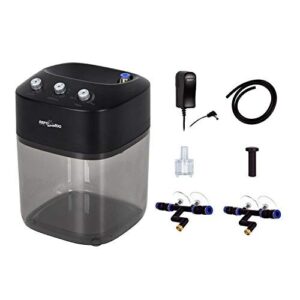
The REPTI ZOO 2.2L Reptile Mister System matches the Exo Terra style in a compact 2.2 L reservoir, ideal for ball python habitats.
It uses a pulse-based misting cadence of 2–4 seconds per spray and a 180° spray pattern from side nozzles for broad coverage.
(https://snakesnuggles.com/misting-enclosure-during-shed/) expands on the technique by guiding even spraying duration to avoid oversaturation when applying close to walls.
It’s built for quiet operation with a 1.5 W pump and can run on 6–12 V with an inline transformer.
Expect direct water filling, a built-in timer, and easy maintenance.
The timer may be inconsistent in some units.
| Best For | Best for reptile enthusiasts seeking a compact, quiet misting system to simulate rainfall in enclosures. |
|---|---|
| Timer | Yes |
| Misting | Yes |
| Nozzles | 2 |
| Reservoir | 2.2L |
| Power | Pump |
| Coverage | MediumArea |
| Additional Features |
|
- Compact 2.2 L design fits small to medium habitats
- Built-in timer and direct water filling for convenient use
- Quiet operation with a micro booster pump
- Timer reliability can be inconsistent across units
- Misting performance may degrade over time or fail in some units
- Leakage or suction cup detachment reported by users
3. Reptile Misting System with Timer
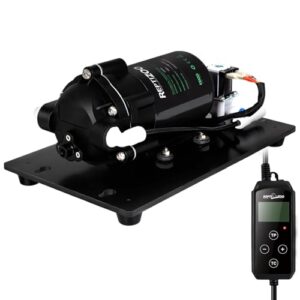
Your setup benefits from a dedicated timer that delivers up to 15 minutes of spraying per cycle, with adjustable frequency to suit ball pythons. The system’s four rotatable nozzles provide full terrarium coverage, while a quiet 1.5 W pump keeps noise minimal.
Expansion is easy: connect up to 20 nozzles for larger enclosures. Use distilled or dechlorinated water to minimize mineral buildup, and position the hygrometer probe 1–2 inches below the lid to keep readings accurate.
Regular maintenance includes weekly tubing checks and monthly nozzle cleaning.
| Best For | Reptile keepers and indoor plant enthusiasts who need a customizable misting system for terrariums, grow tents, or small greenhouses. |
|---|---|
| Timer | Yes |
| Misting | Yes |
| Nozzles | 4 |
| Reservoir | N/A |
| Power | Pump |
| Coverage | FullTerrarium |
| Additional Features |
|
- Timer supports up to 15 minutes of spraying with adjustable misting frequency.
- Four 360-degree rotatable nozzles provide flexible, broad terrarium coverage.
- Expandable design supports up to 20 nozzles and works with any water container.
- Timer controller can be confusing and difficult to program.
- Timer clock resets after a power interruption and must be reconfigured.
- Some users find the pump louder than expected while misting.
Are Misting Systems Good for Ball Pythons?

Are Misting Systems Good for Ball Pythons? They help stabilize daytime humidity 40–60% and nighttime 60–70% with intermittent, controlled mists, reducing swings and assisting shedding without saturating air. Use a humidity controller and placement to avoid false readings. Monitor airflow to prevent mold and heat buildup.
Ball Python Humidity Targets and Misting Frequency

Ball python humidity targets are 50–60% ambient, with hotspots peaking 60–60–70% during shedding weeks. Hatchlings require steadier 60–70% in smaller enclosures. Nighttime drops below 50% raise dehydration risk unless mitigated by misting.
Daily misting usually 1–2 short cycles (5–15 seconds) maintains 60–70% in dense foliage during active weeks; during shedding, 2–3 misting events per day to sustain 60–75% at the hotspot. Program timers to align with room humidity and avoid oversaturation. Place a humidistat probe at the hotspot, away from airflow gaps, to regulate misting intensity, not total spray duration. Calibrate weekly against a hygrometer at microclimates.
Smaller enclosures reach target humidity faster; larger tanks require longer spray or higher reservoir capacity. Distilled water reduces mineral buildup.
Choosing The Right Ball Python Misting System
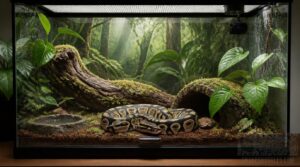
Choosing The Right Ball Python Misting System introduction: You’ll set your expectations for reliable humidity control and quiet operation expectations. Your system choice should align with tank size, feeding routine, and safety, not just price. The options below establish a practical framework for selecting the best fit for your enclosures.
Mister Vs Ultrasonic Fogger
Ultrasonic foggers produce fine haze, quick dispersion, and minimal condensation; use distilled water to prevent mineral buildup and extend transducer life.
Ultrasonic foggers produce fine haze, quick dispersion, and minimal condensation
Misters deliver visible droplets, faster local humidity, but risk uneven ceilings and algae if exposed to light.
Choose based on enclosure layout, humidity goals, and maintenance willingness.
For Ball Python Care Handbook, prioritize safety and reliability.
Tank Size and Reservoir Capacity
For 36x18x12 inch enclosures, start with a 4–5 L reservoir to support 1–2 misting cycles daily, keeping daily misting needs 1.5–2× the reservoir volume to avoid dry intervals. Larger enclosures or longer refill intervals require bigger reservoirs; 8–10 L is sensible for multi-day gaps.
Choose a 4–5 L reservoir with a 20–30% water-surface capacity rule relative to enclosure size. Use 2–4 short pulses (0.5–2 s) per day instead of one long spray to preserve reservoir life.
A 10L integrated tank or a 15L reservoir is ideal when planning 6+ enclosure days between refills, ensuring stable RH and ease of maintenance.
Bolded phrases represent key takeaways: reservoir sizing, pulse frequency, and long-term capacity.
Pump Pressure and Noise Levels
Pump Pressure drives mist reach and pump load. A 24V pump delivers reliable duty, but higher ranges like 45 BAR increase noise and heat.
Use a regulator with ±0.2 bar to keep steady misting and avoid nozzle drift. Expect 30–60 dB at 1 m; vibration from mounting and reservoir agitation matters most. Silent pump operation is achievable with dampening.
Timer Programming and Automation
Timer programming and automation should be precise and auditable. Set a programmable misting system with three daily events: 08:00, 14:00, 22:00, each delivering 30-second pulses for a total of 5 minutes per day. Use the programmable timer to start cycles exactly on schedule and log pump runtimes for trend analysis. Set the three daily pulses using a weatherproof misting module such as a smart timer with built-in humidistat control for reliable 08:00, 14:00, and 22:00 cycles. anchor text
If RH target gaps appear over 3 days, adjust cycle duration or add a short extra cycle within an hour after the scheduled one. Make sure fail-safes trigger if RH stays above 85% for 12 hours, and keep a 12V UPS backing 2–3 cycles for 30 minutes. Maintain a daily calibration check of 1–2 minutes to counter drift.
Use humidistat coupling to stop cycles at 65% RH. Position hygrometer 1–2 cm below lid, enclosure midpoint. Grouped log timer events, RH, pump run-time, and calibration results for 90 days.
Humidistat Control and Probe Placement
Humidistat control should use a dedicated humidity controller wired to the misting pump. Place the probe mid-height, 8–15 cm above substrate, away from direct spray. Use proportional control when possible to smooth cycles, aiming for 2–4% RH swing per cycle. Target 60–70% RH; adjust to 55–65% in dry rooms. Calibrate with a reference hygrometer; make sure common ground. Maintain probe every 4–6 weeks and replace hygroscopic probes every 12–18 months.
Expansion for Multiple Enclosures
Design allows parallel humidity zones with independent enclosure lines. Use individual supply paths to minimize cross-contamination and simplify maintenance.
Configure modular misting manifolds, allowing MistKing Starter Misting System v5 expansion to 10 nozzles. Calibrate reservoir levels per enclosure, align probe placement to mid-height zones, and coordinate shared humidistat logic for synchronized control across enclosures.
Maintain separation for heat and humidity stratification.
Distilled Vs Tap Water
Distilled water reduces mineral buildup in a Misting system, but overuse risks ion imbalance in enclosures. Tap water brings minerals and often chlorine, which can deposit on nozzles and skew humidity. Mineral buildup from tap water taxes pumps and increases cleaning; distilled minimizes deposits yet demands careful handling to avoid contamination.
- Clear lockstep control.
- Consistent reservoir care.
- Safer humidity targets.
- Quick maintenance wins.
Safe Setup, Monitoring, and Maintenance
Keep the enclosure wired for safety and reliability. Use GFCI outlets for all misting circuits and mount power bricks off the floor, sealing cords with cable grommets. The mist system should sit on a dedicated circuit with a water-splash shield within 2 inches of the reservoir; inspect daily for any signs of moisture ingress.
Water quality matters. Use distilled or RO water to minimize mineral buildup; install a basic inline filter at the reservoir inlet and run conductivity checks, aiming for <400 µS/cm.
Humidity remains controlled through deliberate spray timing. Target 50–60% RH during the day, never above 70%, with a humidity probe placed 6–8 inches from spray outlets in the basking area; make sure exhaust airflow to prevent overly humid microclimates.
Maintenance is routine. Clean the reservoir and lines monthly, flushing 2–3 minutes with fresh water. Inspect nozzles weekly, replacing dull or leaking ones. Sanitize the entire system every 3–4 months with a reptile-safe cleaner.
Failure monitoring is proactive. Perform a visual pump-vibration check per shift; any stoppage triggers immediate shut-off. Add a secondary float switch to stop the pump if the reservoir runs low. Record daily humidity, spray times, and anomalies to detect creeping failures over weeks.
Hygrometer calibration is critical. Calibrate periodically and whenever readings drift. Regular checks guarantee the humidity target remains within safe bounds.
Ball python enclosure safety hinges on disciplined maintenance. Adhere to these intervals, and the system will remain reliable, consistent, and safe for your animals.
Frequently Asked Questions (FAQs)
Is a misting system good for ball pythons?
Is a misting system good for ball pythons? Yes, when humidity stays within 50–70% and ventilation is adequate; a controlled system helps maintain shedding-friendly conditions without overheating or wet spots that promote mold.
How often should a ball python be misted?
2–3 times daily for regular periods, 3–4 times daily during shed cycles. Keep RH at 60–70% normally, then push to 70–80% during sheds. Short, controlled bursts maintain your ball python enclosure without flooding the substrate.
Is there an automatic mister for ball pythons?
Yes, an automatic mister exists specifically for your ball python. A programmable misting system runs timed spray cycles without intervention. The MistKing Starter Misting System v5 pairs with a humidity controller for precise, stable results.
Should I mist my ball python tank?
Your ball python’s tank needs regular misting. Aim for 50–60% baseline humidity, spiking to 65–80% during shedding. A programmable misting system with adequate ventilation keeps conditions consistent without guesswork.
What humidity questions about misting systems are most common?
Three questions come up constantly: what humidity percentage to target, how often to mist, and where to place your probe correctly. Nail all three, and your ball python’s entire care routine finally clicks into place.
Conclusion
Most ball python keepers obsess over the heat mat and completely forget the air sitting directly above it. That’s exactly where real health is won or lost.
The right reptile misting systems for ball pythons don’t just prevent a difficult shed; they actively create the stable microclimate your snake depends on every single day.
Choose correctly, clean consistently, and trust your humidistat over guesswork. Your python won’t tell you it’s comfortable. But perfect humidity will.