This site is supported by our readers. We may earn a commission, at no cost to you, if you purchase through links.
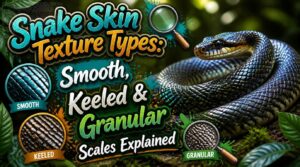
Most people reach for a snake and expect slime. What they find is a surface that ranges from glass-smooth to coarse as sandpaper, depending entirely on where that animal evolved to live and how it moves.
Snake skin texture types aren’t cosmetic variations. Each structural category, smooth, keeled, granular, or specialized friction scales, reflects a precise biomechanical solution to the demands of a specific habitat. A water snake’s glossy scales cut friction in current. A tree-climber’s ridged surfaces lock onto bark under body weight.
Knowing the difference changes how you read every species you encounter in the field.
Table Of Contents
- Key Takeaways
- What Does Snake Skin Feel Like?
- Main Types of Snake Skin Texture
- Why Snake Scale Textures Differ
- Texture, Shine, and Skin Patterns
- Identifying Texture From Shed Skin
- Frequently Asked Questions (FAQs)
- What are the different types of snake skin patterns?
- Can you tell what kind of snake it is from the skin?
- What is the pattern of snake skin?
- What does snakeskin feel like?
- Can snake skin texture indicate a snakes age?
- Do scale textures change after a snake sheds?
- Which snakes have the roughest scales overall?
- Does scale texture affect how venom is delivered?
- Conclusion
Key Takeaways
- Snake skin is always dry and structured, never slimy — what you feel reflects a precise biomechanical design shaped by where that species evolved to live.
- The four scale texture types (smooth, keeled, granular, and specialized friction) each solve a specific locomotion challenge, from cutting drag in water to locking grip onto bark.
- Texture is driven by evolutionary pressures — habitat humidity, movement style, diet, and shedding cycles — making scale feel a reliable ecological fingerprint you can read with your hands.
- Even a shed skin carries the same texture signatures as the living animal, giving you a diagnostic tool for species identification before you ever encounter the snake itself.
What Does Snake Skin Feel Like?
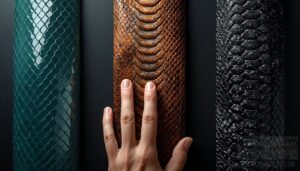
Touch a snake, and you’ll immediately notice something most people don’t expect: it’s dry. There’s no slime and nothing soft. What you’re actually sensing is a firm, slightly pliable outer epidermal layer that feels cool under your fingers and finely structured when you press down. For those new to reptile keeping, a good pair of snake handling gloves lets you focus on that tactile experience without hesitation.
Up close, each scale’s overlapping edges and microscopic ridges reveal a surprisingly intricate architecture—explore a visual snake scale size comparison to see just how varied that structure can be across species.
Scale texture varies considerably across species, and that variation matters. Smooth scales feel uniform and slick, almost glassy under light pressure. Keeled scales introduce a subtle graininess, a central ridge you can feel tracking across each scale. Granular scales go further, delivering a coarse, gritty sensation that persists whether the skin is dry or damp.
If you’ve ever run a finger along a snake and wondered why some feel glassy while others feel rough, this guide to smooth vs. keeled scales breaks down exactly what your fingertips are picking up.
None of these textures are incidental. They’re functional adaptations that shape how a snake grips surfaces and controls friction during snake locomotion.
Main Types of Snake Skin Texture
Snake scale texture falls into four distinct structural categories, each tied directly to how a species moves, hides, and survives. Understanding these types gives you a sharper eye for identification and a deeper grasp of how form follows function in snake biology.
Here’s what each texture looks like and why it matters.
Smooth Scales
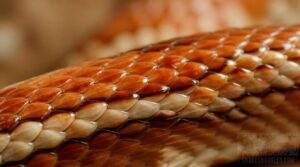
Running your finger along a corn snake’s dorsum, you’ll notice the near-frictionless glide that defines smooth scales. This scale texture comes from dome-like, keel-free scales sitting flush against each other, creating a uniform contact plane.
This sleek, glossy texture distinguishes corn snakes from rougher-scaled species, a difference explored in detail in this corn snake vs. king snake scale and appearance comparison.
The reptile epidermis reflects light evenly, producing a characteristic glossy sheen. As a cutaneous adaptation, scale morphology here minimizes micro-friction, enabling quieter, more efficient movement.
Keeled Scales
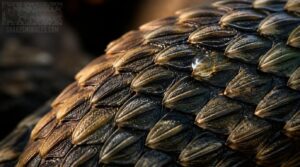
Where smooth scales glide freely, keeled scales grip. Each scale has a raised central ridge, and this scale texture gives the reptile epidermis a sandy, coarse feel.
The scale morphology acts as a cutaneous adaptation for traction, helping ground-dwelling and climbing species navigate loose substrates. You’ll notice the micro-serrations most clearly when pressing along the scale rows.
Granular Scales
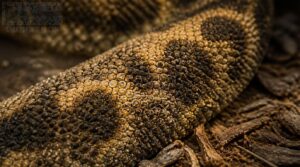
Beyond the ridge of keeled scales lies an even coarser adaptation. Granular scales replace smooth projections with dense, tooth-like granules that create a sandpaper-like surface. You can feel the micro-topography when stroking along scale rows, a friction signature that helps species grip bark and soil. Replicating this texture in captivity is straightforward with coarse bark terrarium substrate, which mimics the natural grip surfaces these scales evolved to navigate.
Granular scales take this principle further still, their dense micro-teeth delivering the sandpaper grip that ventral scale friction patterns across terrain types reveal as strongest in mud and bark environments.
This cutaneous adaptation reflects direct habitat pressure, where traction outweighs any hydrodynamic advantage.
Specialized Friction Scales
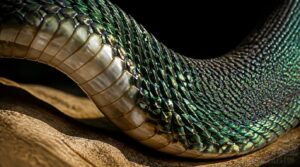
Specialized friction scales occupy a distinct functional niche in snake locomotion. Unlike keeled scales, they carry micro-groove arrays and transverse ridges that engage substrate asperities, shifting contact from sliding to sticking.
The scale overlap mechanism intensifies grip at steeper body angles. Study their tribological properties and you’ll see how scale texture counters friction reduction from moisture or surface oils.
Why Snake Scale Textures Differ
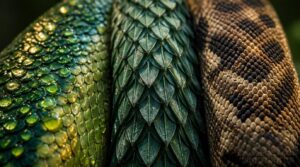
Although scale texture might seem incidental, it reflects evolutionary adaptations tied directly to environment and behavior. Four forces drive what you’re feeling:
- Habitat humidity: Moisture during molts modulates the waxy cuticle, shifting texture from rough to glossy.
- Locomotion demands: Arboreal species develop friction-rich scales for grip; cursorial hunters carry smoother profiles for speed.
- Nutritional status: Dermal thickness changes with diet, making scales feel rigid or pliable.
- Shedding cycles: Overlap intervals shift with each molt, directly altering surface coarseness.
Keeled scales offer traction in rugged terrain, while smooth scales shed water and reduce drag in wet habitats. Granular scales redistribute contact pressure across uneven substrates. Once you understand these drivers, scale texture becomes biological data you can read with your fingertips.
Scale texture is biological data you can read with your fingertips
Texture, Shine, and Skin Patterns
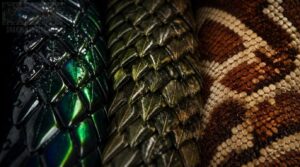
The connection between texture and visual appearance is something you’ll notice immediately when examining a snake closely. Smooth scales produce a high-gloss specular highlight under direct light, their uniform surface reflecting it in a single, clean direction. Keeled and granular scales scatter that same light, giving the skin a matte, dusty quality that shifts with viewing angle. A reptile photography lighting kit designed for specular control can help you capture this distinction precisely, revealing whether a scale surface reflects cleanly or scatters light across its ridges.
Patterning deepens this interplay. Alternating light and dark bands tend to align with scale rows, so texture and color support each other visually. Where granular scales cluster, you’ll often find color patches that look blotched or mosaic-like. Moisture amplifies shine on smooth scales while leaving keeled surfaces comparatively dull, making body hydration a reliable visual cue when you’re evaluating texture in the field.
A dedicated reptile field identification guide can help you cross-reference these hydration and texture cues with regional species quickly and accurately.
Identifying Texture From Shed Skin
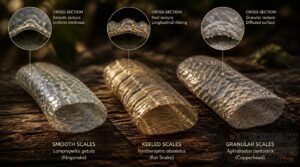
A shed skin holds more diagnostic information than most people realize. Run your fingertips along the inner surface, and you’re reading epidermal texture signatures left behind by each scale type.
- Smooth scales leave a uniform, slick interior with no ridging or surface variation.
- Keeled scales produce a ribbed, longitudinal feel you can trace with a fingernail.
- Granular scales create an even, sandpapery resistance across the shed skin’s surface.
Juvenile specimens shed pliable, finer skin, so don’t assume a soft texture means smooth scales. Habitat context matters too: a burrowing species’ shed feels distinct from an arboreal one, even when both carry keeled scales. Let the tactile evidence guide your identification before you ever see the living animal.
Frequently Asked Questions (FAQs)
What are the different types of snake skin patterns?
Snake skin patterns fall into four main types: smooth scales, keeled scales, striping, banding, and blotching, each shaped by scale structure and coloration working together.
Can you tell what kind of snake it is from the skin?
Texture gives clues, but it’s not enough alone. Reliable species identification requires combining scale morphology with color patterns and geographic range data.
What is the pattern of snake skin?
Like ancient Roman mosaics, scale arrangement patterns tile a snake’s body in overlapping rows. Scale texture shifts by region, and disruptive coloration, using bands or blotches, actively fragments your visual read of the body’s form.
What does snakeskin feel like?
What snakeskin feels like depends on scale type. Smooth scales feel slick and almost glassy under your fingers. Keeled scales deliver gritty tactile resistance, and granular scales feel distinctly sandpapery. Dry conditions shift these sensations.
Can snake skin texture indicate a snakes age?
It can’t reliably. Scale texture reflects species genetics, habitat wear, and ecdysis cycles, not age. Smooth scales don’t roughen predictably, and keeled scale prominence stays stable across molts, making texture an unreliable aging cue overall.
Do scale textures change after a snake sheds?
Shedding renews your snake’s outer surface, yet the base scale texture barely shifts. Smooth scales stay smooth, keeled scales stay keeled.
The waxy shedding film makes freshly molted skin feel temporarily softer and slightly cooler.
Which snakes have the roughest scales overall?
Viperids and certain colubrids consistently rank among the roughest snakes. Their keeled and granular scales produce the most pronounced texture, especially in desert-adapted pit vipers where habitat adaptations drive extreme scale microstructure and surface friction.
Does scale texture affect how venom is delivered?
Scale texture doesn’t affect venom delivery at all. Fang morphology and snake anatomy control how venom moves, not smooth scales, keeled scales, or any external epidermal feature. The delivery mechanism is entirely internal, never dermal.
Conclusion
Scale texture is a map written in keratin, and once you truly learn to read it, snake skin texture types stop being surface details and become ecological signatures. Smooth scales point to water or speed. Keeled ridges signal a climber or a burrower pushing hard through resistance. Granular surfaces tell you an animal built for grip in rough, uneven terrain. Read the texture, and you’re reading the habitat itself. That’s not just identification. That’s fluency.