This site is supported by our readers. We may earn a commission, at no cost to you, if you purchase through links.

Run a fingernail down a garter snake’s flank and you’ll feel a faint, grainy drag. Do the same on a ball python and the skin glides like polished glass. That single tactile difference separates keeled scales from smooth scales, and it changes more than you’d expect.
The distinction between smooth vs keeled scales shapes how light plays across a snake’s pattern, how you clean an enclosure, and even how reliably you can identify a species in the field. Texture alone won’t settle an identification, but it narrows the field fast.
Below, you’ll learn to recognize each scale type by touch, sight, and magnification, and apply that knowledge to pet snakes and wild encounters alike.
Table Of Contents
- Key Takeaways
- Smooth Vs. Keeled Scales: What’s Different?
- How to Recognize Keeled Snake Scales
- How Smooth Snake Scales Look and Feel
- Which Pet Snakes Have Each Scale Type?
- Can Scale Texture Identify a Snake?
- Do Scale Types Change Snake Care?
- Frequently Asked Questions (FAQs)
- What is the difference between smooth scales and keeled scales on snakes?
- Does a cottonmouth have keeled scales?
- Does a copperhead have keeled scales?
- Which snake has the toughest scales?
- Can scale texture affect a snakes shedding process?
- Do keeled scales help snakes climb better?
- Are smooth scales linked to aquatic lifestyles?
- Can keeled scales indicate a venomous species?
- How does habitat influence scale texture evolution?
- Conclusion
Key Takeaways
- Keeled scales have a raised central ridge that feels rough and scatters light, while smooth scales lie flat, feel glassy, and reflect light evenly.
- Texture alone can’t identify a snake—keeled and smooth scales appear across both harmless and venomous species—so pair it with pattern, range, and habitat clues.
- Among common pets, colubrids like corn snakes and garter snakes are typically keeled, while pythons like ball pythons are smooth, and juveniles can mislead you until they mature.
- Keeled scales trap debris and shed less cleanly, requiring slightly more diligent cleaning, but core husbandry like heat and humidity depends on the species, not scale type.
Smooth Vs. Keeled Scales: What’s Different?
Regarding scale texture, every snake falls into one of two camps: smooth scales or keeled scales. Keeled scales carry a raised ridge along the center of each dorsal scale, creating a rough, sandpapery surface. Smooth scales lie flat against the body, producing a glossy or matte finish with minimal texture.
Since texture alone can mislead, pairing scale observations with habitat cues and a solid snake handling hook for outdoor encounters keeps you safer in the field.
That ridge matters more than you’d think. Scale keeling changes how light reflects off the body, so patterns on keeled snakes appear sharper at certain angles while smooth-scaled snakes show more even coloration. Mechanically, keels add friction, improving grip during climbing and handling, whereas smooth scales reduce drag for faster lateral movement and often feel cooler in the sun.
Understanding this distinction gives you a foundation for identification and practical handling decisions.
How to Recognize Keeled Snake Scales
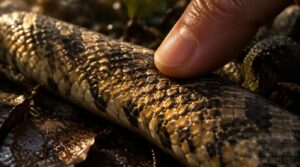
Now that you know what keeling is, here’s how to spot it in the field or your collection. Start with your fingertips: run a fingernail along the flank, and keeled dorsal scales will catch with a faint, grainy drag instead of gliding smoothly.
For a definitive check, follow these steps:
- Shine a flashlight at a shallow angle; each keel casts a short, gutter-like shadow.
- Examine under magnification; you’ll see a central ridge on every scale.
- Compare adjacent scales; keeled ones rise at the midline, smooth ones stay flat.
- Study the pattern edges; scale keeling gives markings a jagged, irregular outline.
Remember that bright, diffuse light flattens the visual texture, so keel depth reads best under oblique illumination. With practice, your eye catches it instantly. An adjustable reptile photography lamp makes dialing in that low-angle lighting much easier.
Once you’ve got the hang of it, this guide to snake species with unique markings makes a handy companion for confirming what your eye is telling you.
How Smooth Snake Scales Look and Feel
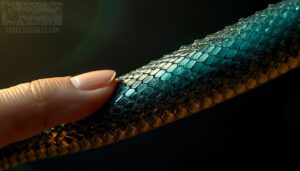
If keeled scales catch your fingernail with a grainy drag, smooth scales do the opposite: they glide, offering almost no resistance. The tactile feedback is slick, almost silky, like running your finger over polished glass.
Visually, the surface finish is uniform and glossy. Light reflects evenly across each scale face with no central ridge to break the sheen, so the body reads as one continuous, polished line rather than a series of ridged segments.
What to check:
- Even light reflection across the entire flank
- Flat scale faces, no midline ridge
- A silky, low-friction feel against cloth
- Markings with clean, uninterrupted edges
- No sawtooth pattern under magnification
Think of the difference as material grain: smooth scales resemble finished hardwood, keeled scales resemble rough-sawn lumber. Once you’ve felt both, your hands will confirm what your eyes suspect.
If you’re still unsure what keeled scales actually look like up close, this guide to rough versus smooth green snakes walks through the difference with photos.
Smooth scales feel like finished hardwood, while keeled scales feel like rough-sawn lumber
Which Pet Snakes Have Each Scale Type?

Once you’ve trained your fingers on that glassy finish, you can sort the common pet species with confidence. Keeled scales dominate the colubrid world: corn snakes, kingsnakes, garter snakes, and most rat snakes show that rough, ridged texture along every dorsal scale row. Boa constrictors carry moderate keeling too, though their large scales soften the feel.
Smooth scales belong mainly to the python family. Ball pythons are the classic example, their flanks reading as one polished surface, and many smaller Pythonidae follow suit.
Watch for mixed cases in hatchlings. Juvenile scale morphology can mislead you, since some smooth-scaled species develop faint keels with age, a product of scale keeling evolution. Always texture-test an adult, or at least a mature juvenile, before you commit to an identification.
Can Scale Texture Identify a Snake?

How reliably can scale texture alone identify a snake? Honestly, it can’t. You’ll find keeled scales in gartersnakes, watersnakes, and vipers alike, and smooth scales across cornsnakes, kingsnakes, and cobras, so texture never stands on its own.
Instead, treat scale texture as one clue in a broader diagnostic framework:
- Corroborate with pattern and color, since dorsal scale arrangement and markings narrow candidates far faster than texture.
- Check geographic range, because scale keeling evolution often repeats across unrelated lineages in similar habitats, creating misleading lookalikes.
- Assess condition, since shedding stage, dehydration, and youth can mute or exaggerate keeling.
When you combine texture with range maps, head scale counts, and habitat notes, your identifications become dependable. Texture confirms; it rarely decides.
Do Scale Types Change Snake Care?

The short answer is that scale texture changes your routine less than you’d expect, but it does change a few things. Keeled scales trap debris along their ridges, so you’ll spot-clean more diligently after feeding or burrowing. Smooth scales wipe clean easily and shed in neater pieces. A basic reptile enclosure cleaning kit makes those post-feeding spot-checks quick, whether you’re dealing with keeled ridges or smooth scales.
| Aspect | Practical Difference |
|---|---|
| Cleaning | Keeled scales hold substrate dust; smooth scales shed it |
| Handling grip | Keels add friction, useful for secure holds |
| Shedding | Keeled skin sheds slightly more irregularly |
| Substrate | Rougher substrates accentuate keeled texture underfoot |
| Species checks | Texture aids, never replaces, proper identification |
Scale function matters here: keels aid camouflage and water runoff in wild species, not terrarium performance. Your center husbandry parameters, heat, humidity, and enclosure size, come from species requirements, not scale type. Adjust cleaning frequency and handling technique modestly, and you’ve covered it.
Frequently Asked Questions (FAQs)
What is the difference between smooth scales and keeled scales on snakes?
You can tell them apart by the central ridge. Keeled scales carry a raised line down each scale’s center, so they feel rough and catch light unevenly. Smooth scales lack that ridge, feeling slick and reflecting light with a uniform, glossy sheen.
Does a cottonmouth have keeled scales?
Absolutely, every time. The cottonmouth has keeled scales, each dorsal scale carrying a central ridge that gives the back a rough, dull texture. Run a finger along one (safely) and you’ll feel that distinct keel immediately.
Does a copperhead have keeled scales?
Like sandpaper against silk, a copperhead’s ridge-backed hide gives it away. Yes, copperheads have keeled scales. Their dorsal scales carry a central ridge, creating a rough texture that aids camouflage, while their ventral scales stay smooth.
Which snake has the toughest scales?
Armor tells the story of survival. Vipers carry the toughest scales: heavily keeled dorsal scales, thickened through scale evolution in Viperidae, resist abrasion and predation. Keeled scales beat smooth scales for durability every time.
Can scale texture affect a snakes shedding process?
Consider a ball python in dry air: its smooth scales shed in one clean piece, while my keeled garter snake flakes patchily. Yes, texture matters. Keeled scales trap moisture in micro-crevices, sometimes slowing your snake’s shedding process.
Do keeled scales help snakes climb better?
Think of ridges as rungs on a ladder: texture promises purchase, but promise isn’t performance. Keeled scales can improve grip performance on bark, yet claws, mass, and muscle dominate arboreal locomotion, so scale type alone won’t guarantee your snake climbs better.
Are smooth scales linked to aquatic lifestyles?
You’ll often hear that smooth scales signal aquatic snakes, but that’s a myth. Water snakes frequently have keeled dorsal scales, while many terrestrial species are smooth. Scale texture and predation pressures, not habitat, drive texture, so always confirm at the species level.
Can keeled scales indicate a venomous species?
You might assume keels signal danger, but that theory fails.
Keeled scales appear in harmless colubrids like garter snakes, while many venomous snakes have smooth scales.
Scale texture and predation, plus scale evolution in Colubridae, drive keels, never venom.
How does habitat influence scale texture evolution?
Habitat influence on scale texture evolution is nothing short of total. Arid, gritty substrates favor keeled scales for grip and wear resistance; slick or open-water environments select smooth scales, streamlining aquatic locomotion and reducing biofouling.
Conclusion
Texture is a fingerprint pressed into every scale, unique and readable once you know how to look. Keeled scales scatter light and catch debris; smooth scales reflect it and shed it. That’s why smooth vs keeled scales matters beyond trivia: it sharpens your field identifications, guides your husbandry choices, and deepens your connection to the animals you keep. Run your finger down a flank and listen. The snake has already told you what it’s.