This site is supported by our readers. We may earn a commission, at no cost to you, if you purchase through links.

Press two fingers against a ball python’s belly and you won’t find the heart where you’d expect. It sits roughly 15 to 25 percent of the way down the body, tucked just behind the trachea.
That placement isn’t random. In arboreal snakes, a forward heart helps push blood up to the brain against gravity, while aquatic species carry theirs farther back because water pressure offsets the gradient. Snake heart location explained by habitat, anatomy and species tells you where to look and why.
You’ll learn how the heart sits among the other organs, how it shifts after a meal, and how vets pinpoint it.
Table Of Contents
- Key Takeaways
- Where is a Snake’s Heart Located?
- Where The Heart Sits Among Snake Organs
- Heart Location in Common Pet Snake Species
- Why Habitat Affects a Snake’s Heart Position
- Can a Snake’s Heart Move During Feeding?
- How Vets Locate a Snake’s Heart
- Frequently Asked Questions (FAQs)
- Where is a snake’s heart located in its body?
- Do snake hearts move around?
- What does a heart with a snake mean?
- What animal has 13 heart chambers?
- How many chambers does a snakes heart have?
- Does shunting change how blood flows through the heart?
- How much does a pythons heart grow after eating?
- Why can snakes survive with mixed oxygenated blood?
- How quickly does an enlarged heart return to normal size?
- Conclusion
Key Takeaways
- Your snake’s heart sits roughly 15 to 35 percent of the way down its body, just behind the trachea and ahead of the liver, with ground-dwellers nearer one-third and climbers closer to the head.
- Habitat explains the difference, since a forward heart helps climbing snakes push blood up to the brain against gravity, while water pressure lets aquatic species carry theirs farther back.
- Without a diaphragm, your snake’s heart can shift slightly, but after a meal it stays anchored by its great vessels and only swells, with heart mass rising up to 40 percent before returning to normal.
- If you can’t find the pulse by sight or touch, a vet can locate it with palpation, Doppler or ultrasound, and you should handle your snake gently since a tight grip can press on the heart.
Where is a Snake’s Heart Located?
Where should you look for a snake’s heart? In most species, heart location falls between one-third and one-quarter of the body length behind the head. That’s a surprisingly forward spot for an animal that’s mostly tail and trunk.
Because the heart sits so far forward, it has a shorter path to the brain, which is one reason how snakes circulate blood works so well even when they rear up.
Heart position shifts with lifestyle. In ground-dwelling snakes, the heart usually sits about one-third of the way down the body. In arboreal snakes, it’s set closer to the head, around 15% of body length, which helps your snake keep blood flowing to the brain when it climbs. Arboreal colubrids also have considerably more vertebrae between the head and the heart top, reflected in their higher pre-atrial vertebral counts.
Because snakes lack a diaphragm, the heart slides within the coelomic cavity. In slim or average-weight snakes, you can often see or feel its beat just beneath the scales. Treat these ranges as a guide.
Where The Heart Sits Among Snake Organs
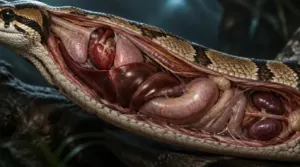
Heart location only makes sense once you know its neighbors. Inside the coelomic cavity, heart position is ventral, between the front ends of the lungs and the leading edge of the liver.
The trachea and esophagus run along the midline nearby. The stomach follows the liver, and the kidneys lie far back. Because there’s no diaphragm, the heart slides a little as your snake moves or eats.
Picture what that means for you:
- Your snake’s heartbeat is one small flutter you can protect.
- A tight grip can easily press on an unseen heart.
- Digestive organ perfusion relies on that tiny pump.
- One careless squeeze could cost you a beloved companion.
- Knowing this map lets you handle your snake with confidence.
Heart Location in Common Pet Snake Species

The general rules of snake anatomy hold true across species, but exact heart placement shifts with body build and habitat. You’ll find that the heart’s position differs slightly among the snakes most keepers own.
Because body shape, diet, and breeding condition all shift where the thickest section sits, it helps to know where the widest part of a snake’s body falls before you take any measurements.
The three species below cover the ones you’re most likely to handle, so you can learn where to look on each.
Ball Python Heart Location
Picture a ball python coiled in your hands, then slide a finger down from its snout until you’ve covered roughly a fifth of its length. That’s where you’ll find the heart, a small, steady pulse beneath the ventral scales.
In this ball python, the heart sits about 15 to 25 percent of body length from the snout, just behind the trachea and ahead of the liver.
Boa Constrictor Heart Location
Boa constrictors follow a similar plan, but the heart location shifts slightly rearward. In most boas, you’ll find it one-third to one-fourth of the body length from the head, with ground-dwelling animals sitting nearer one-third.
Because boas vary a lot in size from one animal to the next, a boa constrictor size chart can help you judge what’s typical for your snake’s age.
The heart structure is the same three-chambered design, and the right lung is enlarged beside it. In snakes under two meters, you can often see the heart beats through the skin.
Corn Snake Heart Location
A corn snake’s heart location sits roughly 19.5% of the snout-vent length back from the snout, within a 15% to 25% range. The heart’s structure is three-chambered and elongate, and it stays mobile to ease large prey through. Its cardiovascular anatomy includes paired aortas that fuse, so you can:
- Expect it nearer the head in older snakes.
- Feel movement in snakes under 2 m.
- Use ventral ultrasound placement.
- Inject cranially.
Why Habitat Affects a Snake’s Heart Position

The habitat your snake evolved in decides where its heart location falls along the body. Gravity is the driver. In arboreal snake hemodynamics, a climbing animal must push blood upward against gravity, so the heart sits close to the head, usually 15 to 25 percent of body length back. That placement keeps blood reaching the brain and stops it pooling in the tail.
A climbing snake’s heart sits close to its head, keeping blood flowing up to the brain against gravity instead of pooling in the tail
Aquatic snake heart positioning works the opposite way. Water pressure pushes against the body and offsets internal gradients, so a heart positioned farther back, at 25 to 45 percent of body length, causes no problem. Fossorial species land in between.
Growth matters too. In juvenile climbers, the heart slides tailward as the snake grows, shifting its position.
Can a Snake’s Heart Move During Feeding?
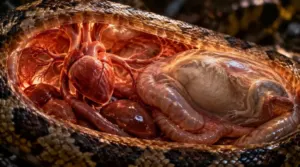
Think of your snake’s heart as a buoy tethered to the seabed. It bobs and swells with the tide, but the anchor line keeps it in place.
Your snake’s heart location stays fixed during digestion. What changes is the organ itself. After a large meal, the heart rate climbs, and the muscle thickens to push blood toward the gut. Ball pythons show nearly 25% greater heart mass one day after eating.
A big meal can press on neighboring organs, but the heart can move only slightly because the great vessels hold it. Watch for these four things:
- Heart rate more than doubling within 24 hours.
- Ventricular volume rising about 20% in juvenile anacondas.
- Mild, temporary pressure shifts near the stomach.
- Reversible enlargement, not heart displacement.
So don’t expect your snake’s heart to slide.
How Vets Locate a Snake’s Heart
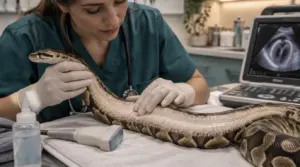
Picture a vet examining your 1.5-meter ball python before a blood draw. She won’t guess at the heart location. She relies on snake anatomy and a few reliable tools.
Here’s what you’ll usually see:
- Palpation: Fingers find the first palpable mass about one-third down from the head.
- Doppler probe: It turns moving blood cells into audible pulses.
- Visual check: Lay the snake on its back and watch ventral scutes for contractions.
- Ultrasound: A ventral probe with ample gel shows the atria and ventricle.
Because the heart can move slightly within the body, vets stabilize it between thumb and index finger before any needle goes in. Heart structure, two atria and one ventricle, shapes heart function and three chambers you’ll see.
Frequently Asked Questions (FAQs)
Where is a snake’s heart located in its body?
Where should you look? Your snake’s heart location sits one-quarter to one-third of body length behind the head. Heart size and the heart chambers snake species share shape the reptilian circulatory system and cardiovascular anatomy.
Do snake hearts move around?
A snake’s heart can shift roughly 15% of its body length, so heart mobility in snakes is real. With no diaphragm, your snake’s heart floats within the coelom, and cardiac displacement happens when large prey passes through.
What does a heart with a snake mean?
A snake’s heart sits about a quarter of the way down its body, yet the snake heart symbol shows up in jewelry as a coiled loop. It stands for fertility, vitality, and life’s endless cycle.
What animal has 13 heart chambers?
Picture a thirteen-room house wired to one pump. No animal has 13 heart chambers. A snake’s three-chambered heart, with its modest heart location and steady heart beats, shows you how simple cardiac anatomy really is.
How many chambers does a snakes heart have?
Wondering what’s inside your snake’s chest? Its three chambered heart has two atria and one ventricle. This heart anatomy, typical of the reptilian cardiovascular system, relies on ventricular compartmentalization, so its heart chambers steer blood.
Does shunting change how blood flows through the heart?
Yes, it does. Intracardiac shunting redirects blood within your snake’s threechambered heart, so oxygenated and deoxygenated streams cross the ventricle. Pulmonary and systemic resistance decide the direction, which changes during apnea, feeding, and anesthesia.
How much does a pythons heart grow after eating?
Picture a fist swelling in your chest within days.
In a Burmese python, postfeeding hypertrophy adds 40% heart mass, a reversible physiological hypertrophy. Cardiac remodeling in reptiles meets digestive demand as the heart pumps blood.
Why can snakes survive with mixed oxygenated blood?
Picture a ball python holding its breath during a long ambush. Its three-chambered heart sends blood away from idle lungs through a right-to-left shunt, while blood oxygenation separation keeps oxygenated streams reaching essential tissues steadily.
How quickly does an enlarged heart return to normal size?
Your python’s ventricular mass jumps 40% within 48 hours of a meal, and heart recovery follows quickly. On a normal 28-day feeding schedule, heart size returns to baseline, though feeding every four days leaves some heart enlargement.
Conclusion
Why would evolution park a heart near the throat in one snake and deep in the body of another? Because gravity, water pressure and lifestyle all shape the answer. You’ve now got snake heart location explained, from habitat to species to vet exam.
Remember the heart drifts slightly after a meal. When you can’t find a pulse, let a vet confirm it with ultrasound. Know where the heart sits, and you’ll keep your snake safe.