This site is supported by our readers. We may earn a commission, at no cost to you, if you purchase through links.

Cedar shavings smell great, which is exactly why they’re dangerous. The phenols behind that sweet scent damage a snake’s lungs, and the same goes for pine and eucalyptus.
Your ball python spends most of its life in contact with whatever you pour on the floor. The right terrarium substrate mixes for ball pythons hold humidity between 50 and 75 percent, let your snake burrow without collapsing, and stay free of fertilizers, pesticides, and perlite. The wrong ones cause respiratory trouble and shedding problems.
Below, you’ll find safe ingredients, two proven recipes, four top product picks, and the depth and cleanup rules that keep your enclosure healthy for years.
Table Of Contents
- Key Takeaways
- Choose Safe Ball Python Substrate Ingredients
- Mix Ball Python Substrate for Lasting Humidity
- Top 4 Ball Python Substrate Products
- Set Substrate Depth, Plants, and Cleanup Crews
- Clean Ball Python Substrate and Know When-to-Replace
- Frequently Asked Questions (FAQs)
- What to put in a ball python terrarium?
- How often should I replace ball python substrate?
- What is a good bioactive substrate for ball pythons?
- How to make bioactive soil for ball python?
- Can I use aquarium sand in ball python enclosures?
- How do I prevent mold in bioactive substrate?
- Are springtails safe to keep with ball pythons?
- What temperature should substrate stay in a terrarium?
- How do I fix substrate that stays too wet?
- Conclusion
Key Takeaways
- Skip cedar, pine, and eucalyptus because their phenols damage your snake’s lungs, and stick with safe options like coco coir, kiln-dried aspen, cypress mulch, or organic topsoil that’s free of fertilizers, pesticides, and perlite.
- Aim for 50 to 75 percent humidity with a 3 to 4 inch layer of a proven mix, such as 2 parts coir to 1 part bark and 1 part moss, or 40% topsoil, 40% coconut fiber, and 20% play sand.
- Tweak your mix to fit your enclosure by adding coconut fiber or covering part of the screen top when the air’s too dry, and by cutting back on sphagnum and keeping the top layer loose when it’s too damp.
- Spot clean daily and replace everything right away if you smell ammonia or see mold, while bioactive setups with a cleanup crew of isopods and springtails can keep the same substrate going for years.
Choose Safe Ball Python Substrate Ingredients
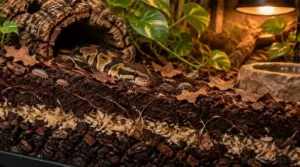
The right ingredients make or break your ball python’s enclosure. Get them right, and your snake thrives. Get them wrong, and trouble follows fast.
A properly sized tank, steady humidity, and a warm-and-cool temperature gradient all work together, and this ball python enclosure setup guide shows how to get each one right.
Choose your ball python’s enclosure ingredients wisely, because the right ones help your snake thrive and the wrong ones invite trouble fast
Stick with safe ball python substrate you can trust. Coco coir holds humidity well, though fine dust can bug heat pits, so pair it with coarser bark. Kiln-dried aspen and pure cypress mulch work too. Organic topsoil is safe only when it’s free of fertilizers, pesticides, perlite, and vermiculite. Those hidden additives can cause impaction or toxicity. Layer your substrate 3 to 4 inches deep, since the ideal substrate depth helps burrowing and healthy humidity gradients.
Skip cedar, pine, and eucalyptus. Their toxic phenols damage your snake’s lungs. Skip sand and walnut shells, too. For bioactive setups, add springtails, isopods, and a layer of leaf litter. Think of them as your tiny, hardworking cleanup crew.
Mix Ball Python Substrate for Lasting Humidity
Ball pythons need steady humidity, and your substrate mix is what delivers it. Below, you’ll find two ball python substrate recipes plus tips for tweaking them to fit your setup. Pick the one that suits your enclosure, and your snake will thank you.
Coco Coir, Bark, and Moss Mix
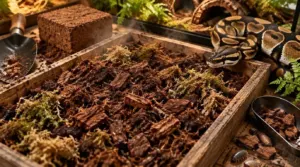
Coco coir, bark, and moss make a reliable base for your ball python. Mix 2 parts coir, 1 part bark, and 1 part moss by volume.
Hydrate the coir with warm water first. It expands 5 to 7 times its size. Rinse and briefly soak the bark and moss.
This mixture gives steady humidity retention and suits a bioactive setup.
Topsoil-Based Bioactive Substrate Mix
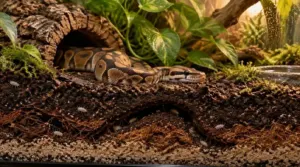
Prefer a soil-based mix? Organic topsoil gives your bioactive setup a rich, earthy base. Check the bag first. It must be free of fertilizers, pesticides, and perlite.
Mix 40% organic topsoil, 40% coconut fiber, and 20% play sand. Aim for substrate depth of 3-4 inches.
- Stable humidity retention
- Better drainage, no soggy spots
- Loose texture for burrowing
- Food-friendly footing for isopods
Adjusting Mixes for Your Enclosure
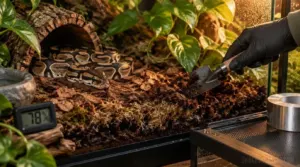
Every enclosure behaves differently, so tweak your mix to fit. Struggling with dry air? Add a bit more coconut fiber, or cover most of a screen top with foil tape for better moisture retention.
If you’re still fighting low humidity, this guide to bedding that keeps a snake enclosure humid compares which substrates hold moisture longest.
Too damp? Cut back on sphagnum and watch your substrate layering. Keep the top layer loose and drier. Check humidity control daily, and adjust slowly.
Top 4 Ball Python Substrate Products
Ready to put your mixes to work? Here are the top 4 ball python substrate products that keep your snake safe, your humidity steady, and your setup easy to manage. Check each pick below and find the one that fits your enclosure best.
1. Bio Dude Terra Firma Substrate
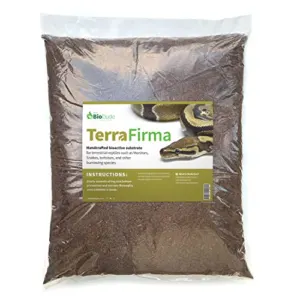
Want a substrate that holds a tunnel without collapsing? Bio Dude Terra Firma does exactly that.
This 36-quart bag weighs 35 lbs and packs a bio-balanced mix that helps create a stable environment. Your ball python can burrow, and the tunnels stay put, which helps with shedding, respiration, and hydration.
It drains and breathes without clogging, so you skip the drainage layer. Humidity stays between 50 and 75%. It suits plants and cleanup crews, too, but it’s built for burrowers, not aquatic setups.
| Best For | Reptile keepers with burrowing species, such as ball pythons, who want a bioactive setup with plants and a cleanup crew and prefer a substrate that holds tunnels and skips the drainage layer. |
|---|---|
| Brand | BIODUDE |
| Weight | 35 lbs |
| Volume | 36 quarts |
| Bioactive Use | Supports bioactive enclosures |
| Material | N/A |
| Humidity Support | Maintains 50-75% humidity |
| Additional Features |
|
- Holds tunnels and burrows, which supports shedding, respiration, and hydration
- Drains and breathes without clogging or stagnation, so no drainage layer is needed
- Keeps humidity between 50 and 75% and supports waste recycling in bioactive enclosures
- Designed for use without a drainage layer, so it may not suit setups that rely on one
- Best suited for burrowing species that may bypass substrate barriers, making it a weaker fit for non-burrowers
- Not specified for aquatic or fully submerged environments
2. Bio Dude Terra Firma Bioactive Substrate
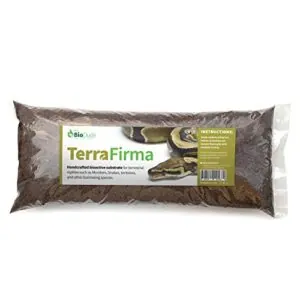
The Bio Dude Terra Firma Bioactive Substrate gives your ball python a place to burrow, shed, and settle in. This 6 quart bag works without a drainage layer, so setup stays simple.
It holds tunnels and burrows for natural behavior, and it works with plants from succulents to tropical species. Pair it with plants and a clean-up crew to get the full bioactive effect.
Keep humidity between 50-75%. Burrow support aids shedding, respiration, and hydration. Just remember, it’s made for diggers.
| Best For | Reptile keepers who want a bioactive setup for burrowing species, with live plants and a clean-up crew, in a habitat that holds 50-75% humidity. |
|---|---|
| Brand | BIODUDE |
| Weight | N/A |
| Volume | 6 quarts |
| Bioactive Use | Bioactive with plants, clean-up crew |
| Material | N/A |
| Humidity Support | Suits 50-75% humidity |
| Additional Features |
|
- Holds tunnels and burrows, so reptiles can dig naturally
- Works without a drainage layer, which keeps setup simple
- Supports plants from succulents to tropical species
- Needs live plants and a clean-up crew to work as a full bioactive setup
- Best suited to burrowing species that may dig past substrate barriers
- Fits only certain habitats, such as seasonal savannas, semiarid, coastal rainforest, and riverbank setups
3. Riare 10LB Organic Clay Pebbles Substrate
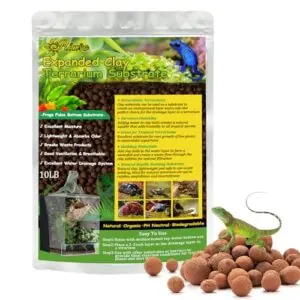
Picture a layer of tiny, rust-colored marbles hiding under your coco coir, quietly sipping extra water so your python’s hide stays fresh. That’s the Riare 10LB Organic Clay Pebbles at work.
You get 10 pounds of natural clay balls, 4–16 mm wide, baked at high heat and pH neutral. Use them as a drainage layer or false bottom beneath coconut husk or moss.
Some buyers say the balls run small, and sizes can vary. Skip them as a standalone substrate.
| Best For | Reptile and amphibian keepers who are building a bioactive terrarium or vivarium and want a natural drainage layer or false bottom under coconut husk, moss, or other substrates. |
|---|---|
| Brand | Riare |
| Weight | 10 lbs |
| Volume | N/A |
| Bioactive Use | Drainage layer for bioactive setups |
| Material | Natural baked clay |
| Humidity Support | Moisture retention for roots |
| Additional Features |
|
- Natural clay baked at high heat and pH neutral, so it won’t change the chemistry of your enclosure
- Works as a drainage layer or false bottom while also supporting aeration, moisture retention, and plant root growth
- Comes in a 10-pound resealable foil pouch that keeps the pebbles easy to store
- Some buyers report the balls are smaller than expected
- Size consistency may vary, since the balls range from 4 to 16 mm
- Not meant to be used alone as a substrate, and it isn’t intended for indefinite indoor reuse without checking its condition first
4. ReptiPlus Coconut Chip Reptile Substrate
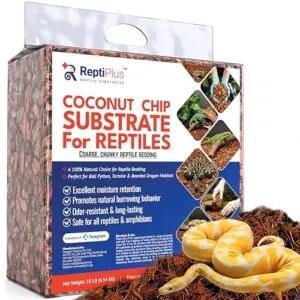
Picture a dense, dark brick of coconut husk swelling like bread dough the moment water hits it. That’s ReptiPlus Coconut Chip Reptile Substrate. This 10 lb block, 11" by 11" by 5", expands into 72 quarts (2.4 cubic feet) of dust-free, chemical-free chips.
Your ball python gets a humid, burrow-friendly floor. The chips hold moisture, absorb odors, and make spot-cleaning easy.
Add water to activate it. Expect slightly varying volume. The carton box takes more storage room than polybags.
| Best For | Reptile and amphibian keepers, including those with ball pythons, bearded dragons, tortoises, or bioactive setups, who want a natural, humidity-holding substrate. |
|---|---|
| Brand | N/A |
| Weight | 10 lbs (compressed) |
| Volume | 72 quarts expanded |
| Bioactive Use | Bioactive bedding for invertebrates |
| Material | 100% coconut husk chips |
| Humidity Support | Retains tropical humidity |
| Additional Features |
|
- Expands from a compact 10 lb block into 72 quarts (2.4 cubic feet) of dust-free, chemical-free coconut husk chips
- Holds moisture well to keep tropical enclosures humid
- Absorbs odors and makes spot-cleaning easy
- Needs water added before it expands and is ready to use
- Final volume may vary slightly depending on how much water it absorbs
- The rigid carton box can take up more storage space than polybag packaging
Set Substrate Depth, Plants, and Cleanup Crews
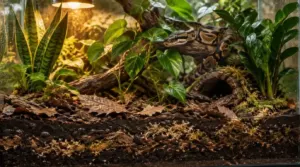
Ready to build a bioactive setup that actually works? Start with substrate depth. Aim for 4 to 6 inches. Deeper layers hold moisture longer and create a stable humidity gradient. If you skip a drainage layer, 2.5 to 3.5 inches of organic topsoil mix is your floor.
Next, pick sturdy live plants. Pothos, snake plants, and ZZ plants handle 50 to 60% humidity and temps up to 86°F. They’ll also survive a heavy snake climbing through them.
Add your cleanup crew. For a 4x2x2 enclosure, start with 20 to 50 isopods. Add springtails too. They’ll break down waste and aerate the soil. Mix sphagnum moss through the substrate for humidity pockets, then top it with oak or magnolia leaf litter.
Clean Ball Python Substrate and Know When-to-Replace
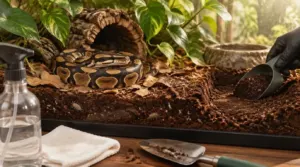
Think a clean enclosure is just a pretty one? Think again. A clean ball python enclosure keeps your snake safe, healthy, and happy.
Start with daily spot cleaning. Scoop out feces, urates, and uneaten food right away. That’s your contaminant removal routine, and it’s simple.
Running a non-bioactive setup? Plan complete substrate changes every one to three months. Scrub the enclosure with a reptile-safe disinfectant like F10SC, rinse well, and dry it fully before your snake goes back in.
Smell ammonia or spot mold? Replace everything immediately, no matter the schedule.
Bioactive setups work differently. A healthy cleanup crew controls waste, so you only spot clean messy areas. Keep substrate depth at four inches or more, and your substrate can last for years.
Frequently Asked Questions (FAQs)
What to put in a ball python terrarium?
Start with 2 to 4 inches of safe substrate, like coco coir, cypress mulch, and organic topsoil. Add hides, climbing branches, and leaf litter. Going bioactive? Springtails and isopods keep the enclosure clean and tidy.
How often should I replace ball python substrate?
Forget guesswork, your snake deserves a spotless home! Build a substrate replacement schedule: spot clean daily, do a full substrate change every 3-4 months, and finish with substrate sterilization. Substrate maintenance protects enclosure moisture balance.
What is a good bioactive substrate for ball pythons?
A great bioactive enclosure starts with smart substrate composition. Mix 40% organic topsoil, 40% coconut fiber, and 20% play sand. This mixture helps microfauna thrive, boosts moisture retention, and gives your python a truly naturalistic habitat.
How to make bioactive soil for ball python?
Mix organic topsoil, reptile-safe potting soil, and play sand in a 2:2:1 ratio. Add coco coir or sphagnum moss for humidity. Layer it 3-4 inches deep, top with cypress mulch, then add springtails and isopods.
Can I use aquarium sand in ball python enclosures?
Is aquarium sand secretly fine for ball pythons? Not really. It offers poor moisture retention and adds impaction risk, since grains cling to food.
Even reptile safe sand fails the substrate clump test. Skip it.
How do I prevent mold in bioactive substrate?
Mold resistance starts with humidity control. Keep ventilation steady and mist lightly. Build smart substrate layering with drainage below.
Then add your cleanup crew early, so springtails and isopods eat mold before it spreads fast.
Are springtails safe to keep with ball pythons?
Worried springtails might bother your snake? Relax. They’re harmless cleanup crew helpers that eat mold and decay, not your python. Keep your bioactive substrate damp, add isopods if you like, and maintain good enclosure ventilation.
What temperature should substrate stay in a terrarium?
Think of substrate as your snake’s hearth. Keep it 88-92°F on the warm side, never above 95°F, and never below 75°F at night. Build a thermal gradient, probe the substrate itself, and check it weekly.
How do I fix substrate that stays too wet?
Soggy substrate is a wet sponge. Swap the wet layer for dry material, then add a drainage layer of clay pebbles.
Cut moisture retention, keep substrate depth shallow, use a moisture gradient for humidity control.
Conclusion
Picture a ball python named Juniper, burrowing into damp coco coir and settling in for a perfect shed. No wheezing, no stuck skin, no vet bills. That’s what good husbandry looks like.
The right terrarium substrate mixes for ball pythons make it happen. Skip cedar, pine, and perlite, keep humidity steady, and refresh the bedding.
Get the base right, and your snake does the rest. Safe substrate is the quiet foundation of a healthy life.