This site is supported by our readers. We may earn a commission, at no cost to you, if you purchase through links.
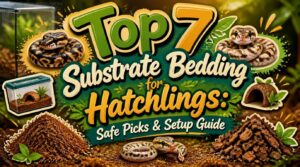
A hatchling snake making its way through its first weeks outside the egg is already working hard to stay alive. Its respiratory tissue is delicate, its gut can’t pass an ingested wood chip, and its skin absorbs whatever it touches. Substrate bedding for hatchlings isn’t a minor detail you fine-tune later. It’s one of the first decisions that separates a thriving juvenile from one that quietly declines.
Get the humidity gradient wrong and your ball python won’t shed cleanly. Reach for a dusty, scented bark mix and you’re setting up a respiratory infection. The right picks, set up correctly, make everything else easier.
Table Of Contents
Key Takeaways
- Substrate choice isn’t cosmetic — it directly controls humidity, prevents gut impaction, and shapes the respiratory health of your hatchling from the moment it leaves the egg.
- Match your bedding to your species: ball pythons need moisture-retentive coconut fiber or bark mix at 60–80% humidity, corn snakes thrive in dry aspen, and tropical species require a fiber blend that holds a 60–80% humidity gradient.
- Particle size and dust levels are non-negotiable safety variables — aim for 1–4 mm rounded, fragrance-free granules to reduce accidental ingestion during feeding and protect delicate airway tissue.
- Maintenance is a system, not a checklist: spot-clean daily, replace up to 20% of the top layer when odor appears, keep humidity below 60% to block mold, and do a full substrate swap whenever ammonia smell or visible breakdown sets in.
How to Choose Safe Hatchling Bedding
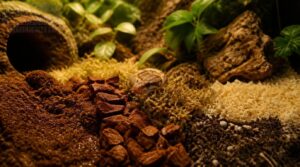
Choosing the right bedding for a hatchling isn’t just about comfort — it directly affects their health, hydration, and ability to behave naturally from day one.
The right substrate also plays a long-term role in your snake’s wellbeing, so it’s worth reviewing the best substrate options for boa constrictors before setting up their enclosure.
Hatchling bedding is never just comfort — it shapes health, hydration, and natural behavior from day one
Not every substrate works for every species, and the wrong pick can lead to respiratory issues, impaction, or failed sheds.
Here are the five key factors to think about before you commit to a bedding for your hatchling’s enclosure.
Species-Specific Humidity Requirements
The substrate you select directly shapes how well your enclosure holds moisture, so species-specific humidity needs should guide every decision. Ball python hatchlings need 50 to 60 percent relative humidity for shedding success, while boa constrictors require closer to 70 percent. Tropical species tolerate higher ranges, but arid hatchlings thrive at 30 to 50 percent, relying on prey moisture instead.
Soft, Appropriately Sized Particles
Particle size matters as much as moisture control. 1 to 4 millimeters in diameter gives hatchlings a natural-feeling growth medium that’s large enough to reduce ingestion risk. Rounded, uniform grains distribute moisture evenly through the base substance without creating dry pockets or oversaturated zones. A stable supporting surface also stays stable when your hatchling digs, which limits loose particle scatter. Just as researchers found that structured observation tools improve data interpretation skills, applying a methodical eye to substrate selection helps you make better-informed choices for your hatchling’s environment.
Low-Dust, Fragrance-Free Materials
Beyond particle size, the air quality inside your hatchling’s enclosure depends on what the base material releases. Scented or dusty substrates irritate delicate respiratory tissue. Natural coconut fiber offers low dust and no added fragrance, making it a reliable plant-based bedding choice. Look for products confirming purified substrate testing, so fine particle control is verified before anything enters the enclosure.
Absorbency and Odor Control
A good absorbent substrate does two jobs at once: pulling moisture away from your hatchling through capillary action, then locking it deep within a porous matrix where bacterial colonization converts waste compounds into odorless byproducts.
Coconut fiber combines strong moisture retention with consistent airflow to support sustained odor control. Without this balance, ammonia can accumulate quickly inside a small enclosure.
Impaction, Mold, and Irritation Risks
Wet substrate behaves like a fish tank environment with neglected clean gravel: damp substrate mold colonizes fast, releasing spores that cause airborne irritant exposure and skin contact irritation. Particle ingestion risk is a separate concern, since fine wet clumps swallowed during feeding can block the digestive tract.
Your priority, like in aquarium maintenance of an aquatic habitat, is moisture control.
Top 7 Substrate Bedding Products for Hatchlings
With the selection criteria fresh in mind, it’s time to put that knowledge to work. Each of the seven products below earns its place for a specific reason—whether that’s humidity control, particle safety, or ease of maintenance. Here’s what you need to know about each one.
1. Zilla Reptile Terrarium Bedding
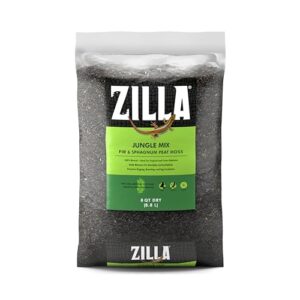
The Zilla Jungle Mix pairs aged Douglas fir bark with sphagnum peat moss, a 100% organic combination that stabilizes humidity through the peat’s capillary moisture retention rather than surface wetting alone. That mechanism makes it reliable for tropical species like rainforest geckos, toads, and forest-dwelling snakes, where consistent enclosure humidity directly affects shedding cycles, hydration, and skin integrity.
Keep bedding depth between 1 and 2 inches. Deeper fills complicate waste detection without improving conditions for the animal, and that tradeoff rarely favors the hatchling.
The fine, loamy texture stays gentle on hatchling scales, and the low-dust, fragrance-free formula limits respiratory irritation risk. Spot-clean waste daily, and replace the full substrate monthly, or sooner when odor or visible soiling becomes apparent.
| Best For | Tropical or forest terrariums for frogs, toads, snakes, and rainforest geckos |
|---|---|
| Material | Fir bark and peat moss |
| Humidity Control | Yes |
| Reusable | No |
| Reptile Safe | Yes |
| Odor Control | Earthy scent |
| Additional Features | Egg incubation support, 1-2 inch depth recommended |
| Best For | Reptile and amphibian owners keeping tropical or forest species like frogs, toads, rainforest geckos, and snakes in humid vivariums or terrariums. |
|---|---|
| Material | Fir bark and peat moss |
| Humidity Control | Yes |
| Reptile Safe | Yes |
| Reusable | No |
| Odor Control | Earthy scent |
| Ideal Species | Tropical and forest species |
| Additional Features |
|
- Made from 100% organic Douglas fir bark and sphagnum peat moss, making it a natural, reptile-safe choice that won’t harm sensitive animals
- Effectively maintains enclosure humidity through the peat moss’s moisture retention, supporting healthy shedding and hydration for tropical species
- Works well in bioactive setups with live plants and drainage layers, giving you flexibility to build a more naturalistic habitat
- Can produce splinters when handled dry, so wetting it before use is a good idea to avoid irritation
- Not reusable — requires full replacement monthly or sooner if soiling becomes visible, which adds ongoing cost
- Bedding depth needs to stay between 1 and 2 inches; going deeper makes waste harder to spot without any real benefit to the animal
2. Pangea Reptile Egg Incubation Substrate
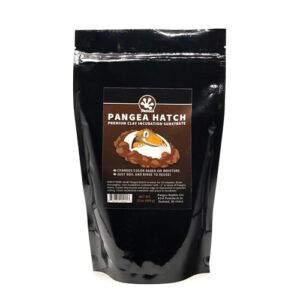
Incubation demands a substrate built around one priority: stable moisture retention without compression or shell damage. The Pangea Reptile Egg Incubation Substrate is a natural clay mineral mixture engineered precisely for that role, with porous granules that absorb many times their weight in water while maintaining structural integrity around each egg.
The color-changing moisture indicator removes guesswork from daily checks. When the clay lightens, hydration is needed. When it holds its deeper brown tone, conditions remain within range. That visual feedback matters when you’re managing multiple clutches across crested gecko, corn snake, or bearded dragon eggs.
Pre-moisten thoroughly before placing eggs, and avoid direct misting onto shells. Because the mixture is reusable and inert, it won’t break down between clutches, making sterilization straightforward and long-term costs manageable.
| Best For | Reptile breeders who need a reliable, reusable substrate to keep eggs stable and moist through incubation |
|---|---|
| Material | Clay |
| Humidity Control | Yes |
| Color | Brown |
| Reusable | Yes |
| Reptile Safe | Yes |
| Odor Control | Neutral |
| Additional Features | Clay incubation substrate, holds eggs in place, highly porous granules |
| Best For | Reptile breeders and hobbyists who need a dependable, reusable incubation substrate to keep eggs consistently moist and stable throughout the entire incubation period. |
|---|---|
| Material | Clay mineral |
| Humidity Control | Yes |
| Reptile Safe | Yes |
| Reusable | Yes |
| Odor Control | Neutral |
| Ideal Species | All egg-laying reptiles |
| Additional Features |
|
- Absorbs and holds a significant amount of water, providing the steady moisture levels reptile eggs need without constant rehydration
- The color-changing indicator makes it easy to see at a glance when the substrate needs water, taking the guesswork out of monitoring clutches
- Reusable and inert design means it won’t break down between uses, keeping long-term costs low and cleanup simple
- Must be properly pre-moistened before use, which adds a prep step before eggs can be placed
- Over-hydration or poor ventilation can lead to mold growth, so conditions need to be monitored carefully
- Designed specifically for incubation rather than general terrarium use, limiting its versatility
3. Riare Coconut Fiber Reptile Substrate
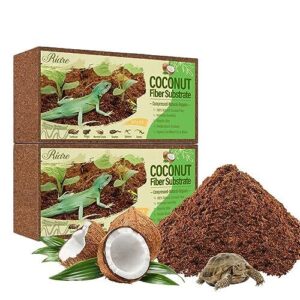
Unlike mineral-based incubation media, the Riare Coconut Fiber Reptile Substrate is designed for daily enclosure use. Each pack gives you two compressed coconut fiber bricks, which expand fully once submerged in water, producing a soft, airy bedding layer that cushions hatchling movement without the abrasive edges that can damage delicate skin.
The coco husk fibers are processed to remove dust and aromatic compounds, reducing respiratory irritation risk in young animals with sensitive mucous membranes. The substrate maintains humidity through capillary action, making it well-suited for tropical species requiring 60-70% relative humidity. Spot-clean daily and regulate moisture by misting to avoid oversaturation.
One practical consideration: some users report a sour odor during initial hydration or extended drying cycles. Allow adequate ventilation when you prepare the substrate. Once the bedding has run its course, it composts cleanly and works well as a natural garden fertilizer.
| Best For | Reptile, amphibian, and invertebrate owners who want a natural, moisture-retaining substrate that encourages burrowing behavior and disposes cleanly when replaced |
|---|---|
| Material | Coconut fiber |
| Humidity Control | Yes |
| Color | Brown |
| Reusable | No |
| Reptile Safe | Yes |
| Odor Control | Fragrance-free (possible odor during drying) |
| Additional Features | Compostable, stimulates digging behavior, reusable as fertilizer |
| Best For | Reptile, amphibian, and invertebrate owners looking for a natural, moisture-retaining bedding that encourages burrowing behavior and can be composted when it’s time to replace it. |
|---|---|
| Material | Coconut fiber |
| Humidity Control | Yes |
| Reptile Safe | Yes |
| Reusable | No |
| Odor Control | Fragrance-free |
| Ideal Species | Tropical burrowing species |
| Additional Features |
|
- Each pack includes two compressed bricks that expand into a soft, fluffy substrate — great value and easy to store before use
- Naturally maintains humidity through capillary action, making it ideal for tropical species that need 60–70% relative humidity
- Biodegradable and compostable, so used substrate can go straight into the garden as fertilizer
- Some users notice a sour smell during the initial hydration or when the substrate is drying out
- Rehydrating the bricks and waiting for them to dry can be a slow process
- The expanded fibers can clump and may take some effort to separate and spread evenly across the enclosure
4. ZeeDix Coconut Fiber Reptile Substrate
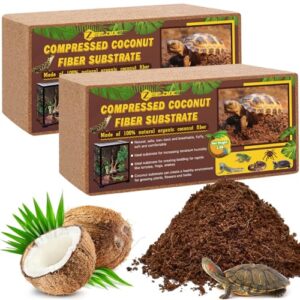
ZeeDix ships as two compressed coconut fiber bricks, each measuring 7.8 x 3.9 x 1.97 inches and weighing 1.4 lb. Soak them in water, agitate during hydration, and you get a loose, airy bedding layer that allows natural digging without the impaction risk that finer mineral substrates carry.
The coir is 100% natural and pH balanced, with low electrical conductivity, so mineral exposure stays minimal for hatchlings with sensitive skin. It absorbs waste quickly, keeping ammonia levels down, and retains enough moisture to sustain moderate enclosure humidity between misting sessions.
Break the bricks apart thoroughly before soaking. Incomplete hydration produces uneven expansion, and patchy substrate depth can disrupt the thermal gradient hatchlings depend on for thermoregulation.
| Best For | Reptile and amphibian owners who want a natural, chemical-free substrate that works double duty as garden soil or pet bedding |
|---|---|
| Material | Coconut fiber |
| Humidity Control | Yes |
| Color | Brown |
| Reusable | No |
| Reptile Safe | Yes |
| Odor Control | Neutral |
| Additional Features | Dual pack value, low EC and pH balanced, biodegradable brick format |
| Best For | Pet owners housing reptiles, amphibians, or invertebrates who want a natural, chemical-free substrate that also doubles as a gardening medium. |
|---|---|
| Material | Coconut fiber |
| Humidity Control | Yes |
| Reptile Safe | Yes |
| Reusable | No |
| Odor Control | Neutral |
| Ideal Species | Reptiles, amphibians, invertebrates |
| Additional Features |
|
- 100% natural coconut fiber with low EC and balanced pH, making it safe for hatchlings and animals with sensitive skin
- Absorbs waste and moisture effectively, helping control odors and maintain humidity between misting sessions
- Comes in a compact dual-brick format that’s easy to store and can also be used as a growing medium for plants
- Bricks can be difficult to break apart, leading to uneven expansion if not properly soaked and agitated
- Not suitable for all reptiles — bearded dragons and leopard geckos face impaction risk, and some tortoises may show allergic reactions
- Requires drying time after hydration before it’s ready to use, which adds a step to the setup process
5. Zilla Reptile Bark Blend Substrate
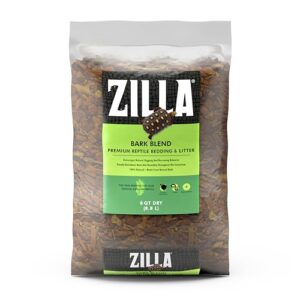
For forest-dwellers like chameleons, rainforest geckos, and arboreal snakes, getting the substrate right determines whether thermoregulation and shedding cycles actually function the way they should. Zilla’s Bark Mix is made entirely from 100% organic Douglas fir bark, oven-dried to eliminate pests and residual oils before it reaches your enclosure.
Lay it at 1 to 2 inches deep and it absorbs moisture overnight, releasing it gradually to sustain stable enclosure humidity through daily temperature fluctuations without becoming waterlogged. No fragrances, no additives.
The particle size is calibrated to be large enough to prevent accidental ingestion but soft enough that small hatchlings can move across it without injury. Available in 8-quart and 24-quart bags, the light bark color also makes waste identification easy during your daily spot-cleaning routine.
| Best For | Forest-dwelling reptiles like chameleons, rainforest geckos, skinks, and arboreal snakes that need a humidity-friendly, natural substrate |
|---|---|
| Material | Fir bark |
| Humidity Control | Yes |
| Color | Brown |
| Reusable | No |
| Reptile Safe | Yes |
| Odor Control | Neutral |
| Additional Features | Oven-dried, pest-free; plant drainage additive; 8 and 24 quart sizes |
| Best For | Forest-dwelling reptiles like chameleons, rainforest geckos, skinks, frogs, and arboreal snakes that thrive in humid, tropical environments. |
|---|---|
| Material | Fir bark |
| Humidity Control | Yes |
| Reptile Safe | Yes |
| Reusable | No |
| Odor Control | Neutral |
| Ideal Species | Forest-dwelling reptiles |
| Additional Features |
|
- Made from 100% organic, oven-dried fir bark — no pests, chemicals, or added fragrances
- Absorbs and releases moisture gradually, helping maintain stable humidity without waterlogging
- Doubles as a soil additive for plants, making it versatile beyond just reptile enclosures
- Larger bark pieces may need sorting if you’re blending it into a finer substrate mix
- Some buyers feel the quantity is on the smaller side for the price
- Natural wood can splinter, so gloves are a good idea when handling it
6. Reptile Cork Bark Substrate Bedding
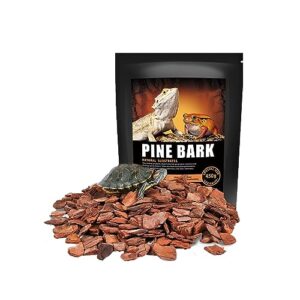
Cork bark earns its place through a quality few substrates can replicate: structural stability under humidity. The BNOSDM pine bark is heat-treated before packaging, reducing mold spore counts before it ever reaches your hatchling’s enclosure. Its rounded granule edges won’t abrade the delicate ventral scales on young snakes or gecko hatchlings, and the bark’s natural suberin content helps slow surface-level bacterial growth without any chemical additives.
At roughly one pound per package, this option suits compact terrariums housing frogs, geckos, or smaller snake hatchlings that don’t require deep burrowing substrate. You can rinse it, air-dry it in sunlight, and reuse it across multiple cycles, making the modest cost per bag reasonable over time. Odor control works passively as the porous bark structure draws urine and fecal compounds inward, reducing odor buildup between full enclosure cleanings.
| Best For | Reptile and amphibian owners who need a natural, humidity-friendly substrate for smaller terrariums housing snakes, geckos, frogs, or similar pets |
|---|---|
| Material | Pine bark |
| Humidity Control | Yes |
| Color | Brown |
| Reusable | Yes |
| Reptile Safe | Yes |
| Odor Control | Odor absorbing |
| Additional Features | Heat-treated natural bark; rounded granule edges; compact lightweight design |
| Best For | Reptile and amphibian owners who want a natural, humidity-regulating substrate for smaller terrariums housing snakes, geckos, frogs, or similar pets. |
|---|---|
| Material | Pine bark |
| Humidity Control | Yes |
| Reptile Safe | Yes |
| Reusable | Yes |
| Odor Control | Odor absorbing |
| Ideal Species | Small terrarium species |
| Additional Features |
|
- Naturally absorbs odors from waste, keeping enclosures smelling fresher between cleanings
- Helps regulate humidity levels, making it great for species that need a stable, moist environment
- Reusable after a simple rinse and air dry, offering solid long-term value
- The small quantity per bag may not go far for larger enclosures or species that need deep substrate
- Can arrive dry and brittle, so it needs careful handling right out of the package
- Pine bark can be harmful to some reptiles if not properly sourced, so it’s worth verifying compatibility with your specific pet
7. ReptiChip Coconut Reptile Bedding
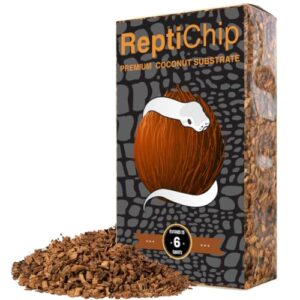
ReptiChip takes a different approach to hatchling substrate: coconut husk chips, triple-washed and screened for uniform size, so fine dust and debris don’t reach your hatchling’s respiratory tract. That process matters more than it sounds, since even small particulate loads can trigger mucus buildup in neonatal snakes.
Where cork bark excels at passive humidity buffering, ReptiChip controls active moisture retention more directly. The chips absorb and release moisture gradually, maintaining 60-70% relative humidity without pooling, which reduces the surface slickness that can stress tropical hatchlings mid-shed. Spot cleaning stays practical because soiled areas clump slightly and lift cleanly, without disturbing the surrounding substrate.
Its 100% organic composition means safe disposal after each replacement cycle, with no synthetic additives and no fragrances included. One bag covers a standard 20-gallon enclosure and works equally well for arid setups when used dry.
| Best For | Ball pythons, geckos, tortoises, and tropical species needing stable humidity |
|---|---|
| Material | Coconut chips |
| Humidity Control | Yes |
| Color | Brown |
| Reusable | No |
| Reptile Safe | Yes |
| Odor Control | Odor absorbing |
| Additional Features | Triple-washed; uniform chip size; bioactive compatible; arid and tropical use |
| Best For | ReptiChip Coconut Reptile Bedding is best for ball pythons, geckos, tarantulas, iguanas, and other tropical or semi-arid reptiles that need reliable humidity control and a clean, dust-free environment. |
|---|---|
| Material | Coconut husk |
| Humidity Control | Yes |
| Reptile Safe | Yes |
| Reusable | No |
| Odor Control | Odor absorbing |
| Ideal Species | Arid and tropical species |
| Additional Features |
|
- Triple-washed and screened to remove fine dust, making it safer for hatchlings and species with sensitive respiratory tracts
- Absorbs and releases moisture gradually to maintain stable humidity without pooling, and soiled spots clump for easy spot cleaning
- 100% organic with natural odor-absorbing properties, no synthetic additives or fragrances, and safe for disposal after each replacement cycle
- Requires hydration before use with tropical species, adding a prep step compared to ready-to-use substrates
- Can expand significantly when wet, so enclosures need enough space to accommodate the added volume
- Not suitable for species that need sandy or calcium-based substrates, limiting its versatility across all reptile types
Best Substrates by Hatchling Snake Species
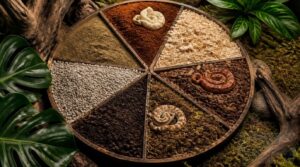
Not every hatchling needs the same setup, and substrate is where those differences become most obvious. What works for a ball python won’t necessarily suit a corn snake or a young boa, so it helps to think species-first. Here’s how to match your bedding choice to the snake you’re actually keeping.
Ball Python Hatchling Substrate
Ball python hatchlings need coconut fiber or bark mix substrate, kept at 1 to 2 inches deep, to hold humidity between 60 and 80 percent.
Fine, dust-free particles reduce impaction risk. Unlike an aquatic habitat, there’s no water circulation to limit biological growth, so treat substrate care like aquarium maintenance: spot-clean daily to prevent pathogens from establishing in damp bedding.
Corn Snake Hatchling Substrate
Where ball pythons lean toward moisture-retentive fiber, corn snake hatchlings (Pantherophis guttatus) thrive in kiln-dried aspen bedding laid 1 to 2 inches deep.
Aspen resettles quickly after burrowing, mimicking natural leaf litter without trapping humidity that could promote biological growth. Its low-dust composition keeps respiratory irritation minimal, and its firm structure prevents hatchlings from accidentally ingesting loose particles during feeding, reducing impaction risk directly.
Boa Constrictor Hatchling Substrate
Unlike aspen, coconut fiber substrate suits boa constrictor (Boa constrictor) hatchlings because it balances moderate humidity retention with adequate airflow, keeping conditions near 50 to 60 percent relative humidity without becoming waterlogged.
Fine particles under 3 mm prevent impaction risk during exploratory burrowing. Keep the layer 2 to 3 inches deep, free of fragrances, pesticide residues, or biological growth.
Tropical Snake Hatchling Bedding
Tropical hatchlings need a substrate foundation layer that allows humidity gradient control between 60 and 80 percent. Choose a natural fiber mix of coconut coir or sphagnum moss. Apply these three checks:
- Moisture retention test: compress a small handful; it should clump, then release.
- Ventilation balance check: confirm airflow reduces mold risk.
- Species-specific adjustment: modify humidity based on shedding patterns.
Arid Snake Hatchling Bedding
Arid hatchling species, such as Kenyan sand boas, require a substrate with particle sizes between 2 and 5 mm. Coarser granules provide dust reduction benefits that protect sensitive airways while improving airflow beneath the enclosure floor. Maintain a consistent layer depth of 2 to 3 inches, and run regular fines accumulation checks to catch any fine particles before they become a choking risk.
How to Set Up Hatchling Bedding
Getting your hatchling’s enclosure set up correctly from the start makes everything else easier — the right substrate depth, humidity, and temperature gradient work together as a system, not a checklist. Each step below builds on the last, so skipping one often creates problems that show up later. Here’s how to do it right, from disinfecting the base to dialing in your ventilation.
Preparing and Disinfecting Enclosure Base
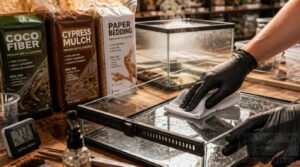
Before you lay a single layer of substrate, the enclosure base needs to be genuinely clean, not just visually tidy. Start by rinsing with hot water and mild detergent, then wipe hard surfaces with 70% isopropyl alcohol, letting it sit for the label’s listed contact time. Air dry completely before adding substrate. Residual moisture dilutes disinfectants and invites bacterial growth.
Choosing Safe Substrate Depth
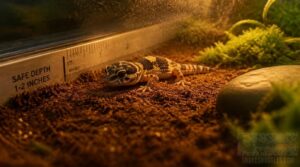
Substrate depth is a safety variable, not just a comfort preference. For hatchlings, 1 to 2 inches is the recommended ceiling, shallow enough that a disturbed animal can surface quickly. Anything deeper encourages burrowing, which raises impaction risk when substrate particles are accidentally ingested. Check depth daily and level it whenever your hatchling’s movement compresses or displaces the base layer.
Moistening Substrate Without Saturation
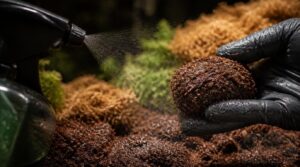
Getting moisture right is the difference between a thriving hatchling and a soggy substrate disaster. Add water in small increments, mixing thoroughly to eliminate dry pockets. Your target is substrate that holds its shape when squeezed lightly but releases no drips. A fine-mist spray bottle distributes humidity evenly across the bedding without saturating it. If clumping occurs, the mix is already too wet, so correct it immediately.
Creating Warm and Cool Zones
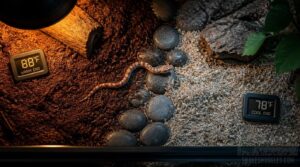
Once your substrate holds the right moisture, place your heat source at one end of the enclosure to establish a thermal gradient. Target 85 to 92°F on the warm side, where darker substrate absorbs radiant heat efficiently, and 75 to 80°F in the cool zone.
Keep obstacles low so hatchlings can move freely between both areas.
Checking Humidity and Ventilation
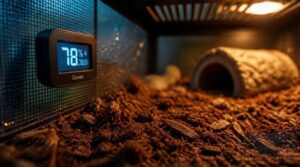
With the thermal gradient set, mount a digital hygrometer at hatchling breathing height, away from water dishes. Target 40 to 60 percent RH; readings above 70 percent signal inadequate ventilation for your hatchlings.
Check enclosure walls for condensation, which indicates poor air exchange near the substrate surface. Bedding that won’t dry between daily checks means your airflow needs immediate adjustment.
Hatchling Bedding Maintenance and Safety
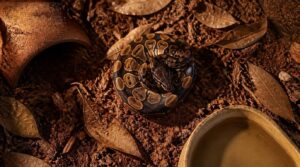
Keeping your hatchling’s enclosure clean isn’t just about appearances — it directly affects their health, immune response, and stress levels. A consistent maintenance routine is what separates a thriving hatchling from one that’s constantly battling environmental pathogens or ingesting unsafe materials. Here’s what you need to stay on top of it.
Proper hide placement also plays a bigger role than most owners realize — check out this guide to boa constrictor hides for rescue owners to understand how security directly reduces stress-related health issues.
Daily Spot-Cleaning Routine
Every day, remove waste within five minutes of detection using a clean scoop, targeting soiled patches without disturbing deeper substrate layers. Think of it like siphoning gravel in a fish tank environment: you’re lifting the bad without uprooting the good.
Wipe enclosure edges with a damp cloth to clear moisture buildup, and replace up to 20 percent of the top layer when odor persists.
Preventing Mold and Pathogens
Spot-cleaning removes waste, but mold and pathogens thrive where unchecked moisture lingers. Dry wet areas within 48 hours and keep humidity below 60%.
- Increase ventilation when stagnant enclosure air builds up
- Target damp substrate patches, not just surface waste
- Scrub hard surfaces with diluted disinfectant weekly
- Discard porous material showing visible mold growth
- Keep humidity between 30% and 50% ideally
Safe Full-Replacement Schedule
Beyond daily cleaning, full replacement becomes necessary when substrate absorbency monitoring reveals breakdown, strong mold odor indicators, or persistent ammonia smells linked to humidity-based buildup.
Remove hatchlings safely to a secure container, wear gloves, and siphon water from damp soil before discarding material, including the humus layer. Rinse clean gravel separately. Confirm humidity and temperature targets before returning your hatchlings.
Feeding Without Substrate Ingestion
When feeding your hatchlings on loose substrate, use clean forceps to place freshly killed prey directly into the mouth. Prey sized for single-bite ingestion reduces the gag reflex and limits substrate contact.
Keep the feeding environment quiet and the lighting low. Small, frequent meals lower the risk of accidental ingestion. Afterward, wipe the enclosure rim and any nearby surface clean.
Transitioning From Paper Towels
Rushing the shift from paper towels can stress even a healthy hatchling. Start with a thin base layer of chosen substrate underneath, then increase coverage gradually over several days.
- Monitor activity for 48 to 72 hours after each layer change
- Keep enclosure temperatures stable to prevent thermal shock
- Document any feeding behavior shifts you notice
Hydration access must remain constant.
Frequently Asked Questions (FAQs)
What should I put in the bottom of my brooder?
For the first 72 hours, paper towels are your best option. They provide traction for fragile legs, let you monitor droppings easily, and swap out in seconds when the brooder floor gets messy.
What to put on the floor of a chicken brooder?
Ironically, the safest brooder floor setup is also the simplest. Layer paper towels over pine shavings, roughly 2 inches deep. This keeps the substrate base dry, improves traction, and simplifies your daily cleaning routine considerably.
Can hatchlings ingest substrate accidentally while eating?
Yes. When hatchlings strike at prey, accidental ingestion of surrounding bedding is a genuine risk. Even fine particles can cause impaction or digestive disruption, which is why substrate particle size remains a critical husbandry concern.
How does lighting affect substrate temperature for hatchlings?
Light intensity and spectrum directly raise substrate temperatures. Infrared emission warms surfaces faster than visible light, while darker substrates absorb heat more readily. Distance and lighting schedule determine whether hatchlings stay in safe thermal zones.
What substrate works best for mixed-species enclosures?
In shared multi-species setups, coconut coir earns its place through humidity gradient balance that works for tropical and semi-arid species alike. A dust-free particle mix with safe depth layering helps natural burrowing behavior and odor control.
Conclusion
It’s almost ironic: the smallest animal in your collection demands the most exacting decisions you’ll make as a keeper.
Substrate bedding for hatchlings looks like a minor setup detail, but it controls humidity, prevents impaction, and shapes your snake’s critical first weeks of life. Get it right and everything else follows naturally. Get it wrong and you won’t always know until it’s too late.
The right substrate isn’t just a background choice. It’s your foundation.