This site is supported by our readers. We may earn a commission, at no cost to you, if you purchase through links.

Your dial thermometer says 85°F. The actual temperature on the substrate might be 100°F. Dial gauges miss by 10 to 15 degrees, and your snake pays for that error with every meal it can’t digest and every shed that goes wrong.
Most common mistakes with snake habitat temperature look harmless at setup. A wrong gradient, a misplaced probe, a thermostat rated too low. Then a ceramic emitter melts its cord at 2 a.m.
Ball pythons and corn snakes need different heat, and both need it measured, controlled, and checked. Here’s what keepers get wrong, and how you fix each mistake.
Table Of Contents
- Key Takeaways
- Using Incorrect Species Temperatures and Thermal Gradients
- Trusting Inaccurate Thermometers and Misplaced Probes
- Installing Snake Habitat Heating Equipment Unsafely
- Overlooking Nighttime Temperatures and Lighting
- Skipping Temperature Checks and Seasonal Adjustments
- Frequently Asked Questions (FAQs)
- What is too cold for snakes to be out?
- What temperature is too hot for a snake?
- Is 90 degrees too hot for a snake?
- What temperature is too hot for a snake plant?
- How does humidity interact with enclosure temperature levels?
- What temperatures are safe for different snake species?
- Can stress from heat affect a snakes eating habits?
- What are the signs my snake is overheating?
- Can cold temperatures make my snake regurgitate its meals?
- Why does my snake only use one side?
- Conclusion
Key Takeaways
- Match your heat to your species and build a true gradient, since a ball python and a corn snake need different warm and cool zones, and one uniform temperature leaves your snake nowhere to regulate.
- Trust digital probes placed on the substrate where your snake’s belly touches, not dial gauges or glass-mounted strips that can be off by 10 to 15 degrees, and cross-check them with an infrared gun.
- Wire every heater to a thermostat rated for its type and wattage, and mount it outside the enclosure with a bulb cage so you avoid burns and fires.
- Let temperatures drop at night without colored bulbs, and check your readings weekly and adjust seasonally, because thermostats drift and rooms change.
Using Incorrect Species Temperatures and Thermal Gradients
Why do so many snakes struggle with digestion and stress? Because keepers ignore species thermal needs. A ball python isn’t a corn snake. Ball pythons need a warm zone of 85–88°F and a cool zone of 76–80°F. Corn snakes want a cool zone of 70–75°F and a warm zone of 80–85°F. Those ranges aren’t interchangeable.
Since each species evolved in a different climate, species-specific snake habitat design helps you match heat sources and hides to your animal’s natural gradient.
Species-specific care starts with research. Research your exact species before any temperature gradient setup.
Don’t heat the whole enclosure to one temperature. A proper thermal gradient setup puts heat at one end and cool air at the other. Never rely on a ceramic heat emitter alone, since it warms air and skin, not the body. Temperature gradient maintenance means checking both zones weekly, without exception.
Trusting Inaccurate Thermometers and Misplaced Probes
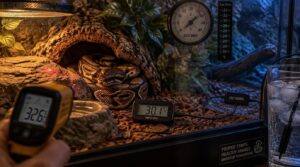
Those gradient numbers mean nothing if your thermometer lies. Inaccurate thermometers are everywhere. Dial models can be off by 10-15°F, and the stick-on LCD strips swing with room temperature. Don’t trust either one.
If you’re running several enclosures, this guide to snake thermometers for multiple terrariums shows how to set up and cross-check each probe without overspending.
Probe placement matters just as much. A probe stuck high on the glass reads air, not the basking surface temperature your snake actually lies on. Put it on the substrate, inside the hide, right where the belly makes contact.
Use at least two probes: one at the warm spot, one at the cool end. For the cool side, the probe should sit on the substrate opposite the heat source in terrestrial enclosures, so it captures the coolest available temperature in the enclosure. Then spot-check surfaces with an infrared temperature gun.
Cheap digital units drift, so test equipment calibration in ice water (32°F). Pinched probe wires cause erratic readings. Check them. Your snake can’t tell you it’s cooking.
Installing Snake Habitat Heating Equipment Unsafely

Your heating setup can heal your snake or hurt it. Most burns and cold-stress cases trace back to two errors: mismatched equipment and careless placement. Here’s how to get both right.
Choosing Compatible Heaters and Thermostats
Picture a cheap extension cord glowing orange behind your snake’s wall. That’s what a mismatched thermostat does.
Beyond probe placement, a proper temperature gradient for a ball python terrarium lets your snake move between a warm side and a cooler retreat, just as it would underground.
Match the unit to the heater. Dimming thermostats run bulbs. Pulse-proportional models run ceramic heat emitters and mats. Check the wattage rating, because an underrated thermostat melts and starts fires. One heater, one thermostat. Your temperature gradient depends on it.
Positioning Heat Sources to Prevent Burns
Right heater, wrong spot, and you’ve still got a problem. Heat source placement decides whether your snake basks or burns.
Mounting the heat source overhead and running it through a thermostat keeps the warm side steady, and this step-by-step guide to heating a snake terrarium properly shows exactly where each component should go.
Mount every lamp outside the enclosure, above a screened top, with a bulb cage. Lamp height errors cause most thermal burn prevention failures. Keep a ceramic heat emitter out of reach, never inside. Run heat mat placement under the tank, never within.
Overlooking Nighttime Temperatures and Lighting

Why do so many keepers flip the lights off and call it night? Because they’ve never watched what happens when the heat stays on.
Most snakes need a nighttime temperature drop. Hold daytime warmth around the clock and you flatten the thermal gradient, then blunt your snake’s digestion, shedding, and rest. Check your species’ needs, then let the ambient air cool while a cool hide stays available.
Skip the red, blue, and black bulbs. Snakes see those wavelengths, so you’re not creating darkness. You’re creating stress. Over time, that light can wear down eyesight and mood.
Want to watch your snake after dark? Don’t. Let it be. If you must heat at night, use a ceramic emitter on a thermostat, mounted with careful heat source placement. Confirm it all with regular temperature monitoring.
Skipping Temperature Checks and Seasonal Adjustments
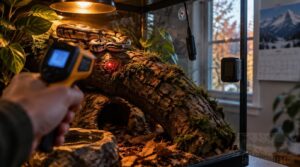
You think the setup is fine because it worked last month. It might not be. Skipping temperature checks is how a stable tank turns lethal without a single warning sign.
Thermostats drift, stick, and fail silently. Rooms heat up in July and chill in January. Those temperature fluctuation risks stack fast. Build a routine of temperature monitoring and don’t skip it:
- Verify the probe position weekly with a second thermometer.
- Log basking, cool-side, and nighttime readings with an infrared gun.
- Calibrate every three to six months.
- Make seasonal adjustments to wattage or setpoints.
Treat temperature seasonal adjustment like routine maintenance. Your snake can’t tell you the heat is wrong. It suffers. Check the numbers before they become a necropsy report.
Your snake can’t tell you the heat is wrong, so check the numbers before they become a necropsy report
Frequently Asked Questions (FAQs)
What is too cold for snakes to be out?
Your "cozy" snake room might actually be a freezer.
Below 60°F, your snake gets sluggish. Under 50°F, brumation starts.
Don’t ignore these: cold stress in reptiles, temperature fluctuation risks, ambient temperature, seasonal temperature adjustment, thermostat settings.
What temperature is too hot for a snake?
Above 95°F ambient is too hot for ball pythons. Corn snakes shouldn’t bask over 90°F. Heat stress sets in, and thermal burns follow.
Watch temperature drift and lamp height errors. Thermostat your nonlight heat source.
Is 90 degrees too hot for a snake?
Corn snakes suffer heat stress above 90°F. Ball pythons handle it fine. Know your species-specific temperature. Keep a temperature gradient, watch for temperature drift, and cap the basking zone. Hot spots cause thermal burns fast.
What temperature is too hot for a snake plant?
Don’t roast your snake plant like a marshmallow! Above 90°F, heat stress sets in and growth slows fast.
Check your thermometer’s temperature accuracy, watch for drooping leaves, and move the plant out of direct sun.
How does humidity interact with enclosure temperature levels?
Heat and humidity work against each other. Warm air holds more moisture, so relative humidity drops as temperature climbs. Cool air does the opposite. Check your temperature gradient, and your humidity follows.
What temperatures are safe for different snake species?
Picture a sunlit rock beside a shaded burrow.
Your ideal temperature range depends on species thermal needs: ball pythons 88–92°F warm, 76–80°F cool; corn snakes 85–90°F, 75°F cool; kingsnakes mid-80s warm. Provide a temperature gradient.
Can stress from heat affect a snakes eating habits?
Heat stress is an appetite killer. When your snake can’t cool down, thermoregulation fails, stress climbs, and digestion impact follows. Fix your temperature management fast, because a snake that’s overheated will refuse food, even when prey is offered.
What are the signs my snake is overheating?
One rescued ball python gaped on the cool side for days. That’s heat stress. Watch for panting, glass surfing, and basking spot avoidance. Failed thermoregulation risks heat stroke. Cool it fast for thermal injury prevention.
Can cold temperatures make my snake regurgitate its meals?
Yes, and it happens fast. Cold slows reptile metabolism, so your snake can’t digest. Food rots and comes back up. Check your thermal gradient and thermostat settings. Keep temperature management steady, day and night, to prevent regurgitation.
Why does my snake only use one side?
Your snake isn’t being lazy. It’s voting with its body. A one-sided snake usually means a broken thermal gradient: warm hide too hot, cool side too warm, or no real temperature zones.
Conclusion
A snake’s enclosure is a tightrope, and one wrong degree can tip your pet off it.
Fix the common mistakes with snake habitat temperature and you’ve removed most of the danger. Set species-correct gradients. Trust a digital probe, not a dial. Wire every heater to a thermostat. Check readings weekly and adjust with the seasons.
Your snake can’t tell you it’s struggling. It can only show you through missed meals and bad sheds. Measure first.