This site is supported by our readers. We may earn a commission, at no cost to you, if you purchase through links.
A snake’s skull contains more moving parts than yours, and that’s precisely why it can swallow prey three times the width of its head. No dislocation involved, no myth about unhinging jaws. Just quadrate-articular linkages doing exactly what evolution spent 167 million years perfecting.
That single adaptation hints at something bigger: snakes aren’t lizards that lost their legs. They’re a complete redesign of the reptilian body plan, from a heart built for horizontal blood flow to a tongue that reads the air like a chemical map.
This snake characteristics guide breaks down the anatomy, senses, and survival strategies that make these animals some of the most refined hunters on the planet.
Table Of Contents
- Key Takeaways
- Snake Evolution and Defining Characteristics
- Snake Anatomy, Skin, and Physiology
- How Snakes Sense Their Environment
- Snake Movement, Hunting, and Feeding
- Snake Habitats, Reproduction, and Survival
- Frequently Asked Questions (FAQs)
- What are 5 characteristics of a snake?
- What are the personality traits of a Snake?
- What are the 7 classifications of a snake?
- What is a snake’s weakness?
- How do snakes move?
- Do snakes have ears?
- How fast do snakes grow?
- What is molting in snakes?
- What physical trait sets snakes apart from other reptiles?
- What are 5 characteristics of snake?
- Conclusion
Key Takeaways
- A snake’s jaw doesn’t dislocate to swallow big prey—it relies on flexible joints called quadrate-articular linkages that let different skull sections move independently.
- Snakes aren’t just legless lizards; they’re a full-body redesign, with hundreds of movable vertebrae, a three-chambered heart, and a forked tongue that reads scent like a map.
- Since snakes can’t hear sound through the air, they "listen" through vibrations instead, picking up ground movement through their jawbone and inner ear.
- Snakes get around in surprisingly different ways depending on the terrain—slithering, anchoring in tight squeezes, or sidewinding across loose sand—all powered by muscle waves and gripping belly scales.
Snake Evolution and Defining Characteristics
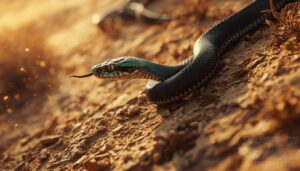
Snakes didn’t just lose their legs by accident—167 million years of evolution rebuilt them from the skull down. Every trait you’re about to explore, from vertebral count to jaw mechanics, exists for a reason rooted deep in that history. Here’s what actually separates a snake from every other reptile on the tree of life.
This kinetic skull design lets snakes swallow prey far larger than their own heads, a feat explained in detail by this breakdown of the snake jaw dislocating mechanism.
Lizard Ancestry and Fossil Evidence
Follow the fossil trail far enough and snakes stop looking mysterious: they’re squamates through and through. Triassic squamate origins push the story past 230 million years, with:
- Lizard-like skulls paired with elongating bodies
- Pleurodont teeth showing regional differentiation
- Early limb reduction in girdles and joints
- Vertebral patterns matching modern lizard counts
These transitional fossils confirm crown group placement within reptile evolution, not beside it. This early divergence echoes the broader ancient split shaping squamate diets, which occurred around the same late Triassic period and helped drive the dramatic differences in diversification seen across lizard and snake lineages today.
Limbless, Elongated Body Plan
Losing limbs wasn’t a loss at all. It freed up the body plan entirely, favoring body elongation and a narrow trunk that slips through crevices no lizard could touch.
Spinal nerve coordination runs the whole length, and even the tail earns its keep as a fulcrum. This limbless, elongated body plan turns scales and jaws into a single hunting machine.
Flexible Spine and Movable Ribs
That elongated trunk needs a spine built for motion. Snakes carry 200 to 400 vertebrae, each paired with movable ribs, giving the vertebral column impressive bend without sacrificing strength.
This skeletal flexibility extends beyond the spine—explore the full bone structure of snakes to see how their uniquely mobile skulls work in concert with that supple vertebral column.
This rib mobility drives locomotion mechanics directly: muscular coordination along the spine lets each segment flex independently, powering the body forward one wave at a time.
Kinetic Skull and Jaw Structure
A flexible spine sets up the body’s motion, but swallowing prey demands a different kind of flexibility: cranial kinesis. Snake skulls disarticulate at multiple joints, letting the quadrate bone swing outward while dentary and articular elements shift independently.
Elastic connective tissue and palatal ligament stretch let the palate deform without risking brain protection, so mandibular mobility accommodates prey wider than the skull itself.
Differences From Legless Lizards
Mistake a legless lizard for a snake and you’ll miss three tells fast: eyelids instead of a spectacle, external ear openings, and a notched, not forked, tongue. Many also carry pelvic remnants, hind limb ghosts snakes lost entirely.
Their ventral scales pair up rather than forming true propulsion rows, and unlike snakes, they can regenerate a lost tail.
Snake Anatomy, Skin, and Physiology
Strip away the skeleton and skull, and what’s left is a body built for its own kind of engineering. Every scale, organ, and heartbeat does a job you might not expect. Here’s what’s actually happening beneath that skin.
Since snakes can’t shiver or sweat, they rely on finely tuned heat-sensing skills, and understanding how snakes sense and respond to temperature changes reveals just how precise this survival system really is.
Scales and Ventral Traction
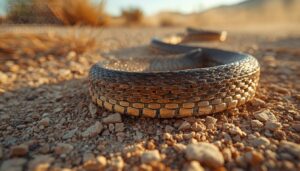
Every scale on a snake’s belly works like a tiny grappling hook. Ventral scales are broad, plate-like shields running from throat to tail, gripping rough surfaces to drive the snake forward.
Texture varies widely: smooth scales suit fast slithering, while keeled ones bite into loose soil or rock. This scale morphology, paired with lateral undulation, converts muscle waves into real traction.
Shedding and Growth Cycles

Growth demands renewal. Ecdysis lets snakes shed worn skin every 4-12 weeks, faster in juveniles chasing rapid growth spurts, slower once sexual maturity hits.
Rising appetite and warming temperatures often signal an approaching molt. Once complete, fresh scales reveal brighter, sharper coloration, a visible marker of health beneath that dull, pre-shed cloudiness you’ll notice days before.
Heart, Lungs, and Circulation

A snake’s three-chambered heart (two atria, one ventricle) does something impressive: it powers blood through a body that’s mostly tail.
Cardiac output stays lean, yet efficient. That single working lung still controls serious oxygen exchange.
This system delivers:
- Steady oxygen flow despite one lung
- Blood pressure suited to a stretched-out frame
- Circulatory efficiency built for stillness and sudden strikes
- Cardiovascular function tuned to cold-blooded life
Cloaca and Waste Elimination
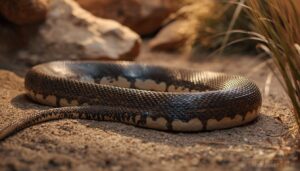
One exit, three jobs. The cloaca controls feces, urine, and reproduction through its coprodeum, urodeum, and proctodeum chambers, reabsorbing water before waste expulsion. This same passage houses the hemipenes, doubling as reproductive channel.
Efficient waste processing here means snakes conserve fluids other reptiles waste, a trick worth admiring next to that flexible vertebral column just before ecdysis strips it all clean.
Ectothermy and Temperature Regulation

Your body heat comes from the sun, not from within, that’s the ectothermic bargain snakes strike. Basking strategies on warm rocks push them into peak thermal performance zones for digestion and strikes.
Too hot, they retreat to shade or burrows. This microhabitat selection, paired with seasonal activity shifts, keeps thermoregulation in reptiles finely tuned between risk and efficiency.
How Snakes Sense Their Environment

Forget eyes and ears as you know them—a snake reads the world through channels most animals don’t even have. Its tongue, skull, and skin all double as sensory tools, picking up signals you’d never notice. Here’s how each system works together to build a complete picture of its surroundings.
Forked Tongue and Jacobson’s Organ
Watch a snake explore, and you’ll see its forked tongue flicking constantly, gathering scent molecules on each prong. Withdrawn, it delivers samples straight to the Jacobson’s organ in the roof of the mouth.
This vomeronasal system reads chemical signals with startling precision, giving snakes true directional scent tracking, left prong versus right, prey versus predator.
Vision and Ultraviolet Sensitivity
Beyond scent, sight opens another channel. Some species carry photoreceptors tuned below 400 nanometers, giving them ultraviolet sensitivity that reveals UV-reflective urine trails and prey traces invisible to us.
Desert dwellers lean on this hardest, where sunlight floods the spectrum. No eyelids exist here either; a fixed brille protects each eye instead, shed whole during every molt.
Infrared Detection in Pit Vipers
Vision only gets you so far in total darkness. Pit vipers solve this with facial pits between eye and nostril, TRPA1 channels detecting temperature shifts of mere thousandths of a degree. This thermal contrast, layered onto visual input in the optic tectum, builds a heat map precise enough to guide ambush strikes within tens of centimeters.
Vibration and Bone-Conduction Hearing
No external ears, yet snakes catch footsteps you’d never hear. Their lower jaw rests against the ground, channeling ground vibration detection through the quadrate bone into the inner ear. This bone conduction hearing picks up low-frequency vibration between 100 and 600 Hz, cochlear pathways translating tremors into sound where jaw disarticulation lets the skull itself listen.
Chemical Tracking and Communication
Long after a snake slithers off, its scent lingers, telling a story to whoever crosses that path next. Scent marking and chemical trails guide olfactory navigation, kin recognition, and mate choice via Jacobson’s organ.
- Anal secretions mark territory and reproductive status
- Pheromone detection guides rival avoidance
- Mucous-coated scales spread compounds through vegetation
- Trails mark home ranges
- Signals enable kin recognition
Snake Movement, Hunting, and Feeding

A snake’s body is a toolkit built for pursuit and capture, not just travel. Every muscle contraction, every scale, and every joint works toward one goal: getting food into that narrow frame. Here’s how snakes turn movement into a meal.
Lateral Undulation and Rectilinear Movement
Watch a snake cross open ground and you’re seeing lateral bending patterns in action, muscle waves rippling head to tail while ventral scales grip every surface irregularity for traction.
Rectilinear movement works differently: ribs shift skin in straight-line pulses, no bending required. Both rely on vertebral column flexibility, hundreds of vertebrae coordinating with muscle to convert substrate friction into forward thrust.
Concertina Locomotion and Sidewinding
Squeeze into a rock crevice and lateral undulation stops working. That’s where concertina locomotion takes over: the snake anchors its rear, pushes a bent front section forward, then grips again as the tail catches up. Friction dependence and surface adaptation dictate anchor length.
Disruptions to this rhythm—like stalling mid-anchor or dragging instead of gripping—can point to underlying health issues worth exploring through a guide on unusual snake movement patterns and what they mean.
Sidewinding solves loose sand instead, lifting body segments to minimize ground contact while weight shifting rolls forward, segment by segment.
Arboreal, Aquatic, and Burrowing Movement
Three worlds, three toolkits. Arboreal locomotion relies on progressive coil grip and scale friction against bark.
Aquatic adaptation trades that grip for lateral undulation, body compressed to cut drag.
Subterranean adaptation shifts to burrowing concertina, anchoring segments in tight soil. Tree burrowing and submerged navigation each demand their own muscular rhythm entirely.
Venom Delivery and Constriction
Two hunting strategies, one goal: subdue prey fast. Fang mechanics drive hollow, double-edged punctures; muscle compression forces venom through ducts in seconds. Grooved fangs control venom dosage, limiting waste.
Constrictors coil instead, tightening in muscular waves that drop prey’s heart rate until circulation stops.
- Fangs inject venom via compressed glands
- Constriction cuts blood flow, not bone
- Neurotoxins paralyze; coagulants trap prey
- Both immobilize before feeding begins
Jaw Flexibility and Prey Ingestion
That "unhinged jaw" myth? Nonsense. Snakes rely on jaw joint mobility, not dislocation. Quadrate-articular linkages and a stretchy mandibular symphysis create a kinetic skull, letting each jaw segment rotate independently.
A snake never dislocates its jaw—independent joints simply rotate to make room
Elastic ligaments store energy for gape, while coordinated muscle activity walks prey down the throat. After constriction ends prey immobilization, peristaltic esophageal waves finish the job, headfirst, patient, mechanically precise.
Snake Habitats, Reproduction, and Survival

Survival isn’t just about anatomy—it’s about where a snake lives, how it reproduces, and what keeps it alive long enough to do either. From scorching sand dunes to river bottoms, these animals have found ways to make nearly every habitat work in their favor. Here’s what that adaptability looks like up close.
Desert, Forest, and Aquatic Habitats
Habitat specialization defines snake success. Desert species tolerate scorching days through burrowing and nocturnal activity, blending sandy substrates with camouflaged scales. Sidewinding solves loose-terrain locomotion where straight crawling fails.
Forest dwellers rely on arboreal snake adaptation, using prehensile control and dappled coloration for concealment among branches.
Aquatic snakes favor lateral, paddle-like strokes suited for water, exploiting oases and washes for hydration and prey access.
Thermoregulation and Seasonal Activity
Being ectothermic means you run on borrowed heat. Snakes bask on sunlit rocks to hit ideal digestion temperatures, then retreat to burrows or shade before overheating.
Spring emergence follows soil warming past species thresholds, ending brumation with feeding sprees. Peak activity tracks prey cycles, cooler mornings, warmer afternoons, until late summer heat pushes snakes toward nocturnal, water-adjacent microhabitats.
Egg-Laying and Live-Bearing Species
Once basking hours are spent, reproduction takes over. Oviparous species lay leathery eggs, incubating 40 to 90 days. Viviparous snakes nourish young via placenta-like tissue. Ovoviviparous females retain eggs internally until hatching.
- Clutch sizes range 2-20 eggs
- Diameters span 1-4 centimeters
- Some females coil, guarding warmth
Courtship, Parental Care, Juvenile Growth
Before eggs form, courtship unfolds: males track pheromone trails, then head-bob and undulate to court receptive females. Signaling confirms readiness.
Post-mating, parental investment stays minimal. Some species guard eggs briefly, then abandon clutches entirely.
Hatchlings grow fast, shifting from invertebrates to larger prey within weeks, sharpening foraging skill through practice as juveniles gain independence.
Defense, Ecological Roles, Conservation Threats
Cornered, a snake bluffs first: hissing, coiling, striking air. Coral snakes flash aposematic warning bands; others simply flee.
Ecologically, snakes anchor food webs, checking rodent booms that ruin crops.
Yet habitat fragmentation, agricultural sprawl, road mortality, and the illegal pet trade squeeze populations hard, especially rare, venomous species already stretched thin by shrinking range.
Frequently Asked Questions (FAQs)
What are 5 characteristics of a snake?
No legs, no problem. Five traits define snakes: an elongated limbless structure, protective scales for traction, a forked tongue for scent, flexible jaws for wide prey, and specialized fangs delivering venom or powerful constriction.
What are the personality traits of a Snake?
Individual snakes show measurable boldness and exploration, staying consistent across contexts.
Territorial species display stable aggressiveness during breeding, while others adjust foraging around competitors.
Risk-taking varies too: some individuals repeatedly chase easier meals despite higher predation exposure, revealing genuine personality-like differences.
What are the 7 classifications of a snake?
Taxonomists sort suborder Serpentes into seven families, such as Viperidae, Elapidae, Colubridae, Boidae, and Pythonidae, based on venom type, constriction ability, reproductive mode, and habitat preference, refined continually through genetic analysis within order Squamata.
What is a snake’s weakness?
Ectothermy is the real vulnerability: without external heat, metabolism stalls and escape speed drops. Add slow injury recovery, molting-related vision loss, and reproductive stress, and you get a predator that’s surprisingly fragile once habitat loss or disease tips the balance against it.
How do snakes move?
Serpentine strength defies their limbless design. Snakes drive forward through lateral undulation, concertina locomotion, and sidewinding, gripping surfaces with ventral scales.
Muscle waves ripple along hundreds of vertebrae, adapting instantly to sand, branches, or tight burrows with impressive efficiency.
Do snakes have ears?
Yes, snakes have working ears, just no external openings. A stapes bone links jaw to inner ear, converting ground vibrations into signals, giving them bone conduction hearing tuned to low frequencies rather than airborne sound.
How fast do snakes grow?
Growth hinges on species, diet, and warmth. A corn snake hatchling can double its length within a year, chasing sexual maturity fast, while large pythons need 4 to 6 years, their size potential demanding slower, steadier energy allocation.
What is molting in snakes?
Ecdysis is a snake’s full-body skin shed, driven by growth, parasite removal, and worn-scale renewal.
The brille clouds milky-blue first, signaling that fresh skin waits underneath, ready to emerge once the old layer peels free head to tail.
What physical trait sets snakes apart from other reptiles?
What single feature separates snakes from every other reptile on earth? Total limb loss. That elongated vertebral column, forked tongue, spectacle eyes, and flexible jaws give snakes their unmistakable, unified limbless structure among reptiles.
What are 5 characteristics of snake?
Five defining traits: a limbless body built on fossil lineages stretching back 167 million years, a flexible spine of hundreds of vertebrae, a kinetic skull, forked-tongue chemoreception via Jacobson’s organ, and periodic skin shedding.
Conclusion
Old as it sounds, the proof is in the pudding, and snakes have spent 167 million years proving it. Every trait covered in this snake characteristics guide, from kinetic skulls to infrared pits, exists because it earns its keep.
You now understand why these animals thrive without limbs, eyelids, or external ears. Watch one hunt, and you’re not seeing a lesser lizard. You’re seeing evolution’s cleanest edit.