This site is supported by our readers. We may earn a commission, at no cost to you, if you purchase through links.

You mist the tank at 8am, hit a perfect 65%, and by noon your hygrometer reads 35%. Sound familiar? That swing isn’t your imagination, and it’s not bad luck either.
So why does your snake tank humidity fluctuate like this? Most of the time, it comes down to ventilation gaps, uneven substrate, or a water bowl in the wrong spot, small setup issues that let moisture escape faster than it should. Even a few degrees of temperature change can send readings crashing or spiking within hours.
The good news: once you know what’s driving those swings, stabilizing them gets a lot simpler.
Table Of Contents
- Key Takeaways
- Why Snake Tank Humidity Keeps Fluctuating
- Best Substrates to Stabilize Humidity
- Fixing Enclosure and Ventilation Setup
- Using Water and Misting Systems
- Monitoring Humidity for Long-Term Stability
- Frequently Asked Questions (FAQs)
- How do I keep the humidity up in my snake tank?
- Is 90 too hot for a corn snake?
- Is 80% humidity too high for ball pythons?
- How to get humidity up in a snake tank?
- How fast should snake tank humidity change daily?
- Can high humidity cause scale rot in snakes?
- Does shedding season change ideal humidity needs?
- Why does humidity drop suddenly during winter months?
- How do multiple snakes affect shared room humidity?
- Conclusion
Key Takeaways
- Humidity swings usually trace back to three culprits—poor ventilation, uneven substrate, or a misplaced water bowl—not bad luck or a faulty gauge.
- Mixing substrates like coconut fiber, cypress mulch, and sphagnum moss (a 60/30/10 ratio with bark, fiber, and moss) releases moisture gradually and smooths out spikes and crashes.
- Getting the setup right matters just as much as products: proper vent sizing, sealed gaps, and a water bowl placed on the cool side all keep evaporation steady instead of erratic.
- Accurate monitoring ties it all together—use a calibrated hygrometer (±3% RH) placed at substrate level, check it twice daily, and aim to keep daily fluctuations within 5-10% RH.
Why Snake Tank Humidity Keeps Fluctuating

One day your hygrometer reads 65%, the next it’s stuck at 40%, and you didn’t touch a thing. That kind of swing usually isn’t random—it’s your setup fighting itself in a few predictable spots. Here’s where to look first.
Ventilation and Airflow Issues
Ever notice how your hygrometer swings after you clean the tank? That’s airflow, not bad luck.
Repositioning vents or adding a small fan often steadies those readings faster than fiddling with the gauge itself—this guide to humidity gauges for small spaces breaks down placement tricks that keep airflow and accuracy working together.
Mesh tops cause humidity stagnation zones in corners while dry air rushes elsewhere, swinging levels 20-30% in hours.
Fix your vent placement strategy with cross ventilation and sealing lid gaps using gaskets, and convection currents stay balanced instead of erratic.
Inconsistent Substrate Moisture Retention
Airflow’s only half the story. Your substrate does the real moisture work, and not all materials hold water the same way.
Coconut fiber’s fibrous network retention outperforms cypress mulch’s porosity control. Sphagnum moss binds water through capillary action, while compacted organic matter dries unevenly, spiking your hygrometer readings between mistings.
- Coconut fiber
- Cypress mulch
- Sphagnum moss
- Aspen shavings
Water Bowl Placement Problems
Substrate sets the baseline, but water bowl placement can undo all that work fast. A bowl too near the basking spot spikes evaporation rate; too close to substrate edges, and dampness creeps unevenly.
| Placement | Effect | Fix |
|---|---|---|
| Near heat | Fast evaporation | Move to cool side |
| Center floor | Bowl shadow, tipping | Raise slightly |
| Against wall | Vibration damping, sealed edges | Refill on schedule |
Temperature-Humidity Interaction Effects
Fix the bowl, and temperature still calls the shots. Warm air holds more moisture, so basking-side heat spikes thermal evaporation rates fast. At night, cooling drops that same air’s capacity, triggering cooling-induced humidity spikes as it condenses. That’s temperature-driven condensation at work, riding your tank’s temperature gradient and reshaping the humidity gradient hour by hour.
If you’re dialing in placement, this guide to choosing water bowls for humid enclosures breaks down sizing and positioning for steadier microclimates.
Warm air holds moisture and cool air releases it, so temperature swings quietly reshape your tank’s humidity hour by hour
Research on dynamic indoor humidity evaluation shows this kind of temperature-driven moisture shift usually unfolds in distinct decrease-then-increase stages rather than a smooth, steady change.
Best Substrates to Stabilize Humidity

Substrate is your humidity foundation, quite literally—it holds and releases moisture long after the mister shuts off. Some materials hang onto that moisture like a sponge, while others dry out fast and leave you chasing readings all day.
Here’s what actually works, what to mix, and what to keep far away from your enclosure.
Cypress Mulch and Coconut Fiber
Think of cypress mulch as your steady moisture anchor: dense wood fibers slow evaporation, breaking down slowly so retention lasts months.
Coconut fiber works differently, absorbing water into its cellulosic matrix and hollow channels while still allowing airflow.
- Prevents sudden humidity crashes
- Reduces daily misting stress
- Protects against respiratory illness
Together, they balance moisture retention with breathability, the foundation for real humidity control.
Mixing Substrates for Balance
Why settle for one substrate when mixing gives you better control?
A 60/30/10 ratio works well: coarse bark for drainage, fiber for moisture retention, moss on top for surface humidity.
This organic mix releases moisture gradually over 24-48 hours, smoothing out spikes and crashes that plague single-substrate setups while keeping airflow intact underneath.
Substrates to Avoid
Certain bedding choices sabotage your humidity efforts while poisoning air quality. Skip these:
- Cedar bedding releases toxic oils causing distress
- Pine shavings irritate mucous membranes, trigger wheezing
- Fine sand creates dust, risks impaction if ingested
- Gravel traps waste, injures vents
- Wood shavings dust irritates airways
Stick with aspen, paper bedding, cypress mulch, or pine bark instead.
Layering Techniques for Stability
One substrate rarely does the whole job, so layering splits the work. A coarse base layer drainage (gravel or clay pellets) stops puddling, while a middle moisture buffer (moss or leaf litter) bridges dry and wet zones. Top it with fine substrate for evaporation control.
Check compatibility and adjust seasonally, drier layers in winter, damper ones in summer, for steady microclimate control.
Fixing Enclosure and Ventilation Setup
Sometimes the problem isn’t your substrate or your water bowl at all—it’s the box itself. The wrong tank type or a leaky lid can undo every other fix you make, letting humidity bleed out faster than you can replace it. Here’s what to check first, from the enclosure you pick to how you seal it up.
Choosing Tank Type and Lid
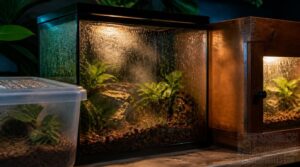
Your enclosure itself sets the humidity ceiling before you even add substrate. Glass terrariums hold moisture well but stay heavy. Plastic tubs trap humidity efficiently, lightweight and budget-friendly.
Vented lid designs balance airflow for smaller snakes, while sliding door access eases cleaning. Wooden enclosures need sealed joints, or moisture seeps in and warps the wood over time.
Adjusting Vent Size Correctly

Think of vent size like a stove dial for humidity. Bigger holes speed up airflow control, cooling things but drying the air fast; smaller ones slow exchange, trapping moisture during dry spells.
Start with a few 1-inch ventilation holes, then adjust. Cover part of a mesh screen with tape if humidity drops too quickly, this simple vent size adjustment stabilizes swings without guesswork.
Sealing Gaps Without Overheating
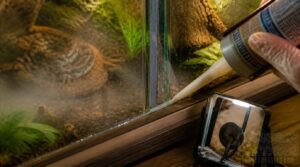
Got the vent size dialed in? Good, but gaps around doors and cable pass-throughs still leak air. Use heat-safe caulking (silicone, pencil-width gaps only) and foam backer rods for bigger ones.
Weather stripping and brush gaskets handle cable holes without blocking airflow. Check seams monthly with a lighted mirror, small leaks undo your ventilation balance fast.
Humid Hide Placement Tips
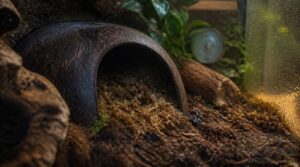
Sealed the gaps? Now check the humid hide itself. Place it on the cool side, against the substrate, with an entry hole about 1.5 times your snake’s width.
Layer damp sphagnum moss for moisture retention, verify hide stability, and keep airflow nearby balanced so humidity stays 70-90% without stagnation.
Using Water and Misting Systems
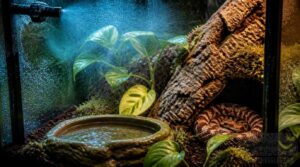
Water is the engine behind your tank’s humidity, but where it sits and how it’s delivered matters just as much as how much you add. Get the bowl placement or misting routine wrong, and you’re either fighting a swamp or chasing a desert. Here’s how to dial in your water sources so humidity stays steady instead of swinging.
Water Bowl Size and Placement
Bowl size and placement drive humidity more than most keepers realize. Surface area matters more than volume: shallow, wide bowls boost evaporation faster than deep ones. Match diameter to snake size, 6-8cm small, 10-15cm large. Position on the cool side, off-center, away from heat. Keep 10cm clearance so movement stays easy.
Manual Vs Automated Misting
Once your bowl placement’s dialed in, the next question is how you’re adding moisture day to day.
Manual spraying gives you immediate control but relies on memory and timing. Automated misting costs more upfront yet delivers consistent coverage with less daily effort. Weigh setup complexity against maintenance effort, and don’t skip hygiene, clean lines and filtered water prevent mold either way.
Fogger Positioning for Even Coverage
Ever notice one corner of the tank staying bone dry while another turns swampy? That’s shadowing.
Fix it with a vertical spray gradient, high and low nozzles angled 30-45 degrees, plus multiple fogger heads instead of one blaster.
Keep foggers clear of the water bowl to avoid stagnant pooling, then confirm results through hygrometer zone testing within a 10% variance.
Preventing Mold and Bacteria Buildup
Because misting adds moisture faster than airflow removes it, damp corners invite mold growth fast. Wipe walls weekly, watch for condensation, and keep a substrate drying schedule going.
Sanitize the water bowl every 2-3 days; check hide disinfection routines too. Balance ventilation airflow so humidity monitoring stays steady, not swampy.
Monitoring Humidity for Long-Term Stability

Fixing the setup only gets you so far if you’re not tracking what’s actually happening inside the tank. Guesswork leads right back to the same swings you just solved. Here’s what it takes to actually know your humidity, day in and day out.
Choosing an Accurate Hygrometer
A cheap hygrometer lies to you, and your snake pays for it. Look for ±3% RH accuracy, calibrated near 75% using a salt test.
Digital hygrometers with capacitive sensors respond fastest, ideal for a fluctuating microclimate. Skip analog dials measuring only ambient room humidity, they’re notoriously unreliable for enclosure-specific monitoring where precision actually matters.
Correct Hygrometer Placement
An accurate hygrometer placed wrong still lies to you. Mount it at substrate level, away from vents, water dishes, and damp hides. Keep steady airflow around the sensor, not stagnant corners or heat sources. Skip angled mounts; level orientation keeps readings honest.
Good ventilation and substrate choice mean nothing if your enclosure setup hides the truth.
Daily and Weekly Check Routines
A single good reading means nothing without routine. Check your hygrometer twice daily, morning and night, logging results for a real Humidity Log Review.
- Sensor Accuracy Check: compare two hygrometers weekly
- Water Bowl Care: clean daily, refill often
- Substrate Moisture Test: touch-test, adjust misting
Verify your misting system’s timer and coverage weekly. Small habits catch big swings before they hurt your snake.
Species-Specific Humidity Targets
A ball python isn’t a corn snake, so why treat them the same? Species-specific humidity targets matter for shedding and health.
| Species Type | Ideal Humidity |
|---|---|
| Tropical (ball pythons) | 50-70% |
| Arid (corn snakes) | 40-50% |
| Desert (rosy boas) | 20-40% |
Juveniles often need higher moisture, while diel cycles mimic natural dryness at night. Match habitat simulation to species reality.
Frequently Asked Questions (FAQs)
How do I keep the humidity up in my snake tank?
Layer moisture-retaining substrate, mist twice daily, and balance ventilation airflow so air exchanges gently instead of venting fast.
If your snake’s eyes turn cloudy despite good humidity, check this guide on why a snake won’t shed its eyes properly before assuming something’s wrong.
Add a humidity gradient with a humid hide, position water dishes for better surface evaporation, and verify readings using a calibrated hygrometer.
Is 90 too hot for a corn snake?
Ninety’s a hot topic, literally. Yes, it’s too warm: basking zone safety calls for 85°F (28-30°C) via thermostat calibration. Hitting 90°F risks burns and shrinks your thermal gradient, so regulate with heat lamp caution.
Is 80% humidity too high for ball pythons?
Not during shedding, but sustained daily readings that high risk mold growth and respiratory issues, especially with poor ventilation. Keep 80% brief and localized (humid hide), then ease back toward 55-70% baseline once your hygrometer shows the shed’s done.
How to get humidity up in a snake tank?
Move the water bowl onto the warm side to boost evaporation, add a moss-filled humid hide, mist twice daily, and use hygroscopic substrate like coconut fiber. Seal small enclosure gaps to trap moisture before it escapes.
How fast should snake tank humidity change daily?
Slow and steady wins the race: keep daily humidity fluctuations within 5 to 10 percent RH. Bigger jumps stress snakes, so adjust ventilation or evaporation gradually over several hours toward your species’ stable humidity targets.
Can high humidity cause scale rot in snakes?
Yes. High humidity paired with damp substrate or hides keeps scales wet too long, letting bacteria and fungi trigger scale rot. Fix it with better ventilation, proper substrate moisture balance, and accurate hygrometer readings at substrate level, not guesswork.
Does shedding season change ideal humidity needs?
Picture that milky-eyed, sluggish look right before a shed: your snake’s shedding humidity baseline should climb 5-15 points above normal. Track it with a hygrometer, adjust ventilation gradually, and match targets to your species’ natural shedding cycle.
Why does humidity drop suddenly during winter months?
Cold outdoor air holds less moisture, so heater impact on RH turns brutal once furnaces kick on. Warm air craves water vapor, pulling it from substrate and water bowls. Poor insulation and drafts worsen cold air moisture loss.
How do multiple snakes affect shared room humidity?
Like a room full of humidifiers running on VHS-era timers, multiple snakes raise ambient room humidity through group respiration, water bowl clustering, and heat source overlap.
Fix it with ventilation improvement, staggered misting schedules, or a room dehumidifier for real air circulation.
Conclusion
Somewhere, a snake is judging your hygrometer more than you judge its shed skin. Funny, but true: asking "why does my snake tank humidity fluctuate" usually traces back to one loose vent or a misplaced water bowl, not some reptile conspiracy.
Fix the airflow, stabilize your substrate, and place your hide correctly, and swings shrink fast. Humidity control isn’t glamorous work. It’s steady, boring maintenance. But that boring routine is exactly what keeps your snake healthy, calm, and shedding clean.