This site is supported by our readers. We may earn a commission, at no cost to you, if you purchase through links.

Your dial thermometer says 88°F. Your snake’s basking spot actually hits 104°F. That eight-dollar gauge isn’t measuring anything close to reality, it’s off by double digits, and your snake is quietly cooking.
This is why terrarium thermometer accuracy matters for snakes: enzymatic activity, immune defense, and digestion all run on tight thermal windows. A few degrees of drift doesn’t just skew a reading. It pushes a healthy animal toward impaction, burns, or suppressed immunity, often with zero visible warning until damage sets in.
Get the tool right, and the rest of husbandry follows.
Table Of Contents
Key Takeaways
- Cheap thermometers can be off by double digits, so your snake could be roasting or freezing while the dial looks perfectly normal.
- Since snakes can’t regulate their own body heat, an accurate temperature gradient directly controls their digestion, immune strength, and overall health.
- Digital thermistors and thermocouples beat analog dials and infrared readers for accuracy, but every sensor still needs correct placement and regular calibration to be trusted.
- Test your equipment with ice baths and boiling water, use at least two probes per enclosure, and replace thermometers every 12 to 24 months to catch drift before it hurts your snake.
How Snakes Depend on Terrarium Temperatures

Your snake can’t regulate its own body temperature. It relies entirely on the enclosure to do that job for it. Here’s what’s actually happening beneath the surface, and why every degree counts.
Getting the temperature gradient right starts with the setup itself, and this guide to designing a snake enclosure walks through exactly how to build one that works.
Behavioral Thermoregulation
Watch a snake long enough and you’ll see the pattern: bask, retreat, bask again. That’s behavioral thermoregulation in action. Your snake can’t generate its own heat, so it moves through the gradient, hunting warmth before digestion, ducking into cool hides to avoid overheating. Sudden ambient shifts trigger fast adjustments.
This conscious, goal-directed process is considered the first line of defense against thermal stress, often more effective than involuntary responses alone. A stable, accurate gradient isn’t optional. It’s the whole system your snake depends on.
Metabolism and Digestion
Digestion is temperature-dependent, full stop. Enzymatic activity peaks between 28-32°C, and outside that window, digestion slows or stalls.
Q10 effects roughly double metabolic rate per 10°C rise, meaning sloppy gradients mean sloppy digestion. Consider what’s at stake:
- Impacted meals rotting internally
- Wasted energy from failed Specific Active Action
- Malnutrition despite regular feeding
Sensor accuracy isn’t optional here. It’s the gatekeeper.
Immune Function Support
Metabolic math has consequences beyond the gut. Ectotherm physiology ties immunity to temperature too: antimicrobial peptide activity rises with warmth, and behavioral fever lets sick snakes self-treat by basking hotter.
But fluctuation stress hormones sabotage this. Corn snakes above 92°F lose immunocompetence; stable gradients near species immune temperature optima keep bacterial killing ability sharp. Sloppy sensors mean quietly suffering snakes.
Species-Specific Thermal Gradients
No universal gradient exists. Corn snake basking temps run 90–95°F, cool zones near 80°F. Leopard gecko gradients sit 88–92°F. Bearded dragon heat zones spike to 100–110°F. Desert species thermal range demands steep swings; tropical species narrow gradient stays tighter.
Match your basking zone target range and cool retreat zone target range to species, not guesswork. Run the probe placement checklist every time.
Nighttime Temperature Drops
Because clear skies and calm wind speed radiative heat loss, your terrarium needs an engineered nighttime temperature drop, not an accidental one. Dry air and rocky substrate accelerate cooling further.
- Desert species tolerate 15°F swings
- Tropical species need gradual drops
- Sensor accuracy catches dangerous overnight dips
Urban heat moderation won’t save an uncalibrated thermometer. Track thermal gradient stability nightly, not occasionally.
A dependable heat gradient keeps your snake’s immune defenses strong, which matters most when you’re working to prevent fungal infection in reptiles through consistent, informed care.
Accurate Thermometers Protect Snake Health
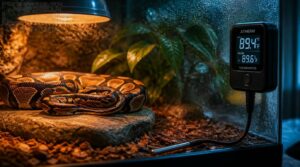
A cheap thermometer doesn’t just give bad numbers, it gives false confidence. Your snake can’t tell you it’s too hot or too cold, so the device on the wall is doing that job for you. Here’s exactly where accuracy makes or breaks your snake’s health.
A cheap thermometer doesn’t just give bad numbers, it gives false confidence your snake can’t afford
Preventing Dangerous Overheating
A stuck thermostat can cook a snake alive within hours. Your basking zone needs a thermostat safety cutoff, correct heat lamp placement, and daily temp logging.
| Risk | Prevention |
|---|---|
| Sensor drift | Weekly checks |
| No cutoff | Fail-safe switch |
| Poor probe placement | Direct contact |
| Unlogged spikes | Daily logging |
| Lamp too close | Proper clearance |
Skip these steps, and overheating risk climbs fast.
Avoiding Chronic Cold Stress
Cold stress is quieter than a burn, but just as damaging. Watch for lethargy, refusal to eat, and huddling in the warm hide.
Undersized thermal gradient depth and poor enclosure insulation let cool zones drift too low. Keep nighttime temperature drops within species tolerance, usually 4-8°F, using accurate probe placement in the cool hide to catch chronic thermal gradient collapse before it triggers illness.
Supporting Reliable Digestion
Digestion is temperature dependent, full stop. Enzymatic activity range sits within a narrow band; drop below it and meal processing speed stalls for days.
Post-feed temperature stability matters most. Fluctuations disrupt digestive enzyme stability, raising regurgitation risk. Accurate temperature measurement, not guesswork, confirms your snake actually reached digestion-supporting warmth. Log readings. Species tolerance to temperature swings varies, but none forgive a cold, silent gut.
Maintaining Healthy Immune Responses
A snake’s immune system runs on heat. Neutrophil motility jumps 60% between 35°C and 38°C, phagocytosis climbs from 45% to 78%, and complement activity nearly triples near 38°C.
Cytokine signaling (IL-6, TNF-alpha) depends on that same window. Miscalibrated sensors mask cold zones where antifungal defenses drop 25%, leaving snakes quietly vulnerable to ophidiomycosis and bacterial infection.
Validating Warm and Cool Zones
A gradient you haven’t checked is just a guess. Warm zone readings need to land within two degrees of your basking target; cool zone within one to two. Verify probe placement accuracy at three points minimum, don’t trust a single number. Dual probes should agree within 0.5 degrees. Recheck often. Drift happens quietly.
Which Terrarium Thermometer is Most Accurate?
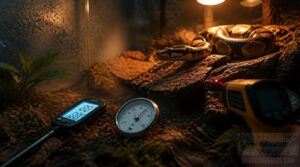
Not all thermometers are created equal, and the gap between them can mean the difference between a thriving snake and one quietly suffering. Some read fast and true, others lag or drift the moment you look away. Here’s how the main types stack up.
Digital Thermistor Accuracy
Regarding digital vs analog terrarium thermometer accuracy, thermistors win. Calibration stability hits ±0.1 to 0.5°C. Manufacturers use Steinhart Hart compensation for thermistor nonlinearity, plus three or five point interpolation. Watch excitation current effects and shielded cables, both curb self-heating and drift. Track sensor drift with min-max logs. Not rocket science, just precision that keeps your snake safe.
Analog Dial Limitations
Analog dials look reassuring, but that swinging needle hides real problems. Calibration drift creeps in as springs age and gears loosen, so backlash delays every reading. Vibration near the terrarium causes needle wobble, and painted scales fade until tick marks blur. Thermal inertia slows response to fast swings. Bottom line: charming, but not precise enough to trust.
Infrared Surface-Only Readings
Ditch the swinging needle, but don’t trust your eyes either. Infrared thermometers read surface temperature only, never internal body heat, and skip emissivity adjustment (0.95–0.98) and reflections throw readings off by 2–3°C. Spot size limits accuracy too, 1–2cm averages miss patterned scales.
Pair infrared with contact probes. Non-contact convenience isn’t the same as truth.
Thermocouple Speed and Precision
Contact isn’t the whole game, speed matters too. A 0.25mm thermocouple junction reacts in 0.1 to 0.3 seconds, catching sharp swings near basking zones instantly.
That speed needs backup: signal amplification and cold junction compensation convert microvolt output into readable numbers. Skip shielding, and heater interference skews everything.
Accuracy holds within ±1.0°C from 20-40°C, ideal for gradient mapping and probe placement across zones.
Waterproof Probes for Humidity
Humidity matters as much as heat, and a waterproof probe experiences both without frying itself. Sealed to IP67, these sensors survive misting and submersion cleaning. Sensor accuracy holds across 0-95% RH, with temperature compensation improving humidity-temperature correlation. Place probes mid-air column, never under nozzles. Wireless transmission benefits keep cables clear. Calibrate periodically against known references, not rocket science.
Where Should Terrarium Probes Go?
A great thermometer still lies to you if it’s sitting in the wrong spot. Placement isn’t a minor detail, it’s the difference between real data and false comfort. Here’s exactly where each probe needs to go.
Basking Surface Probe Contact
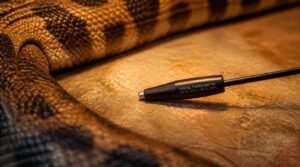
An air-suspended probe lies to you. Direct substrate contact is non-negotiable, tip flush against the slab, not floating above it.
- Center placement on the slab
- Smooth, debris-free contact surface
- Metal tip for fast heat transfer
- Shield from direct lamp beams
- Stable positioning, no drift
Sloppy contact means false-low readings. Your snake basks on a lie, and burn risk climbs.
Cool Hide Probe Positioning
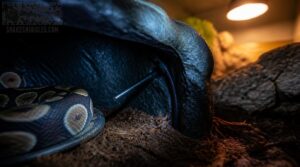
The cool side needs honest data too, not just the basking zone. Rest the probe tip against the cool hide’s interior surface, 1 to 2 inches above substrate, angled away from lamps. Route cable exit through the back panel, chew risk is real.
Check monthly, substrate shifts and decor changes cause drift, silently skewing your gradient.
Avoiding Lamp and Substrate Errors
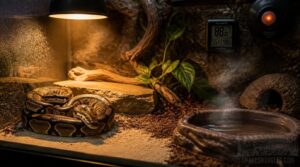
Line-of-sight to the lamp will cook your probe, not just the perch. Shield probes from direct beams, angle them toward decor instead.
White or sandy substrate reflects heat evenly; dark substrate breeds hot spots. Thick, damp substrate insulates and traps humidity, skewing readings and inviting mold.
Ceramic emitters help, steady heat, zero disruptive light.
Dual-Zone Gradient Monitoring
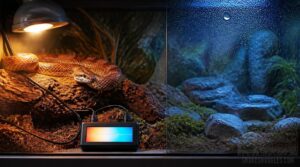
One probe tells you nothing. Two probes tell you everything.
Dual-zone gradient monitoring pairs a warm-side and cool-side probe, ±0.5°C calibrated, reporting to a shared display with 1-second refresh.
- Real-time gradient profile from both zones simultaneously
- Alarms fire past 2°F setpoint deviation
- Color heat maps flag drift instantly
- 24-hour logs catch slow calibration creep
Air temperature alone won’t cut it. Surface readings matter just as much.
Arboreal Multi-Level Readings

Height matters. Arboreal species live in three dimensions, so a single probe near the substrate misses the whole picture.
Vertical temperature mapping across five zones, basking to canopy, reveals swings of 2 to 6°C between levels. Space probes 15 to 25 cm apart for accurate level-specific heat zones, tracking both surface temperature and air temperature at each tier.
How to Verify Thermometer Accuracy
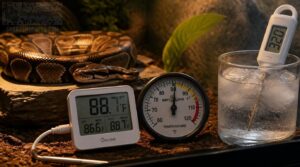
Placement means nothing if the thermometer itself is lying to you. Every sensor drifts eventually, some faster than others, and you won’t catch it by staring at the display. Here’s how to put your equipment to the test.
Ice Bath Calibration Checks
Trust your gut, then verify it. Ice bath testing catches sensor drift before it costs you a snake.
- Submerge probe center-mass for 30 seconds
- Wait 3 seconds for stabilization
- Compare against 32°F
- Retest a second spot
Use crushed ice, not cubes. Avoid container walls. Recheck after every sensor swap or relocation. Not rocket science, just discipline.
Boiling Water Verification
Ice water proved the low end. Now check the top: a rolling boil for one full minute confirms high-end accuracy.
Submerge center-mass, avoid touching walls, gloves on. Reading should hit 212°F (sea level; elevation shifts this). Log start/end times, device model, and result.
Cool before handling, burn risk is real.
Display Mode and Battery Checks
Boiling water confirms accuracy. Battery life confirms reliability.
Check the battery indicator weekly. Low voltage skews readings before you notice. Enable battery saver or power mode toggle to stretch runtime, and adjust display mode brightness so alerts stay visible without draining power. Historical battery alerts flag past drops, don’t ignore them, that’s your device warning you before it fails silently.
Min-Max Logs and Spot Checks
A single reading tells you nothing about the swings your snake actually lives through. Minmax temperature tracking exposes hidden spikes and drops between checks.
Pair logged min and max values with weekly spot checks for probe placement validation.
- A gecko slowly overheating while you sleep
- Cold stress going undetected for days
- Data loss erasing weeks of health signal detection
Frequently Asked Questions (FAQs)
How often should terrarium thermometers be replaced entirely?
Plan on 12 to 24 months for most setups. Digital probes hold up longer; analog dials drift sooner. High humidity, UV exposure, or drift beyond 1°C signals earlier replacement, don’t wait for failure.
How many thermometers should one terrarium actually have?
One thermometer tells you nothing, it’s a guess dressed up as data. Two is the minimum effective sensor count: warm and cool zones, dual sensor gradient mapping for redundancy and fault detection, catching drift before your snake pays the price.
What causes sudden or unexplained thermometer reading fluctuations?
Five culprits cause erratic readings: heat source proximity, substrate moisture shifts, battery voltage drops, sensor aging with calibration drift, and rapid ambient changes from doors or fans creating transient spikes.
Conclusion
Funny thing: the cheapest gadget in your setup controls the most expensive outcome, your snake’s life. That’s the irony of husbandry.
This is why terrarium thermometer accuracy matters for snakes: a $10 probe guards against burns, impaction, and vet bills stretching into the hundreds. Calibrate every sensor. Verify every zone. Trust the animal’s biology, not the dial’s optimism.
Nail this one detail, and you’ve solved most of thermal husbandry. Not rocket science, just diligence.