This site is supported by our readers. We may earn a commission, at no cost to you, if you purchase through links.

Your snake isn’t being dramatic when it shoves its face into the substrate and vanishes. It’s building a tunnel, and if the dirt collapses, you’ve got a very confused reptile and a very messy tank.
Burrowers need dirt that holds a shape, drains well and stays safe to nose around in. Bark chips and bagged "reptile bedding" often fail that test (tonnes of them crumble on day two). The right terrarium substrate mixes for burrowing species match your animal’s climate, from damp, springy humid blends to dry surfaces over moist depths.
Here’s how to pick ingredients, mix ratios and layer them so your snake’s tunnels actually stay put.
Table Of Contents
- Key Takeaways
- Choose Substrate Ingredients for Your Burrowing Snake
- Blend Terrarium Substrate Mixes by Climate
- 3 Terrarium Substrates for Burrowing Species
- Set Substrate Depth, Drainage, and Moisture Gradients
- Maintain Burrowing Substrates and Bioactive Cleanup Crews
- Frequently Asked Questions (FAQs)
- Conclusion
Key Takeaways
- Match your substrate mix to your snake’s climate: humid burrowers do well with topsoil, coir, orchid bark, and charcoal, while arid species need topsoil, washed play sand, and about 20% clay so tunnels hold their shape.
- Choose ingredients free of fertilizers, pesticides, and weed inhibitors, and use low-dust mixes, since chemicals and fine particles are especially hard on burrowing snakes.
- Depth and moisture gradients decide whether tunnels survive, so aim for 15 to 20 cm for arid setups, 10 to 15 cm for tropical ones, and 30 to 45 cm for true diggers, with a damp zone at one end and dry substrate elsewhere.
- Keep the substrate working by topping up leaf litter weekly, letting the top layer dry while the depths stay damp, feeding your cleanup crew, and housing each burrowing species in its own enclosure.
Choose Substrate Ingredients for Your Burrowing Snake
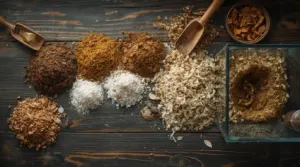
I always tell keepers to start with the ingredients, not the recipe. Your burrowing snake will tunnel through whatever you give it, so purity comes first. Choose organic topsoil and play sand free of fertilizers, pesticides, and weed inhibitors, because those chemicals hit burrowing species hard.
Since wild burrowers pick loose sand, soft topsoil, and damp leaf litter for good reasons, it helps to see what snakes naturally burrow in before you mix your own substrate.
Next, think texture. Sifted topsoil gives a consistent crumb, while uniform play sand keeps drainage brisk. Coconut fiber resists compaction and holds moisture well, and peat moss adds even more (but it lowers pH, so watch it).
Want tunnels that don’t collapse? Add 10 to 25% clay for stickiness. Keepers of desert burrowers also note that calcium bentonite clay works well at low ratios because, unlike sodium bentonite, it doesn’t expand when wet. A 70:30 topsoil and sand mix is a cracking starting point. Source leaf litter and sphagnum moss carefully, since foraged material can easily carry sprays.
Blend Terrarium Substrate Mixes by Climate
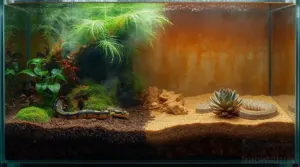
Your snake doesn’t care about fancy labels, it cares about the climate you recreate. A rainforest burrower and a desert dweller need completely different recipes, so let’s match your mix to your animal’s home turf. Below, you’ll find the humid blends first, then the arid ones (no sandcastles required).
Humid Mixes and Sustainable ABG Alternatives
Most burrowers in humid setups want moisture without sogginess. Swap peat for coir and you’re sorted, and the bogs thank you. Here’s a solid soil mix:
- 40% organic topsoil
- 30% coconut coir
- 20% orchid bark for drainage
- 10% charcoal
- Leaf litter on top for springtails
Charcoal and bark keep aeration high. Without tree fern fiber, refresh it every 6-12 months.
Arid and Semiarid Burrowing Substrate Mixes
Arid setups flip the script: dry surface, damp depths. Mix topsoil with washed play sand, then add excavator clay so tunnels don’t collapse. Squeeze a handful. It should pack without weeping water.
Once the base is mixed, a guide to substrate and bedding for desert species can help you adjust the sand-to-soil ratio for your particular animals.
| Topsoil | Sand | Clay |
|---|---|---|
| 60% | 40% | 0% |
| 40% | 40% | 20% |
| 50% | 30% | 20% |
Excavator clay at 20% builds sturdy burrows, and a misted thin layer forms a natural crust.
3 Terrarium Substrates for Burrowing Species
Ready to stop guessing and start digging? Below are three proven substrate picks I’d happily line up for a burrower, each suited to a different setup (humid or bone-dry). Find the one that matches your animal’s climate, and you’re halfway to a tunnel system they’ll actually use.
1. Zoo Med Reptisoil 10 Qt Substrate
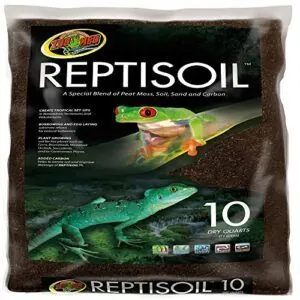
Picture a forest floor in a bag: dark, crumbly, smelling faintly of damp earth. That’s Reptisoil, a mix of peat moss, soil, sand and coconut carbon. The carbon gives bacteria a porous home and keeps things aerated, so moisture lingers without turning soggy.
If you’re building a bioactive enclosure, this guide to reptile substrates for bioactive setups shows how Reptisoil compares with other layered options.
Pile it 2 to 4 inches deep and your burrower can tunnel happily. Thicker is better.
Two caveats? It can get dusty when you pour it, and some keepers notice a mildewy whiff after a few days.
| Best For | Keepers of tropical reptiles, amphibians, box turtles, hermit crabs, or invertebrates who want a naturalistic, bioactive terrarium substrate that holds moisture and lets their animals burrow and lay eggs. |
|---|---|
| Weight | 30 grams |
| Volume | 10 quarts |
| Burrowing Support | Suitable for burrowing |
| Egg-Laying Support | Enables egg-laying |
| Substrate Type | Peat, soil, sand, carbon blend |
| Target Species | Tropical reptiles, amphibians, invertebrates |
| Additional Features |
|
- Coconut carbon supports beneficial bacteria and helps reduce odors.
- A blend of peat moss, soil, sand, and coconut carbon gives a naturalistic look and holds moisture well for tropical setups.
- Works for burrowing, egg-laying, and plant growth, and suits a wide range of animals.
- Can produce dust when you handle or pour it.
- Some users notice a mildew-like smell after several days of use.
- Customer feedback on odor and dustiness is mixed, so your results may vary.
2. Joshs Frogs BioBedding Tropical Substrate
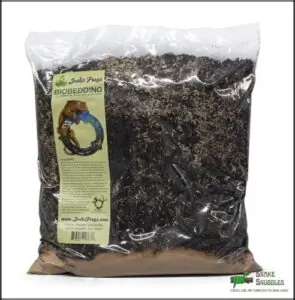
Coconut fiber, orchid bark and milled sphagnum moss make up the base here, with charcoal, trace elements and beneficial fungi stirred through. It holds humidity yet still lets your snake dig and lay eggs (no soggy tunnels).
Mix it with dechlorinated or R/O water until it clumps when squeezed. Springtails and isopods will happily chew through waste, and live plants root straight in.
The catch? Value for money divides opinion. Expect to replace it once it breaks down, usually after several years.
| Best For | Reptile and amphibian keepers who want a bioactive terrarium with live plants, springtails, and isopods, and who need a substrate that holds humidity while still letting pets dig and lay eggs. |
|---|---|
| Weight | 2.61 kg |
| Volume | 10 quarts (320 ounces) |
| Burrowing Support | Allows pets to dig |
| Egg-Laying Support | Allows egg laying |
| Substrate Type | Organic and inorganic mix |
| Target Species | Terrarium pets with microfauna |
| Additional Features |
|
- Holds humidity while still allowing pets to dig and lay eggs
- Supports live plant growth and works well with springtails and isopods for bioactive waste processing
- Blends organic and inorganic ingredients with trace elements and beneficial fungi
- Needs to be mixed with dechlorinated or R/O water to the right consistency before use
- Customers have mixed opinions on its value for money
- Must be replaced once it breaks down, typically after several years
3. Zoo Med ReptiSand Desert White 10 lb
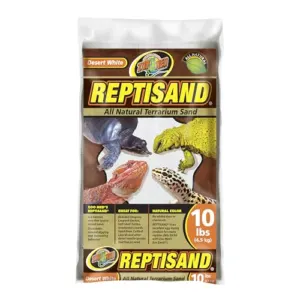
Sand like this is a dream for desert dwellers. It’s all natural, with no dyes or chemicals, and it conducts heat brilliantly, so your bearded dragon or leopard gecko can thermoregulate properly. Sand boas will happily dig tunnels in it, and it’s lovely for egg laying too.
Now, the caveats. It’s loose, so expect frequent spot cleaning. Skip it for humid or tropical species, and think twice with juveniles, who might gulp down a mouthful. Ten pounds goes a long way, though.
| Best For | Owners of desert reptiles like bearded dragons, leopard geckos, and sand boas who want a natural, diggable substrate that holds heat well. |
|---|---|
| Weight | 10 pounds |
| Volume | N/A |
| Burrowing Support | Stimulates digging and burrowing |
| Egg-Laying Support | Supports egg laying |
| Substrate Type | All natural sand |
| Target Species | Desert reptiles |
| Additional Features |
|
- All natural sand with no dyes or chemicals added
- Excellent heat conductor, helping reptiles regulate their body temperature
- Encourages natural digging, burrowing, and egg laying
- Not recommended for humid or tropical reptile species
- Loose substrate may need frequent spot cleaning
- Ingestion risk for juvenile or small reptiles that may swallow sand
Set Substrate Depth, Drainage, and Moisture Gradients
Picture a rosy boa in a 4-foot tank with just 5 cm of sand. Within a week, every tunnel she digs collapses. Sound familiar?
Aim for 15 to 20 cm of substrate depth for arid species, 10 to 15 cm for tropical ones. True diggers want 30 to 45 cm.
Tropical tanks need a 5 to 10 cm drainage layer of LECA under a mesh barrier. Arid tanks usually skip it.
Then make a 70/30 split: wrung-out sphagnum, 3 to 5 cm deep, at one end, dry everywhere else. Keep a 10 to 15 cm buffer zone between them. A burrowing substrate mix helps moisture retention, since deeper layers dry slowly. Finish with 2 to 3 cm of leaf litter.
Maintain Burrowing Substrates and Bioactive Cleanup Crews
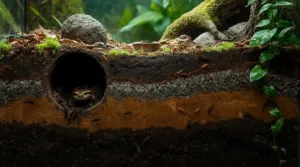
Say your corn snake’s favourite tunnel collapses and white fuzz appears behind it. Classic. The cause is usually soggy lower layers and a cleanup crew with nothing to eat.
Good substrate layering helps, but upkeep keeps it working. Give the crew time, too. A bioactive terrarium setup needs months to mature, so be patient.
- Top up leaf litter weekly, adding handfuls when it looks thin.
- Offer a pinch of fish food in a shallow dish if the enclosure’s spotless.
- Let the top layer dry occasionally while the lower layers stay damp.
- Watch for isopods in the litter and springtails on decaying matter.
- Review your substrate replacement frequency monthly, noting tunnel stability and whether the crew needs a fresh microfauna introduction.
Frequently Asked Questions (FAQs)
Is substrate dust harmful to burrowing animals lungs?
Yes, substrate dust can hurt. Snakes have one working lung and can’t cough, so fine particles linger, inflame airways and invite respiratory issues. Choose low-dust mixes, keep them damp, and respect your terrarium ventilation needs.
What temperature should the substrate stay at?
Aim for a gradient, not one number. Keep the cool side around 75-80°F, the warm side near 86-90°F, and let the substrate run a few degrees warmer below the surface. Check with a digital probe.
How do I stop substrate from sticking to feeders?
Feed on a clean deli lid or a flat tile, not bare substrate. Pat feeders dry first, too. Wet prey is basically a lint roller. Clear the drop zone and keep burrowing substrates slightly drier.
Can burrowing species be housed together safely?
Tempted to stack two burrowing species in one tank? Don’t. Their humidity, substrate depth and clean-up crew needs clash, and stress or shared parasites follow.
Give each one its own enclosure and substrate mixing ratios.
Conclusion
Picture a corn snake that spends a week carving a tidy tunnel, then curls up inside like it’s paying rent. That’s what the right terrarium substrate mixes for burrowing species buy you.
Match the mix to your snake’s climate, pack it deep enough to hold a shape, and keep a moisture gradient running through it.
Top up what the tunnels displace every single week. Your job is the foundation. The architecture belongs to your snake.