This site is supported by our readers. We may earn a commission, at no cost to you, if you purchase through links.

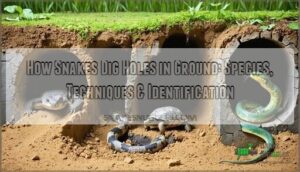
Most people picture snakes gliding across open ground, but a surprising number of species spend the majority of their lives underground—hidden in burrows they either dug themselves or quietly claimed from another animal.
A sand boa can submerge into loose desert substrate in seconds, leaving no trace above the surface.
That kind of behavior isn’t opportunistic; it’s deeply wired into how snakes regulate temperature, avoid predators, and hunt.
Understanding what snakes burrow in naturally reveals a precise set of preferences—specific soil types, moisture levels, and structural conditions that determine where a snake settles and survives.
Table Of Contents
- Key Takeaways
- What Snakes Burrow Into Naturally
- Abandoned Burrows Snakes Reuse
- Natural Places Snakes Dig Their Own
- Underground Cover Snakes Hide In
- Why Snakes Choose Certain Substrates
- Frequently Asked Questions (FAQs)
- What are burrowing snakes?
- Do snakes burrow underground?
- Why do snakes burrow?
- Can snakes live underground?
- Which snake species burrow most aggressively in the wild?
- How deep do burrowing snakes typically tunnel underground?
- Do snakes share burrows with other animal species?
- How does soil compaction affect a snakes ability to burrow?
- Can burrowing snakes survive in urban or suburban environments?
- Conclusion
Key Takeaways
- Burrowing snakes aren’t random about where they dig — they pick substrates like loose sand, soft topsoil, and damp leaf litter based on precise needs: temperature stability, moisture, and how easily they can move through it.
- Many snakes skip the hard work entirely and move into tunnels already built by rodents, gophers, or badgers, treating abandoned burrows as ready-made shelter with built-in thermal and humidity benefits.
- Going underground solves three survival problems at once — hides snakes from predators, puts them right where prey lives (ant colonies, beetle larvae, earthworms), and keeps their skin from drying out.
- A snake’s substrate choice is essentially a calculated biological decision, where soil compaction, moisture gradient, and depth all determine whether that spot becomes a long-term home or a dead end.
What Snakes Burrow Into Naturally
Snakes don’t just burrow anywhere — they’re selective about the substrates they choose, and for good reason. The right ground offers the right combination of resistance, moisture, and temperature.
Sandy loam, coconut fiber, and similar loose mixes give snakes exactly what they need, as covered in this guide to essential snake habitat requirements.
Here’s what they naturally dig into.
Loose Sand and Sandy Dunes
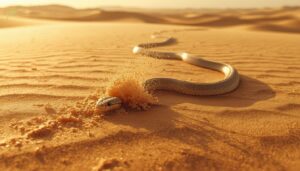
Loose sand is prime real estate for certain snakes. Sand boas, for example, use sand swimming locomotion — a fluid, wave-like motion that exploits sand grain distribution to slip beneath the surface with minimal effort.
This sand submersion gives them access to a stable dune microclimate, where substrate compaction stays low and burrow ventilation happens naturally. Their substrate preferences for sand aren’t accidental — it’s precision engineering.
The dunes’ sand dune formation process continuously replenishes loose sand, providing ideal burrowing conditions for these reptiles.
Soft Soil and рыхлый Topsoil
Sand gives way easily, but soft topsoil offers something richer.
With high porosity reaching up to 60 percent and strong moisture retention, loose topsoil suits burrowing snakes that rely on stable soil moisture and consistent soil structure.
Its natural nutrient cycling and organic amendments create aerated, workable ground.
That combination facilitates efficient soil digging mechanics, letting species like hognose snakes penetrate shallow layers with minimal resistance.
Leaf Litter Over Damp Ground
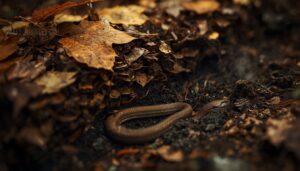
Beyond soft topsoil, leaf litter over damp ground offers a surprisingly effective microhabitat for burrowing snakes. This layered mat excels at soil moisture retention and thermal buffering, keeping temperatures stable beneath the surface.
Leaf litter concealment also facilitates habitat specialization through:
- Prey microfauna like beetles and worms are concentrated underneath
- Camouflage concealment that breaks a snake’s visual outline
- Scent masking that reduces detection by predators
- Moisture retention that sustains humid conditions for days after rain
Soil Gaps Around Roots and Rocks
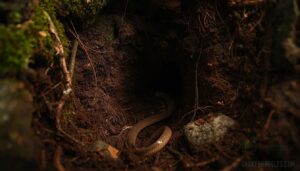
Roots and rocks quietly reshape soil in ways that suit burrowing snakes perfectly. As roots shrink and decay, they leave behind biopores — hollow channels that persist long after the plant tissue is gone. This Biopore Persistence creates low‑resistance pathways that snakes navigate with minimal effort. Rock‑Root Interaction further loosens surrounding substrate, improving soil aeration and microhabitat moisture retention.
| Feature | Benefit to Snake | Example Species |
|---|---|---|
| Root-Induced Porosity | Easy tunnel entry | Blind snakes (Typhlopidae) |
| Rock crevices | Stable refuge zones | Stiletto snakes (Atractaspis) |
| Decayed root systems | Nutrient Diffusion pathways | Sand boas (Eryx) |
These microhabitat characteristics of snake burrows directly support thermoregulation, prey access, and soil composition stability.
These conditions also reflect broader unusual snake behavior patterns underground that reveal just how actively snakes engineer their own microenvironments.
Abandoned Burrows Snakes Reuse
Snakes are opportunists — if something dug the tunnel already, why bother starting from scratch? Abandoned burrows offer ready-made shelter with very little effort, which makes them a natural first choice.
Here are the main types snakes that tend to move into.
Rodent Holes
Rodent holes are some of the most reliable ready-made shelters a snake can find. Look for the telltale signs: 2–4‑inch openings with fan-shaped mounds of freshly turned soil nearby, plus a distinct grease odor indicating regular mammal traffic.
These burrows stay structurally sound partly because fine particles pack between coarser soil grains, and you can see how snakes interact with such tunnels in this guide to how snakes dig and use holes.
Snakes recognize these cues too. Seasonal entrance peaks after rainfall signal prime real estate.
Compact soil around old burrows, however, often discourages use.
Gopher Tunnels
Gopher tunnels offer snakes something rodent holes often can’t — serious depth. Primary runways sit 4 to 12 inches down, while food storage chambers drop 3 to 6 feet, creating ideal thermal refuges year‑round. Watch for volcano-shaped mounds with soil plugs; those mound indicators confirm active networks worth investigating.
- Tunnel depth variation facilitates both shelter and hunting
- Soil aeration benefits improve movement through loosened substrate
- Seasonal network changes shift access points across your yard
- Snakes enter near mound clusters, not random surface openings
Mammal-made Underground Chambers
What makes mammal-made underground chambers so attractive to snakes is their ready-made complexity. Burrow architecture built by badgers, moles, and prairie dogs includes multi-level nesting zones, food storage chambers, and ventilation shafts — all without the snake lifting a scale. Soil compaction benefits keep walls stable, reducing collapse risk.
| Chamber Feature | Snake Benefit |
|---|---|
| Multi-level nesting zones | Thermal refuges at different depths |
| Ventilation shafts | Consistent airflow and humidity |
| Food storage chambers | Direct proximity to cached prey |
Opportunistic use of existing burrows means snakes conserve energy while gaining immediate shelter.
Pre-existing Tunnel Networks
Pre-existing tunnel networks function like ready-built highways underground. Snakes navigate these corridors using scent cue mapping, following chemical traces left by rodents and other inhabitants. Tunnel network architecture — featuring horizontal runs, vertical shafts, and branching junctions — gives snakes access to stable microclimates and ambush spots.
- Inter-species tunnel sharing reduces energy costs substantially
- Seasonal tunnel use shifts with temperature gradients at depth
- Underground acoustic signals help snakes detect prey movement
- Opportunistic use of existing burrows means immediate, low-effort shelter
Natural Places Snakes Dig Their Own
Not every snake waits around for another animal to do the digging. Some species are built to break ground themselves, moving through substrates that most reptiles would never attempt.
Here’s where they actually do it.
Loose Sand Deposits
Loose sand is where species like sand boas truly thrive. These snakes use sand-swimming locomotion — a fluid, wave-like body motion that fluidizes surrounding grains — for rapid sand submersion without full excavation.
Grain sorting variability, where particle sizes range from fine to coarse, creates natural voids that aid entry. Moisture cohesion effects and temperature gradient stiffness further shape which loose soil layers snakes actually prefer.
Soft Earth in Open Ground
Open ground with soft, organically enriched soil is prime territory for fossorial snakes. Organic Matter Softening breaks down compacted layers, making initial entry almost easy.
Granular Soil Dynamics shift with Moisture Compaction, stabilizing tunnel walls just enough for safe passage.
The Subsurface Thermal Buffer keeps temperatures 8–12°C cooler than the surface, while a Microhabitat Moisture Gradient along loose soil and leaf litter draws prey — and snakes — right in.
Shallow Nesting Sites
Shallow nests don’t need to go deep to do their job well. Sand boas and similar species favor loose sand and leaf litter, where Nest Depth Variation — usually 1 to 8 centimeters — balances Thermal Insulation with Ventilation Mechanics.
Here’s what makes these sites work:
- Substrate Moisture Levels stay regulated without waterlogging
- Camouflage Strategies blend naturally with surrounding soil composition
- Leaf litter buffers temperature swings
- Sandy substrate preferences of sand boas allow quick entry and exit
- Reproductive nesting sites stay concealed near roots or rocks
Species That Excavate Deeper Shafts
Not every snake stops at few centimeters. The woma python (Aspidites ramsayi), a true fossorial species built for Deep Soil Penetration, excavates vertical shafts reaching up to five feet.
These structures reflect clear Vertical Shaft Morphology — narrow at the entrance, widening below.
Extended Burrow Networks like these rely on Energetic Digging Strategies and Substrate Moisture Preference to stay structurally stable underground.
Underground Cover Snakes Hide In
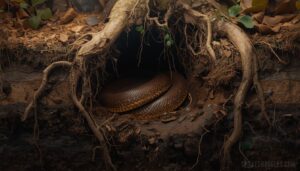
Not every snake needs to dig its own tunnel to stay hidden underground. Many species are perfectly content using whatever natural cover already exists beneath the surface.
Here are the main types of underground shelter snakes rely on.
Rock Crevices and Fissures
Rock crevices and fissures, formed along natural joints where tectonic stress has already weakened the stone, offer snakes something surprisingly reliable: stability. Granite holds cool longer than basalt, and north-south oriented cracks retain moisture better — both examples of fissure orientation effects and rock type influence shaping which species settle where.
- Granite crevices stay cooler past sundown, attracting heat-sensitive species
- Mineral nutrient access draws invertebrates into crevice walls, giving snakes a built-in pantry
- Structural stability limits matter — freeze-thaw weathering widens cracks over decades, but earthquakes can seal them overnight
- Crevice acoustic signals, subtle vibrations traveling through rock, help snakes detect approaching prey or threats
Snakes also exploit stone walls, building foundations, and other human-made structures as readily as natural fissures — tight, compact holes in foundations mimic abandoned burrows almost perfectly.
Spaces Under Logs
Unlike rigid stone, spaces under logs shift with the seasons. Decaying wood creates a moisture reservoir, holding 70–90% relative humidity long after the soil dries out.
Fungal symbiosis breaks down the timber interior, opening hidden prey reservoirs of isopods, beetle larvae, and earthworms.
That steady cool dampness — often 5–10°C below surface temperatures — acts as a seasonal temperature buffer, snakes genuinely depend on.
Thick Leaf Litter Layers
Dense leaf litter works like a layered hotel — each stratum offers snakes something different. Moisture retention capacity stays remarkably high in the undecomposed upper sublayer, keeping humidity stable long after rainfall ends.
Below that, fungal decomposer networks break down plant material, fueling an invertebrate community of mites, springtails, and beetle larvae.
That nutrient release dynamics process, combined with a reliable thermal insulation effect, makes leaf litter a prime microhabitat for burrowing snakes.
Moist Root Systems
Root zones quietly do a lot of heavy lifting underground. Moist root systems trap moisture through Soil Water Retention while supporting Root-Associated Microbes that drive Nutrient Cycling Boost and Root Hair Development — making these spaces rich, stable refuges.
- Soil Temperature Buffer keeps conditions consistent year-round
- soil aeration and soil structure create navigable gaps, snakes slide through
- Leaf litter above locks in soil moisture below
Snakes don’t miss that.
Why Snakes Choose Certain Substrates
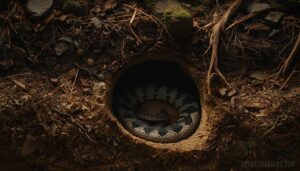
Snakes don’t pick a substrate randomly — there’s always a reason behind where they settle. The right ground offers more than just a place to hide; it shapes how well they survive day-to-day.
Here’s what drives those choices.
Temperature Stability Underground
Soil works like a natural thermostat. Within the first one to two meters, thermal inertia — the soil’s resistance to temperature change — smooths out surface swings, giving snakes a predictable microclimate year-round.
Geologic layer effects deepen that stability, while groundwater buffers nearby soils near 8–12°C in temperate zones.
Cavity ventilation stays minimal underground, and depth temperature gradients flatten almost entirely beyond three meters, making subterranean temperature regulation remarkably reliable.
Protection From Predators
Going underground isn’t just about comfort — it’s a survival strategy.
Rodent holes, measuring 2 to 4 inches wide and up to 24 inches deep, give snakes vertical escape shafts that confuse pursuing predators.
Camouflaged burrow entrances blend into surrounding substrate, while scent-masking soil disrupts predator tracking.
Sand boas exploit thermal concealment zones where temperature stability also reduces scent diffusion, making predator avoidance remarkably effective through burrowing behavior and habitat use.
Sand boas use thermal concealment to simultaneously hide from predators and mask their scent underground
Easier Access to Prey
Burrowing puts snakes right where the food is. Subterranean foraging gives species like blind snakes direct access to ant colonies and termite mounds, their primary invertebrate prey underground.
Scent funnel channels concentrate odor cues in enclosed tunnels, while moisture-driven ambush places snakes along prey path alignment routes.
Thermal cue exploitation and prey trail detection help snakes time strikes with precision.
Better Moisture and Shelter Conditions
Moisture isn’t a luxury for snakes — it’s survival. Underground, substrate moisture retention keeps skin hydrated and prevents dangerous desiccation.
Leaf litter traps humidity at tunnel entrances, while gaps near root systems create microclimate humidity that stays stable through dry spells.
Snakes exploit moisture gradient exploitation and seasonal moisture timing to select burrows with steady burrow airflow regulation, making microhabitat selection as precise as any survival instinct.
Frequently Asked Questions (FAQs)
What are burrowing snakes?
Fossorial snakes — species adapted to life underground — show impressive phylogenetic diversity, from blind snakes to sand boas, with morphological adaptations like reinforced skulls and sensory modifications that make subterranean survival possible.
Do snakes burrow underground?
Yes, many snakes burrow underground. They use morphological digging adaptations — like reinforced snouts and compact bodies — to move through soil, sand, and leaf litter for shelter, thermoregulation, and prey access.
Why do snakes burrow?
Snakes burrow for four core reasons: temperature regulation, predator avoidance, food access, and reproductive nesting sites.
Underground microhabitat selection also facilitates seasonal brumation, physiological stress relief, energy efficient locomotion, and long-term soil aeration impact.
Can snakes live underground?
Absolutely — many species, known as fossorial snakes, spend nearly their entire lives underground.
Seasonal brumation, thermal regulation, predator avoidance through burrowing, and lowered metabolic rate all make underground habitats a surprisingly complete living environment.
Which snake species burrow most aggressively in the wild?
Some species treat the ground like a tool. Sand boas, blind snakes, stiletto snakes, shieldtails, and hognose snakes rank among the most committed fossorial diggers in the wild.
How deep do burrowing snakes typically tunnel underground?
Most burrowing snakes tunnel just 2 to 12 inches deep. Depth depends on soil resistance limits, moisture depth influence, and seasonal depth shifts tied to temperature regulation in underground snakes.
Do snakes share burrows with other animal species?
Yes, they do. Many snakes readily share burrows with other species — gopher tortoise tunnels, for example, host pine snakes and black rat snakes alongside lizards and small mammals.
How does soil compaction affect a snakes ability to burrow?
Soil compaction forces snakes to spend more energy per centimeter dug, slowing burrow speed and straining muscular effort.
Harder ground weakens scale grip and risks tunnel stability, making loose substrates far more efficient.
Can burrowing snakes survive in urban or suburban environments?
Urban and suburban environments can be surprisingly viable — not ideal, but workable — for burrowing snakes.
Rodent holes under sheds, soil gaps near foundations, and leaf litter around garden beds all function as urban refuges for snakes adapting to fragmented habitats.
Conclusion
The substrate a snake chooses isn’t random—it’s a calculated survival decision made in seconds. Loose sand, soft topsoil, borrowed rodent tunnels, damp root systems: each one solves a specific biological problem.
Now that you understand what snakes burrow in naturally, you can read a landscape the way they do—noticing what’s hidden beneath the surface rather than what’s visible above it. That shift in perspective makes you a sharper observer of the natural world.