This site is supported by our readers. We may earn a commission, at no cost to you, if you purchase through links.

Most snakes don’t dig holes. That surprises people, but it’s true. The image of a snake boring through dirt like a living drill belongs to a small group of specialized species built for exactly that work.
Head-first soil displacement is where real digging begins. A snake drives its snout into loose substrate, using reinforced skull bones and powerful jaw muscles to push forward while its body widens the channel behind it. Efficient. Almost mechanical.
Understanding how snakes dig, and why most skip the effort entirely, tells you a lot about how these animals survive.
Table Of Contents
- Key Takeaways
- Snakes Dig Holes With Their Heads and Bodies
- Most Snakes Reuse Existing Animal Burrows
- Physical Adaptations That Help Snakes Dig
- Which Snake Species Dig Burrows?
- Why Snakes Use Holes and Burrows
- Frequently Asked Questions (FAQs)
- How to tell if a snake is in a hole?
- How can I tell the difference between a rodent hole and a snake hole?
- How do you tell if you have snakes in your yard?
- How do I get rid of a snake hole in my yard?
- How do snakes dig holes in the ground?
- How do you know if a snake is digging a hole?
- Do snakes burrow in holes?
- How do snake holes work?
- Are there snake holes in your backyard?
- Do snakes make their own holes?
- Conclusion
Key Takeaways
- Most snakes don’t dig their own holes; they act as "opportunistic renters," moving into abandoned rodent or tortoise burrows to save energy for hunting, temperature control, and safety.
- The few true diggers—like sand boas, hognose snakes, and bull snakes—use specialized anatomy such as wedge-shaped or upturned snouts, hardened rostral scales, and reinforced skulls to push through loose soil head-first.
- Digging works through a mechanical sequence: the snout penetrates the substrate first, side-to-side body movements widen the channel, and compacted soil against the tunnel walls creates a stable, self-supporting tube.
- Burrows serve critical survival functions beyond shelter, keeping snakes 4–10 degrees cooler than the surface, enabling brumation (winter dormancy with metabolism dropping to about 2% of normal), and providing ambush hunting spots and nesting sites.
Snakes Dig Holes With Their Heads and Bodies
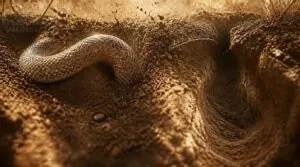
Snakes that actually dig don’t rely on luck — they rely on a surprisingly efficient system built right into their bodies. The process breaks down into a few distinct physical mechanics, each one doing a specific job. Here’s how it works, step by step.
It’s the same biological precision that lets snakes digest prey far larger than their own heads — a body built for efficiency from the inside out.
Head-First Soil Displacement
When you watch a snake dig, the head always goes in first. The snout presses into the substrate, driving substrate penetration while jaw muscles sustain forward thrust.
- This head-first soil displacement is a key fossorial adaptation
- Cephalic modification reinforces the skull to handle soil pressure
- The head shapes the bore; the body follows
Soil displacement always starts at the snout. Much like students who improve their focus by shifting attention from text to visual data, snakes demonstrate a similar principle of data-centered examination — where precise, figure-by-figure analysis of burrowing mechanics reveals how each head movement systematically displaces soil.
Side-to-Side Body Movements
Once the head creates an opening, the body follows with purpose. Muscles along the snake’s sides fire in waves, bending the torso left and right to widen the channel. Think of it like a swimmer’s kick pushing water aside. This side-to-side body movement clears far more space than the head alone, and bigger snakes simply move more soil per stroke.
Tunnel Shaping and Compaction
The body’s motion does more than just clear a path.
As the snake pushes forward, displaced soil compacts against the tunnel walls, forming a firm, self-supporting tube. Fine particles fill gaps between coarser grains, raising density along the tunnel axis. That steady pressure keeps the burrow from collapsing, leaving you with walls the snake built on the way through.
Loose Sand and Soil
All that compaction depends on one thing: the right substrate. Loose sand and soil give snakes the easiest path, since large pore spaces between grains allow soil displacement with very little effort.
If you watch dry sand shift and resettle around a burrowing snake, it behaves almost like a slow liquid. That’s exactly why dedicated diggers target sandy substrates first.
Most Snakes Reuse Existing Animal Burrows
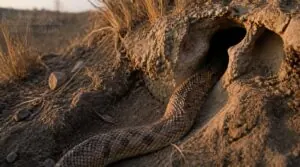
Here’s something that might surprise you: most snakes don’t dig at all. Instead, they move into ready-made shelters left behind by other animals, which saves energy and keeps them out of the open. The options they rely on cover more ground than you’d expect.
Rodent and Tortoise Burrows
Think of snakes as opportunistic renters. They don’t need to dig when existing holes are ready to use.
When a rodent abandons its tunnel, a snake moves right in. Rodent burrows offer the right dimensions and entrance shape.
Gopher snakes and black racers are especially skilled at claiming these ready-made homes, as explored in this guide to how snakes find and use underground burrows.
Tortoise burrows go even deeper, sometimes reaching 3 meters down, and you can see why that appeals.
Burrow usurpation at its finest.
Rock Crevices and Hollow Logs
Rock crevices and hollow logs are two of the most reliable shelters a snake can claim. Crevices create cool microshades during peak heat and stay warmer on cold nights, giving snakes quick escape routes from predators too.
Hollow logs trap moisture, making them damp refuges packed with fungi and invertebrates. For a snake, that’s a buffet and a bedroom combined.
Energy-Saving Shelter Choices
Digging burns calories. That’s why snakes are opportunistic renters by nature, claiming burrows that other animals already built rather than starting from scratch.
A ready-made tunnel costs almost nothing in energy. It lets a snake focus on what actually matters: hunting, thermoregulating, and staying safe. Microhabitat use like this is a classic survival strategy, not laziness. Smart efficiency, really.
Snakes don’t dig out of laziness—they borrow tunnels to save energy for what actually matters: hunting, hiding, and staying alive
Shared Burrow Ecosystems
A snake rarely has a burrow all to itself. These tunnels become shared underground communities, hosting lizards, insects, and small mammals within the same network.
- Temperatures stay stable year-round
- Shed scales and droppings cycle nutrients through the floor
- Multiple species use separate entrances simultaneously
Burrow fidelity is real here. Snakes return to familiar spots, reinforcing existing habitat over time.
Physical Adaptations That Help Snakes Dig
Not every snake can dig — but the ones that do are built for it in ways you might not expect. Their bodies carry a set of purpose-built tools, from the tip of the snout to the shape of the skull, that make moving through soil look almost easy. Here’s what actually gives these snakes their digging edge.
Wedge-Shaped or Upturned Snouts
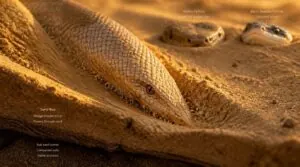
The wedge-shaped snout acts like a plow. If you look at sand boas, womas, or black-headed pythons, you’ll see an upturned nose built for burrow creation, keeping nostrils clear while pushing forward.
| Species | Snout Type | Key Advantage |
|---|---|---|
| Sand boa | Narrow wedge | Channels loose sand |
| Woma python | Broad, flat tip | Compacts tunnel walls |
| Black-headed python | Slightly upturned | Clears airway while digging |
Hardened Rostral Scales
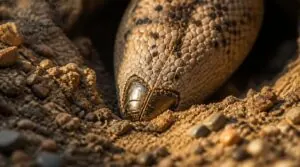
That snout doesn’t just push. It’s armored. Hardened rostral scales, thickened keratinous plates at the snout tip, handle the constant grinding against pebbles and packed soil so the nose doesn’t wear down.
In sand boas and black-headed pythons, these scales develop a polished surface that cuts friction during burrow creation, letting the snake glide through substrate cleanly.
Reinforced Skull Bones
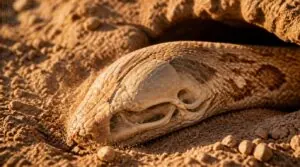
The scales protect the surface, but what’s underneath matters just as much.
Burrowing snakes carry reinforced skull bones built to absorb the repeated impact of pressing through compacted soil. Think of it as a built-in helmet. The bones interlock tightly, spreading force evenly so the brain stays protected. Sand boas show some of the thickest cranial bones of any snake.
Cylindrical, Streamlined Bodies
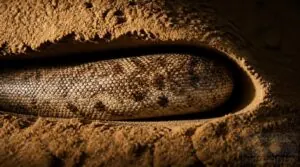
The skull takes the hits, but the whole body has to follow. Cylindrical, smooth bodies work like a natural boring tool, pushing through tight soil with minimal resistance.
That uniform round shape spreads pressure evenly along tunnel walls, preventing snags. In loose soil burrowing and sand submersion, this form lets the body glide forward without collapsing the passage around it.
Narrow Heads and Necks
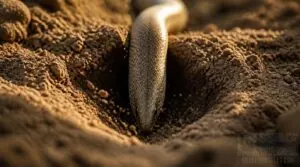
The cylindrical body follows wherever the head leads, but a narrow head is what gets the snake in first. Narrow snouts taper to a fine point, probing ahead to displace soil without moving the whole skull.
That small cross section keeps tunnel entry tight, reducing collapse risk and wall friction. Flexible neck joints help the head steer through narrow passages.
Which Snake Species Dig Burrows?
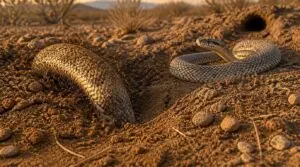
Not every snake has what it takes to move real earth — most are opportunists, happy to inherit a tunnel someone else dug. But a handful of species are built differently, with specialized anatomy that lets them break ground on their own. Here are the notable diggers worth knowing.
Sand Boas
Sand boas are champion diggers. Their flat rostral scale acts like a tiny shovel, making loose soil burrowing natural and efficient. As desert-adapted snakes, they rely on this burrowing adaptation to stay cool, hide from predators, and launch ambushes through sand submersion.
- Native to arid East Africa
- Eyes and nostrils sit high on the head
- Create multiple burrow openings for ambush hunting
- Burrows keep cooler than the surface
- Females deliver live young, not eggs
Hognose Snakes
The hognose snake has an upturned snout that works like a built-in plow. That rostral adaptation lets it push soil aside, making loose soil burrowing easy.
When sandy ground is available, a hognose snake will dig its own holes rather than wait for a vacant rodent burrow. The snout controls soil displacement while the body compacts tunnel walls behind it.
Pine and Gopher Snakes
Pine and gopher snakes won’t waste energy digging when a ready-made rodent burrow is available. These arid-region hunters, stretching anywhere from 2.5 to 7 feet, slip into abandoned tunnels with ease.
Their earth-toned, smooth bodies fit into sandy soils, making them natural fits for underground life. If you spot a smooth burrow entrance in scrubland, one of these constrictors might be home.
Bull Snakes
Few constrictors match the bull snake’s burrow-building drive. At 4 to 8 feet long, these snakes push through soft soil or sand using wedge-shaped snouts, and you’ll often spot them near fresh tunnel entrances.
Bull snakes are known for:
- Excavating their own burrows
- Reusing abandoned rodent tunnels
- Ambushing prey underground
- Regulating temperature in deep chambers
- Laying eggs in sheltered nests
Woma and Black-Headed Pythons
Australia’s woma pythons are built for the dig. Their broad, wedge-shaped snouts push through loose desert sand with surprising efficiency, and they’ll reuse an abandoned burrow as readily as they’ll excavate a new one.
Black-headed pythons share that same instinct, retreating underground to dodge extreme heat. Both species prove that effective snake excavation doesn’t always require brute force, just the right shape.
Why Snakes Use Holes and Burrows
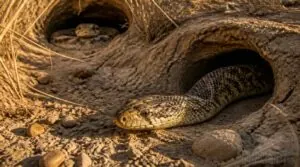
Snakes don’t hole up underground just to hide — every burrow acts a real purpose, whether that’s staying alive through a brutal summer or raising their young safely. Once you understand what drives them underground, snake behavior starts making a lot more sense. Here’s what those holes are actually doing for them.
Temperature and Moisture Control
If you watch a snake vanish underground, it isn’t just hiding from the heat. Snakes need ectothermic regulation to survive, relying entirely on the outside environment to properly manage body heat. A quality reptile terrarium thermometer hygrometer lets you track those temperature and humidity swings, so your snake can self-regulate just like it would underground.
The burrow microclimate and soil moisture retention keep temperatures 4 to 10 degrees cooler than the surface. That reliable thermal gradient helps with precise temperature regulation without burning extra energy.
Breeders mimic that natural cooling by holding corn snakes at 50-60°F for 8 to 12 weeks, as covered in this guide to preparing corn snakes for breeding season.
Predator Protection and Brumation
A burrow isn’t just shelter from heat. It’s a full survival system.
Many snakes retreat underground during brumation, a deep winter dormancy where their metabolism drops to roughly 2 percent of normal.
The narrow entrance keeps larger predators from getting in, and some species brumate in groups to confuse anything that sniffs around.
Staying hidden all winter means staying alive.
Ambush Hunting and Nesting
Snakes don’t just hide underground. They also hunt from it.
Ambush spots let snakes intercept prey with minimal movement:
- Sand boas partially bury in loose soil and strike upward
- Pine snakes use rodent tunnels as ready-made corridors
- Tail flicks lure curious prey into striking range
- Entrances align with active animal trails
Nesting also uses these same spaces, especially in spring.
Smooth, Round Burrow Entrances
The same holes snakes use for ambush also have a distinct look. A smooth, circular opening in soft soil or sand, usually 4 to 15 cm across, signals active use. The sloped lip prevents snagging and drains rain away. A good snake burrow entrance field guide includes size charts and photos that help you distinguish occupied holes from abandoned ones.
| Feature | Function |
|---|---|
| Circular shape | Prevents entry snagging |
| Compacted rim | Retains interior moisture |
| Flush ground level | Reduces predator detection |
Sheds, Droppings, and Fresh Tracks
Beyond the entrance itself, the real clues are scattered close by.
Fresh shed skin, translucent and parchment-like, near a hole confirms recent occupancy. Dark, moist fecal droppings containing visible prey fragments tell you feeding is active. And sharp-edged track impressions in soft soil point to recent movement.
Together, these signs read like a field journal left open just for you.
Frequently Asked Questions (FAQs)
How to tell if a snake is in a hole?
Nature leaves receipts, and a snake’s hideout is no exception. Look for fresh tracks leading to circular openings, plus nearby shed skins and tubular droppings with white tips. A clean, smooth-worn entrance means regular use.
How can I tell the difference between a rodent hole and a snake hole?
Look for spoil piles and digging marks. Rodent holes show loose soil, tracks, and droppings outside, while snake holes have clean, smooth circular openings with no fresh excavation, since snakes reuse existing burrows.
How do you tell if you have snakes in your yard?
The trickiest snake sign is the one you don’t see. Look for shed skins, pellet droppings with white tips, and fresh tracks near burrows. These snake signs beat any snake tracks guesswork.
How do I get rid of a snake hole in my yard?
First, confirm the hole is active. Wear protective gloves, remove loose debris, then fill the hole with packed soil or gravel. For persistent snake holes, use professional removal before sealing entry points.
How do snakes dig holes in the ground?
Snakes rarely excavate from scratch. They push loose soil aside with their heads and bodies, or simply move into abandoned rodent burrows. Black-headed pythons and sand boas can dig into soft sand for shelter.
How do you know if a snake is digging a hole?
You’ll notice clean, circular openings two to four inches wide, free of cobwebs and digging debris. Watch for fresh tracks, shed skins, droppings, and displaced soil, sand, or leaf litter nearby.
Do snakes burrow in holes?
Yes, snakes burrow in holes, but most move into existing tunnels dug by rodents or tortoises rather than excavating their own, seeking warmth, moisture, and safe shelter underground.
How do snake holes work?
Snake holes work as subsurface shelters, usually borrowed from rodents. Narrow, rounded entrances lead to tunnels holding stable warmth, moisture, and protection. Snakes rest, hunt, and brumate safely underground.
Are there snake holes in your backyard?
Look closely before you assume. Snake holes in your backyard often start as rodent holes, quietly borrowed along fences, woodpiles, and tall grass. Most sheltering species there are non-venomous and helpfully control rodents.
Do snakes make their own holes?
Most snakes don’t dig their own holes. They’re opportunistic renters, claiming abandoned rodent or tortoise burrows instead. Existing underground spaces offer stable temperatures, moisture, and safety from predators, making them ideal shelters.
Garter snakes are a good example, since they often settle into existing burrows, and this guide on whether garter snakes burrow explains how they use them through the seasons.
Conclusion
Snakes are nature’s squatters more often than nature’s excavators. When you ask how do snakes dig holes, the honest answer is that most don’t. They borrow, inherit, and improve what other animals leave behind.
Only a handful of specialists, like hognose snakes and sand boas, move earth with their own heads. So if you spot a burrow in your yard, remember: the snake inside probably didn’t build it. It simply moved in.