This site is supported by our readers. We may earn a commission, at no cost to you, if you purchase through links.

Your boa spends its whole life in the box you build. Get the shape wrong, and you’re not just cramping its style—you’re limiting thermoregulation, muscle development, and natural behavior every single day.
Here’s the debate nobody settles cleanly: horizontal enclosures give ground-dwelling boas room to stretch and coil, while vertical setups tap into climbing instincts most keepers never knew existed. Both work. Neither wins outright.
The vertical vs horizontal boa enclosure choice comes down to species, growth stage, and how your snake actually moves—not just what looks good in your living room. Get the gradient, the footprint, and the climbing access right, and your boa tells you which one it prefers.
Table Of Contents
- Key Takeaways
- Vertical Vs. Horizontal Boa Enclosures Compared
- Size Horizontal Space by Growth Stage
- Add Safe Vertical Climbing Space
- Compare Enclosure Materials and Performance
- Choose Your Best Boa Enclosure
- Frequently Asked Questions (FAQs)
- Do snakes prefer vertical or horizontal enclosures?
- What is the best enclosure for a boa constrictor?
- What snakes like vertical enclosures?
- Can a sand boa live in a 20 gallon tank?
- How often should you clean a boa enclosure?
- Can two boas share the same enclosure?
- What lighting schedule do boas need daily?
- How do you safely handle boas after feeding?
- What are common signs of stress in boas?
- Conclusion
Key Takeaways
- Your boa’s ideal enclosure isn’t about horizontal versus vertical—it’s about matching the space to how your specific snake actually moves, so watch its behavior for the real answer.
- Size changes as your boa grows, so use real measurements: juveniles need at least 2×3 feet of floor space (1.2 times body length), while adults need 1.5 times body length plus 12–16 square feet for an 8-footer.
- Climbing isn’t optional for most boas, so give juveniles 12–18 inches of vertical clearance and adults 24–36 inches minimum, with sturdy branches spaced to prevent falls and injury.
- Your enclosure material shapes everything else—PVC holds heat about 20% longer than glass—so pick materials, ventilation, and secure locking doors that keep temperature and humidity steady day to day.
Vertical Vs. Horizontal Boa Enclosures Compared
Boas don’t care about your floor plan—they care about function. Vertical or horizontal, each layout solves different problems for your snake’s body and behavior. Here’s how they actually stack up, side by side.
If your boa keeps rubbing its nose on the glass or can’t fully stretch out, these signs your snake enclosure is too small will tell you whether it’s the layout or the size holding your pet back.
Floor Space Benefits
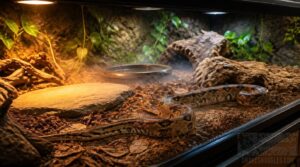
More floor, fewer problems. Horizontal setups give your boa stretching and coiling room without stacking vertical clutter, easing enclosure size calculation and access for cleaning.
| Benefit | Why It Matters |
|---|---|
| Thermal gradient spread | Even heat, no cold pockets |
| Humidity stability support | Deeper substrate, less drying |
| Weight and portability | Lighter, simpler moves |
Vertical Climbing Value

Extra square feet aren’t the only currency that matters. Vertical space utilization taps climbing instincts horizontal tanks waste entirely.
| Feature | Horizontal | Vertical |
|---|---|---|
| Climbing enrichment | Minimal | High |
| Observation views | Limited | Elevated |
| Behavior expression | Restricted | Natural |
Thermoregulation at height lets boas pick zones 2–4°C cooler up top, while climbing branches and hides encourage genuine arboreal movement.
Movement and Stretching Differences
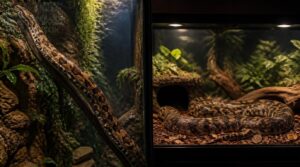
Climbing engages different muscles than crawling. Vertical stretching works the shoulder girdle; horizontal coiling relaxes it.
| Movement Type | Body Response |
|---|---|
| Climbing | Full extension, arching |
| Ground travel | Compact coils, lateral flexes |
| Mixed layout | Balanced range of motion |
| Confined floor space | Restricted body extension |
Branches and hides invite genuine climbing movement, not just tolerance of vertical space for snakes.
Heating Gradient Differences

Muscle range isn’t the only thing height changes — heat behaves differently too. Vertical layouts create sharper thermal gradient shifts, since basking heat rises and stacks near the top. Horizontal setups spread warmth flatter, needing side-to-side monitoring instead.
| Layout | Gradient Pattern | Monitoring Focus |
|---|---|---|
| Vertical | Sharp top-down | Height probes |
| Horizontal | Flat side-to-side | Floor-to-wall probes |
| Mixed | Balanced zones | Multi-point mapping |
Overall Pros and Cons

So which orientation actually wins? Depends on your boa’s size and your square footage.
For that awkward juvenile stage, a rack setup often makes more sense than a full enclosure — this guide on multi-snake boa rack systems breaks down sizing options that grow with your snake.
| Factor | Vertical | Horizontal |
|---|---|---|
| Space efficiency | Smaller footprint | Larger, apartment-tight |
| Enrichment | Climbing variety | Lateral stretching |
| Maintenance | Frequent branch checks | Easier substrate access |
Cost and long-term suitability favor vertical setups for arboreal species; horizontal wins for heavy-bodied boas needing full-length gradient control.
Size Horizontal Space by Growth Stage
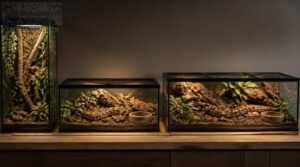
Guesswork gets snakes injured. Floor space isn’t one-size-fits-all — it changes as your boa grows, stage by stage. Here’s exactly how to measure and size it right, from hatchling to full-grown adult.
Measure Your Boa Relaxed
A coiled boa lies. That’s your real ruler.
A coiled boa hides its true length, so measure it relaxed for an honest reading
Snout-to-tail measurement on a calm, flat surface beats guessing from a stretched-out snake every time.
- Wait for stillness
- Note curve shape
- Record full length
- Track every 3–6 months
- Compare against prior data
Watch for tail flicking or tight coiling — stress signs that skew your proportionate enclosure size planning.
Considering the species’ arboreal nature, providing vertical climbing opportunities in the enclosure helps natural behaviors and thermoregulation, as seen in the Amazon tree boa habitat.
Hatchling Enclosure Dimensions
Tiny snake, big consequences: undersized hatchling starter tanks cause stress and poor feeding response.
Give hatchlings an 18x12x12 setup — minimum floor footprint roughly 18 by 18 inches, with 12–18 inches vertical clearance height.
| Element | Spec | Purpose |
|---|---|---|
| Basking | 88–92°F | Thermal gradient |
| Cool end | 78–82°F | Thermoregulation |
| Substrate | 3–4" | Humidity buffer |
Space branches 4–6 inches apart for secure grip.
Juvenile Floor Space Requirements
Outgrown that hatchling tub already? Juveniles need a minimum floor space of 2×3 feet — unencumbered, not counting branches or hides.
Use the length formula: 1.2 times body length. Keep 1.5 feet clearance around basking zones and a clear aisle for hands during handling.
This is where enclosure scalability matters — build for growth, not just today’s boa.
Adult Length and Footprint
Full-grown boas can stretch past 12 feet. That length demands a real footprint-to-length ratio: 1.5 times body length, plus room for coils.
Skimp here and you’ll see restricted movement, poor thermoregulation, and stress coiling. Budget 12–16 square feet for an 8-footer — non-negotiable linear retreat clearance for safe, straight-line travel.
Enclosure Upgrade Timing
When do you actually pull the trigger on a bigger tank? Watch growth milestones, not the calendar — approaching 3 feet or a stalled thermal gradient both signal it’s time.
Plan seasonal upgrades during mild weather to control heating costs. Check hardware for structural wear first, then schedule the juvenile to adult shift during calm, low-stress windows with everything staged beforehand.
Add Safe Vertical Climbing Space
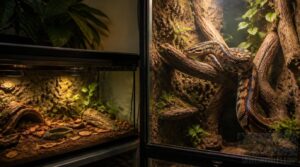
Floor space only tells half the story. Boas are semi-arboreal, and without room to climb, that instinct has nowhere to go. Here’s what your setup needs to get vertical space right.
Juvenile Vertical Clearance
Height matters as much as floor space for a growing snake. Juveniles need 12 to 18 inches of clear vertical space above substrate. Girth clearance should run 1.5 times body width—no rubbing walls.
Exact sizing needs shift species to species, so it’s worth checking a popular snake species list before settling on an enclosure.
- Space branches 2–4 inches apart
- Choose 1.0–2.5 inch diameters
- Avoid dead-end pathways
Proper spacing helps climbing, coiling, and natural behavior enrichment.
Adult Enclosure Height
Juveniles need inches; adults need feet.
Give adult boas 24 to 36 inches minimum, though 48+ inches cuts strike risk against the lid.
A 60-inch build allows real vertical basking.
Match height to full body length plus clearance—tail rubbing means you’ve undersized it.
Platforms can’t eat into that minimum, or you’re back to square one.
Branch Diameter and Spacing
Not just height—what you bolt to it matters too.
Keep branches under two-thirds trunk diameter for union strength and structural safety.
- Space branches 6–12 inches apart
- Use 1.5–4" diameter branches
- Install 3+ for climbing enrichment
- Match spacing to snake climbing behavior
Proper load distribution across branches aids natural thermoregulation as your boa seeks its gradient.
Clear Climbing Pathways
Branches mean nothing if your boa can’t move between them safely. Clear climbing pathways need unbroken routes—no gaps wider than head width—linking bark-textured branches with two coiling zones per route.
Add contrast markers and diffuse lighting so pathways stay visible day or night, supporting natural climbing behavior without hesitation or missteps.
Fall and Injury Prevention
Gravity doesn’t forgive a bad landing. A boa that slips off a branch onto hard flooring risks spinal injury, so non-slip flooring is non-negotiable under every climbing structure.
Keep floor zones clear of clutter, add a stable humidity mat for traction after misting, and secure lids tight—an escape-proof enclosure prevents panicked falls during unsupervised exploration.
Compare Enclosure Materials and Performance
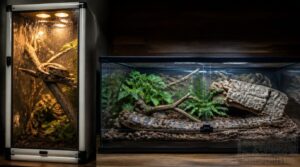
Your enclosure’s shape matters, but the material it’s built from decides whether that heat and humidity actually stay put. PVC, glass, and sealed wood each handle thermoregulation and bioload differently, and the wrong pick means fighting your equipment daily. Here’s how the main options stack up.
PVC Heat Retention
Plastic doesn’t just look warmer—it acts warmer. PVC retains heat roughly 20% longer than glass, thanks to low thermal conductivity (0.14–0.19 W/m·K) and denser molecular structure in rigid uPVC panels.
Sealed joints cut convective loss, while modern OBS stabilizers keep thermal performance consistent across heating cycles—critical for holding that 88–92°F basking gradient without costly fluctuations.
Glass Terrarium Limitations
Glass looks spotless until you factor in gas exchange limitations — being nonporous, airflow depends entirely on vents, not diffusion. Condensation clouds visibility fast, trapping humidity pockets that breed mold.
Direct sun triggers overheating risks through greenhouse effect. Scratches create structural weak points, and degraded seals invite moisture loss, undermining any escapeproof enclosure design or stable temperature gradient.
Sealed Wood Maintenance
Wood demands work glass never asks for. Choose a hybrid sealer for balanced penetration and easy cleaning. Sand 180–220 grit, apply thin coats, cure 24–72 hours (up to 7 days full cure) at 60–80°F.
- Clean surface
- Sand smooth
- Seal thin
- Cure fully
- Bead-test annually
Reapply when water stops beading—your escapeproof latch security means nothing if the wood underneath is rotting.
Ventilation and Airflow Balance
Sealed wood traps heat—so how does air still move? Airflow balance keeps pressure near ambient. Size vents to enclosure volume; oversized dampers cut static pressure loss, undersized ones force fans to overwork. Position intakes toward center, not the basking zone, to dodge short circuiting. Balanced ventilation rate protects your thermal gradient setup while curbing condensation and mold.
Front Doors and Secure Latches
Boas escape through weak doors, not weak walls.
Choose front-opening door advantages: full access, easy cleaning, secure locking mechanisms. Demand deadbolt inclusion or mortise-style latches over flimsy tubular ones.
Strengthen the door frame, upgrade strike plates with longer screws, and pick brass or stainless hardware—zinc corrodes fast.
Proper enclosure security means escape prevention isn’t optional; it’s foundational snake enclosure design.
Choose Your Best Boa Enclosure
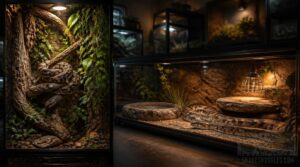
So which setup actually wins for your snake? The right answer depends on species, space, and a few habits you probably haven’t thought about yet. Here’s what to weigh before you commit.
Boa Species and Activity
Species matters more than square footage alone. A common boa constrictor with slow, ambush hunting instincts and mostly ground-based habits needs less climbing structure than an arboreal type.
Check activity level too: nocturnal or crepuscular boas often use vertical space at dusk. Solitary by nature, growth rate also dictates when floor space becomes cramped.
Thermal Gradient Space Needs
Gradient shape follows enclosure shape. Vertical tanks stack heat top to bottom—warm zone placement stays upper-level, cool retreat at the floor. Horizontal setups spread it side to side instead.
Either way, position heat sources off substrate contact, calibrate your thermostat to the sensor location, and check both ends with a probe thermometer before trusting the numbers.
Humidity and Substrate Depth
Depth matters as much as shape. Whatever enclosure you pick, substrate moisture retention depends on 3–6 inches of cypress mulch or coconut fiber—thin layers dry fast, forcing constant misting and wrecking your humidity gradient stability.
Deeper layers support shedding and resist compaction. Skimp on depth, and you’ll fight mold, bad sheds, and a bioactive substrate that never quite balances.
Apartment-Friendly Footprint Options
Small square footage doesn’t mean small living quarters for your boa. A compact vertical setup solves this: 18×18-inch base, 36-60 inches tall.
- Wall mounted shelves for stacked levels
- Modular rack system with removable platforms
- Slim glass terrarium at 18-inch depth
Shallow base cage, vertical design—apartment-friendly pet solutions built around a smart floor space formula, not square inches.
Signs The Enclosure Fits
How do you know it’s right? Watch your boa move. A relaxed snake posture check beats guesswork—no wall rubbing, easy tail coiling room, and confident branch access ease. Do a quick wall clearance test and confirm neck headroom space near perches. Track temperature monitoring and humidity levels weekly. If growth accommodation stays comfortable without cramped corners, you’ve nailed the fit.
Frequently Asked Questions (FAQs)
Do snakes prefer vertical or horizontal enclosures?
Neither, exclusively. Boas want both floor space and climbing structures—rectilinear stretching along the ground plus vertical enrichment for natural posture variety. Watch your snake’s movement patterns; that’s your best welfare indicator for what the setup actually needs.
What is the best enclosure for a boa constrictor?
There’s no single winner. The best setup combines horizontal floor space for stretching with enough vertical design for climbing, plus a proportional thermostat holding steady temperature gradients, proper humidity control, and secure escape prevention.
What snakes like vertical enclosures?
Think of branches as a snake’s highway system. Arboreal species like green tree pythons crave them daily. Ball pythons and rat snakes use vertical climbing structures too, boosting activity, thermoregulation, and natural arboreal adaptation.
Can a sand boa live in a 20 gallon tank?
Yes — a 20 gallon long tank suits adult Kenyan sand boas (11–14 inches). Prioritize floor space over height for burrowing, keep 4–6 inch substrate depth, maintain an 85–90°F warm side, and monitor humidity to avoid shedding problems.
For more on why floor dimensions matter more than height, this guide on boa enclosure sizing and space requirements explains how linear stretch room directly supports your snake’s natural movement.
How often should you clean a boa enclosure?
Picture week-old feces baking under a basking bulb for days — ammonia spikes, bioload climbs, humidity swings. Spot clean daily, deep clean every 2–4 weeks, and swap substrate every 3–6 months. Ramp up frequency after shedding or illness.
Can two boas share the same enclosure?
Only same-species, same-sex boas belong together, and only in an oversized enclosure. Resource competition triggers stress, poor shedding, and appetite loss. Feed separately, watch health monitoring closely — most keepers still recommend solo housing for adults.
What lighting schedule do boas need daily?
Steady days, steady nights: run a 12/12 photoperiod baseline, shifting toward 13 hours light in summer and 11 in winter. Use a timer for consistent light timing—abrupt changes stress boas and disrupt feeding and shedding cycles.
How do you safely handle boas after feeding?
Wait 48 hours minimum before handling. Limit contact to light duty only—spot cleaning, brief checks—if unavoidable during digestion. Watch for regurgitation or defensive strikes. A front-opening door helps you access without disturbing a digesting boa’s resting spot.
What are common signs of stress in boas?
An animal’s body never lies. Watch for appetite changes, prolonged hiding, restless activity shifts, breathing irregularities, and irregular shedding patterns — these snake stress indicators demand immediate reptile stress reduction through better thermoregulation, gradient correction, and increased behavioral stimulation.
Conclusion
A cramped box is a life sentence dressed up as décor—don’t hand your snake one. The vertical vs horizontal boa enclosure debate isn’t really a debate; it’s an observation exercise.
Watch your boa. Does it climb, or coil low and stay put? Give ground-dwellers sprawling floor space and a heat gradient they can chase. Give climbers branches and vertical clearance.
Build the box around the snake, not the other way around.