This site is supported by our readers. We may earn a commission, at no cost to you, if you purchase through links.

A boa constrictor doesn’t grow in tidy increments—it can add a foot of length in a single year, then slow down without warning. That unpredictability trips up even careful keepers, who buy one enclosure and assume it’ll last. It won’t.
Sizing enclosure for growing boa correctly means treating it as an ongoing calculation, not a one-time purchase. Length, girth, and activity level all shift as your snake matures, and each stage carries different spatial demands.
Get the measurements and timing right, and you’ll stay ahead of every growth spurt instead of scrambling to catch up.
Table Of Contents
- Key Takeaways
- Measure Your Growing Boa Correctly
- Calculate Minimum Enclosure Size
- Plan Boa Enclosure Upgrades
- Choose The Right Enclosure Type
- Set Up Space for Health
- Frequently Asked Questions (FAQs)
- How big should a boa enclosure be?
- What size tank for a full grown boa?
- What size tank for tree boa?
- What is the best enclosure for a boa?
- How much does a full boa enclosure setup cost?
- Can two growing boas share the same enclosure?
- What lighting, if any, does a boa need?
- How often should substrate be fully replaced?
- What temperament changes occur as boas grow larger?
- Conclusion
Key Takeaways
- Boas grow unpredictably, so treat their enclosure as a recurring recalculation—measure snout-to-tail monthly while your snake is warm and relaxed, then resize every six months instead of buying one tank for life.
- Use the length-plus-width rule (their sum should meet or exceed your boa’s total length) to set floor space, and add vertical clearance—60 cm for youngsters, 90–120 cm for adults—since boas climb as much as they crawl.
- Match enclosure size to your boa’s current length plus a 10–20% margin, upgrading around the 6–12 month mark when it nears half the tank’s width, since both cramped and oversized-empty setups cause stress and poor thermoregulation.
- PVC enclosures outperform glass and untreated wood, retaining heat about 20% longer, resisting humidity warping, and pairing with strong latch security to build a durable setup that scales with your boa’s growth.
Measure Your Growing Boa Correctly
Every enclosure calculation you make depends on one thing: an accurate, current measurement of your boa. Guess wrong here, and you’ll either cramp your snake or waste money on space it doesn’t need yet. Here’s exactly how to measure your growing boa the right way, every time.
For a full walkthrough of nose-to-tail measuring, sizing charts, and growth-stage adjustments, check out this complete boa terrarium setup guide.
Monthly Length Checks
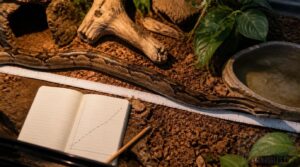
Rarely does a boa’s growth stay predictable, which is exactly why monthly length checks matter.
Measuring once every month lets you catch growth pattern tracking early, comparing each reading against the last for consistent increments.
Record the date every time — length recording accuracy depends on it.
This monthly size comparison habit builds a growth chart that tells you precisely when your enclosure size needs recalculating.
Snout-to-tail Measurement
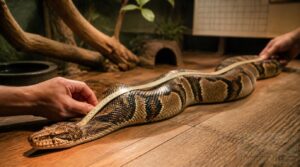
Snout to tail means exactly that — nose tip to tail tip, fully extended, with tail inclusion accuracy determining whether your numbers mean anything. Run a flexible tape along the body’s curve, not straight across. Log each figure on your growth chart to spot trend lines, since floor space priority calculations depend on accurate length feeding directly into minimum enclosure size math.
For accurate measurement, consider using the ball of yarn method to follow your boa’s natural curves without stress.
Measure When Relaxed
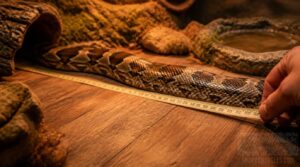
A tense boa curls defensively, shrinking your numbers and skewing every calculation downstream. Warm your snake to normal basking temps first, then wait until it stretches out calm before pulling tape.
This relaxed measurement protocol isn’t optional — accurate relaxed length feeds directly into minimum enclosure size and floor space priority. Monthly relaxation tracking, done consistently, keeps growth monitoring honest instead of guesswork.
Track Growth Milestones

A single relaxed measurement tells you little on its own — real insight comes from tracking length, weight, and shed quality together over time.
Log monthly length, note weight gain patterns, and watch shedding regularity and activity level, since juveniles hit peak growth velocity between 12–24 months, directly shaping minimum enclosure size and adult projections.
Recalculate Every Six Months

Every six months, pull your logged measurements and run the numbers again — this is your size recalculation protocol, not a guess. Compare current length against minimum enclosure size formulas and adult size projections.
Growth velocity shifts fast during juvenile months, so length-based upgrade triggers keep space requirements ahead of your boa, preventing a scramble toward its permanent adult enclosure.
Calculate Minimum Enclosure Size
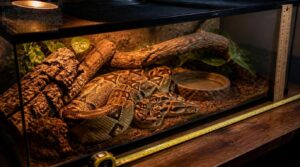
Once you’ve got an accurate measurement, the real work starts: turning that number into actual dimensions. Guesswork won’t cut it here—undersized housing stresses your boa, while a poorly planned oversized tank wastes heat and money.
Here’s exactly how the math breaks down, from floor space to height to the specific sizes you’ll need at each growth stage.
Floor Space Formula
Guesswork won’t cut it here. The floor space formula ties minimum enclosure size directly to your boa’s current length, giving you a real square footage target instead of a hunch.
As body length grows, so does the required footprint — recalculated every six months, since growth tracking keeps you ahead of restrictive housing before it becomes a problem.
Length Plus Width Rule
When the floor formula feels abstract, the length plus width rule offers a faster sanity check: their sum should equal or exceed your boa’s total length.
- Quick space assessment guide for tight footprints
- Validation tool before finalizing enclosure size
- Backup check against square footage math
Apply it, then verify against actual measurements—adjust dimensions if movement still feels restricted.
Height for Climbing
Boas don’t just crawl—they climb, and vertical space matters as much as floor footprint. Young boas need roughly 60 cm of clearance above their reach, while adults benefit from 90–120 cm vertical height for full-body stretching.
Space branches 10–20 cm apart for secure grip, and always run a load capacity check—worn perches should retain 95% of their original strength.
Baby Boa Dimensions
A newborn boa fits in your palm—birth length runs 1.6 to 2.5 feet, yet growth rate hits 12 to 18 inches by six months.
At this size, calculate floor space around 2 ft by 1.5 ft (60 by 45 cm), keeping length plus width equal to body length. Measurement tips: measure snout-to-tail, relaxed and warm, monthly.
Juvenile Boa Dimensions
By month twelve, your boa hits 2 to 4 feet—doubling that palm-sized hatchling fast. Track growth monthly; snout-to-tail, relaxed and warm.
Juveniles need roughly 4 ft by 2 ft floor space, with vertical climbing room added in. Once length nears 24 inches, upgrade—don’t wait for a cramped, thrashing tenant to tell you.
Plan Boa Enclosure Upgrades

Boas don’t grow on a schedule, but your upgrade plan needs to. Waiting until your snake looks cramped means you’re already behind. Here’s how to stay ahead at every stage, from hatchling to full adult.
When Babies Outgrow Tanks
That "starter" tank rarely lasts. Most babies outgrow small enclosures within 6 to 12 months, depending on genetics and feeding schedule.
Watch for the cue: when length nears half your tank’s width, upgrade timing has arrived. Waiting too long restricts movement and can trigger appetite changes—stall now, pay for it later with a stressed, cramped boa.
Twelve-to-twenty-four-month Growth
This stretch is where growth velocity peaks—expect steady gains demanding monthly rechecks, not annual guesswork.
- Track length monthly, snout to tail
- Adjust feeding frequency as growth rate shifts
- Watch for restless, exploratory behavior
- Recalculate floor space every six months
- Increase vertical space as climbing instincts sharpen
Nutritional needs rise alongside body mass—undernourish here, and size achievement checks will flag the shortfall fast.
Signs Space is Restrictive
Watch the body language. Constant wall contact, restless pacing, and repeated escape attempts all signal your boa’s outgrown its footprint—stress from tight spaces shows up fast.
Shedding issues and erratic humidity fluctuations often follow, since cramped air circulates poorly. Housing multiple boas together compounds it further.
Fix it with proper vertical space and escapeproof design, not just a bigger floor plan.
Avoid Oversized Empty Setups
Restrictive space hurts your boa, but the opposite mistake causes trouble too. Buying a tank sized for a five-foot adult to house a two-foot juvenile creates oversized empty setups that waste heat and stress thermoregulation.
Housing a two-foot juvenile in a five-foot adult tank wastes heat and stresses thermoregulation, not comfort
Keep proportionate enclosure size matched to current length plus 10–20% margin. Fill remaining footprint with functional zones, not empty floor space—every square foot should serve a purpose.
Adult Boa Size Planning
Six to eight feet of muscle needs real square footage. Plan for a 6×3×3 foot enclosure minimum, scaling to 8×4×4 for larger individuals.
Build your upgrade timeline now, not later—gradual scaling over 5–7 years beats scrambling. Maintain thermal gradients (88–92°F basking, 78–82°F cool end) and 55–75% humidity at every size.
Choose The Right Enclosure Type
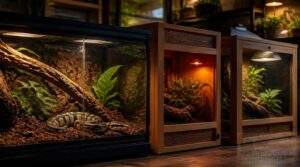
Sizing your boa’s space correctly means nothing if the enclosure itself works against you. Material choice affects heat retention, humidity control, and long-term durability, so it’s not a decision to make casually. Here’s how the main options stack up against each other.
The wrong material can also throw off how you set up a proper basking spot, since some surfaces hold or shed heat in ways that fight your gradient instead of supporting it.
PVC Enclosure Benefits
PVC wins on heat retention efficiency, holding warmth roughly 20% longer than glass—critical for maintaining your temperature gradient overnight.
Humidity resistance matters too: PVC won’t warp like wood in a bioactive setup. Add lightweight construction, solid impact protection, and chemical durability against cleaners, and you’ve got a low-maintenance, escapeproof enclosure that scales with your boa’s growth.
Glass Terrarium Limits
Clarity comes at a cost. Glass wins for observation but loses badly on heat retention, making floor space and vertical height harder to hold steady.
- Minimum 3mm thickness for impact resistance
- Reinforced corners prevent bowing
- Neutral-cure silicone seals resist humidity
- UV coating protects interior plants
- Tempered glass fails safely, not dangerously
Weigh these limits against your enclosure size goals before committing.
Sealed Wood Enclosures
A wooden vivarium built right rivals PVC, if you respect its one enemy: moisture.
| Task | Frequency | Purpose |
|---|---|---|
| Sealant coats | 4 layers | Moisture barrier |
| Recoating | 12–24 months | Wood warping prevention |
| Hygrometer check | Weekly | Humidity control balance |
Use stainless fasteners for corrosion resistance, an interior liner for balance, and gasketed doors for escape prevention across your enclosure size and thermal gradient.
Front-opening Door Advantages
Ever tried wrestling a hide through a top-opening lid? A front-opening door solves that: full-panel access means wider item access for branches and substrate, plus faster cleaning.
Benefits include:
- Easy access cleaning
- Reduced component stress on hinges
- Faster routine maintenance
- Improved hazard control
- Tight-sealing frames for escape prevention
Escape-proof Latch Security
A determined boa can shove through gaps most owners assume are secure. That’s why latch quality matters as much as door style.
Look for rotating disk latches paired with reinforced strike plates, or dual action mechanisms offering keyless tamper resistance. Multi point latching adds backup security on PVC enclosures, keeping ventilation design intact without sacrificing lid security.
Set Up Space for Health
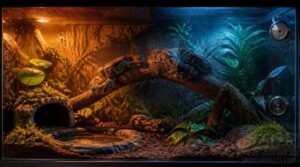
Getting the dimensions right is only half the job—what you put inside that space matters just as much. A properly sized enclosure still fails your boa if the internal setup ignores its biological needs. Here’s what a health-focused layout actually requires.
Thermal Gradient Layout
Place your heat source so the basking spot hits 88–92°F while the cool end stays 78–82°F — a genuine gradient, not a hot box.
Cover elements under substrate, monitor both zones with probe thermometers, and recalibrate your thermostat seasonally.
Watch how your boa splits time between zones; skewed usage signals a gradient needs adjusting for proper thermal regulation.
Humidity-friendly Substrate Depth
Getting the thermal gradient right controls air temperature, but moisture lives in the substrate beneath your boa’s belly. Coconut fiber or cypress mulch at 3–4 inches deep creates a stable moisture reservoir, holding humidity within a tight 5% band.
Go shallower than 1.5 inches and you’ll fight constant swings — deeper substrate simply retains water longer, buffering against your enclosure’s daily temperature drops.
Water Bowl Placement
Substrate moisture controls ambient humidity, but your boa still needs standing water for hydration and soaking. Set the bowl in a low-traffic corner away from heat lamps, on a non-slip mat, with 2 inches of clearance for cleaning.
- Bowl height — low for hatchlings, shoulder-level as growth continues
- Stability — weighted, rounded-edge bowls resist tipping
- Cleaning — wash weekly with reptile-safe soap
Climbing Branches and Hides
Boas are semi-arboreal, so vertical space matters as much as floor size. Use 3+ branches (1.5–4" diameter), spaced 6–12" apart, securely anchored. Place 2–4 hides beneath branches for thermally protected resting spots without blocking climbing routes.
Add driftwood or jute rope for climbing enrichment that helps natural behavior within your calculated enclosure size.
Ventilation Without Heat Loss
Because a sealed enclosure traps heat, your ventilation system needs to remove stale air without stealing warmth.
Trickle vent control lets you fine-tune airflow while an exhaust-first layout curbs humidity buildup.
Look for units citing 70–95% heat recovery efficiency.
Add basic frost protection strategies if temperatures dip, and pair tight seals with intentional venting for real humidity regulation.
Frequently Asked Questions (FAQs)
How big should a boa enclosure be?
Size follows the length plus width rule: floor space should equal or exceed body length, with vertical space for climbing. Baby boas need roughly 2×5 feet; juveniles require more square footage, hiding places, and proper ventilation as growth accelerates.
What size tank for a full grown boa?
For a full-grown adult, target a 6-foot by 3-foot floor footprint minimum, with 3 feet of vertical height. Boas over 8 feet need 8×4 feet, prioritizing enclosure type and humidity levels over a cramped, undersized tank.
What size tank for tree boa?
Adult tree boas need at least 6 ft long by 3 ft wide by 3 ft high, with vertical height matching half their body length to support climbing structures and true arboreal behavior as they mature.
What is the best enclosure for a boa?
PVC enclosures win out, retaining heat 20% longer than glass, resisting humidity warping, and offering better escape prevention with double-latch security—giving you a durable, ventilation-balanced setup that holds stable temperature gradients and humidity levels far better than glass or untreated wood.
How much does a full boa enclosure setup cost?
Budget $300–$800 for a complete setup: PVC enclosure, temperature control, humidity levels, substrate selection. Material costs scale with enclosure size—adult 6-foot PVC builds cost more upfront but deliver long-term savings versus repeated juvenile upgrades.
Can two growing boas share the same enclosure?
Togetherness can breed isolation: even same-species boas sharing space often compete rather than coexist.
Species compatibility and size matching matter most—mismatched boas face resource competition, feeding aggression, and health risks that separate housing, careful monitoring, and adequate enclosure size can prevent.
What lighting, if any, does a boa need?
UVB stays optional, though a 5–7% diffused tube helps. Run a 12-hour light cycle, adjusting seasonally, with brighter basking zones and dimmer retreats—paired with a thermostat-controlled gradient (88–92°F basking, 78–82°F cool end).
How often should substrate be fully replaced?
Full replacement isn’t a monthly chore. Lightly stocked setups need it every 12 to 18 months; heavier bioload cuts that to 6–12 months. Watch for mold, compaction, or foul odor as your real cue, not the calendar.
What temperament changes occur as boas grow larger?
Picture a coiled boa settling into stillness, breath slow, eyes half-closed.
Growth brings calmer baseline behavior—slower reactivity, coiling over lunging, and steadier stress recovery—alongside sharper territoriality and pickier feeding responses tied to established hiding spots.
Conclusion
Your boa isn’t misbehaving when it presses against the glass—it’s simply outgrowing its quarters, a polite way of saying the walls have closed in. That signal deserves action, not a shrug.
Sizing enclosure for growing boa needs stays constant even as the numbers shift monthly. Measure consistently, upgrade deliberately, and match dimensions to actual length rather than guesswork. Do that, and you’ll never chase a growth spurt again. Your snake stays calm. You stay ahead.