This site is supported by our readers. We may earn a commission, at no cost to you, if you purchase through links.

Your studio apartment feels tight enough already, and now you’re picturing a six-foot enclosure eating your living room. Here’s the good news: full-grown boas don’t need sprawling floor space, they need smart vertical design. Stackable modules, corner nooks, and rolling columns turn a cramped corner into a secure, comfortable home without swallowing your square footage.
Getting the setup right matters. Wrong-sized housing stresses boas and invites escapes, and neither makes for good apartment living.
From hatchling starter tanks to full adult upgrades, sizing your boa constrictor enclosures for apartments the right way keeps your snake calm, your space livable, and your downstairs neighbors none the wiser.
Table Of Contents
- Key Takeaways
- Choosing The Right Boa Constrictor Enclosure
- Sizing Enclosures From Hatchling to Adult
- Managing Heat and Humidity Indoors
- Building a Secure, Escape-Proof Setup
- Furnishing an Apartment-Friendly Habitat
- Frequently Asked Questions (FAQs)
- What is the best enclosure for a boa constrictor?
- What size enclosure for a boa constrictor?
- Can boa constrictors be housed together?
- How to make a boa enclosure?
- Will noise from a boa enclosure disturb neighbors?
- Can these enclosures pass apartment pet or weight restrictions?
- How often should the enclosure be relocated or moved?
- What size enclosure suits a 14-foot adult boa?
- Conclusion
Key Takeaways
- Vertical design—stackable modules, corner nooks, and rolling columns—lets you house a full-grown boa in a small apartment without sacrificing floor space.
- Size your enclosure to your boa’s growth stage, using the rule of 1.2 times body length for juveniles and 1.5 times for adults, with adults needing 6+ feet of linear footprint.
- A stable habitat depends on dialing in temperature gradients (95–105°F basking, 75–85°F cool side) and humidity (55–75%, up to 85% during shedding) using proportional thermostats and digital hygrometers.
- Escape-proofing and comfort go hand in hand, so prioritize front-opening doors with multi-point locks, opaque panels to reduce stress, sturdy climbing branches, and tip-proof water bowls.
Choosing The Right Boa Constrictor Enclosure
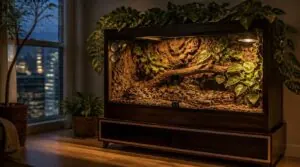
Small apartments and big snakes can absolutely work together, but the enclosure you pick makes all the difference. You’ll want something that fits your floor plan, holds up over time, and keeps your boa comfortable as it grows. Let’s break down the options so you can find the setup that’s right for you.
If you’re short on square footage, browsing custom snake tank layouts for small spaces can help you maximize vertical room without cramping your boa’s style.
Minimum Size Requirements for Apartments
How much space does your boa really need? In apartments, floor space rules the game as much as tank size does.
Adult boas need room to stretch, especially with German settlement permit standards requiring around 12 square meters per person. Your snake’s enclosure won’t compete with that, but smart apartment density planning matters. A solid 4x2x2 enclosure gives adults enough room without eating your whole living space.
Modular and Stackable Cage Options
Modular and stackable cages turn floor space into vertical space. Each 24×18-inch module locks together with quick slide locks, adding 12 inches per level, up to 6 levels high.
Vertical stacking stability comes from alignment rods and coupling points. Add locking casters, and your whole rolling column moves in minutes—perfect for small apartments and PVC reptile enclosures alike.
Space-Saving Designs for Urban Living
Rolling columns are great, but corners hold hidden potential too. Corner nook utility turns dead space into real habitat footprint.
Think in layers, not floor tiles:
- Vertical stacking for height
- Modular bracket systems for flexibility
- Slimline material benefits for easy handling
- Room left for multi-purpose furniture setup
That’s space optimization in action—smart vertical design built for real urban living, not just big houses.
Durability and Weight Considerations
Vertical design saves floor space, but your frame still has to handle a hefty boa without buckling. Frame material longevity matters here.
| Material | Weight | Best For |
|---|---|---|
| Steel | Heavy | Stability |
| Aluminum | Light | Mobility |
| Reinforced Plastic | Light | Impact resistance |
Understanding material mechanical properties is essential to make sure the structure can withstand constant weight and stress.
Managing enclosure weight and fastener corrosion resistance keep modular, stackable cages sturdy for years in small apartments.
PVC Vs Wood Vs Glass
PVC reptile enclosures win for humid apartments—moisture resistant, low maintenance, easy on your schedule. Wood reptile enclosures bring natural warmth and better insulation but need regular upkeep. Glass adds weight and demands sturdy framing.
If you’re ready to level up, this guide to choosing snake enclosures for experienced keepers breaks down which material fits your reptile’s specific heat and humidity needs.
For compact terrariums with strong thermal performance and minimal fuss, PVC’s the practical pick. Wood suits style-lovers willing to do the work.
Sizing Enclosures From Hatchling to Adult
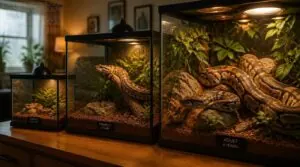
Your boa won’t stay small for long, and its home needs to keep up. Growth happens fast, so sizing right at each stage saves you money and stress down the road. Here’s how to scale up smart, from hatchling to full-grown adult.
Hatchling Starter Setups
Baby boas don’t need a mansion, just room to explore. An 18x12x12 inch enclosure gives your hatchling space to move and curl without stress.
Stick with smooth, fiber-free substrate to prevent ingestion. Keep a shallow water dish, front-opening doors curb escape attempts, and place feeding zones away from water and hides. Watch growth closely, since your compact terrarium won’t fit them forever.
Body-Length Sizing Rule
How do you know when it’s time to size up? Just measure. The bodylength sizing rule keeps things simple: juveniles need enclosures 1.2 times their length, adults need 1.5 times.
Just measure: juveniles need 1.2 times their body length in enclosure space, adults need 1.5 times
That clearance stops tail curling and wall contact. Track growth milestones and recheck dimensions every few months. This scaling proportion keeps Boa Constrictor enclosures right-sized for small apartments, no guesswork needed.
4x2x2 Growth Upgrade
This is your sweet spot upgrade. The 4x2x2 enclosures give juveniles serious room to stretch without eating up your apartment’s floor space.
Modular expansion means you add height later, not more square footage. That’s smart urban footprint management.
Rapid growth transitions get easier here, too. This size buys time before the next jump, supporting long-term enclosure scalability without constant re-buying.
Floor Space by Age
Your boa’s floor needs shift fast. Hatchlings use 60-70% of their space just crawling and scenting around, while juveniles climb more, dropping floor use to 40-50%.
Subadults balance both worlds—50-65% floor time. Growth spurt planning matters here: modular, stackable cages let you scale space without hunting for a bigger apartment footprint.
Planning for Adult Size
Full-grown boas can top out at 8-10 feet, so think ahead before you build. Adult enclosures need 6+ feet of linear footprint for a full circuit, plus floor space scaled to length and girth. Don’t skimp on vertical height—aim for 1.5x body length for climbing shelves. For a deeper dive into sizing, gradients, and layout, this step-by-step naturalistic boa enclosure guide breaks down exact dimensions for every growth stage.
Custom enclosure builds save money long-term versus repeated upgrades. Plan your final size now.
Managing Heat and Humidity Indoors
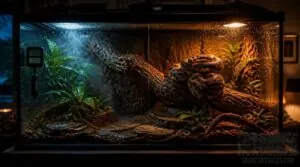
Your apartment’s climate control system won’t cut it for a boa—your enclosure needs its own. Getting the temperature and moisture right keeps your snake healthy, calm, and shedding like it should. Here’s what you need to dial in the perfect indoor climate.
Basking and Cool-Side Temperatures
Ever wonder why your boa slides between hot and cool spots all day? That’s thermoregulation in action, and it’s why your setup needs a real gradient.
- Basking spot: 95–105°F (adults) at belly level
- Cool side: 75–85°F ambient
- Gradient: minimum 20°F difference
Skip ambient guessing—measure surface temps directly, and log readings weekly to catch drift early.
Thermostats and Heat Sources
Getting that gradient right takes real hardware, not guesswork. A proportional thermostat ramps output up and down smoothly, holding your basking spot steady without harsh swings. Pair it with a ceramic heat emitter mounted overhead, angled away from branches and decor, to prevent thermal burns. Want dual zone control? Run separate probes for both sides.
| Feature | Benefit |
|---|---|
| Proportional output | Smooth heat regulation |
| Ceramic emitters | No light, steady warmth |
| Night mode | Lower nighttime set points |
| Dual zones | Independent gradient control |
| High-temp cutoff | Prevents burns |
Target Humidity Ranges
Heat’s only half the battle—your boa’s comfort hinges on humidity too. Keep RH steady between 55% and 75%, bumping toward 85% during shedding humidity spikes.
- Digital sensor accuracy beats stick-on gauges
- Watch for seasonal RH shifts
- Practice microclimate management side to side
Stable humidity control means fewer stuck sheds and healthier skin, no guesswork required.
Substrates That Hold Moisture
Substrate options matter as much as your hygrometer readings. Coconut coir and sphagnum moss absorb fast and release slowly, cutting compaction risk. Mix coir with vermiculite for airflow without sacrificing retention.
Bark chips add an organic material boost, creating gentle moisture gradients. Just watch drainage—soggy layers invite mold, so keep depth balanced and airflow steady.
Digital Hygrometers and Thermometers
How do you know your readings are right? A digital hygrometer beats stick-on gauges every time, with sensor accuracy ranges around ±2-3% RH.
Look for:
- Bluetooth monitoring apps
- Data logging for trend analysis
- Battery life optimization features
- Min/max memory
- Backlit displays
Regular hygrometer calibration keeps humidity control and thermal regulation locked in.
Building a Secure, Escape-Proof Setup
A boa that feels secure won’t spend its energy testing every seam and latch in your apartment. Escape-proofing isn’t about one big fix, it’s a handful of smart choices working together. Here’s what your setup needs to keep your snake calm and your home safe.
Front-Opening Doors and Locks
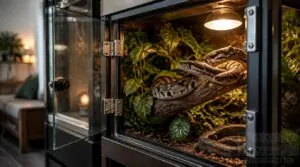
Front-opening doors are your best friend for escape-proofing. One motion swings the door open, no wrestling with lids overhead.
Look for multi-point locking systems that grip the frame at several spots, plus corrosion-resistant hardware like stainless steel. Sturdy hinges and keyless entry options add convenience without sacrificing security—because in a small apartment, a loose boa is nobody’s idea of fun.
Opaque Panels for Anxiety Relief
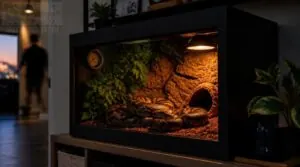
Picture your boa peeking out at every passing roommate or delivery guy—stressful, right? Opaque panels solve that by covering three sides, creating a true visual barrier that cuts external distractions.
Your snake gets calm ambiance instead of constant stimulation. Panels also shield feeding areas and minimize light fluctuations, giving apartment-dwelling boas the species-appropriate comfort they need in tight quarters.
Sturdy Climbing Branches
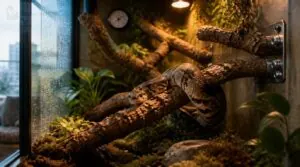
Your boa’s a natural climber, so branches aren’t optional décor. Branch load capacity matters most—go for at least 10 kg support with no bending or flex.
Choose textured grip surfaces like cork bark for secure traction. Anchor everything with secure anchor hardware, following a vertical climbing progression from low to high. Moisture resistant materials prevent mold in humid setups.
Heavy, Tip-Proof Water Bowls
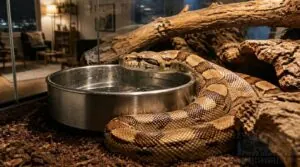
Watch a boa muscle its way across an enclosure, and you’ll understand why a light water bowl just doesn’t cut it.
- Weighted metal base for a low center of gravity
- Non-skid feet that grip smooth flooring
- High rims to contain splashes and spills
- Rubberized seals for stable, secure contact
Choose dishwasher-safe materials for easy sanitizing between refills.
Furnishing an Apartment-Friendly Habitat
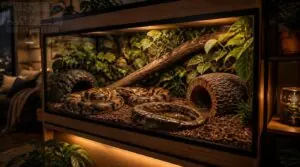
A secure enclosure is just the shell—now it’s time to make it feel like home. Your boa needs the right mix of hides, substrate, and décor to actually thrive in a small space. Here’s what your setup needs to go from safe to truly comfortable.
Hides for Warm and Cool Sides
Every boa needs two hides, not one. Your snake will pick warm or cool based on thermal regulation needs, so place one hide right over the heat source and another on the cool end.
Snug hide sizing matters most—your boa should touch all sides while coiled. Keep both dark, stable, and easy to clean. Skip drafts near entrances to protect your temperature gradients.
Bioactive Substrate for Odor Control
Once hides are set, tackle the smell. Bioactive substrate turns your enclosure into a self-cleaning system using live microbes.
- Ammonia conversion: microbes break waste into non-airborne compounds
- Material mix: wood chips, biochar, and organic matter feed the colony
- Moisture retention keeps microbes active
- Odor control stays natural, no perfumes
- Light surface refresh maintains microbial community stability
Natural Décor and Mold Resistance
Décor should look good, not grow mold. Moisture-resistant wood like cedar or redwood resists decay from humidity swings, while sealed stone accents and anti-fungal finishes keep bacteria off cork branch pieces and other climbing gear.
Choose non-porous plant decor and mold-preventing textiles for cushions or hides. Paired with your bioactive substrate, this keeps microclimate management simple, so substrate moisture retention works for your boa, not against your décor.
Placing Feeding Zones Safely
Where you feed matters as much as what you feed. Set the feeding zone 12 inches from hides, away from foot traffic and vibrations.
A feeding mat contains mess and simplifies cleanup, toss prey residue within two hours. Use stainless steel feeding tongs, never bare hands, to avoid mistaken bites. Afterward, watch for regurgitation or stress before handling again—good reptile husbandry means patience pays off.
Frequently Asked Questions (FAQs)
What is the best enclosure for a boa constrictor?
Your best bet? PVC enclosures built for modular and stackable cages, sized for urban footprint optimization.
They beat glass on thermal retention benefits, pass material longevity tests, and offer safety latch reliability—perfect for small apartments needing custom enclosure builds.
What size enclosure for a boa constrictor?
Size scales with growth: babies start around 2’x5’x1′, juveniles need 4’x2’x2′, and adults over 8 feet require 8’x4’x4′.
Plan for long-term spatial needs early, since scaling habitat dimensions gradually beats constant replacements in tight apartments.
Can boa constrictors be housed together?
Not really your best move. Boas are solitary by nature—cohabitation risks stress behaviors, resource guarding, and parasite spread. Give each snake its own space for true species-appropriate comfort and easier, individualized husbandry.
How to make a boa enclosure?
Picture panels, hardware, sealant, all waiting on your floor. Building starts with custom dimension planning, then material sealing, joint reinforcement, and component assembly. Install locking hardware last. That’s your modular, stackable vivarium ready for small apartments.
Will noise from a boa enclosure disturb neighbors?
Not much, honestly. Equipment hum stays low-level, easily cut with vibration dampening mats and smart shared wall placement. Skip the wall your neighbor sleeps against, add acoustic panel usage, and nighttime clicking won’t travel far in small apartments.
Can these enclosures pass apartment pet or weight restrictions?
Yes, with the right approach. Lightweight PVC builds and a stable Cabinet Stand help you dodge weight caps, while written landlord approval, pet count check, and liability insurance keep your setup lease-compliant and stress-free.
How often should the enclosure be relocated or moved?
Think of your snake’s home like a houseplant, not a piece of furniture — move it only when it truly needs a new spot. Best move frequency: every 6-12 months for space, minor shifts every 2-4 weeks max.
What size enclosure suits a 14-foot adult boa?
For your full-grown boa, 8 feet by 4 feet is your sweet spot. Length plus width should match snake length, giving proper stretching room and horizontal movement.
Some keepers go 10x4x4 for extra adult mobility space and reptile husbandry peace of mind.
Conclusion
Who says a big snake needs a big apartment? Smart vertical design proves size isn’t about square footage, it’s about structure. Done right, boa constrictor enclosures for apartments give your snake room to stretch and you room to live.
Stack the modules, lock the doors, dial in the humidity, and watch your boa settle in. That’s the real win: a calm snake, a calm home, and neighbors who never even know.