This site is supported by our readers. We may earn a commission, at no cost to you, if you purchase through links.

Most keepers outgrow their first enclosure setup within a year.
The snake’s fine—but the keeper isn’t, because poorly retained humidity, inconsistent gradients, and flimsy latches become daily friction points that wear on you fast.
At the expert level, your enclosure isn’t just a box; it’s a precision system that either works with your husbandry or fights it.
Snake enclosures for experienced keepers demand real decisions: PVC or glass, rack or vivarium, fixed heating or zoned automation.
The setups ahead cut through the noise and show you exactly what builds a collection worth maintaining.
Table Of Contents
- Key Takeaways
- Best Enclosure Types for Experts
- Sizing Enclosures by Snake and Goal
- Materials, Layout, and Access
- Heating, Ventilation, and Humidity Control
- Safety, Security, and Advanced Features
- Frequently Asked Questions (FAQs)
- What is the best pet snake for experienced keepers?
- What type of enclosure is best for a snake?
- How often should large snake enclosures be cleaned?
- What backup systems protect snakes during power outages?
- How can you safely transport an occupied enclosure?
- How do you quarantine new snakes before enclosure setup?
- Which snake species thrive in bioactive setups?
- How do rack systems compare to display enclosures?
- What warranties should experienced keepers expect?
- How does enclosure design reduce reptile stress?
- Conclusion
Key Takeaways
- PVC beats glass every time — it holds heat, locks in humidity, and you can drill it without calling a glazier.
- Size your enclosure for the adult animal on day one, not the hatchling in front of you right now.
- Rack systems are the only practical choice once your collection outgrows a shelf — independent thermostats per level aren’t optional, they’re damage control.
- Automate lighting, heat, and misting from the start — consistency beats manual adjustments every single time.
Best Enclosure Types for Experts
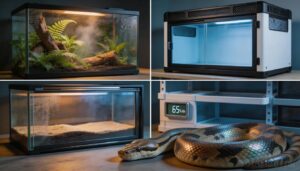
Not every enclosure works for every keeper — and at this level, you already know that. The setup you choose shapes everything from daily maintenance to long-term animal health.
That tradeoff becomes especially clear when you dig into a reptile carpet vs loose substrate comparison and see how each option handles humidity, cleanup, and burrowing behavior differently.
Here are the four enclosure types that consistently deliver for experienced keepers.
PVC Enclosures for Heat and Humidity Retention
PVC reptile enclosures outperform glass on every metric that matters.
Half-inch panels deliver closed-cell insulation that kills heat loss before it starts—panel thickness impact is real.
Silicone seam sealing locks humidity in, while adjustable vents give you airflow humidity balance without sacrificing thermal efficiency.
Add radiant panel integration overhead, and you’ve got a system built for modular expansion as your collection grows.
Its precision‑machined interlocking joints(https://apexreptile.com/blogs/apex-reptile-blog/the-last-reptile-enclosure-you-will-ever-need-apex-reptile-pvc) provide a sturdy, screw‑independent assembly.
Rack Systems for Multi-snake Collections
Rack systems are the backbone of any serious multi-snake operation. Each tub slides out like a drawer—quick-access cleaning takes seconds, not minutes.
Independent thermostats on every shelf give you failsafe thermal regulation, so a heat spike on level two doesn’t cook level three. Tub labeling prevents costly mix-ups.
Modular rack expansion and smart cable management keep your stackable reptile system organized as your collection grows.
Custom Enclosures for Large-bodied Species
When snake tops six feet, standard enclosures stop making sense. Large-bodied species need at least 1.8 meters of floor length, reinforced framing, and heavy substrate support that won’t sag under 15-plus centimeters of layered substrate.
Custom door mechanisms and integrated sensor mounts let you control every variable.
Structural load distribution across modular panels turns one enclosure into an expandable system built around your animal’s actual adult size.
Front-opening Vivariums for Easier Access
Front-opening doors change how you work inside a build. One-handed access keeps your other hand free for the animal while cable routing stays clean behind sealed channels.
Ergonomic latches open fast without fumbling. Quick heat reposition after maintenance takes seconds.
Pair front-opening doors with customizable enclosures, modular expansion options, stackable design, easy assembly, and seal retention—and you’ve got a system built for serious keeping.
Sizing Enclosures by Snake and Goal
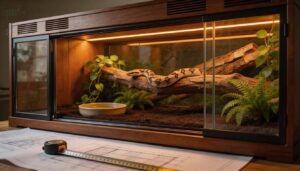
enclosure sizing right separates a good setup from a great one. The right dimensions depend on your snake’s species, adult size, and how you plan to keep it long-term.
Here’s what every experienced keeper needs to know.
Full-body Stretch as The Minimum Standard
Full-body stretch isn’t a luxury—it’s the baseline. Your snake needs one continuous, unobstructed usable path equal to its total length. That’s your clear stretch length.
A 150 cm ball python needs 150 cm of usable path after furniture impact is factored in. Diagonal stretch routes help in tighter cage dimensions, but species stretch standards, custom dimensions, and terrarium size selection for snakes must always start with that core measurement.
Floor Space for Active Terrestrial Species
Active terrestrial species demand serious footprint optimization—a corn snake tolerates tighter quarters, but a kingsnake or hognose needs genuine ground cover ratio built into your terrarium size selection for snakes.
- 48×24 inches minimum for kingsnakes (8 sq ft)
- 60×24 inches for larger colubrids (10 sq ft)
- Three distinct active zone allocations per enclosure length
- Modular expansion options for reptile systems as collections grow
- Customizable reptile enclosure solutions for species floor requirements
Vertical Space for Arboreal Setups
Arboreal species like green tree pythons need at least 90–120 cm of height for real perch tiering—not just dead vertical space. Match your height depth ratio (height ≥ depth) so angled branches actually fit.
Upper zone humidity is drier near ventilation, so monitor both levels. Multi-level perches with 25–35 cm spacing give your animal genuine ceiling clearance and thermal choice.
Planning Around Adult Size, Not Juvenile Size
Designing large snake enclosures around a juvenile’s current size is a costly mistake. A ball python hatchling at 12 inches becomes a 5-foot, 2,500-gram adult fast.
Adult weight and body bulk demand more than floor space—hide scaling, opening width, and thermal zones must match the mature animal.
Build for the growth forecast now. Modular and expandable terrarium systems make that practical.
Room to Expand With a Growing Collection
A collection doesn’t stay small. Standardized footprints — like the common 48×24 format — let you stack up to three enclosures safely and add units without rebuilding your room.
Rack density planning keeps your floor space efficient, while electrical load management prevents circuit overload as devices multiply.
Reserve quarantine space from day one, adjust aisle width for cart access, and expand anytime with modular connectors. Designed to grow with your collection.
Materials, Layout, and Access
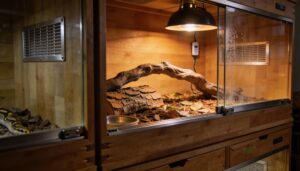
material your enclosure is built from shapes everything — heat retention, humidity, sanitation, and how long the whole setup actually lasts. Beyond the shell itself, door style and interior layout either work with your daily routine or quietly fight against it.
Here’s what experienced keepers pay attention to when building it right.
PVC Vs. Glass Vs. Sealed Wood
thermal conductivity wins on thermal conductivity, weight comparison, and moisture retention — glass loses heat fast and lets humidity escape through mesh tops.
sealed wood insulates well but warps if the seal coat fails.
PVC drillability makes probe ports and cord pass-throughs easy; tempered glass can’t be modified after manufacture.
For cost efficiency across a modular habitat, PVC is simply the smarter glass alternative.
Sliding, Swing-out, and Drop-down Doors
Door choice shapes your whole workflow. Sliding panels keep things compact — no Access Clearance Requirements eating into your floor space — but Door Gap Control matters with escape-prone species, and Track Wear Management is real.
Swing-out doors offer better Panel Fit Precision and full-front access.
Drop-downs need clear below-door clearance every time. Hinge Alignment on drop-downs affects how evenly the panel seals.
Custom routed, customizable enclosure builds with sliding swingout or dropdown window styles and optional Acrylic Door Lockers give you the custom features that actually match how you work.
Deep Substrate Dams for Naturalistic Setups
A good door keeps snakes in. A substrate dam keeps everything else where it belongs.
Dam Height Guidelines matter: keep the barrier below your door sweep for Front Door Clearance, but tall enough — 10 to 20 cm — to hold real substrate depth.
For a BioactiveReady, Designed for Naturalistic Setups build, follow these Modular Dam Construction priorities:
- Match dam material to enclosure walls — PVC resists moisture best
- Seal every seam; wet substrate creates serious Load Bearing Design pressure
- Slope substrate deeper toward the back for Substrate Moisture Management
- Size depth for your species — burrowers need 8–15 cm minimum
- Use the added volume for environmental enrichment: roots, leaf litter, microfauna
That’s a functional bioactive terrarium, not just a pretty one.
Nonporous Interiors and Easier Sanitation
Keeping things clean starts with what your walls are made of.
| Surface Type | Sanitation Benefit |
|---|---|
| Nonporous Matte Finish Surface | Waste stays topside — wipe and done |
| Sealed Panel Joints | No liquid seeps behind floors or frames |
| HDPE Tub Maintenance | One-piece tubs rinse fast, dry faster |
| Removable Sanitation Trays | Full liner swap without dismantling anything |
PVC Waste Visibility is a real advantage — light interiors show mites, urates, and mold early. Glass Cleaning Protocols are simpler when tempered panels don’t absorb disinfectant. PVC bioactive-ready reptile enclosures with a maintenance-free surface cut your cleaning time considerably.
Modular Panels, Stackability, and Extension Kits
Modular habitat design is where clean surfaces meet smart planning. Panel Standardization means your door tracks, vents, and lighting mounts stay perfectly aligned through every rebuild.
Corner Bracket Design and Interlocking Foot Mechanisms keep stacked units locked — no shift, no wobble.
Extension Kit Compatibility lets you grow from 8 to 16 square feet without scrapping your original build.
Modular Expansion Planning wins long-term.
Heating, Ventilation, and Humidity Control
Getting the environment right is what separates a good setup from a great one. Temperature, airflow, and humidity all have to work together — and each one can make or break your snake’s health.
Here’s what experienced keepers focus on to get all three dialed in.
Building a Reliable Thermal Gradient
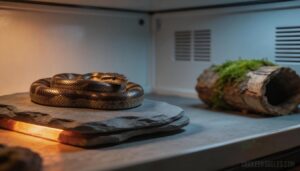
Your heat source placement determines everything. Fix it at one end — covering one-third to one-half of the floor — and zone partitioning happens naturally.
PVC helps with heat retention, but vent positioning still shapes your gradient. Think of heat gradient mapping as your blueprint:
- Anchor heat at one end only
- Place warm hides fully inside the heated zone
- Keep cool hides on the opposite end
- Use basking surfaces to boost surface conductivity
- Position vents away from the hotspot to stabilize temperature control
Thermostats, Probes, and Temperature Monitoring
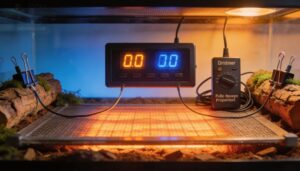
Your thermostat choice shapes the whole system. Pulse proportional control suits heat mats; dimming thermostat modes work best with basking bulbs.
Probe placement made easy — use the dedicated probe slot on each shelf, and fix it firmly.
Dual-sensor thermometers confirm both warm and cool ends at once.
Run calibration procedures before your snake goes in and add Wi‑Fi alert systems for overnight temperature control.
Safe Heating Choices for PVC Enclosures
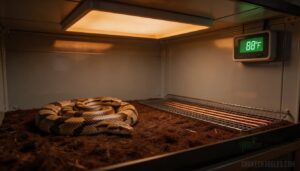
PVC plays by different rules than glass. Pick the wrong heat source, and you’ll warp panels, void warranties, or cook your animal.
- Radiant Heat Panels mount overhead and spread warmth evenly — no hotspots, no visible light disruption.
- Heat Tape Safety means external placement only; deep substrate kills floor-heat transfer fast.
- Cable Run Placement needs even spacing — stacked loops create dangerous concentrated heat lines.
- Ceramic Guard Requirement is non‑negotiable; exposed elements exceed PVC’s heat tolerance instantly.
Always run a thermostat with fail‑safe overheating protection features built in.
Adjustable Ventilation for Species-specific Needs
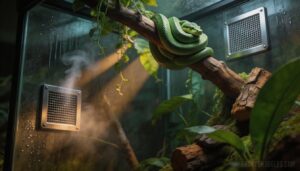
One vent size doesn’t fit every species.
Cross Vent Placement — low intake on one side, high exhaust opposite — pushes air through the full snake enclosure instead of just the front few inches.
Adjustable Vent Panels let you dial airflow up or down without drilling.
Arboreal Airflow demands upper vents where your snake actually lives.
Species Vent Tuning and Mesh Size Selection complete the ventilation design.
Humidity Control Through Substrate and Airflow
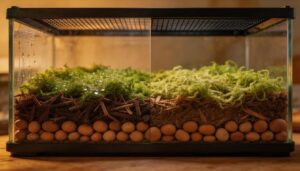
Substrate does the heavy lifting in any climate-controlled enclosure. Coconut husk and sphagnum moss hold moisture deep in the bed, while a drainage layer keeps standing water away from your snake’s contact zone.
Spot-water one side to build a moisture gradient — dry lane on one end, humid on the other.
Airflow tuning then locks it in without over-drying.
Safety, Security, and Advanced Features
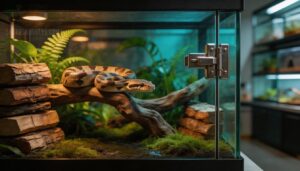
At this level of keeping, a good enclosure does more than hold a snake — it works for you. The details that separate a solid setup from a great one come down to security, functionality, and how well it holds up over time.
Here’s what experienced keepers actually look for.
Locking Systems and Escape Prevention
Snakes find every weak point—guaranteed.
Sliding door locks must clamp both panes so there’s no gap to nose‑open. Hinged door latches need positive cam or compression mechanisms, not just magnets. Vent gap control is critical; if a snout fits, the body follows. Seal cable ports with grommets. Run regular frame fit checks—warped panels shift alignment fast.
If a snout fits, the body follows—lock every gap, seal every port, and check every frame
Bioactive-ready Design for Experienced Keepers
Locks hold the animal in—bioactive design makes the space worth staying in.
A proper build starts with Drainage Layer Design: 2–5 cm of expanded clay, a mesh barrier, and a drain port. Soil Depth Planning means 10+ cm minimum. Live Plant Integration and Microfauna Colonies handle waste naturally.
- Pothos and philodendron survive enclosure heat
- Springtails eliminate mold; isopods break down shed
- PVC seams sealed with aquarium silicone lock in Substrate Moisture Management
Enrichment With Hides, Branches, and Ledges
Thermal hide positioning matters more than most keepers admit. Place one hide on the warm side, one on the cool — your snake thermoregulates without ever losing cover. Secure hide fit means snug interior walls, not open shelter.
For more on arranging hides alongside plants, décor, and substrate, corn snake habitat ideas worth stealing show how a thoughtfully layered enclosure supports both thermoregulation and natural exploratory behavior.
For hides that hold their shape and won’t warp from heat or moisture, custom PVC snake enclosure designs give you a durable foundation that supports proper thermal gradients long-term.
Branch angle diversity turns vertical space into actual travel routes. Ledge surface texture prevents falls.
Enrichment pathway flow connects floor to canopy seamlessly.
Automation for Lighting, Heat, and Misting
Automation closes the gap between good setups and consistent ones. Photoperiod Timers lock your UVB lighting and heat lamp cycles without daily babysitting. Pulse-Dimming Thermostats with probe monitoring cut temperature swings better than simple on/off models. Smart Misting Controllers paired with Digital Humidity Sensors handle humidity regulation on schedule.
Integrated Power Strips built with failsafe design — one overload won’t take down the whole rack.
Durability, Maintenance, and Long-term Value
Rigid PVC construction outlasts sealed wood and glass when humidity is a daily reality. Thicker panels hold square under stacked weight, and smooth nonporous walls won’t absorb odor or warp.
Seal integrity holds around substrate dams where wood fails first.
Stainless hardware extends hardware longevity, and modular expansion options protect your investment as your collection grows.
A 5-year warranty backs it all.
Frequently Asked Questions (FAQs)
What is the best pet snake for experienced keepers?
Carpet pythons and boa constrictors top the list. Both reward handling expertise, eat reliably, and live 20-plus years. Blood pythons suit keepers who prefer a calmer, heavy-bodied challenge.
What type of enclosure is best for a snake?
PVC reptile enclosures win for most keepers — they nail heat and humidity control, outlast glass, and adapt to species-specific needs.
Your best pick depends on budget considerations, climate zone compatibility, and the snake you’re housing.
How often should large snake enclosures be cleaned?
Clean daily, deep disinfect every 4–12 weeks. Remove waste same-day, refresh water bowls daily, and log your cleaning frequency to catch humidity or substrate dam issues before they compound.
What backup systems protect snakes during power outages?
A UPS Power Backup keeps thermostats and Temperature Alarm Monitoring online during brief outages. A Generator Power System manages long ones.
Use Insulated Emergency Tubs with Shipping Heat Packs as a last resort.
How can you safely transport an occupied enclosure?
Move fast, break things — not here. Lift from the base, clear interior hazards, lock every door, and use a dolly. Climate-controlled transport keeps stress low.
How do you quarantine new snakes before enclosure setup?
Separate Room Isolation is non-negotiable. Use Paper Towel Substrate, Dedicated Cleaning Tools, and follow strict Health Monitoring Protocol. Quarantine Duration Guidelines recommend 60–90 days minimum before any permanent enclosure setup begins.
Which snake species thrive in bioactive setups?
Ball pythons, corn snakes, and western hognose snakes all thrive in bioactive setups — each needing species-specific conditions. Match humidity, substrate depth, and thermal gradients to the animal, not the trend.
How do rack systems compare to display enclosures?
Racks win on space efficiency and maintenance efficiency. Display enclosures win on access monitoring and enrichment. Your choice depends on collection size, not personal preference.
What warranties should experienced keepers expect?
Expect a 5-year warranty minimum. Top brands offer lifetime structural warranty coverage on panels and a hardware latch coverage clause for daily-use components. Always check exclusion clauses before buying.
How does enclosure design reduce reptile stress?
Opaque panels block outside movement, minimal reflections calm the animal, and airflow management keeps conditions stable. A consistent thermal gradient and steady light cycle handle the rest.
Conclusion
Like a master builder adding the final touches to a grand structure, you’ve now assembled the knowledge to create superb snake enclosures. Your collection deserves precision, control, and innovation — the hallmarks of first-rate snake enclosures for experienced keepers.
With these insights, raise your husbandry, simplify your care routine, and enjoy the satisfaction of a thriving, well-maintained collection. Your expertise shines through in every detail, every decision, and every snake that thrives under your care, perfectly.