This site is supported by our readers. We may earn a commission, at no cost to you, if you purchase through links.

The Mexican black kingsnake doesn’t stop at tolerating other snakes. It eats them. That trait, called ophiophagy, defines how you’ll house and manage this species from the start. It signals something broader too: this snake carries the precision instincts of a predator shaped by the Sonoran Desert’s rocky canyons and sun-baked washes.
Mexican black kingsnake care rewards that same precision. Jet-black scales, a calm temperament once acclimated, and a lifespan that routinely hits 20 years make it one of the most serious long-term commitments in the reptile hobby. Get the fundamentals right, and this snake will outlast most pets you’ve ever owned.
Table Of Contents
- Key Takeaways
- Mexican Black Kingsnake Care Basics
- How to Set Up The Enclosure
- How to Regulate Temperature and Humidity
- How to Feed and Handle Safely
- How to Maintain Long-Term Health
- Frequently Asked Questions (FAQs)
- Do Mexican black kingsnakes make good pets?
- Do Mexican black kingsnakes like being held?
- Are Mexican black kingsnakes aggressive?
- Are Mexican black kingsnakes easy to take care of?
- How often should you feed a Mexican black kingsnake?
- Are Mexican black kingsnakes bitey?
- How big of a tank does a Mexican black kingsnake need?
- How big do Mexican black kingsnakes get?
- What size cage does a Mexican black kingsnake need?
- How often should my kingsnake be handled?
- Conclusion
Key Takeaways
- Mexican black kingsnakes are ophiophagous — they eat other snakes, including their own kind — so they must always be housed alone, and their enclosures need to be escape-proof since any gap wider than 2 millimeters is an exit.
- Core husbandry targets are a basking spot of 88–92°F with a cool side of 75–80°F, humidity held at 40–60%, and a 40-gallon breeder minimum (4x2x2) enclosure for adults with 2–4 inches of burrowable substrate.
- Feeding follows age-based schedules — hatchlings every 5–7 days, juveniles every 7–10 days, adults every 10–14 days — using frozen-thawed prey sized to about 1.5 times the snake’s mid-body girth, with no handling for 48 hours after meals.
- With a lifespan of 15–20 years (often up to 25), this species is a serious long-term commitment that requires quarantine of new arrivals, annual reptile vet exams, and consistent monitoring for shedding problems, respiratory infections, and mites.
Mexican Black Kingsnake Care Basics

The Mexican Black Kingsnake (Lampropeltis getula nigrita) is a striking, purpose-built predator native to the Sonoran Desert — and keeping one well starts with understanding what it actually is. Before you build an enclosure or choose a feeding schedule, a few foundational facts will shape every decision that follows. Here’s what you need to know first.
Its glossy, jet-black scales and ophiophagous diet are just the beginning — understanding how UVB lighting supports snake health helps you replicate the Sonoran sun it evolved under.
Scientific Name and Native Range
The Mexican black kingsnake (Lampropeltis getula nigrita) is native to the Sonoran Desert, ranging from Sonora and Baja California into southern Arizona and New Mexico.
Nigrita means "dark" in Latin. In the wild, it occupies a classic desert reptile habitat of rocky canyons, scrubland, and sandy washes, where ophiophagy is among its defining survival traits. Understanding this species benefits from a data-centered reading approach when reviewing scientific literature on its ecology and behavior.
Adult Size and Growth Rate
Knowing the species’ desert roots, you can predict its adult proportions. Adult size in captivity lands at 3 to 5 feet, reached by age 2 to 3 with consistent feeding.
Track growth rate by:
- Weighing monthly
- Measuring length quarterly
- Upsizing prey as the body grows
- Following a strict juvenile feeding schedule every 5 to 7 days
Lifespan and Ownership Commitment
That growth curve plateaus around age 3. The lifespan and ownership commitment that follow are what most new keepers underestimate: healthy individuals usually reach 15 to 20 years, many pushing to 25.
This is a genuine reptile long-term commitment. Plan for longevity care from day one, including vet access, husbandry records, and a named caregiver if your situation ever changes.
Ophiophagy and Single-snake Housing
That longevity comes with one fixed rule: house this species alone. Mexican black kingsnakes are ophiophagous, meaning they naturally eat other snakes, including their own kind. Cohabitation isn’t just stressful, it’s a feeding event you’re setting up.
Mexican black kingsnakes are ophiophagous — house two together and you’re not cohabitating, you’re scheduling a meal
Despite that instinct, they thrive on a standard diet of appropriately sized rodents in captivity. Keep the enclosure escape-proof with a gap-checked lid.
Morphs and Captive-bred Sourcing
The standard all-black morph is what you’ll encounter most. Captive breeding morphs with subtle speckling exist too, but either way, prioritize captive-bred only sourcing.
- Lineage and generation records
- Birth dates and clutch history
- Health screening documentation
- Permits and compliance paperwork
Breeder reputation verification is non-negotiable. Request references before committing to any Mexican black kingsnake.
How to Set Up The Enclosure
Getting the enclosure right is the foundation everything else builds on. Mexican black kingsnakes are active, intelligent, and relentlessly curious—so your setup needs to account for their size, their escape artistry, and their need for proper hides and substrate. Here’s what you need to cover before your snake moves in.
If you want a deeper dive into what makes a habitat truly work for your snake, these snake habitat essentials walk through the details that separate a good setup from a great one.
If you’re newer to keeping snakes, brushing up on beginner-friendly snake breeds and their care requirements can give you useful baseline knowledge before diving into the more specific demands of a Mexican black kingsnake setup.
Juvenile and Adult Enclosure Sizes

A 20-gallon long helps juveniles comfortably through their first year. Once yours crosses 3 feet, move it up to a 40-gallon breeder minimum, giving enough floor space to sustain a real temperature gradient from a basking spot of 88-92F to a cool end.
A sandy soil substrate mix at 2-4 inches depth rounds it out, with humidity held at 40-60%.
Escape-proof Lid and Gap Checks
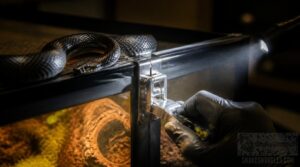
Mexican Black Kingsnakes will test every seam in your setup. Treat an escape-resistant juvenile enclosure as non-negotiable from day one.
When you move to a 48 L x 24 W x 24 H adult tank, any gap wider than 2 millimeters is an exit. Fit a secure locking lid with an over-center latch, then confirm the seal with a flashlight.
Warm and Cool Side Hides

Every snake uses hides to thermoregulate, not just to hide.
Your warm side hide should run 2 to 6 degrees Fahrenheit above ambient daytime temperature, and dark, snug materials help it hold heat without spiking.
The cool side runs 5 to 10 degrees cooler, with lighter interior surfaces to prevent buildup.
Place a thermometer inside each to confirm actual readings.
Substrates and Burrowing Depth
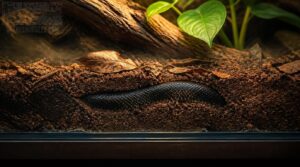
Cypress mulch and aspen hit the right burrowing depth of 3 to 6 inches without compacting. A substrate sandy soil mix adds variety if drainage is reliable.
Keep substrate moisture balance in check, as excess dampness breeds mold, and monitor substrate moisture retention during shedding periods. Deep layers also affect enclosure security measures, so confirm lid fit when substrate increases.
Enrichment and Bioactive Setup
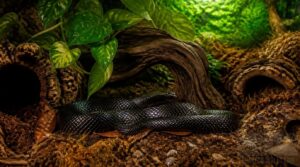
A bioactive setup works for you around the clock. Pair isopods and springtails with a layered substrate to handle waste without scrubbing it yourself.
- Cork bark hides on both warm and cool sides
- Hollow driftwood for climbing and retreat
- Live plants to add vertical complexity
- Isopods and springtails as your cleanup crew
- Rotate enrichment items every two to four weeks
How to Regulate Temperature and Humidity
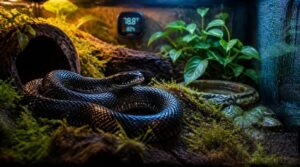
Getting the climate right inside your Mexican black kingsnake’s enclosure isn’t complicated, but the details matter more than most beginners expect.
Temperature gradients, humidity levels, and lighting schedules each play a distinct role in keeping your snake healthy and stress-free.
Here’s what you need to dial in before anything else.
Basking and Ambient Temperature Ranges
The thermal gradient across your enclosure is what makes reptile thermoregulation actually work. Aim for a basking spot of 88-92°F, where your snake can absorb heat quickly. The broader 85-90°F basking zone, often delivered by a ceramic heat emitter, allows comfortable activity at slightly lower temps.
Your cool side should hold around 75-80°F, giving the snake real options for self-regulation.
Pairing this gradient with the right equipment makes all the difference—explore how different thermostat types regulate snake enclosure temperatures to avoid frustrating hot or cold spots.
Nighttime Drops and Safe Heating
Temperatures can safely drop to 70-75°F at night.
- Ceramic heat emitters provide warmth without light, preserving the night cycle
- Under-tank pads should cover only half the floor
- Always pair any heat source with a thermostat
- Don’t let temps fall below 65°F for long
A ceramic heat emitter on one side keeps things safe if your room runs cold at night.
Thermostats and Digital Monitoring
Once your ceramic heater is in place, you need something controlling it. The Exo Terra Pulse Dimming Proportional Thermostat 300w dims output gradually rather than cycling on and off, pairing cleanly with the Arcadia Ceramic Reflector Clamp Lamp 55 and Arcadia LampGuard Pro. Log readings with the Bio Dude Digital Thermometer Hygrometer for accurate digital hygrometer monitoring.
| Tool | Function |
|---|---|
| Exo Terra Pulse Dimming Proportional Thermostat 300w | Gradual output control, stable basking temps |
| Bio Dude Digital Thermometer Hygrometer | Real-time temperature and humidity tracking |
| Auto shutoff | Prevents overheating if a sensor fails |
Humidity and Humid Hide Setup
Once your thermostat holds temperatures steady, shift attention to moisture. Mexican Black Kingsnakes thrive at humidity 40-60%, enough for clean sheds without mold risk.
A humid hideout packed with damp sphagnum moss controls most of that load, keeping reptile humidity control simple.
Substrate layering in bioactive setups lets cleanup crew organisms process waste while passively stabilizing moisture at depth.
UVB Lighting and Day Cycle
A 12-hour light cycle keeps your Mexican Black Kingsnake’s behavior predictable, shaping both feeding drive and shed quality through consistent lighting photoperiod effects. UVB lighting for snakes isn’t strictly essential, but a UVB 50 tube is a low-cost, optional upgrade that delivers real benefits:
- helps with vitamin D3 synthesis
- Reinforces natural daytime activity
- Encourages more consistent feeding behavior
- Reduces incomplete sheds
How to Feed and Handle Safely
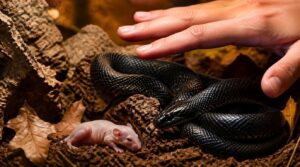
Feeding and handling a Mexican black kingsnake correctly isn’t complicated, but the details matter more than most new keepers expect. Get the prey size wrong, handle too soon after a meal, or push interaction before the snake is ready — and you’ll run into problems that are entirely avoidable.
Here’s what you need to know before you ever open that enclosure door.
Prey Type, Size, and Preparation
Mice are the go-to prey for Mexican black kingsnakes in captivity. Frozen-thawed rodents are the safer choice, eliminating the bite risk that live feeders carry, and they’re easy to stock in bulk. Warm each one to around 90-95°F before offering it on tongs.
Prey size regulation keeps feeding safe. Match prey width to roughly 1.5 times your snake’s mid-body girth.
Age-based Feeding Schedule
Three distinct feeding stages define your care schedule, and knowing each one prevents chronic underfeeding and obesity.
- Hatchlings: every 5-7 days, one pinky
- Juveniles: every 7-10 days, fuzzies through small hoppers
- Adults: every 10-14 days on large mice
- Breeding females: every 7 days to support egg production
- Post-feed rule: no handling for 48 hours
Always fine-tune based on body condition.
Live Prey Risks and Alternatives
Live rodents fight back. A defensive mouse can bite your snake’s eye or mouth, causing wounds that need a vet.
Frozen-thawed prey eliminates that risk entirely. Thaw in warm water, never microwave, and confirm the prey reaches room temperature before offering it with tongs. If your snake refuses, scent the rodent with chicken broth to trigger a reliable feeding response.
Handling Frequency and Acclimation
Give a new Mexican black kingsnake two to eight weeks before handling. It needs time to map the enclosure and settle into a feeding routine.
Once it’s eating reliably, aim for one to two sessions weekly. Scoop with both hands, support the full body, and stay calm if it musks. That defensiveness fades with consistent handling.
Post-feeding and Pre-shed Precautions
Two rules govern your handling schedule beyond acclimation. Skip handling for at least 48 hours after every feeding. Disturbing a digesting snake risks regurgitation, which can be life-threatening.
Cloudy, opaque eyes signal the start of a shed cycle. Vision is compromised, the snake strikes defensively, and handling only adds stress. Wait until the shed is complete.
How to Maintain Long-Term Health
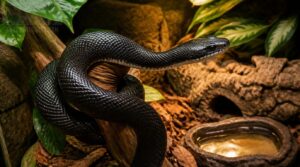
Long-term health isn’t complicated, but it does require consistency. Most problems that land a Mexican black kingsnake at the vet trace back to something small that was overlooked — a dirty water dish, a skipped shed check, a delay in finding the right reptile vet. Here’s what to stay on top of.
Healthy Snake and Shedding Signs
A healthy Mexican Black Kingsnake sheds every 4 to 6 weeks. Watch for cloudy, bluish eyes and dull, hazy skin signaling the pre-shed phase, usually 7 to 14 days out.
After shedding, your snake should produce one complete, intact piece, eye caps included. Bright, glossy scales confirm a successful shed. Fragmented or stuck shed points to low humidity or dehydration.
Respiratory Infections and Mouth Rot
That same humidity imbalance can tip into something more serious. When enclosure humidity climbs consistently above 70%, your snake becomes a prime candidate for respiratory infection. Watch for wheezing, nasal discharge, or open-mouth breathing that isn’t related to thermoregulation. Any of these warrants a vet visit, not a wait-and-see approach.
Mouth rot (stomatitis) usually follows an injury: a bite from live prey or a scratch from enclosure furniture lets bacteria take hold fast. Early signs are redness, swelling, or small blisters inside the mouth. Left untreated, it spreads up the jaw and into surrounding tissue.
Both conditions respond well to antibiotic therapy when caught early. A reptile vet will confirm the diagnosis using bacterial cultures and may prescribe a 2-4 week treatment course. Prevention is straightforward: maintain humidity between 40-60%, avoid pine or cedar substrates, and clean the enclosure on a consistent schedule.
Mites, Parasites, and Quarantine
Mites are small enough to escape notice until the infestation is already well established. Quarantine every new snake for at least 60 days, keeping it completely isolated from your existing collection.
- Watch for excessive soaking or restless behavior
- Check scales carefully at each shedding cycle
- Disinfect enclosures with F10SC between animals
- Schedule your annual parasite screening with your reptile vet
Cleaning, Water, and Hand Hygiene
Keeping things clean is the other half of parasite prevention. Spot-clean waste daily and deep-clean monthly using F10SC or Rescue disinfectant.
Scrub the water bowl weekly and swap in a larger one during shedding so your snake can soak fully.
Treat minor skin contact points with Leucillin antiseptic spray. Always wash hands before and after handling to prevent Salmonella transmission.
Veterinary Care and Health Records
A reptile-savvy vet isn’t optional. Schedule an annual wellness exam and keep detailed records that include:
- Parasite screening results and treatment dates
- Shedding cycle notes and any retained shed incidents
- Respiratory infection symptoms and treatment logs
- Vaccination and medication history
- Weight and growth measurements at each visit
That gives you a reliable health monitoring protocol from the start.
Frequently Asked Questions (FAQs)
Do Mexican black kingsnakes make good pets?
Like the proverbial diamond in the rough, the Mexican black kingsnake is an excellent beginner pet snake: manageable enclosure size, a calm temperament with handling after settling, and a lifespan of 15 to 20 years.
Do Mexican black kingsnakes like being held?
Most tolerate it rather than enjoy it. Captive-bred individuals acclimate best, and calm, brief sessions build trust over weeks. Defensive juveniles usually settle with patient, consistent handling.
Are Mexican black kingsnakes aggressive?
No. Mexican black kingsnakes are calm, non-aggressive snakes, though defensive juveniles may rattle tails initially. Apply handling safety protocols and stress reduction techniques; behavioral observation tips confirm consistent docility.
Are Mexican black kingsnakes easy to take care of?
Yes, they’re genuinely easy. A secure enclosure size, basking heat near 88-90 F, humidity 40-60%, and correct feeding frequency by age cover the basics. Their calm temperament and simple health monitoring protocols make them beginner-friendly.
How often should you feed a Mexican black kingsnake?
Feed hatchlings every 5–7 days, juveniles every 7–10 days, and adults every 10–14 days. Match prey size to the snake’s widest body point, and never feed during shed.
Feeding frequency works hand in hand with proper heat and humidity, so a solid tropical snake enclosure setup makes digestion easier and keeps your snake on a healthy schedule.
When you’re ready to feed, thaw frozen prey safely in the fridge and offer it with long tongs—our beginner’s guide to feeding pet snakes walks through each step in detail.
Sticking to a consistent schedule is easier than it sounds—this snake feeding frequency guide breaks down the signs your snake is thriving at its current routine.
Stress from irregular feeding schedules is one of the most overlooked triggers, so brushing up on corn snake bite prevention techniques can help you stay ahead of defensive behavior before it starts.
Are Mexican black kingsnakes bitey?
Not really. Mexican black kingsnakes are calm, curious snakes that rarely bite, preferring defensive musking or bluff strikes when stressed. Use gentle snake handling techniques, watch temperament cues, and your bite risk stays minimal.
How big of a tank does a Mexican black kingsnake need?
A 40-gallon breeder, roughly 48x18x16 inch tank, suits most adults. Larger, active snakes benefit from a 4-foot enclosure. Start juveniles in smaller, escape-resistant housing, and always plan a proper thermal gradient setup.
How big do Mexican black kingsnakes get?
Expect 3 to 4 feet as the adult norm, with well-fed captives occasionally pushing 5 feet. Hatchlings start near 8 inches but grow fast. A 48x18x16 inch tank suits adults comfortably, and prey should never exceed 15 times head width.
What size cage does a Mexican black kingsnake need?
An adult needs a 4x2x2 enclosure, like the Terra Sahara Substrate Kit, with 2 to 4 inches of burrowable substrate. Juveniles stay in escape-resistant housing. Always house kingsnakes alone, and lock every lid.
How often should my kingsnake be handled?
Handle your kingsnake 1-2 times weekly to maintain tameness. Keep sessions short, around 10-15 minutes, and never within 48 hours of feeding to prevent regurgitation. Consistency builds trust faster than frequency.
Conclusion
Twenty years from now, your Mexican black kingsnake may still be watching you from its hide, jet-black and unhurried. That’s the quiet contract you signed.
Mexican black kingsnake care isn’t a checklist you finish, it’s a rhythm you keep: correct temperatures, measured prey, clean water, watchful eyes. Master the details and the snake rewards you with decades of steady, low-drama companionship. Few pets ask so little and stay so long.