This site is supported by our readers. We may earn a commission, at no cost to you, if you purchase through links.

The first time I saw a rainbow boa catch the light, I stopped mid-sentence. Here was a plain brown snake, nothing special at first glance, suddenly flashing colors like an oil slick in sunlight. No pigment involved. The effect comes from microscopic ridges on each scale that split light the same way a soap bubble does.
That trick explains the name, but it’s only part of the story. Epicrates cenchria hails from humid South American forests, hunts by infrared at night, and gives birth to live young instead of laying eggs. It also happens to be one of the most rewarding boas you can keep, provided you nail the humidity.
Getting that balance right is easier than you think. Let’s walk through it.
Table Of Contents
- Key Takeaways
- What is a Rainbow Boa?
- Rainbow Boa Size and Appearance
- Rainbow Boa Enclosure and Climate
- Rainbow Boa Diet and Hydration
- Rainbow Boa Temperament, Health, and Lifespan
- Frequently Asked Questions (FAQs)
- How big will a rainbow boa get?
- Are rainbow boas venomous?
- Do rainbow boas like to be held?
- Are rainbow boas rare?
- Can a rainbow boa be a pet?
- How hard is it to take care of a rainbow boa?
- Is a rainbow boa endangered?
- What color is a rainbow boa?
- Where do rainbow boas come from?
- What is a Brazilian rainbow boa?
- Conclusion
Key Takeaways
- The rainbow boa’s famous shimmer comes from microscopic scale ridges that split light like a soap bubble, not from any pigment in its brown-to-orange skin.
- These non-venomous South American constrictors stay a manageable 3.5 to 6 feet, hunt rodents by infrared at night, and give birth to live young after a five-month gestation.
- Successful keeping hinges on climate control: a 28-32°C warm zone with a cool end, 60-70 percent humidity, and moisture-retaining substrate like coconut coir to ensure clean one-piece sheds.
- Feed frozen-thawed prey no wider than the snake’s body every 5-14 days depending on age, avoid handling for 24-48 hours afterward, and expect a 20-30 year commitment with consistent daily monitoring.
What is a Rainbow Boa?

Before you pick out a tank, you should know exactly what a rainbow boa is and why it behaves the way it does. This section covers its scientific classification, natural range, hunting style, and how it brings live babies into the world. Once you understand the snake itself, choosing the right enclosure becomes much easier.
If you’re leaning toward an even more beginner-friendly species, this rosy boa easy care guide breaks down everything you need for a low-maintenance setup.
Scientific Name and Classification
Every rainbow boa you meet carries a scientific name: Epicrates cenchria. This binomial system, called binomial nomenclature, gives each animal a unique two-word label. The genus, Epicrates, is capitalized; the species epithet, cenchria, stays lowercase. Both words appear italicized in print. The modern taxonomic system uses eight hierarchical levels, ranging from species at the lowest level to domain at the highest.
Here’s the full classification breakdown:
- Kingdom: Animalia
- Phylum: Chordata
- Class: Reptilia
- Order: Squamata
- Family: Boidae
That last rank matters most to keepers. Boidae includes boas, and Epicrates groups large, non-venomous New World constrictors sharing similar scale patterns. The common name Brazilian Rainbow Boa refers to this same species. After first mention, scientists abbreviate it as E. cenchria.
Taxonomy isn’t frozen, though. Molecular studies occasionally revise placement, so check current databases for the accepted species summary.
Native Range and Habitat
So where does E. cenchria actually live? Wild rainbow boas call northern South America home, especially Guyana, Suriname, and northern Brazil. You’ll find them in humid forests near streams and swamps, plus forest-savanna edges.
Days are spent sheltering in hollow logs or leaf litter. At night, they emerge for forest floor foraging, hunting in that damp, warm Amazon rainforest darkness.
Nocturnal Hunting Behavior
Once the sun sets, rainbow boas get to work. They hunt using infrared heat sensing, detecting warm rodent bodies through facial pits. Their carnivorous diet makes them key players in rodent population control across the forest floor. Rather than chasing, they ambush from dense cover, striking within seconds.
This predator-prey relationship peaks after dusk, when humidity and temperature align perfectly for forest floor foraging.
Constriction and Venom Status
After that ambush strike, the real work begins. Rainbow boas subdue prey with constriction, wrapping multiple muscular coils around the animal until it stops struggling. Each coil tightens as prey fights back, then swallowing begins head first.
Here’s the good news for keepers: rainbow boas are non-venomous. They lack functional venom glands entirely. A defensive bite is just a warning, requiring simple wound care only.
Reproduction and Live Birth
When breeding season arrives, females give birth to live young, not eggs. Rainbow boas use viviparous reproduction, meaning embryos develop inside eggs retained within the mother’s body until hatching internally.
After a gestation period of roughly five months, litters of 4 to 12 babies arrive, each about 12 inches long. Watching a birth in my collection remains unforgettable!
Rainbow Boa Size and Appearance
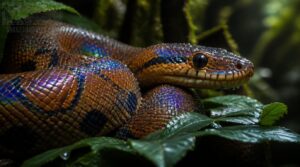
Before you set up an enclosure, you need to know what you’re housing. Rainbow boas have a specific size range and a look that’s unlike almost any other snake. Once you understand their adult length and famous shimmer, choosing the right setup gets much easier.
Since adults typically reach five to six feet and stay fairly heavy-bodied, planning an appropriately sized tank from the start saves you costly upgrades later—this guide to appropriate snake tank dimensions breaks down exact measurements by age and enclosure style.
Adult Length and Weight
How big will your rainbow boa actually get? Most Epicrates cenchria stay surprisingly manageable, averaging 3.5 to 6 feet as adults.
- Females usually reach 4.5 to 6 feet
- Males stay smaller, around 3.5 to 5 feet
- Adult weight spans 4.4 to 8.8 pounds, sometimes 22
- Captive snakes often grow heavier than wild ones
Track your boa’s growth rate with monthly measurements. Steady gains signal good health. Most reach full size by age three, and with proper care, expect a 20-plus year lifespan!
Colors, Patterns, and Markings
The name "rainbow boa" fits, but the base colors are actually earthy. Expect deep brown to orange tones with cream undertones. Dark dorsal bands run neck to tail, and lateral tan crossbands create a segmented look. Some snakes show marbled blotches instead of clean stripes. The belly stays cream to pale yellow, nearly uniform. Juveniles look lighter, then darken with each shed. Lighter ground color means higher pattern contrast, so habitat lighting really shows off markings.
Iridescent Scale Structure
Here’s the real magic behind that shimmer. Rainbow boa scales stack ultra-thin layers that bend light like a soap bubble. View your snake from different angles and you’ll see blue, green, and purple flashes shift.
A rainbow boa’s shimmer comes from ultra-thin scale layers that bend light like a soap bubble, flashing blue, green, and purple as it moves
Keratin and melanin gradients boost the brightness. Keep scales healthy with proper humidity and good reptile nutrition, since damage dulls the effect. Try a flashlight at night!
Common Captive Color Morphs
Wild-type rainbow boas already glow, but captivebred reptiles now come in stunning morph variations. Selective breeding locks in morph genetics for color and pattern traits. Here’s a quick comparison of popular options:
| Morph | Body Color | Key Trait |
|---|---|---|
| Albino | Cream to pink | Red eyes |
| Hypo | Light caramel | Reduced dark pigment |
| Anery | Silver to gray | High contrast pattern |
| Amelanistic | Creamy ivory | Lavender sheen |
| T Positive | Deep saturated | Extra iridescence |
Each morph needs slightly different reptile care. Albinos fade under harsh light, so dim your fixtures. Hypos hold color best with a stable thermal gradient. Amelanistics shed more easily thanks to lighter skin. T positives deepen in color with age! Choose based on your experience level and budget.
Rainbow Boa Enclosure and Climate
Getting the enclosure right is where most rainbow boa success stories begin. In the field, I’ve watched Epicrates cenchria thrive in steamy Amazonian humidity, and your job is to recreate a slice of that world at home. Don’t worry, it’s easier than it sounds—let’s start with the enclosure itself, from hatchling to adult.
Juvenile and Adult Enclosures

A rainbow boa that fits in your palm today will need serious space tomorrow. Juveniles thrive in 10 to 20 gallon tanks, while adults require 40 to 125 gallon enclosures with reinforced corners.
Use tamper-resistant latches, since these snakes test every opening. Add climbable branches and at least one hide per animal. Secure lids matter, because adults can lift loose tops!
Temperature Gradient and Heating

Once your enclosure is secure, heating becomes your next priority. Rainbow boas need a temperature gradient spanning warm to cool zones for proper reptile thermoregulation.
Target these numbers:
- Basking lamp zone: 28 to 32 C
- Cool end: 22 to 26 C
- Thermostat accuracy: ±1 C
Use a ceramic heat emitter or under-tank heater, always controlled by a digital thermostat with probe. Map your gradient with an infrared thermometer, and check daily!
Humidity and Shedding Needs
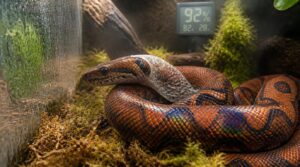
Temperature is only half the climate puzzle. Humidity is the other half, and for Epicrates cenchria, it matters even more!
Keep ambient humidity between 60 and 70 percent, measured at snake level with a digital hygrometer. Consistency beats swings here. Offer a damp hide lined with sphagnum moss for shedding, keep a clean water dish, and mist only as needed. Watch for clean, one-piece sheds!
Moisture-Retaining Substrate Options
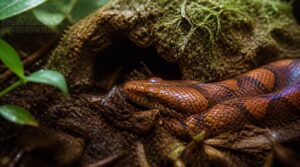
Your substrate is the humidity engine of the whole setup. Choose wisely!
Coconut coir is my go-to. It holds 4 to 5 times its dry weight in water, buffering humidity beautifully. Mix it with vermiculite for drainage, or mix in coco husk fiber and rice hulls for extra porosity. Avoid peat alone; it compacts and blocks airflow. Sphagnum moss works great draped over hides, keeping moisture close without packing down.
Hides, Climbing, and Enrichment

Now for the fun part: turning that substrate into a real habitat. Your rainbow boa (Epicrates cenchria) needs hides at multiple levels, dark and enclosed, never near heat sources. Add sturdy branches and ledges for climbing, since these snakes cruise vertical paths at night.
Rotate enrichment weekly to prevent boredom. Try scent-based puzzles or vine configurations. Watch for failed climbs or chewed items, and remove anything worn. That’s behavioral enrichment done right!
Rainbow Boa Diet and Hydration
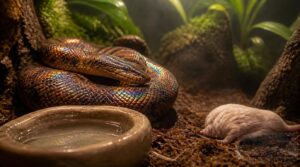
Feeding a rainbow boa (Epicrates cenchria) is one of the simplest parts of keeping one, but the details matter. Get the prey size, schedule, and hydration right, and your snake will reward you with steady growth and clean sheds. Here’s everything you need to know about feeding and watering your boa.
Appropriate Mice and Rats
In the wild, Epicrates cenchria eats almost anything warm and fuzzy. In captivity, feeder mice are your staple, from pinkies up to adults, with rats offered once your boa grows. I always buy frozen from reputable suppliers, since lab-raised rodents carry far fewer parasites than wild-caught prey.
Follow these rules:
- Choose frozen-thawed prey, never live
- Buy from vendors with health guarantees
- Reject prey with freezer burn or off smells
- Store at steady freezer temperatures
Thaw fully, warm gently, and offer with tongs!
Choosing The Right Prey Size
Because size matters more than species, matching prey to your boa’s girth is the golden rule. Offer feeder mice no wider than the snake’s thickest body point.
Too large causes regurgitation; too small leaves hunger. Weigh monthly and adjust gradually. Watch post-feeding behavior closely!
Age-Based Feeding Schedules
Growing at different rates means your boa’s feeding schedule changes with age. Hatchlings eat every 5 to 7 days, juveniles every 7 to 14, and adults every 10 to 14.
Keeping a ball python instead? This ball python care and handling guide covers feeding routines, housing, and safe handling.
Because feeding goes hand in hand with proper warmth, it also helps to review these snake habitat setup tips so your boa can digest each meal comfortably.
Whatever the age, frozen-thawed mice are the safer choice, and this guide on feeding mice to your snake safely covers thawing and prep.
If your boa refuses a thawed rodent, a guide to feeding live prey safely can help you offer it with less risk to your snake.
As your boa grows, pairing the right feeding frequency with a proper warm-and-cool temperature gradient setup helps ensure your snake digests meals efficiently and stays on track.
If you’re weighing whether a boa fits your lifestyle, our complete guide to corn snake pet ownership covers what daily care actually looks like.
If your boa refuses meals or acts unusually, recognizing stress and aggression signs in boa constrictors can help you tell the difference between a picky eater and a snake that needs attention.
Match prey size to body weight: 5 to 10 percent for juveniles, 15 to 25 percent for adults.
Adjust during sheds or illness. Consistency matters, so weigh monthly and watch body condition!
Water Bowl Requirements
Water is the one thing your Rainbow Boa can’t skip a day without. In the field, Epicrates cenchria drinks nightly from forest pools, so offer fresh water daily in a shallow, heavy ceramic bowl. Here’s your checklist:
- Shallow depth for easy entry
- Non-skid bottom
- Wide, flat rim
- Spill-resistant lip
- Stable, open placement
Rinse daily, sanitize monthly, and skip chlorinated water!
Safe Feeding Practices
Feeding time is where mistakes happen fast. Always use long feeding tongs to keep your hand outside strike range, and offer prey at night when Epicrates cenchria naturally hunts. Thaw rodents in warm water, never a microwave, and skip refreezing.
Feed in a clean, substrate-free tub to prevent bedding ingestion. Afterward, avoid handling them for 24-48 hours to prevent regurgitation. Quiet surroundings help, too!
Rainbow Boa Temperament, Health, and Lifespan
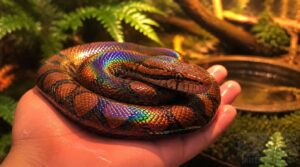
A rainbow boa’s temperament is often misunderstood, so let’s set the record straight. With patient handling, these snakes calm down beautifully and can become real companions over the years. Here’s what you need to know about their behavior, common health issues, and how to help one live a long, healthy life.
Handling and Bonding Tips
Yes, rainbow boas can learn to enjoy handling!
Support the midbody gently, never the head or tail, and start with short daily sessions of five minutes. Wash hands before and after, move slowly, and skip handling for 48 hours after feeding. Keep nails trimmed and watch for stress signs like thrashing. End calmly, return them home, and ask me anything!
Defensive Behavior and Biting
Even calm rainbow boas bite sometimes, and understanding why keeps you both safe.
Snake body language warns you first: raised head, coiled body, hissing. Give space! Most bites happen when startled or restrained.
Reduce risk with these steps:
- Approach slowly, never grab the tail
- Avoid the head and mouth
- Provide adequate hides
- Keep handling sessions calm
Stress reduction means fewer defensive bites!
Common Health Problems
A stressed boa can turn sick fast. Watch for wheezing or open-mouth breathing, signs of a respiratory infection from cold, damp cages. Bubbles around the nostrils mean it’s time for a vet.
Regurgitating food usually points to stress or wrong temperatures. Dry, dull eyes or stuck sheds signal humidity problems.
Catch issues early through daily reptile health monitoring, and most problems stay fixable!
Cleaning and Preventive Care
A clean cage stops most of those problems before they start. Spot clean daily, removing feces, urates, and leftover prey. Every 4 to 6 weeks, sanitize the entire habitat with a 3% bleach solution or reptile-safe cleaner, rinse well, and dry.
Reptile water dish hygiene matters too. Change water daily and scrub weekly. Wash your hands before and after handling to prevent Salmonella. Consistent reptile enclosure cleaning plus daily observation keeps your boa thriving!
Lifespan and Longevity Factors
Good care pays off. A rainbow boa’s average lifespan in captivity is 20 to 30 years, sometimes longer! Genetics sets the ceiling, but your habitat setup, diet, and daily observation decide how close your boa gets to it.
Expert Tip: Document sheds and feedings in a notebook. Patterns reveal problems early.
Commit for decades, and your iridescent friend will reward you. Questions? Ask away!
Frequently Asked Questions (FAQs)
How big will a rainbow boa get?
Most rainbow boas reach 4 to 6 feet as adults. Females grow slightly larger than males. Your snake should hit full length by age 3 to 5, so track growth rate monthly and adjust enclosure requirements accordingly.
Are rainbow boas venomous?
No fangs, no venom, no worries! Rainbow boas are non-venomous constrictors, so their bites cause minor irritation at worst. Their behavior temperament is docile, and handling them regularly builds trust without any potential health issues.
Do rainbow boas like to be held?
Most snakes tolerate handling rather than enjoy it, and rainbow boas are no exception. With calm, gentle, regular handling, many become remarkably docile and accept being held without stress.
Are rainbow boas rare?
No, they’re not rare. The Brazilian Rainbow Boa is widespread across South America and commonly captive-bred. Its conservation status is secure, though some local habitat loss causes regional declines.
Can a rainbow boa be a pet?
Yes, and the Brazilian Rainbow Boa makes a wonderful one! With proper enclosure setup, simple diet, manageable size, and a 15 to 20 year lifespan, these beauties reward dedicated keepers.
How hard is it to take care of a rainbow boa?
You’ll juggle humidity control, a proper temperature gradient, and steady feeding schedules. Once your enclosure setup is dialed in, though, daily care becomes surprisingly simple and rewarding.
Is a rainbow boa endangered?
No, rainbow boas aren’t endangered. The IUCN lists them as least concern thanks to their broad biogeographic distribution. Habitat destruction and wildlife trade pressure some local populations, but captive breeding keeps the species secure.
What color is a rainbow boa?
Funny thing: the name oversells the paint job! A rainbow boa is actually orange to reddish brown, with dark rings, but its iridescent scales flash rainbow sheen under light. That glow is structural, not pigment!
Where do rainbow boas come from?
Deep in the Amazon rainforest habitat and humid forests of Central America, these snakes range from Costa Rica and Panama south to northern Argentina. They thrive near rivers, flooded areas, and dense leaf litter.
What is a Brazilian rainbow boa?
Brilliantly beautiful and boldly built, the Brazilian rainbow boa is a medium South American constrictor, Epicrates cenchria, famous for iridescent scales. Adults reach 4 to 6 feet, eat rodents, and thrive in humid, tropical-style setups.
Conclusion
Keeping a rainbow boa isn’t rocket science. It’s really about nailing humidity, offering right-sized prey, and respecting a shy, nocturnal animal’s pace. Do that, and you’ll spend twenty years watching plain brown scales flash like spilled gasoline every evening. That shimmer never gets old. Neither does the quiet trust a calm boa builds with you. Start with one healthy captive-bred juvenile, keep your records, and enjoy the glow. Questions? Drop them below!