This site is supported by our readers. We may earn a commission, at no cost to you, if you purchase through links.

A ball python that’s well cared for can outlive your car, your couch, and possibly your next three apartments. Captive animals regularly hit 20 to 30 years, and some pass 40.
That’s a long commitment wrapped in a docile, slow-moving snake who curls into a tight ball the moment he’s stressed. Get the basics wrong, like humidity that dips below 60% or a hot side that cools off, and he’ll tell you through stuck sheds and refused meals.
Ball python care and handling comes down to a few habits you can master quickly. Start with the home you build him.
Table Of Contents
- Key Takeaways
- Ball Python Basics: Lifespan, Size, and Temperament
- How to Set Up The Perfect Ball Python Enclosure
- Feeding Your Ball Python: Prey Size and Schedule
- How to Handle a Ball Python Safely
- Keeping Your Ball Python Healthy: Shedding, Illness, and Vet Care
- Frequently Asked Questions (FAQs)
- Are ball pythons difficult to take care of?
- How to tell if a ball python is happy?
- What if a ball python bites you?
- Do ball pythons like to be handled?
- Can ball pythons live together in one enclosure?
- What are signs of a healthy ball python?
- How often should you handle your snake?
- Do ball pythons need UV lighting in captivity?
- What substrates are unsafe for ball pythons?
- Why is my ball python refusing to eat?
- Conclusion
Key Takeaways
- You’re signing up for 20 to 30 years or more with a ball python, so plan for a long-term commitment to a docile snake that curls into a defensive ball when stressed.
- Keep your snake’s enclosure right for its age, with a hot side around 88-92°F, a cool side around 76-80°F, humidity at 60-80%, and a safe substrate like coco coir or cypress mulch (never cedar or pine).
- Feed frozen-thawed prey that weighs about 10-15% of your snake’s body weight and is no wider than its midsection, adjust the schedule as it grows, and skip handling for 24-48 hours afterward.
- Handle your snake gently once or twice a week for short sessions, watch its body language for stress, and call an exotic vet if you see wheezing, blisters, or repeated feeding refusals.
Ball Python Basics: Lifespan, Size, and Temperament
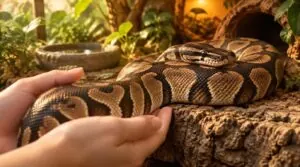
A ball python is a commitment measured in decades, so let’s start with the Ball Python Basics: Lifespan, Size, and Temperament you need before you bring one home.
Most adults stay around three to five feet long and tend to be docile, and this complete ball python care guide walks through setup, feeding, and handling so you’re ready for every year of their long lives.
Lifespan comes first. Captive ball pythons commonly live 20 to 30 years, and some pass 40. That’s longer than most careers. Good ball python care and handling, plus solid genetics, shape where your snake lands in that range.
Because age alone says little about readiness, it helps to understand how ball python age relates to size and maturity, since weight is the better guide for breeding.
Before committing for decades, explore ball python morphs for sale and note that recessive traits need two carrying parents to produce visual babies.
A ball python can outlive most careers, commonly living 20 to 30 years and sometimes beyond 40
Size is manageable. Hatchlings measure 10 to 17 inches, while adults reach 3 to 5 feet. Females run larger and heavier than males.
Temperament is the best part. Most are docile and slow-moving once they’re used to routine handling. Stressed or startled? Expect a tight defensive ball. That’s exactly where the name comes from.
How to Set Up The Perfect Ball Python Enclosure
Your ball python’s enclosure is its whole world, so it’s worth getting right from day one.
If you’d like a living, self-cleaning habitat, this guide to setting up a bioactive ball python enclosure walks through substrate, cleanup crew, and humidity basics.
Below, you’ll find the two things that matter most: the right enclosure size for each stage of life and the heat, humidity, and substrate that keep it comfortable.
Get these set up properly, and you’ll have a calm, healthy snake and a lot less guesswork.
Enclosure Size by Age
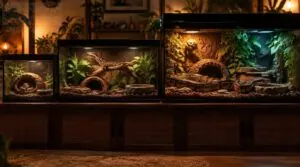
The right enclosure size changes as your snake grows. Hatchlings under 300g do best in a 10 to 20 gallon tank, since big spaces stress them out. Juveniles up to 800g need about 36"x18"x12".
Adult males can stay in that size, but adult females want a 4’x2’x2′ enclosure. Larger tanks need snug hides, a temperature gradient, and lower handling frequency. Aim for a hot side of 88-92°F and a cool side of 76-80°F so your snake can regulate its body temperature.
Heating, Humidity, and Substrate
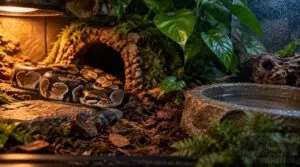
Now let’s heat that enclosure setup properly. Run a temperature gradient with a hot side of 88-90°F and a cool side of 78-80°F, and put every heat mat on a thermostat.
With temperatures dialed in, your snake will feel calmer at handling time, and it helps to know whether ball pythons are poisonous before you begin.
Humidity control comes next. Keep it at 60-80%. Among substrate options, choose coco coir or cypress mulch, never cedar or pine. A secure, comfortable snake builds real handling trust.
Feeding Your Ball Python: Prey Size and Schedule
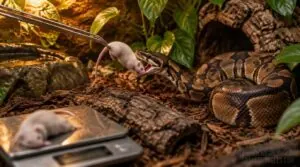
Once the enclosure is dialed in, food is the next big piece. Get prey size right and most feeding problems never start.
Aim for a rodent weighing about 10–15% of your snake’s body weight, and no wider than the thickest part of its midsection. Weigh the prey. Rodents of the same age vary more than you’d think.
Your feeding schedule shifts as your snake grows. Hatchlings and juveniles eat every 5–7 days, subadults every 7–10, and adults every 10–14. More frequent meals won’t build a better snake, just a heavier one.
If your snake turns down a meal even on schedule, common snake feeding problems and how to fix them can help you pinpoint the cause quickly.
Offer frozen-thawed rodents with feeding tongs. It’s safer for both of you.
Skip handling for 24–48 hours afterward. A missed meal now and then is normal, but repeated refusals deserve a husbandry check.
How to Handle a Ball Python Safely
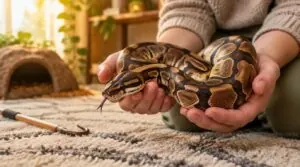
Because ball pythons are shy by nature, your handling techniques matter more than you’d think. Start with behavioral observation: a calm, exploring snake is ready, while a stiff, tightly coiled one needs space. Never pull it from a hide; let it emerge, then use a snake hook to tap its side gently.
For safe lifting, approach from the side, then support the body with both hands. Never grip the head or tail, and stay low over a bed or floor.
- Feel its quiet trust slowly settle.
- Watch its tongue flick curiously.
- Notice a nervous newcomer finally relax.
- Celebrate that first calm session.
- Protect the bond you’re building.
Keep handling sessions brief, and wash up before and after, every single time.
Keeping Your Ball Python Healthy: Shedding, Illness, and Vet Care
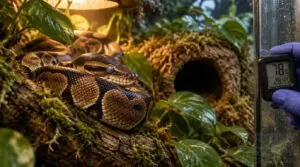
While your ball python sheds every 4 to 6 weeks as a juvenile, adults slow to 6 to 8 weeks. Milky blue eyes mean shedding is coming, so raise humidity to 65-70%. Shedding problems like stuck eye caps usually trace back to dry air.
| Problem | Early signs | Action |
|---|---|---|
| Respiratory infections | Wheezing, bubbly saliva | Call an exotic vet |
| Scale rot | Blisters, foul odor | Clean enclosure, see vet |
Don’t wait on any symptoms. Respiratory infections won’t clear up on their own, and snakes hide illness well. Book annual veterinary care even when your snake looks fine, and ask about parasite prevention, since mites spread fast. Keep temperatures steady and the enclosure clean. You’ll catch trouble early, and that’s what mastery looks like.
Frequently Asked Questions (FAQs)
Are ball pythons difficult to take care of?
Difficult? Not really, but not easy either. Ball pythons forgive beginners who master a temperature gradient and humidity control.
Expect occasional feeding refusals. Gentle handling techniques and steady health monitoring keep you ahead of trouble.
How to tell if a ball python is happy?
Think of your solitary snake as a quiet book, not a chatty friend.
Good snake behavior observation means watching for calm exploring, use of both hiding spots, steady feeding response, and no visible stress signals.
What if a ball python bites you?
Stay calm. A ball python bite is rarely dangerous.
Wash the wound with soap and running water, then cover it. Seek care for deep wounds, face or joint bites, or infection signs. Watch stress signals.
Do ball pythons like to be handled?
Ever wonder if your snake enjoys being picked up? Ball pythons are solitary animals, so they tolerate handling sessions rather than crave them. Keep them short, watch for stress signals, and practice safe lifting.
Can ball pythons live together in one enclosure?
Looks calm together? Don’t trust it.
Ball pythons are solitary animals, so house each separately with solid enclosure security and habitat enrichment. You’ll get snake stress reduction, plus clearer symptoms before any reptile vet visit.
What are signs of a healthy ball python?
Wondering if your snake’s thriving? Look for clear eyes, smooth skin, and a clean vent.
A strong feeding response, a complete shedding process, and steady weight mean your temperature gradient works. Spot health issues early.
How often should you handle your snake?
Picture Mia, whose new ball python hides all week. She waits, then starts short Handling sessions.
Aim for once or twice weekly, 10 to 15 minutes. Safe handling beats frequency, so watch the snake’s cues.
Do ball pythons need UV lighting in captivity?
Myth check: ball pythons need UV lighting to survive. Not true. Vitamin D3 synthesis happens through diet.
Still, low-level UVB for 12 hours, with a temperature gradient, is smart reptile husbandry, even in captive breeding.
What substrates are unsafe for ball pythons?
Your snake’s lungs hate the wrong bedding with a passion! Skip pine, cedar, and dusty substrate options. For substrate safety, choose cypress mulch, coconut husk, or a bioactive substrate, and keep it dry, never moldy.
Why is my ball python refusing to eat?
Most feeding refusals trace back to husbandry. Check your temperature gradient, keep humidity control steady, and match prey size to your snake’s widest girth. Skip handling sessions after meals. Persistent refusal? See a reptile vet.
Conclusion
Twenty years from now, your ball python could still be curled in his hide, unbothered and healthy. Good ball python care and handling makes that possible, and it’s built on habits, not luck.
Keep humidity above 60%, hold the warm side steady, feed prey that matches his girth, and handle him gently. Watch his sheds, and call a vet when something feels off. Do those things, and he’ll reward your patience with decades of companionship.