This site is supported by our readers. We may earn a commission, at no cost to you, if you purchase through links.

A snake that escapes its enclosure in the first week isn’t bad luck. It’s a setup problem. Gaps over 5 mm, a lid that pops open with one hand, or a thermal gradient that runs too cool can turn a thriving reptile into a stressed-out escape artist.
Getting snake habitat essentials right matters because snakes depend entirely on their environment to regulate temperature, humidity, and stress. A wrong substrate or a soggy enclosure doesn’t cause mild discomfort; it causes respiratory infections and bad sheds.
None of this is rocket science. Here’s exactly what your setup needs to get right.
Table Of Contents
- Key Takeaways
- Choose a Secure, Properly Sized Enclosure
- Create and Monitor a Safe Thermal Gradient
- Balance Humidity, Ventilation, and Clean Water
- Choose Safe Substrate and Cleaning Routines
- Add Lighting, Hides, and Enrichment
- Frequently Asked Questions (FAQs)
- What 7 scents do snakes hate?
- What is the best thing to put around your house for snakes?
- How do I build a snake habitat?
- What habitat do snakes prefer?
- What should be in a snake enclosure?
- What habitat does a snake need?
- What supplies do I need for a snake?
- How to set up a snake habitat?
- How do I disinfect a snake enclosure?
- Can live plants be used in a snake tank?
- Conclusion
Key Takeaways
- A snake’s enclosure must have gaps under 5 mm, two-hand latches, and rigid escape-proof materials — because a single weak point is all it takes for an escape.
- Snakes can’t regulate their own body temperature, so you need a deliberate thermal gradient of 28–32°C on the warm end and 22–26°C on the cool end, controlled by a thermostat and monitored daily. For a full walkthrough of equipment setup and placement, setting up a safe snake enclosure and habitat covers how to position hides and heating elements to support natural thermoregulation behavior.
- Humidity should stay between 40–60% for most species (rising to 85% during shedding), with adequate ventilation to prevent mold — a cheap hygrometer and passive vents covering 5–8% of floor area handle this reliably.
- Substrate choice and cleaning rhythm directly affect your snake’s health — avoid cedar and pine resins, stick to aspen or cypress, spot-clean weekly, and do a full substrate swap every 2–4 weeks.
Choose a Secure, Properly Sized Enclosure
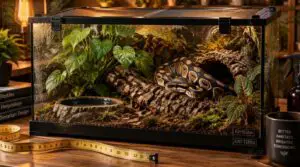
Getting the enclosure right isn’t rocket science, but it’s the foundation everything else builds on. You’ll need to think through adult snake size, escape-proof materials, and secure lids before you buy anything. Here’s what each one means for your setup.
A good starting point is the two-thirds body-length rule for floor space, which snake cage and habitat sizing guides break down clearly for common species.
Match Adult Snake Size
Size matters more than rocket science here. Measure your adult snake from snout to tail tip, then pick an enclosure at least 1.5 times that length. Width should be two-thirds of the length so your snake can turn fully.
Large boas and pythons need a 1.0–1.2 m footprint with 0.6–0.9 m height. Check species-specific requirements, and reassess after growth spurts.
Select Escape-Proof Materials
Once you’ve nailed the footprint, materials make or break snake escape prevention. Choose 6 mm polycarbonate panels; they shrug off bite pressure. Axial-screw fasteners and mortise-and-tenon joints with metal brackets beat prying attempts every time. Rounded internal corners eliminate crevices, and epoxy coatings keep surfaces smooth and sanitizable. A truly secure enclosure isn’t rocket science, but flimsy materials spell trouble fast.
Secure Lids and Openings
Solid walls mean nothing if the top pops off. Secure lids are your last line of defense, so make them count:
- Pick closures that need two hands or tools to open
- Keep seam gaps under 5 mm, no exceptions
- Choose lids with gasketed seals that compress fully
- Overhang lids 2–3 cm past the opening to beat prying tricks
- Test with a flexible 0.5 cm rod; if it slides through, so can your snake
Latch down every access point and your habitat security is basically bulletproof.
Pairing locked enclosures with low-maintenance burrowing substrates reduces contamination risks and keeps your cleaning routine manageable long-term.
Create and Monitor a Safe Thermal Gradient
Now that your enclosure is escape-proof, it’s time to get the heat right. Snakes can’t make their own warmth, so thermoregulation depends entirely on you.
Proper warmth also keeps your snake’s appetite steady, so if a meal gets refused, check temperatures first and see which symptoms of a snake that won’t eat actually signal trouble.
Set up a thermal gradient: a warm zone of 28–32°C at one end, cooling to 22–26°C at the other. Place your heat sources under one end only, and make sure the enclosure runs 2–3 times your snake’s body length so the gradient actually spans the space.
Temperature control is where thermostats earn their keep. A proportional controller beats a bare heat lamp every time. Use temperature sensors at both ends, check daily, and aim for less than 2–3°C of fluctuation.
Record readings for two weeks before your snake moves in. If a hotspot creeps over target, dial back the mat power. Simple as that.
Balance Humidity, Ventilation, and Clean Water
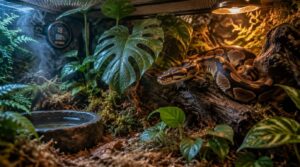
When your snake’s habitat holds the right moisture, everything else gets easier. Aim for humidity levels between 40 and 60 percent for most species, and bump toward 60 to 85 percent during sheds. A cheap hygrometer in the basking zone tells you the truth, so trust it over guesswork.
Enclosure ventilation matters just as much. Passive vents covering 5 to 8 percent of the floor area keep air moving without turning your terrarium into a wind tunnel. If substrate stays soggy past 48 hours or you spot haze on the glass, open things up before mold moves in.
Water comes down to three habits: water dechlorination, shallow bowls placed away from the heat source, and daily rinses. Poor water quality spells trouble fast, but fresh, chlorine-free water keeps things safe. It’s not rocket science, just consistency.
Choose Safe Substrate and Cleaning Routines
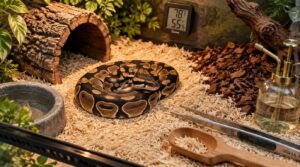
Because substrate sits against your snake’s skin all day, toxic substrate avoidance matters more than most keepers think. Skip cedar and pine, whose resins spell trouble for reptiles. Go with inert substrate materials like aspen or cypress, and keep granules in the 2–5 mm range so nothing gets swallowed.
Substrate hygiene isn’t rocket science, but it does demand a rhythm. Follow this routine:
- Spot-clean feces and shed fragments weekly.
- Change substrate every 2–4 weeks, or sooner when waste builds up.
- Disinfect decor with a 1:32 bleach dilution, rinse well, and air-dry.
- Use separate tools for cleaning the enclosure and handling substrate.
- Log depth, humidity, and temperature readings weekly to catch drift.
If ammonia odor lingers after cleaning, bump your turnover frequency by 25%. Consistent enclosure cleanliness keeps your snake healthy and your nose happy.
Add Lighting, Hides, and Enrichment
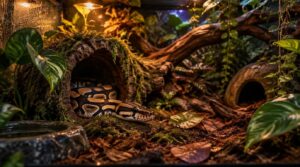
Once your substrate is sorted, it’s time to think about lighting, hides, and enrichment. These elements shape how comfortable and stimulated your snake feels day to day. Here’s what you need to cover.
Set a Consistent Photoperiod
Light controls your snake’s circadian rhythm more than most keepers realize. Automating lighting with a programmable timer keeps the light cycle locked at 10-12 hours of light and 12-14 hours of darkness each day for most colubrids. Abrupt shifts will spell real trouble for feeding and shedding, so ramp up and down gradually. That’s solid photoperiod management without the guesswork.
| Photoperiod Element | Recommended Setting |
|---|---|
| Daily light hours | 10-12 hours |
| Daily dark hours | 12-14 hours |
| Dawn/dusk ramp time | 30-60 minutes |
| Max adjustment increment | ±15 minutes |
Evaluate Species-Specific UVB Needs
A ball python and a green tree python share almost nothing regarding UVB exposure needs. Always check your species-specific care sheets before buying UVB lighting.
Most snakes need 0.5–2.0 μW/cm² at the basking site for healthy vitamin D synthesis, and skipping it causes serious calcium absorption problems. Replace bulbs every 6–12 months, since output drops silently before burnout.
Provide Snug Hides
Think your snake wants a mansion? Wrong. Snug hiding spots feel like a hug, not a hideout.
- Keep gaps under 1.0 cm for small species
- Allow 1.5–2.5 cm gaps for larger species
- Depth should reach 2.5 body diameters
- Choose smooth interior surfaces to prevent abrasion
- Entry should require a slight squeeze
A proper fit is genuinely good for snake welfare.
Rotate Climbing Features
Snakes get bored. It’s that simple.
Rotating your climbing structures every quarter keeps enclosure enrichment fresh and actively drives natural behavior simulation. Swap spots, swap materials, even swap angles along the thermal gradient. Your snake shouldn’t memorize its own home like a daily commute route.
Rotate climbing structures quarterly so your snake never memorizes its own home like a daily commute
Check fasteners and all surfaces every 2-3 days for wear. Any loosening? Replace it immediately.
Adapt Setup by Species
Rotating features keeps things fresh, but species-specific requirements define your real baseline.
- Boa constrictors need 6-8 ft enclosures with secure lids
- Arboreal species need tall vertical space for climbing structures
- Burrowing species need 4-6 inches of loose substrate
- Tropical species need 60-80% humidity with proper ventilation
Your naturalistic environment only works when the habitat setup truly matches your actual snake.
Frequently Asked Questions (FAQs)
What 7 scents do snakes hate?
Your best bets are peppermint oil, clove oil, cinnamon oil, citrus oils, white vinegar, cypress or eucalyptus, and capsaicin sprays. These seven scents can deter snakes, but repeated exposure will often lead to habituation quickly.
What is the best thing to put around your house for snakes?
It’s not rocket science, but a solid escape-proof enclosure is the real answer here. Focus your habitat setup on sealed gaps, quality multi-point latches, smooth rigid walls, and a lid that won’t budge under pressure.
How do I build a snake habitat?
Think of it as building a micro-ecosystem. Good snake habitat design means a secure enclosure, a temperature gradient across warm and cool zones, correct humidity levels, and snug hiding spots your snake can actually use.
What habitat do snakes prefer?
Your snake craves a layered world. Imagine warm basking stone dissolving into cool, damp shadow. That contrast is home to them. A temperature gradient, steady humidity levels, and snug hiding spots are what they need.
What should be in a snake enclosure?
Most first-time keepers are genuinely surprised by how often snakes test their lids. Your secure enclosure needs a solid temperature gradient, steady humidity levels, at least two hiding spots, clean substrate, and an escape-proof lid.
What habitat does a snake need?
Your snake needs a secure enclosure sized to match its full adult body length, a proper temperature gradient, correct humidity levels, fresh clean water, and a couple of hiding spots to feel safe and comfortable.
What supplies do I need for a snake?
Every good den starts with structure. For essential snake habitat supplies, you’ll need an escape-proof enclosure, a thermostat-controlled heat mat, two thermometers, a hygrometer, a large fresh water dish, safe substrate, and two snug hides.
How to set up a snake habitat?
Your snake habitat needs five things done right: a properly sized enclosure, a two-point thermal gradient, species-appropriate humidity levels, a clean water dish, and snug hiding spots. Get all those dialed in and you’re set.
How do I disinfect a snake enclosure?
Take your snake out with all hides and the water bowl. Scrub visible waste, apply a reptile safe disinfectant, and honor the full wet contact time. Rinse if the label says to, then dry completely.
Can live plants be used in a snake tank?
Want a naturalistic environment your snake will actually thrive in? Live plants absolutely can work well. They support humidity retention, add environmental enrichment, and make any bioactive setup look great. Just use non-toxic, pest-free specimens.
Conclusion
Yes, this takes real effort upfront. But snake habitat essentials aren’t a checklist you rush through once and forget. They’re the foundation your snake lives on every single day.
Get the enclosure secure, the thermal gradient dialed in, and the humidity consistent. Add snug hides, rotate enrichment, and clean on schedule. Do those things well, and your snake won’t just survive its new home.
It’ll actually thrive in it.