This site is supported by our readers. We may earn a commission, at no cost to you, if you purchase through links.
A monitor lizard can go weeks looking perfectly healthy while metabolic damage quietly accumulates beneath the surface—because carnivorous reptiles don’t show nutritional deficiencies until they’re already serious.
Keepers who rely on whole prey alone often discover too late that even a varied feeder rotation can leave critical gaps in fat‑soluble vitamins and trace minerals.
Preformed vitamin A, D₃ paired with calcium, and the right trace mineral ratios aren’t optional extras for meat‑eating species—they’re the difference between a reptile that thrives and one that develops hypovitaminosis A or metabolic bone disease before its second birthday.
Choosing the right reptile vitamins for carnivorous reptiles means knowing exactly what’s in the supplement, how often to use it, and how it interacts with your lighting setup and prey items.
Table Of Contents
- Key Takeaways
- Essential Carnivorous Reptile Vitamins
- Top 10 Reptile Vitamins Reviewed
- 1. Flukers Reptile Vitamin Supplement with Beta Carotene
- 2. Exo Terra Reptile Vitamin Powder
- 3. Flukers Repta Boost Reptile Supplement
- 4. Foxcup Repta Boost Reptile Amphibian Supplement
- 5. Rep Cal Herptivite Reptile Multivitamin Powder
- 6. Gargeer Reptile Multi Vitamin Fruit Supplement
- 7. Zilla Reptile Vitamin Supplement Spray
- 8. Zoo Med ReptiVite Vitamin D3
- 9. Rep Cal Herptivite Reptile Multivitamin
- 10. Fluker Calcium Reptile Supplement
- Choosing Safe Reptile Supplements
- Dosing Carnivorous Reptiles Correctly
- Preventing Deficiencies and Toxicity
- Frequently Asked Questions (FAQs)
- What vitamins do carnivores need?
- How to get vitamin A to leopard gecko?
- What vitamin supplements do bearded dragons need?
- Is too much Vitamin D3 bad for bearded dragons?
- Can carnivorous reptiles overdose on vitamin K?
- Do carnivorous reptiles need vitamin C supplements?
- How does temperature affect vitamin absorption rates?
- Should supplements change during brumation or hibernation?
- Are there differences between reptile and amphibian vitamins?
- Can reptile supplements expire before the listed date?
- Conclusion
Key Takeaways
- Carnivorous reptiles can’t convert plant-based carotenoids into usable vitamin A, so their diet must supply preformed retinol directly from animal sources like liver, fish oil, and eggs to prevent serious deficiencies.
- Vitamin D3 and calcium work as a team — without D3, even a calcium-rich diet won’t protect your reptile’s bones, so you need to match your dusting frequency to your UVB lighting setup.
- Fat-soluble vitamins like A and D3 build up in tissue over time, meaning over-supplementing is just as dangerous as deficiency, so dosing logs and species-specific schedules aren’t optional extras.
- Whole prey diets shift your supplement math entirely — bone adds phosphorus, liver spikes vitamin A, and that means you need to adjust your dusting routine based on what your animal actually ate that week.
Essential Carnivorous Reptile Vitamins
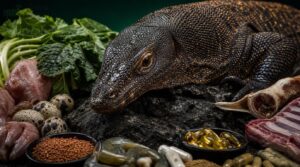
Carnivorous reptiles have specific nutritional demands that go well beyond what feeder insects alone can provide. Getting the right vitamins and minerals in place is what separates a thriving animal from one that slowly declines. Here are the essential nutrients your carnivorous reptile needs to stay healthy.
A varied diet is the foundation of all of this — check out these carnivorous reptile nutrition and health tips to build a feeding plan that covers every gap.
Preformed Vitamin a Needs
Carnivorous reptiles can’t convert plant-based carotenoids into preformed vitamin A reliably, so their diet must supply retinol directly from animal sources. Here’s what that means practically:
- Animal sources matter — liver, fish oils, and eggs deliver retinyl esters your reptile can use immediately.
- Vitamin A deficiency causes thickened skin, eye damage, and reproductive failure.
- Vitamin A toxicity from over-supplementing causes skin peeling and liver damage.
The recommended adult vitamin A limit is 3,000 µg RAE per day.
Balance supplement dosing carefully against what feeder insects already provide.
Vitamin D3 and Calcium
Vitamin D3 activates calcium use by converting into active metabolites that drive intestinal absorption — without it, even a calcium‑rich diet won’t protect your reptile’s bones.
Aim for calcium with D3 dusting two to three times weekly, using calcium carbonate as a reliable dietary calcium source, and always match your D3 supplementation frequency to your UVB lighting setup.
Vitamin E Antioxidant Support
Once your reptile’s calcium and D3 are in order, don’t overlook what protects those cells from the inside out.
Vitamin E’s antioxidant function works by interrupting free radical chain reactions in cell membranes — a process called tocopherol antioxidant activity that shields lipids from oxidative damage during fat metabolism.
For carnivorous reptiles, this matters in four specific ways:
- Lipid antioxidant protection prevents membrane breakdown when fatty prey is digested
- Membrane cell integrity stays intact under oxidative stress, supporting organ function
- Immune system boost helps your reptile resist bacterial and viral threats
- Antioxidant synergy effects link vitamin E to other dietary antioxidants, strengthening overall reptile nutrition
Inadequate vitamin E compromises skin condition and immune support simultaneously, which makes it worth checking your supplement label carefully.
B Vitamins for Metabolism
B vitamins quietly run the engine behind every meal your carnivore processes.
Thiamine carbohydrate cycling keeps glucose moving through metabolism efficiently, while riboflavin electron transfer feeds the energy chain that powers cellular activity.
Niacin NAD production drives ATP generation, pantothenic coenzyme A links fatty acid and carb pathways, and biotin enzyme function facilitates gluconeogenesis — all requiring consistent dietary replenishment since none are stored in tissue.
Trace Minerals for Health
Every carnivore depends on a small but mighty group of trace minerals to stay healthy, and getting the balance wrong shows up fast.
- Zinc immune support — fights infection and speeds wound healing
- Copper antioxidant role — powers enzyme systems protecting tissues
- Iron blood health — drives red blood cell formation via iron sulfate
- Selenium antioxidant protection — guards cells from oxidative damage
- Manganese enzyme function — helps metabolism and bone development through manganese sulfate
Maintaining mineral balance in reptile diets, including a proper calcium to phosphorus ratio, keeps these systems working together.
Top 10 Reptile Vitamins Reviewed
Finding the right vitamin supplement for your carnivorous reptile doesn’t have to feel like guessing in the dark. Each product below was evaluated for ingredient quality, species suitability, and dosing clarity — the things that actually matter when your animal’s health is on the line. Here are ten options worth knowing about.
1. Flukers Reptile Vitamin Supplement with Beta Carotene
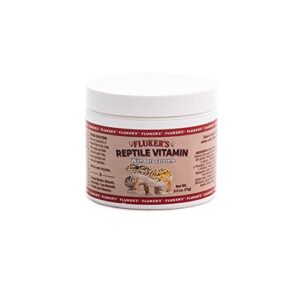
Fluker’s Reptile Vitamin Supplement with Beta Carotene is a multi-vitamin powder you can dust directly onto feeder insects, rodents, or produce, making it one of the more flexible options for carnivorous species.
It combines beta-carotene and preformed vitamin A, which enhances vision, epithelial health, and natural skin coloration without relying on synthetic dyes.
At 3.84 oz, it’s compact and practical, though note that no measuring scoop is included, so you’ll need to gauge your dusting amounts carefully.
| Best For | Reptile owners looking for an easy, all-in-one vitamin boost they can dust onto live feeders or produce for any species. |
|---|---|
| Form | Powder |
| Target Animals | Reptiles |
| Vitamin A Source | Beta-carotene |
| Net Weight | 3.84 oz |
| Vitamin D3 Included | No |
| Application Method | Dust on food |
| Additional Features |
|
- Works with almost any reptile — bearded dragons, leopard geckos, tortoises, you name it
- The beta-carotene supports natural color and overall health without synthetic additives
- Lightweight and simple to use — just shake it onto feeders and you’re done
- No scoop included, so getting the right amount takes some guesswork
- The smell is noticeable, which might be a turnoff for sensitive noses
- Zero dosage guidance on the label, leaving you to figure out portions on your own
2. Exo Terra Reptile Vitamin Powder
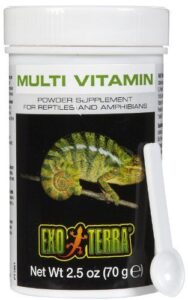
Exo Terra Reptile Vitamin Powder (PT1861) is a solid complementary option if you’re building a complete supplementation routine for your carnivore.
It delivers beta-carotene as provitamin A, a complete amino acid profile, and trace minerals like zinc, copper, and manganese — all in an easy-to-dust powder.
At $7.51 for roughly 3.5 oz, the value is reasonable.
Just remember, it requires separate calcium and D3 supplementation, so don’t use it as a standalone solution.
| Best For | Reptile and amphibian owners who want an easy, affordable way to round out their pet’s diet with vitamins, amino acids, and trace minerals. |
|---|---|
| Form | Powder |
| Target Animals | Reptiles & Amphibians |
| Vitamin A Source | Beta-carotene |
| Net Weight | 3.53 oz |
| Vitamin D3 Included | Yes |
| Application Method | Dust on food |
| Additional Features |
|
- Covers a wide nutritional base — vitamins, complete amino acids, and key trace minerals like zinc, copper, and manganese all in one powder
- Super easy to use — just dust it on feeder insects or sprinkle it over fresh produce
- At $7.51 for 3.5 oz, it’s a budget-friendly addition to a solid supplement routine
- Not a standalone supplement — you’ll still need a separate calcium and D3 powder for proper bone health
- The gritty texture can put some animals off, especially pickier species like certain tortoises
- Contains menadione sodium bisulfite (synthetic vitamin K), which might be a dealbreaker if you prefer natural-only formulations
3. Flukers Repta Boost Reptile Supplement
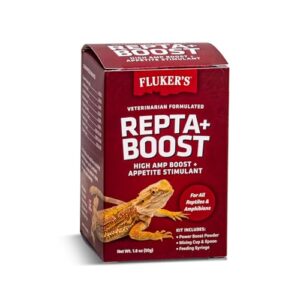
When your animal won’t eat and time is working against you, Flukers Repta Boost steps in as a critical-care formula rather than a standard vitamin powder. It combines protein, carbohydrates, fat, vitamins, and minerals into a single mix you can syringe-feed directly — no guesswork, no piecing together homemade solutions.
It’s especially useful for newly acquired or anorexic reptiles needing rapid nutritional support.
Just don’t rely on it as a permanent diet replacement.
| Best For | Reptile and amphibian owners dealing with sick, newly acquired, or anorexic animals that need fast nutritional support without the hassle of mixing homemade formulas. |
|---|---|
| Form | Powder |
| Target Animals | Reptiles & Amphibians |
| Vitamin A Source | Not specified |
| Net Weight | 0.3 oz |
| Vitamin D3 Included | No |
| Application Method | Mix with water |
| Additional Features |
|
- Covers all the basics — protein, carbs, fat, vitamins, minerals — in one easy powder you can mix and syringe-feed in minutes.
- Comes with everything you need right out of the box: measuring cup, spoon, and feeding syringe.
- Works well for a range of situations, from dehydration and brumation to rapid growth and post-acquisition stress.
- Not a long-term diet replacement — your animal still needs a proper, species-appropriate feeding routine.
- Has a strong odor that some owners (and animals) find off-putting.
- Packaging is flimsy and can arrive crushed, which makes storage a bit of a pain.
4. Foxcup Repta Boost Reptile Amphibian Supplement
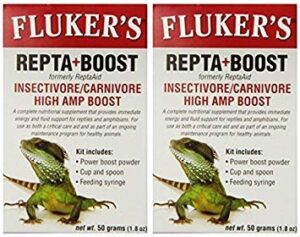
Foxcup Repta Boost takes a slightly different approach than standard dusting powders — it’s built as a complete daily nutritional blend you can mix into water or apply directly to feeder insects. The formula includes vitamin D3, calcium, vitamin E, biotin, and DL methionine, covering both bone health and cellular protection in one product.
It’s a solid option for stressed or recovering animals, though you’ll want to avoid combining it with other D3 or vitamin A sources without veterinary guidance.
| Best For | Reptile and amphibian owners dealing with stressed, recovering, or malnourished animals who need a quick, all-in-one nutritional boost they can mix right into water. |
|---|---|
| Form | Powder |
| Target Animals | Reptiles & Amphibians |
| Vitamin A Source | Not specified |
| Net Weight | 3.6 oz |
| Vitamin D3 Included | No |
| Application Method | Mix with water/liquid |
| Additional Features |
|
- Covers the big bases — protein, carbs, fat, vitamins, and minerals — all in one powder instead of juggling multiple supplements.
- Easy to administer however works best for your animal, whether that’s a water bath, syringe, or mixing it with electrolyte solutions like Pedialyte.
- Works as a long-term care option, not just a short-term fix for sick or recovering pets.
- Dosing instructions aren’t fully adapted to U.S. measurements, which makes accurate administration trickier than it should be.
- Small packaging means you’ll be reordering frequently if you’re using it regularly or for multiple animals.
- Some animals may flat-out refuse the unflavored powder, so getting them to actually consume it can take some trial and error.
5. Rep Cal Herptivite Reptile Multivitamin Powder
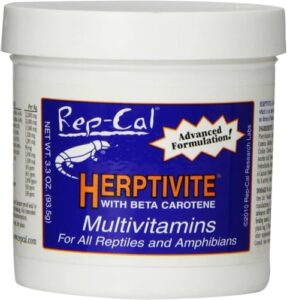
Rep Cal Herptivite stands out for its beta-carotene-based vitamin A, which your reptile converts to active vitamin A as needed — markedly lowering the risk of toxicity compared to preformed retinol.
Built on a natural sea vegetation base with dried kelp and alfalfa, it delivers trace minerals like zinc, copper, manganese, and iodine alongside B vitamins that support metabolism.
Use it once weekly alongside a dedicated calcium supplement, as Herptivite isn’t a calcium replacement.
| Best For | Reptile and amphibian owners who want a well-rounded multivitamin that’s gentle on their animals and easy to add to feeding routines. |
|---|---|
| Form | Powder |
| Target Animals | Reptiles & Amphibians |
| Vitamin A Source | Not specified |
| Net Weight | 3.3 oz |
| Vitamin D3 Included | No |
| Application Method | Dust on food |
| Additional Features |
|
- Uses beta-carotene instead of preformed vitamin A, so your reptile self-regulates what it needs — much safer long-term
- Built on a natural sea vegetation base with kelp and alfalfa, so you’re getting real trace minerals, not just synthetic filler
- Dead simple to use — just dust it on food, no mixing or measuring required
- The 3.3 oz container goes fast if you’re keeping multiple animals or larger species
- Powder application can get messy and leave residue around the enclosure
- Sits on the pricier side compared to generic reptile vitamins, which adds up over time
6. Gargeer Reptile Multi Vitamin Fruit Supplement
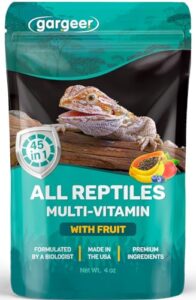
Where Rep Cal Herptivite leans on beta‑carotene, Gargeer takes a different angle — blending vitamins A, D3, E, and C with calcium carbonate and a broad mineral spectrum that includes zinc, manganese, and iron.
What makes it stand out is the organic fruit flavoring — dried banana, papaya, mango, and blueberry — which genuinely helps with picky eaters.
At $15.57 for 4 oz, it’s accessible, though you’ll want to establish your own dosing schedule since specific instructions aren’t included.
| Best For | Reptile and amphibian owners dealing with picky eaters who need a well-rounded multivitamin with broad mineral and amino acid support. |
|---|---|
| Form | Powder |
| Target Animals | Reptiles & Amphibians |
| Vitamin A Source | Not specified |
| Net Weight | 4 oz |
| Vitamin D3 Included | Yes |
| Application Method | Dust on food |
| Additional Features |
|
- Organic fruit flavoring (banana, mango, papaya, blueberry) makes it easier to get fussy reptiles to actually eat their supplements
- Solid nutrient lineup — vitamins A, D3, E, and C paired with calcium carbonate and a wide mineral spectrum covering zinc, iron, and manganese
- Made, tested, and packaged in the US, which is a nice trust signal at a reasonable $15.57 price point
- No dosing instructions included, so you’re on your own figuring out how much to use — which can be a real problem with fat-soluble vitamins
- The fruit flavoring could shorten shelf life if not stored carefully in a cool, dry spot
- A 4 oz pouch goes fast when you’re rationing carefully, so it may not last as long as you’d hope
7. Zilla Reptile Vitamin Supplement Spray
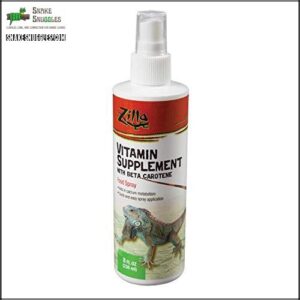
If Gargeer won you over with flavored powder, the Zilla Vitamin Supplement Spray takes a completely different approach — no dusting required. You simply spray it directly onto food and wait 15 seconds before feeding.
For guidance on whether to choose a D3-containing formula like Zilla’s spray, this breakdown of the best snake supplements explains how your UVB setup should drive that decision.
It delivers D3, beta-carotene, B vitamins, and vitamin C in a water-based, allergen-free formula suited to most carnivorous and omnivorous species. At $8.79 for 9.6 oz, it’s practical — though pair it with Zilla Calcium Spray, since this product won’t cover your reptile’s calcium needs alone.
| Best For | Reptile and amphibian owners who want a quick, low-mess way to supplement vitamins without the hassle of dusting powders. |
|---|---|
| Form | Liquid Spray |
| Target Animals | Reptiles & Amphibians |
| Vitamin A Source | Beta-carotene |
| Net Weight | 9.6 oz |
| Vitamin D3 Included | Yes |
| Application Method | Spray on food |
| Additional Features |
|
- Super easy to use — just spray on food or live insects and wait 15 seconds
- Covers a solid range of vitamins (D3, B vitamins, vitamin C, beta-carotene) in one allergen-free formula
- Works for pretty much any reptile or amphibian at any life stage
- No protective cap, and the spray nozzle has been known to break after just a handful of uses
- Doesn’t provide calcium, so you’ll need to buy Zilla Calcium Spray separately to round out nutrition
- Application can get messy if you’re not careful with the nozzle
8. Zoo Med ReptiVite Vitamin D3
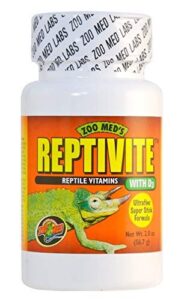
Where the Zilla spray trades dusting for misting, Zoo Med ReptiVite with D3 goes back to basics — and delivers.
This ultra-fine powder supplement costs just $3.09 for 45 g, making it one of the most affordable options here.
It maintains a 2:1 calcium-to-phosphorus ratio, includes cholecalciferol as its D3 source, and packs a full amino acid complex alongside trace minerals like zinc oxide and copper sulfate — no fillers, no soy, no sucrose.
| Best For | Reptile owners who want a reliable, no-frills calcium supplement for lizards, turtles, or snakes — especially those dusting live feeders like crickets or roaches. |
|---|---|
| Form | Powder |
| Target Animals | Reptiles & Amphibians |
| Vitamin A Source | Not specified |
| Net Weight | 1.6 oz |
| Vitamin D3 Included | Yes |
| Application Method | Dust on food |
| Additional Features |
|
- At $3.09 for 45 g, it’s one of the most budget-friendly supplements you’ll find without sacrificing quality
- The 2:1 calcium-to-phosphorus ratio with added D3 covers your bases for bone health in one scoop
- Clean formula — no soy, fillers, or sucrose, and it’s trusted in professional zoo settings too
- The powder isn’t super fine, so some of it shakes off prey before your reptile actually eats it
- Easy to over-supplement if your pet’s diet is already calcium-heavy, so you’ll want to track dosing carefully
- A handful of customers have run into shipping delays, which is frustrating when you’re running low
9. Rep Cal Herptivite Reptile Multivitamin
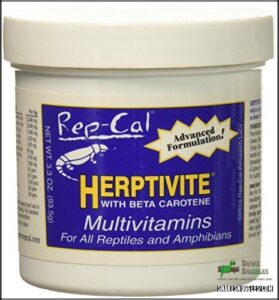
Zoo Med’s budget pick takes care of the minerals — but what about the broader vitamin picture?
That’s where Rep-Cal Herptivite steps in.
This 3.3 oz multivitamin powder costs $12.91 and covers amino acids, trace minerals, and vitamins E, C, and B-complex, using beta-carotene instead of preformed vitamin A — meaning your reptile converts only what it needs, reducing toxicity risk.
Kelp and alfalfa provide natural trace elements, making it a smart weekly companion to your calcium supplement.
| Best For | Reptile and amphibian owners who want a well-rounded multivitamin to pair alongside a separate calcium supplement for species like bearded dragons, geckos, and dart frogs. |
|---|---|
| Form | Powder |
| Target Animals | Reptiles & Amphibians |
| Vitamin A Source | Beta-carotene |
| Net Weight | 3.3 oz |
| Vitamin D3 Included | Yes |
| Application Method | Dust on food |
| Additional Features |
|
- Uses beta-carotene instead of preformed vitamin A, so your reptile self-regulates intake and you avoid toxicity risk
- Natural base of kelp and alfalfa brings in trace minerals without synthetic fillers
- Dusts easily onto insects or veggies and won’t mess with the smell or taste of their food
- No independent lab testing to back up the manufacturer’s claims
- Costs a bit more per ounce than competitors like Zoo Med
- Doesn’t replace calcium — you’ll still need a separate supplement on top of this
10. Fluker Calcium Reptile Supplement
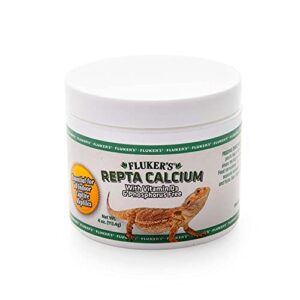
Closing out this list is Fluker’s Calcium with Vitamin D3, a straightforward indoor supplement designed for reptiles that don’t get reliable UVB exposure.
With 36% calcium by weight and 100,000 IU of D3 per pound, it delivers meaningful bone support through simple insect dusting.
The 4‑oz powder format keeps dosing practical, though it won’t replace a full multivitamin — pair it with a broader supplement for complete coverage.
| Best For | Indoor reptile owners — bearded dragons, leopard geckos, turtles, and frogs — that miss out on natural UVB and need reliable calcium support. |
|---|---|
| Form | Powder |
| Target Animals | Reptiles & Amphibians |
| Vitamin A Source | Not specified |
| Net Weight | 4 oz |
| Vitamin D3 Included | Yes |
| Application Method | Dust on food |
| Additional Features |
|
- Simple to use — just dust it on crickets, mealworms, or leafy greens before feeding
- Includes Vitamin D3, so indoor reptiles can actually absorb the calcium they’re getting
- All-natural, abalone-free formula in a compact 4 oz container that’s easy to store
- Doesn’t cover the full vitamin and mineral spectrum, so you’ll likely need a separate multivitamin
- Too much D3 can be a problem if your setup already has solid UVB lighting — worth watching
- The powder can get a little messy and needs good mixing to coat feeders evenly
Choosing Safe Reptile Supplements
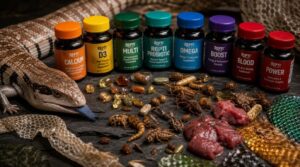
Not every reptile supplement on the shelf is worth your money or your animal’s health. Knowing what separates a quality product from a poorly formulated one can save you a lot of frustration down the road. Here’s what to look for before you buy.
Powder Versus Liquid Vitamins
Powder supplements dominate reptile care for good reason — formulation stability is far more effective than liquid alternatives. Liquids introduce water, raising microbial growth risk and shortening shelf life.
Powders also deliver more consistent dosing when dusting feeder insects, whereas liquid droppers can vary with each squeeze. For carnivores where precise vitamin ratios matter, powder’s reliability makes it the safer, more practical choice.
Label Dosage Instructions
A supplement label is your first line of defense against dosing errors. Look for per-feeding dose units — teaspoons, grams, or measured scoops — and a clearly stated frequency, whether daily for juveniles or twice weekly for adults.
Labels should also warn against exceeding fat-soluble vitamin limits, since overdosing vitamins A and D₃ carries real toxicity risk.
Calcium Phosphorus Balance
Calcium and phosphorus must stay in balance — specifically a 2:1 calcium to phosphorus ratio — because excess phosphorus triggers hormonal responses that pull calcium from bone, accelerating metabolic bone disease.
When choosing a supplement, confirm it maintains this CaP ratio. ReptiVite, for example, delivers 450 mg/kg calcium against 225 mg/kg phosphorus, hitting that target precisely.
Fillers to Avoid
Not every ingredient on a reptile supplement label is working for your animal. Some products are padded with inert fillers — things like soy lecithin, microcrystalline cellulose, and maltodextrins — that bulk up the powder without adding a single usable nutrient.
Avoid anything listing soy, yeast, or hidden additives under vague "other ingredients" wording, since those artificial flavors and synthetic fillers dilute the actual vitamin dose your reptile receives.
Manufacturer Quality Standards
The label on a supplement tells part of the story — the manufacturer’s standards tell the rest. Look for products made under GMP-certified facilities or holding ISO 9001 certification, which require documented processes, internal audits, and corrective action tracking to guarantee every batch meets safety benchmarks. Without these, there’s no guarantee what’s on the label is actually in the jar.
- Batch traceability records link every ingredient to its source
- Supplier quality audits verify raw material purity before production begins
- Process validation protocols confirm consistency across manufacturing runs
- Certificates of analysis document potency and confirm safety before release
Dosing Carnivorous Reptiles Correctly
Getting the dose right matters just as much as choosing the right supplement. Too little and your reptile misses out on critical nutrients; too much and you risk toxicity that’s just as dangerous as a deficiency. Here’s what you need to know about dosing carnivorous reptiles correctly.
Dusting Feeder Insects
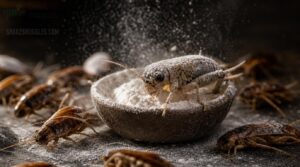
Dusting feeder insects correctly starts with a simple shake. Place your crickets or roaches in a small container, add a light pinch of calcium powder, and tumble them briefly until they’re lightly coated — not caked. That thin, even layer is exactly what you want. Over-dusting wastes supplement and can clump, dropping off before your reptile ever gets a bite.
Offer dusted insects immediately. The longer they sit, the more powder they shed through grooming and movement, and your reptile ends up with far less than intended. Timing your dusting to match feeding time keeps vitamin D3 and calcium delivery consistent. Between sessions, keep your dusting container clean and tightly sealed to prevent moisture from clumping the powder or contaminating fresh batches.
Gut Loading Prey Items

Powder coating your feeders is only half the equation — what those insects ate before the shake matters just as much. Gut loading prey items means feeding your feeder insects nutritious foods 24 to 48 hours before offering them to your reptile, so the nutrients transfer directly at mealtime.
Offer dark leafy greens, sweet potato, carrot, and bell pepper for strong vitamin and beta-carotene delivery. Avoid spinach — its oxalates bind calcium, reducing what your reptile actually absorbs.
Whole Prey Diet Adjustments
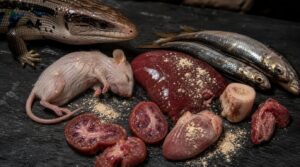
Feeding whole prey changes the supplement equation entirely. When liver is included, vitamin A load rises fast — so you’d cut back on preformed vitamin A supplements that week.
Bone content contributes calcium and phosphorus together, meaning your calcium dusting schedule needs adjusting.
Rotate prey types to prevent nutrient stacking and keep organ ratios balanced across feedings.
Juvenile Versus Adult Dosing

Just as whole prey feeding demands you adjust for bone and organ nutrients, life stage shapes dosing frequency just as sharply.
Juveniles are building bone fast, so they need:
- Calcium with D₃ at nearly every feeding
- Multivitamins twice weekly to fuel tissue growth
- Tighter calcium pacing to avoid skeletal gaps
Adults shift to maintenance, so excess fat-soluble vitamins accumulate — follow label juvenile guidelines precisely as your reptile matures.
UVB and D3 Scheduling
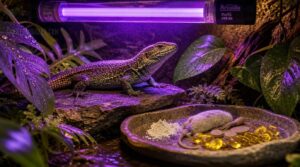
When UVB lighting is working correctly, your reptile’s skin produces D3 naturally, so D3 supplementation frequency drops noticeably. Without reliable UVB exposure, you’ll need calcium with D3 at each feeding.
Always account for basking distance effects and replace bulbs on schedule — output fades before the light does.
Match your D3 dusting to what your UVB lamp actually delivers.
Preventing Deficiencies and Toxicity
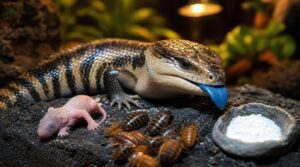
Getting the dose right is only half the battle — knowing what to watch for is just as important. Too little of the right vitamin is just as dangerous as too much, and your reptile can’t tell you when something’s off. Here’s what to look for, track, and act on before small issues become serious ones.
Metabolic Bone Disease Signs
Metabolic bone disease is one of the most preventable tragedies in reptile keeping, yet it remains common when calcium supplementation or vitamin D3 is overlooked. Watch for these early warning signs:
- Bone Deformities and bowed limbs
- Increased Fracture Risk from minor handling
- Mobility Issues and reluctance to move
- Spinal curving causing Height Loss
Catching these signs early gives you real options.
Vitamin a Deficiency Symptoms
Vitamin A deficiency — known clinically as hypovitaminosis A — quietly chips away at your reptile’s health before obvious symptoms appear.
Watch for night blindness and dry eyes, along with skin scaling and mucosal keratinization, affecting respiratory and digestive linings.
Immune function declines sharply, raising infection risk, while juvenile reptiles may show growth retardation, and reproductive problems can emerge in adults.
D3 Overdose Warning Signs
Too much D₃ doesn’t just cause minor discomfort — it can silently damage organs before you notice anything wrong. Hypervitaminosis D₃ triggers hypercalcemia, flooding tissues with excess calcium.
Excess D3 doesn’t just harm — it silently floods your reptile’s tissues with calcium before you notice anything wrong
Watch for these warning signs:
- Digestive upset — vomiting, constipation, or lost appetite
- Kidney stress — excessive urination, thirst, or stone formation
- Neuromuscular effects — weakness, confusion, or tremors
- Cardiovascular risks — abnormal heart rhythms or pressure changes
Clinical veterinary monitoring and blood tests confirm toxicity early.
Feeding and Supplement Logs
A simple log can be the difference between catching a problem early and missing it entirely. Record log entry timestamps for every feeding — date, time, and supplement used — so you can spot dosing gaps or overlaps at a glance.
| Date | Supplement Brand & Dosage | Feeding Observation Notes |
|---|---|---|
| May 20 | ReptiVite multivitamin powder, light dust | Active, full appetite |
| May 22 | Fluker’s calcium, standard dust | Normal stool, alert |
| May 24 | ReptiVite D₃ formula, measured dose | Slight lethargy noted |
Note container batch logging too — expired or degraded supplements skew your entire dietary supplementation schedule without warning.
When to Call Veterinarians
Knowing when to call a vet can genuinely save your reptile’s life.
If your ball python suddenly hisses, understanding why ball pythons hiss and what triggers this defensive behavior can help you tell normal stress responses apart from signs that warrant a vet visit.
Open-mouth breathing, gasping, or clicking sounds signal a respiratory emergency that needs same-day care.
Seizures, collapse, or loss of coordination are neurological red flags — don’t wait.
Persistent vomiting, severe dehydration, or abdominal swelling also warrant urgent evaluation, as does suspected hypervitaminosis A from over-supplementation.
Frequently Asked Questions (FAQs)
What vitamins do carnivores need?
Carnivorous reptiles can’t convert beta-carotene reliably, so preformed vitamin A (retinol) is non-negotiable. They also need vitamin D3, calcium in a correct calcium phosphorus ratio, vitamin E, B vitamins, and key trace minerals.
How to get vitamin A to leopard gecko?
Leopard geckos get vitamin A through dusting feeder insects with a reptile multivitamin containing preformed vitamin A or beta-carotene, and rotating a varied insect diet weekly to reduce vitamin A deficiency risk.
What vitamin supplements do bearded dragons need?
Bearded dragons quietly thrive or decline based on what’s in their supplement routine. They need calcium with D3, a weekly multivitamin, and controlled vitamin A to stay healthy.
Is too much Vitamin D3 bad for bearded dragons?
Yes, too much vitamin D3 is harmful to bearded dragons. Excess D3 raises blood calcium, causing mineral deposits in kidneys and soft tissues, lethargy, appetite loss, and dehydration — serious consequences that require prompt veterinary attention.
Can carnivorous reptiles overdose on vitamin K?
Vitamin K overdose is very rare. Unlike vitamins A or D₃, vitamin K toxicity poses minimal risk at normal supplementation levels — your main concern is deficiency or rodenticide exposure, not excess.
Do carnivorous reptiles need vitamin C supplements?
Most carnivorous reptiles rely on endogenous synthesis — producing vitamin C internally through the kidneys and intestines — so routine vitamin C supplementation isn’t necessary unless illness or poor synthesis is suspected.
How does temperature affect vitamin absorption rates?
Temperature directly shapes vitamin absorption efficiency in reptiles. Warmer body temps drive enzyme activity and gut motility, speeding nutrient uptake. Cold slows transport mechanisms, meaning vitamins pass through largely unabsorbed.
Should supplements change during brumation or hibernation?
Brumation Supplement Pause means less feeding, less dosing, less risk. When your reptile stops eating, winter dosing adjustments are simple: pause supplementation, resume carefully once appetite and basking return post-dormancy.
Are there differences between reptile and amphibian vitamins?
Yes, reptile and amphibian vitamins differ. Amphibians absorb nutrients through their skin differently, making certain vitamin A forms and D3 dosing less interchangeable than you might assume.
Can reptile supplements expire before the listed date?
Supplements can expire before their printed date — call it potency before paper. Heat, moisture, and oxygen break down vitamins D₃ and A long before the label’s deadline, especially in opened powder containers.
Conclusion
An ounce of prevention is worth a pound of cure—and nowhere is that truer than in reptile nutrition. Selecting the right reptile vitamins for carnivorous reptiles isn’t guesswork; it’s a calculated decision built on understanding your animal’s biology, your lighting setup, and what your prey items actually deliver.
Proper nutrition also supports healthy shedding, helping reduce issues like retained shed eye caps in snakes.
Track your dosing, respect your species’ specific thresholds, and don’t wait for symptoms to guide you. Your lizard can’t tell you something’s wrong until the damage is already done.