This site is supported by our readers. We may earn a commission, at no cost to you, if you purchase through links.

A female corn snake can look ready at two years old, and breeding her anyway can cost you her life. Egg binding, a depleted body, and a clutch of weak hatchlings all trace back to one rushed pairing.
Preparing corn snakes for breeding season starts months before any male enters the enclosure. You count backward from your hatch date, weigh each female against the 333 rule, and set feeding, temperatures, and cooling on a schedule your snakes can handle.
Skip a step and you won’t see the damage until eggs fail. Here’s how to build every phase so the next one holds.
Table Of Contents
- Key Takeaways
- Plan Your Corn Snake Breeding Season
- Select Healthy, Unrelated Corn Snake Breeding Pairs
- Condition Corn Snakes With Appropriate Feeding
- Prepare Breeding Enclosures and Egg-Laying Supplies
- Plan Safe Brumation for Breeding Corn Snakes
- Check Breeding Readiness Before Introducing Corn Snakes
- Frequently Asked Questions (FAQs)
- How difficult is it to breed corn snakes?
- What time of year is mating season for corn snakes?
- Can I make money breeding snakes?
- How old should a corn snake be to breed?
- What morphs or color patterns breed best together?
- Can I breed corn snakes from different localities?
- How long should I wait between breeding seasons?
- Do corn snakes need separate enclosures after mating?
- What veterinary checks should be done before breeding?
- How long after mating do corn snakes lay eggs?
- Conclusion
Key Takeaways
- Don’t breed a female until she’s hit the 333 rule (three years, three feet, 300 grams), and screen every snake with a vet and unrelated lineage first, because rushing a pairing risks egg binding, a depleted body, and weak hatchlings.
- You’ll get better clutches by counting back from your target hatch date and planning 4 to 6 months ahead, since incubation runs 60 to 70 days and females lay 30 to 45 days after mating.
- Build your breeders’ reserves with disciplined feeding, matching prey to their body condition and girth, and fast them for two weeks before any cooling so undigested food doesn’t rot inside them.
- If you cool your snakes, hold them at 50-60°F for 8 to 12 weeks, then warm them gradually and wait for the female’s post-brumation shed before you introduce the male.
Plan Your Corn Snake Breeding Season

You’ll get better clutches when you plan 4 to 6 months ahead instead of reacting to the season as it arrives. Start with your target hatch date and count backward: incubation runs 60 to 70 days, and females usually lay 30 to 45 days after mating. Those numbers set your pairing window, and they tell you when the cooling period must end.
Once your pairing window is set, keep incubator temperatures near 78-82°F with steady humidity, and check this gopher snake breeding guide for setup tips that help eggs hatch reliably.
Next, map the full calendar. Schedule prebreeding conditioning, the cooling period, and a steady photoperiod so each phase leads cleanly into the next. Protect reproductive health by never rushing any step. Plan for a 60–90 day cooling period held at 10–15°C, with fresh water available throughout.
Budget before you buy anything. You’ll need separate enclosures sized correctly, since enclosure size affects stress, plus incubation equipment and hatchling housing before the very first pairing.
Select Healthy, Unrelated Corn Snake Breeding Pairs

Your breeding pairs set the ceiling for every clutch, so you can’t afford to guess. Before you introduce any snakes, you’ll check three things: their age, size, and condition, their health status, and their family lines. Work through each one in order, and you’ll build your season on solid ground.
Age, Size, and Body Condition
Most females aren’t ready until they hit the 333 rule: three years, three feet, and 300 grams. Check age first, then measure size with tape.
Run body condition scoring every month. You want a bread-loaf shape with no visible spine ridges. Keep weight monitoring on a log, and match pairs by size so breeding pair compatibility favors the female’s reserves.
Veterinary Screening and Quarantine
A snake that hits 333 can still carry trouble, so book veterinary screening before you pair anything. Quarantine every new arrival for 60 to 90 days in a separate room with its own gear.
Beyond quarantine, a few simple habits like disinfecting enclosures and washing your hands between animals go a long way, and this guide on how to prevent snake infections walks through them.
Bring fresh fecal samples for parasite control, and ask your vet to check mites and listen for respiratory health problems. Weak animals show higher disease susceptibility.
Genetic Compatibility and Lineage Records
A clean vet report doesn’t tell you whether two snakes share ancestors, so check lineage tracking before you pair them. Keep your inbreeding coefficient low and protect genetic diversity.
- Record each snake’s morph, het genes, and parents.
- Verify three generations of lineage.
- Avoid pairing siblings or half-siblings.
- Use gene pool expansion to dodge recessive disorders.
Condition Corn Snakes With Appropriate Feeding

Build your breeders’ reserves before the season starts, because reproductive health begins in the feeding tub. Weigh every snake and check body condition. Visible spine ridges with no lateral fat rolls mean you should increase feeding; early obesity means you should cut back.
If you’re unsure how much to offer at each meal, this snake feeding guide covering portion sizes and schedules can help you match prey size and frequency to each animal’s weight.
In early March, move females to two sized mice per week. Match each prey item to 1 to 1.5 times the snake’s widest girth, and never exceed 1.5 times, or you’ll risk regurgitation and digestive injury.
Keep your feeding schedules disciplined. Adults on weekly meals fatten fast, so hold them to every 10 to 14 days until conditioning begins. Log prey size, date, and response each time, and you’ll catch problems. Well-conditioned, not overweight, is the goal.
Prepare Breeding Enclosures and Egg-Laying Supplies
Set up your enclosure before your pair meets. Start with enclosure size: 40 gallons is the minimum for adult corn snakes. Build a gradient, 84-88°F on the warm side with basking spots, 75-80°F on the cool side, and add a hide at each end.
Line the floor with aspen substrate, and skip pine and cedar, since their oils irritate respiratory systems. Keep humidity control simple: hold 40-60%, rising to 70% during shedding.
Build the egg-laying nesting box. Use a sealable tub with an entrance hole in the lid, sized so the female can turn around. Fill it with moist sphagnum moss, and set it on the cool side. The substrate should hold its shape when squeezed but release no water.
Plan Safe Brumation for Breeding Corn Snakes
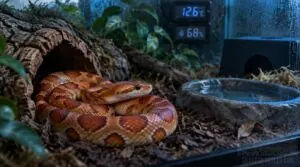
Brumation can make or break your breeding season, so you need a plan before the temperatures drop. The four steps below walk you through deciding whether to cool your snakes, preparing them, running the cooling period, and bringing them back up safely. Work through them in order and you’ll keep control of every stage.
Deciding Whether Brumation is Appropriate
Brumation isn’t mandatory, so ask whether your snakes truly need it.
Skip it if your pair breeds reliably without a brumation period. Consider temperature cycling only when your snakes are mature, healthy, and well-conditioned, or when you need synchronized timing. Can you hold a stable cooling period at 45 to 65F, with a gradual photoperiod ramp afterward? If not, wait.
Pre-Cooling Fasting and Health Checks
Picture a male corn snake that ate on Saturday, then got moved into cooling on Sunday. Weeks later, that undigested rat is still sitting in his gut, rotting. Don’t let that happen to yours.
Never move a snake into cooling on a full stomach, or that undigested meal will rot inside him for weeks
Run pre-cooling fasting for two weeks, and weigh him before and after. Check for mites, respiratory wheezing, and parasites before any cooling period begins. Keep fresh water available throughout.
Cooling Temperatures, Duration, and Monitoring
Your brumation period lives or dies by cooling temperatures. Hold the enclosure between 50-60°F (10-15°C), and never let it drop below 41°F or climb past 65°F.
Run the dormancy period for 8-12 weeks, keeping the room dark. Provide a modest temperature gradient so thermal regulation stays possible. Check the water dish every few days, refill it, and watch for discharge, labored breathing, or odd posture.
Gradual Warming and Feeding Resumption
Your corn snake’s brumation period ends slowly, never abruptly. Run a postbrumation warmup like this:
- Raise temperatures 2-3°F daily.
- Add a gradual photoperiod ramp.
- Offer a thermal gradient reaching 88-92°F.
- Mist twice daily, then restore water.
- Feed small prey after 48-72 hours.
Expect feeding aggression to return within days, but don’t rush. Refusals lasting three to five days are normal.
Check Breeding Readiness Before Introducing Corn Snakes
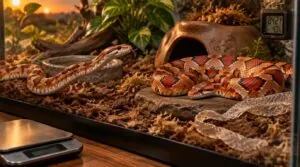
Your brumation cycle is finished, but your snakes aren’t ready until their bodies say so. Watch for the female’s post-brumation shed, which usually arrives two to three weeks after temperatures return to normal. That shed signals follicular development has started.
Check your male next. Spermatogenesis is underway when he turns restless, eats less, and tongue-flicks constantly, often over 30 times a minute. Look for enlarged cloacal bulges too, with enclosure temperatures holding between 75 and 82°F.
Then weigh and inspect both animals. Weight loss beyond 10 percent, sunken eyes, nasal discharge, or poor muscle tone means a vet visit comes first.
Place the male in her enclosure at dusk, and watch for any aggression. Gravid female signs come later.
Frequently Asked Questions (FAQs)
How difficult is it to breed corn snakes?
Breeding corn snakes is easier than breeding most reptiles, but it’s not easy. You’ll need brumation protocols, reproductive health checks, and egg incubation protocols dialed in, plus homes lined up for 20-40 hatchlings.
What time of year is mating season for corn snakes?
Your corn snake breeding season runs March through May in the wild, right after winter brumation ends. Captive breeders aim for February through April. Southern climates can stretch breeding year-round.
Can I make money breeding snakes?
You can, but don’t expect quick profit. Most new breeders lose money for 2-3 years because feeding, enclosures, and slow sales outpace income. Chase rare morphs, sell 5-10 snakes monthly, and keep a day job.
How old should a corn snake be to breed?
Breed one too young and you’ll ruin your entire bloodline. Females need three years and 300 grams; males, about two years and 250 grams. Proper brumation protocols protect reproductive health and help smooth postbreeding recovery.
What morphs or color patterns breed best together?
Het amel pairings produce 25% visual amelanistic babies. Pair recessive carriers together, choosing unrelated mates for genetic diversity and hybrid vigor.
Watch mating cues closely, use proven, safe pair methods, and keep your crossventilation strong.
Can I breed corn snakes from different localities?
Think of locality lines as different paint shades from one tin. Yes, you can pair them. Geographic isolation shaped each look, but they’re all one species, so you boost genetic diversity without hybrid vigor worries.
How long should I wait between breeding seasons?
Recovery takes six to twelve weeks after laying. Weigh her weekly. Wait until she regains baseline weight, then run the 60 to 75 day dormancy period. Slow recovery means resting a full year. Never rush.
Do corn snakes need separate enclosures after mating?
Absolutely, give every corn snake its own fortress! Smart reptile enclosure design keeps them solo, since socialization methods don’t suit loners.
Separate her after mating cues, protect her reproductive health, and add a nesting box.
What veterinary checks should be done before breeding?
Five vet checks protect your pairing: a physical exam, fecal testing, infectious disease assessment, reproductive evaluation, and brumation clearance.
Book reptile veterinary care, record baseline weight, don’t breed until your vet confirms each snake’s health.
How long after mating do corn snakes lay eggs?
You’ll wait a lifetime. Really, it’s 30 to 45 days after mating, once ovulation induction and reproductive hormones finish their work.
Always hold a steady thermal gradient, then try egg candling to judge clutch viability.
Conclusion
Count backward from the hatch date. Weigh each female against the 333 rule. Match feeding, temperatures, and cooling to what your snakes can handle.
Preparing corn snakes for breeding season rewards patience, not speed. A female who enters the pairing strong, rested, and fully conditioned gives you thick-shelled eggs and hatchlings that feed on their own. Rush her, and you pay in eggs and in her health.
Build the schedule. Then trust it, every week.