This site is supported by our readers. We may earn a commission, at no cost to you, if you purchase through links.

A rosy boa can bask at 110°F and still shiver through a 55°F night. Desert species live on extremes, and your enclosure has to copy them.
Get it wrong and the damage builds quietly. A stick-on dial reads 85°F while the sand under the lamp hits 120°F. A heater plugged straight into the wall has no thermostat to stop it. A snake that flattens itself against the glass is already telling you it’s overheating.
The right snake enclosure heaters for desert species give you a hot basking zone, a cool retreat, and a safe cutoff. These eight picks, plus the setup rules that keep them safe, put you in control.
Table Of Contents
- Key Takeaways
- Set Species-Specific Desert Snake Temperature Targets
- Choose Heater Types for Desert Snake Enclosures
- Top 8 Heaters for Desert Snake Enclosures
- 1. Arcadia Deep Heat Emitter 50W
- 2. Zoo Med Basking Spot Lamp 75W
- 3. Zilla Mini Ceramic Heat Emitter 50W
- 4. Exo Terra Sun-Glo Basking Infrared Lamp
- 5. Flukers 100W Ceramic Heat Emitter
- 6. CarolinaCustomCages 35w GU10 Basking Lamp Set
- 7. CAROLINACUSTOMCAGES 75w GU10 Basking Lamp
- 8. Zoo Med Repti Tuff Splashproof Halogen Lamps
- Install Snake Heaters With Thermostats and Guards
- Maintain Temperature Gradients and Troubleshoot Snake Heaters
- Frequently Asked Questions (FAQs)
- What is the best heat source for a snake enclosure?
- What are some good heaters for snakes?
- How to increase heat in a snake enclosure?
- How to keep snakes warm with no power?
- How often should heat bulbs be replaced?
- Can desert snakes sleep with heaters on?
- Do desert snakes need UVB lighting too?
- How much does running a snake heater cost?
- Should heaters run during power outages or travel?
- Conclusion
Key Takeaways
- Give your desert snake a hot basking spot and a cool retreat that matches its species, such as 90-110°F for rosy boas, so it can choose its own temperature.
- Run every heater through a proportional thermostat with the probe secured under the heat source, and add a guard and GFCI protection, because a bare plug-in heater can overheat your snake.
- Choose a ceramic heat emitter for steady, light-free heat at night, but check any heater or bulb you buy on arrival and keep a spare, since many of these products fail early or arrive broken.
- Measure temperatures weekly with an infrared temp gun instead of a stick-on dial, and treat glass-surfing or flattening as a sign your snake needs cooling right away.
Set Species-Specific Desert Snake Temperature Targets
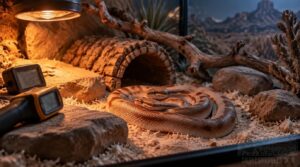
The wrong temperature can kill your snake. Species-Specific Heating Needs aren’t optional, so set your targets before you buy a single heater.
Even with the right heater, your snake needs a hot side and cool side in its habitat so it can regulate its own body temperature.
Desert rosy boas need a 90-110°F Basking Spot, daytime ambient of 65-85°F, and nights of 60-70°F. Desert king snakes want a cool side of 68-75°F, a basking surface of 88-92°F, and nights no lower than 65°F.
Practice Temperature Ranging daily. Measure with a probe thermometer or temp gun, never a stick-on dial. Guessing is dangerous.
Build in Thermal Gradient Control. Your snake must move between warm and cool zones at will. Desert king snakes in particular do best when heat is applied to one side of the enclosure only, because one-sided heating for thermoregulation lets them choose their own temperature. Substrate Thermal Properties matter too. Sand holds heat longer than aspen, so check surface temperatures after your lamp has run for an hour. Don’t trust air readings.
Choose Heater Types for Desert Snake Enclosures
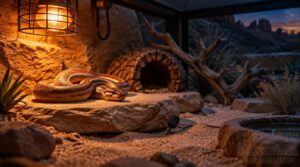
Your targets decide your hardware. Match the heater to your snake’s Species-Specific Heating Needs, or you’ll chase numbers all winter.
Three options fit desert setups:
- Ceramic Heat Emitters give off infrared with no light, so nights stay dark. They run hot, so cage them.
- Radiant Heat Panels warm a wide area gently, which helps Thermal Gradient Control.
- Halogen basking lamps create a bright, defined basking zone for rosy boas.
Skip under-tank pads as your only heat source. They warm the belly, not the air, and they can overheat glass.
Mount every heater over one end only. Follow Electrical Safety Protocols: use a thermostat, a guard, and a drip loop in the cord. Never plug a heater straight into the wall.
Top 8 Heaters for Desert Snake Enclosures
You’ve picked your heater type, so now it’s time to match it to your enclosure. The eight options below cover ceramic emitters, basking lamps, and halogen units, each suited to a different setup. Check wattage and enclosure size before you buy, because an underpowered or oversized heater puts your snake at risk.
1. Arcadia Deep Heat Emitter 50W
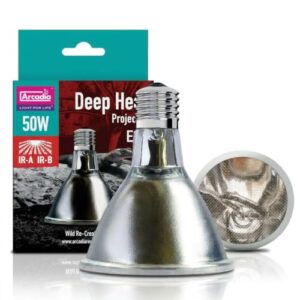
Picture a dark enclosure at midnight, warm as a sun-baked rock, with no glow at all. That’s the Arcadia Deep Heat Emitter 50W. It emits Infra-Red-A and B radiation, so heat penetrates deep into muscle tissue. Its aluminum body weighs just 3.2 ounces, and it uses less energy than tungsten or ceramic emitters.
Here’s the catch. Some units fail within a month, and customers report mixed reliability. Check yours daily. Keep a backup heater ready before you trust it overnight.
| Best For | Reptile keepers who want steady, light-free nighttime heat and are willing to check the unit daily and keep a backup heater on hand. |
|---|---|
| Heat Type | Infrared radiant heat |
| Wattage | N/A |
| Light Output | No visible light |
| Fixture Compatibility | N/A |
| Pack Size | N/A |
| Reliability Concerns | Early failures reported |
| Additional Features |
|
- Emits Infra-Red-A and B radiation, so heat penetrates deep into muscle tissue
- Gives off no visible light, making it a good fit for 24/7 use without disrupting day/night cycles
- Uses less energy than tungsten and ceramic emitters
- Some units fail within a month of use
- Customers report mixed reliability
- Multiple reviews raise concerns about lifespan
2. Zoo Med Basking Spot Lamp 75W
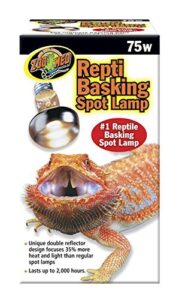
Now flip the lighting. The Zoo Med Basking Spot Lamp 75W glows bright, so it suits diurnal desert snakes that need a daytime basking site.
If you’d rather keep the tank dark at night, pair that daytime basking lamp with a ceramic emitter and check out these kid-friendly snake enclosure ideas for a setup everyone can enjoy.
Its double reflector design focuses 35% more heat and light into a tighter beam. That builds a hot spot and lets the rest of the enclosure stay cooler. It also gives off UVA, and it fits standard can fixtures.
Don’t trust it blindly. Some bulbs die within a week. Others arrive defective. Keep a spare.
| Best For | Owners of diurnal reptiles, such as desert snakes, who need a concentrated daytime basking spot in a terrarium that uses a standard can lamp fixture. |
|---|---|
| Heat Type | Basking heat and light |
| Wattage | 75 watts |
| Light Output | Visible light with UVA |
| Fixture Compatibility | Standard can lamp fixtures |
| Pack Size | N/A |
| Reliability Concerns | Short bulb lifespan |
| Additional Features |
|
- The double reflector design focuses 35% more heat and light into a tighter beam, creating a concentrated basking site.
- It gives off beneficial UVA rays that support reptile well-being.
- It fits standard can lamp fixtures and helps raise the overall ambient air temperature in the enclosure.
- Some customers report bulb lifespans as short as one week.
- Defective bulbs are possible upon arrival, according to one review.
- Import fees may apply for warranty replacements on U.S. shipments.
3. Zilla Mini Ceramic Heat Emitter 50W
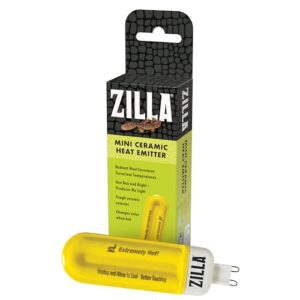
Ceramic construction defines the Zilla Mini Ceramic Heat Emitter, a 50 watt unit that fits Zilla Low Profile, Pro Sol, and Mini Heat & UVB fixtures. It measures just 1.5 x 0.5 x 4.5 inches and weighs 2.08 ounces, so it suits compact setups.
It gives off radiant heat with no visible light, which protects your snake’s day and night cycle. The yellow shell shows when it’s actively heating.
Pair it with a thermostat. Always. Without one, it can overheat. Monitor it closely, because reviewers report mixed reliability over time.
| Best For | Reptile and amphibian keepers with a compact or low-profile terrarium who want nighttime heat without disrupting the light cycle, and who will pair it with a thermostat. |
|---|---|
| Heat Type | Radiant ceramic heat |
| Wattage | 50 watts |
| Light Output | No visible light |
| Fixture Compatibility | Zilla low-profile fixtures |
| Pack Size | N/A |
| Reliability Concerns | Mixed long-term reliability |
| Additional Features |
|
- Gives off radiant heat with no visible light, so day and night cycles stay undisturbed
- Small and light, and it fits Zilla Low Profile, Pro Sol, and Mini Heat & UVB fixtures
- Has a color-changing indicator that shows when it’s actively heating
- Needs a thermostat to prevent overheating
- Shouldn’t be used for long-term continuous heating without monitoring
- Reviewers report mixed opinions on how well it holds up over time
4. Exo Terra Sun-Glo Basking Infrared Lamp
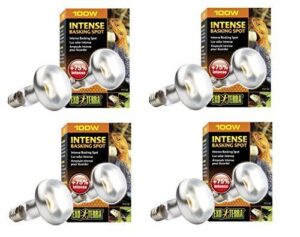
The Exo Terra Sun-Glo is a 100-watt, 120-volt basking lamp that delivers a 35 percent boost of light and heat in the beam. It carves out a focused hot spot and raises ambient temperature for thermoregulation. Pair it with Night Glo or Heat Glo bulbs for a 24-hour cycle.
Know the risks. Several buyers report bulbs arriving shattered, because packaging has no protective material. Lifespan is short too, often 2-3 weeks. Inspect all 4 bulbs on arrival. Always use thermostats.
| Best For | Reptile keepers who want an affordable basking spot lamp for a terrarium and are willing to inspect the bulbs on arrival and replace them often. |
|---|---|
| Heat Type | Basking heat and light |
| Wattage | 100 watts |
| Light Output | Visible light with UVA |
| Fixture Compatibility | N/A |
| Pack Size | Pack of 4 |
| Reliability Concerns | Short lifespan, shattering |
| Additional Features |
|
- Delivers a 35 percent increase of light and heat in the beam for a focused basking area
- Raises ambient air temperature to support thermoregulation
- Pairs with Night Glo or Heat Glo bulbs for a 24-hour lighting cycle
- Several buyers report bulbs arriving shattered because the packaging has no protective material
- Short lifespan, often failing within 2-3 weeks
- Pack of 4 means any damaged bulbs must be caught and dealt with right after delivery
5. Flukers 100W Ceramic Heat Emitter
Picture a ball python keeper who screws a ceramic emitter into a cheap plastic socket. Two weeks later, the socket warps and the whole fixture sags toward the substrate. Don’t be that keeper.
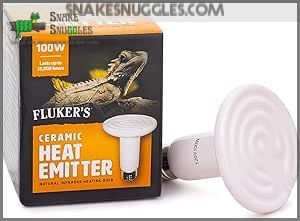
The Flukers 100W Ceramic Heat Emitter gives you 24-hour heat with zero light, so your snake’s day cycle stays intact. It suits tropical and desert species alike.
Pair it with a compatible lamp fixture, like a Repta-Clamp Lamp. The emitter can break or melt at the socket over time, so inspect it often.
| Best For | Reptile and amphibian keepers who need a steady, light-free heat source for tropical, desert, or nocturnal animals and already have a compatible lamp fixture. |
|---|---|
| Heat Type | Ceramic radiant heat |
| Wattage | 100 watts |
| Light Output | No visible light |
| Fixture Compatibility | Repta-Clamp Lamp |
| Pack Size | N/A |
| Reliability Concerns | Socket melting possible |
| Additional Features |
|
- Gives 24-hour heat without any light, so your animal’s day and night cycle stays intact
- Helps set a suitable temperature range for reptiles and amphibians
- Works for tropical and desert species as well as nocturnal animals
- Needs a compatible lamp fixture, such as a Repta-Clamp Lamp
- Can get very hot, with surface temperatures reported up to 100°F
- May break or melt at the socket over time, which can damage the lamp
6. CarolinaCustomCages 35w GU10 Basking Lamp Set
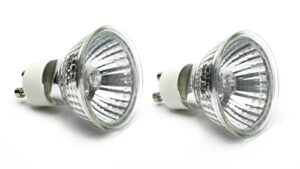
Imagine this: you open the box expecting two bulbs, find one, and your leopard gecko’s basking spot goes dark when it burns out days later. That’s the risk with the CarolinaCustomCages 35w GU10 Basking Lamp Set.
It’s a 35 watt GU10 lamp, sold as a set of two. Its compact size mounts under screen mesh and fits Reptile T5HO UVB and GU10 fixtures.
Check your bulbs immediately. Count them, inspect the prongs, and keep a spare. Loose prongs caused failures.
| Best For | Reptile keepers who already use a Carolina Custom Cages or Reptile T5HO UVB + GU10 fixture and want a compact 35 watt basking lamp that fits under screen mesh. |
|---|---|
| Heat Type | Basking heat |
| Wattage | 35 watts |
| Light Output | Visible warm light |
| Fixture Compatibility | GU10 T5HO fixtures |
| Pack Size | Set of 2 |
| Reliability Concerns | Short lifespan, loose prong |
| Additional Features |
|
- Compact 35 watt GU10 design mounts under screen mesh
- Made to work with Reptile T5HO UVB GU10 Basking Light Fixtures and Carolina Custom Cages lighting systems
- Sold as a set of two, with temperature adjustable to your terrarium size and ambient conditions
- Some buyers received only one bulb instead of two
- Several users said bulbs burned out within days or weeks
- One reviewer reported a loose prong that caused early failure
7. CAROLINACUSTOMCAGES 75w GU10 Basking Lamp
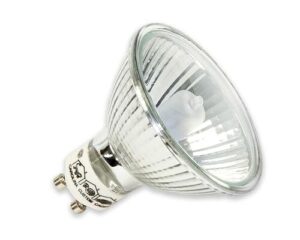
Don’t trust this bulb blindly. The 75W GU10 halogen gives your bearded dragon or desert snake a focused basking spot, and it’s built for Reptile T5HO UVB and GU10 fixtures. Its compact size mounts under the top screen mesh.
Wattage sets basking surface temperature, so aim for 110-120°F and verify with a temp gun. Use a ceramic socket and a thermostat.
Here’s the catch: many owners report failure within 1-2 months, and some bulbs arrive broken. Keep a spare ready.
| Best For | Bearded dragon owners with a compatible Reptile T5HO UVB + GU10 fixture who want a compact basking bulb and are willing to keep spares on hand. |
|---|---|
| Heat Type | Basking heat |
| Wattage | 75 watts |
| Light Output | Visible warm white light |
| Fixture Compatibility | GU10 T5HO fixtures |
| Pack Size | N/A |
| Reliability Concerns | Failure within 1-2 months |
| Additional Features |
|
- Compact GU10 size mounts under the top screen mesh
- 75W output is meant to reach a 110-120°F basking surface temperature
- Works with a range of terrarium sizes, from 36x18x18 up to 48x24x24
- Many owners report the bulb failing within 1-2 months
- Some bulbs arrive broken or defective
- Lifespan has dropped noticeably from the 3-6 months earlier versions lasted
8. Zoo Med Repti Tuff Splashproof Halogen Lamps
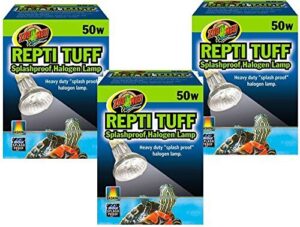
Don’t let a splash ruin your setup. This pack of three 50-watt splashproof halogen bulbs (model OH-50) is built for humid and aquatic enclosures, so it experiences moisture that would wreck a standard basking bulb.
You get UVA output, efficient basking heat, and richer color rendering. Average life is 2,500 hours.
Inspect every bulb on arrival. One customer received a broken bulb, and some report failure within seven months of storage. Lifespan varies by batch. Wire it to a thermostat.
| Best For | Reptile keepers with humid or aquatic enclosures who need a splashproof basking bulb that also gives off UVA light. |
|---|---|
| Heat Type | Basking heat and light |
| Wattage | 50 watts |
| Light Output | Visible light with UVA |
| Fixture Compatibility | N/A |
| Pack Size | Pack of 3 |
| Reliability Concerns | Mixed lifespan consistency |
| Additional Features |
|
- Splashproof design suited to humid and aquatic setups
- Provides efficient heat and light for basking areas, plus UVA output and richer color rendering
- Comes as a pack of three 50-watt bulbs with an average life of 2,500 hours
- Some users report bulb failure within seven months of storage
- Lifespan is inconsistent across batches
- One customer received a broken bulb in the initial shipment
Install Snake Heaters With Thermostats and Guards
You’ve chosen your heater, so now wire it up safely. Never plug a heater straight into the wall. Plug it into a proportional thermostat so your snake can’t overheat while you’re at work or asleep.
Place the probe directly under the heat source, on the enclosure floor, where it reads true basking surface temperature. Secure it with aluminum tape or a mechanical fastener. A loose probe gives false readings, and false readings cook snakes.
Put the thermostat probe directly under the heat source and secure it firmly, because a loose probe gives false readings, and false readings cook snakes
Fit every Ceramic Heat Emitters unit with a porcelain socket and a wire guard. Keep the clearance the manufacturer specifies so air can move. Check that your thermostat’s wattage rating matches your heater’s load.
Heat mats and undertank heaters need their probe on the substrate inside the warm hide.
Add GFCI protection to the outlet.
Maintain Temperature Gradients and Troubleshoot Snake Heaters
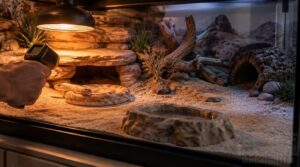
Your heater is wired in, but the job isn’t done. Check Thermal Gradients every week with an infrared thermometer gun. Probes only read air or contact points, not radiant heat.
Verify Thermostat Calibration monthly. Compare the display against your gun reading and adjust if they drift apart.
Watch the cool end. Desert snakes bolt underground when heat peaks, and they’ll overheat without a cool retreat. Constant soaking, glass-surfing, and flattening mean immediate cooling is required.
Good Temperature Regulation means a warm side and a cool side. If the cool end climbs, drop your wattage or add distance.
Heat Pad Safety: never cover the pad, and keep its probe inside the warm hide.
Troubleshooting Heating Problems starts with measuring, never guessing.
Frequently Asked Questions (FAQs)
What is the best heat source for a snake enclosure?
Your best heat source is a ceramic heat emitter. It heats the air around the clock without light, so your snake’s day and night cycle stays intact. Always run it on a thermostat.
What are some good heaters for snakes?
Start with Ceramic Heat Emitters. They give steady, lightless warmth day and night. Always run them through Thermostats.
Heat Tape and Heat Pads work for belly heat, but never skip control. You’ll need Temperature Gradients.
How to increase heat in a snake enclosure?
Don’t guess. Check your basking surface temperature with a temperature gun first. If it’s low, add an overhead heat source on one side, and run it through a thermostat for safe temperature control.
How to keep snakes warm with no power?
Start emergency heating now. Insulate the enclosure with blankets, add hot water bottles, and use generatorassisted heating or batterybacked heat mats. Watch temperature deviation through continuous data logging, and move your snake somewhere warmer fast.
How often should heat bulbs be replaced?
Heat bulb replacement frequency depends on type. Swap halogen flood lights every 4 to 6 months. Replace ceramic heat emitters every 12 months. Don’t wait for failure. If your basking spot drops 5°F, replace it immediately.
Can desert snakes sleep with heaters on?
Yes, but only the right heater. Use a ceramic heat emitter on a thermostat. Never leave a visible-light basking lamp on overnight. Let nighttime temperature drops reach 68-75°F, and keep a cool zone.
Do desert snakes need UVB lighting too?
Think of UVB as the sun your snake never gets indoors. It isn’t strictly required for survival, but Desert Dweller Adaptation means your snake thrives with it. Provide UVB and heat working together: a 12-14 hour basking zone.
How much does running a snake heater cost?
A 50W heater running 12 hours daily costs about $70 monthly at $15/kWh. Thermostats cut runtime 30-50%, so you’ll pay less. Poor enclosure insulation and cold rooms push costs up. Monitor temperatures constantly.
Should heaters run during power outages or travel?
Well-insulated enclosures lose 1-2°F per hour, so yes, run heaters whenever you can. Use Backup Power, Generatorassisted heating, or Batterybacked heat mats for Emergency heating. Don’t skip Power outage backup.
Travel always needs 75-85°F ambient.
Conclusion
Picture a rosy boa keeper who swaps a bare bulb for a ceramic emitter on a thermostat. The probe reads 110°F under the lamp, the cool side holds 75°F, and the snake moves freely between them. That’s control.
Choose from the snake enclosure heaters for desert species above, then pair every unit with a thermostat and guard. Verify readings with a digital probe every week. Your snake can’t warn you, so your setup has to.