This site is supported by our readers. We may earn a commission, at no cost to you, if you purchase through links.

A snake without a cool retreat dies faster than one without food. Skip a meal, it survives for months. Skip the thermal gradient, overheating kills within hours.
That’s the stakes behind understanding hot side cool side snake habitat setups. Your snake can’t sweat, can’t pant, can’t regulate its own body temperature—it depends entirely on moving between zones you build for it. Get the gradient wrong, and you’re not looking at a sluggish pet. You’re looking at impaired digestion, chronic stress, or a fatal thermal spike.
Here’s what proper zone construction actually requires, species by species, degree by degree.
Table Of Contents
- Key Takeaways
- What Are Hot and Cool Sides?
- Why Snakes Need a Temperature Gradient
- How to Set Up Hot and Cool Sides
- Choosing Safe Heating and Monitoring Equipment
- Hot and Cool Side Temperatures by Species
- Frequently Asked Questions (FAQs)
- How do I know if my snake enclosure is too hot?
- Do snakes like cold or hot environments?
- Why is my snake staying on the cool side?
- What temperature should a snake’s hot side be?
- What should my snakes’ cool side be?
- How often should I replace heating equipment?
- Can I use multiple heat sources simultaneously?
- What temperature changes occur during snake shedding?
- How do seasonal shifts affect enclosure temperatures?
- Do hatchlings need different temperature gradients than adults?
- Conclusion
Key Takeaways
- Without a cool retreat, your snake can overheat to the point of death within hours, so the gradient isn’t optional comfort, it’s survival gear.
- A proper setup needs a basking zone around 88–95°F (species-dependent) and a cool side 72–80°F, always checked with a thermostat and separate thermometer rather than guesswork.
- Heat drives digestion, immune function, and stress recovery, so a snake without the right gradient can suffer slow digestion, weakened immunity, and chronically high stress hormones.
- Always match equipment (heat mats, radiant panels, lamps) and probe placement to your snake’s actual resting spots, and skip heat rocks entirely since they cause burns without a way to escape.
What Are Hot and Cool Sides?

Every enclosure has two ends, and each one has a job to do. Your snake depends on that split to function properly, not just to feel comfortable. Here’s what each zone actually needs to look like.
On the warm end and the cool end alike, picking the right hide style for your ball python makes a real difference in how secure your snake feels.
Hot Side and Basking Area
Your snake’s hot side isn’t optional decor. It’s a basking zone where surface temps hit 95–110°F, measured with a surface thermometer, not guesswork.
Position heat mats or lamps at one end, over the basking hide, on thermostat control. Never freehand the wattage.
Correct heat source placement means efficient digestion. Get it wrong, and you’re rolling dice with your snake’s gut.
Using a dimming thermostat for basking bulbs ensures stable temperature control without flickering or rapid cycling.
Cool Side and Retreat Zone
Basking is only half the job. The cool side retreat gives your snake somewhere to escape to, dropping temps 5–15°C below the hot end.
Deeper substrate (2–4 inches) helps with thermal buffering, while cypress mulch aids humidity retention. Place hides away from airflow, near vents but not in drafts.
- Ground-level cool hide, shaded, low traffic
- Substrate depth 2–4 inches
- Moisture-retentive material (cypress, coconut fiber)
- Gentle retreat zone ventilation, no drafts
- Stable, drier-adjacent humidity pocket
How Thermal Gradients Work
That retreat zone doesn’t work in isolation. Heat transfer principles drive the whole system: conduction from mats, radiation from bulbs, convection through air.
| Mechanism | Function |
|---|---|
| Conduction | Substrate heating |
| Radiation | Bulb-to-body heat |
| Convection | Air circulation |
| Thermostat | Prevents spikes |
| Probes | Gradient measurement |
Gradient formation depends on thermostat control, stable heat mats, and correct substrate depth, keeping hot and cool zones distinct.
Ambient Versus Surface Temperatures
Air temperature and surface temperature aren’t the same number. That basking spot can run 20–40°F hotter than ambient air through radiation surface gain. Probe measurement accuracy matters: check both zones. Dark hides absorb more heat than pale ones. Mismatched readings mean false security—your snake could overheat on a "safe" thermal gradient.
- Surface heat absorption spikes near bulbs
- Ambient air cooling happens in shaded corners
- Microclimate zones form around hides and rocks
- Infrared guns catch surface spikes probes miss
- Dark substrate holds heat longer than light
How Snakes Use Both Zones
Watch long enough and a pattern emerges: your snake isn’t wandering, it’s working. This is behavioral thermoregulation in action, a deliberate shuttle between zones based on need.
If you’re wondering whether that back-and-forth is truly necessary, this guide on whether corn snakes can survive without a heating pad breaks down why consistent access to a warm zone matters so much.
Digestion timing pulls it toward heat; energy conservation and stress reduction pull it back to the cool side. Shedding support depends on this back-and-forth too.
Movement is diagnostic, not random.
Why Snakes Need a Temperature Gradient
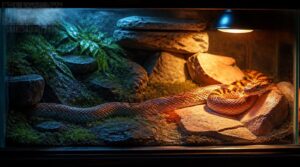
Your snake isn’t just picking a comfy spot. That gradient drives real physiology, from digestion to immune defense. Here’s what’s actually riding on those few degrees.
Digestion and Metabolic Function
Cold snakes can’t digest. Heat drives the enzyme activation process — amylase, protease, lipase all need warmth to work. Below 25°C, digestion stalls; undigested prey rots internally.
Proper heat source placement on the hot side boosts thermal digestion efficiency, cutting fecal passage time from 5.5 to 3.1 days. That’s a real metabolic boost, supporting nutrient absorption and gut microbiome function.
Immune Function and Recovery
Skip the gradient, and immune function drops fast. Cold blood can’t mount a proper defense.
Warmth drives neutrophil mobilization and healthy cytokine signaling balance. Chronic heat stress spikes cortisol, suppressing immune response and disease resistance.
- Stable heat aids immune surveillance
- Cool retreats prevent cortisol overload
- Temperature monitoring catches problems early
- Gradients aid lymphocyte function
- Rest zones lower heat stress
Stress and Energy Regulation
Stress hits your snake’s HPA axis hard, flooding blood with glucose for fight-or-flight. Ectothermic temperature needs make this trickier than in mammals.
A cool retreat lets stress hormone management happen naturally. Without it, cortisol stays elevated, forcing poor energy allocation strategies and metabolic rate shifts.
Behavioral thermoregulation through temperature gradient mapping speeds recovery energy replenishment, keeping your snake resilient once the stressor passes.
Shedding and Hydration Support
A gradient does more than warm digestion, it drives shedding.
Cool-side hydration keeps mucous membranes functional; humid hide access prevents stuck shed.
Place water bowls off the hot side, near retreats, to encourage drinking without evaporation loss.
Post-shed soaking removes residual patches.
Substrate moisture retention matters too: too dry, and scales flake instead of releasing clean.
Overheating and Chilling Risks
No escape route, no survival. Overheating without a cool retreat causes fatal heat stress within hours. Watch for panting, restlessness, thermal burns from surfaces past 110°F.
Chilling risks work slower but still hurt: bradycardia, poor digestion, regurgitation. Hypothermia warning signs include disorientation, sluggish movement. Temperature fluctuation effects compound both — daily swings spike injury risk and dehydration. Your gradient isn’t optional; it’s life support.
A thermal gradient isn’t optional for your snake, it’s life support against chilling, poor digestion, and dehydration
How to Set Up Hot and Cool Sides
Knowing why your snake needs a gradient is one thing. Building one correctly is another. Here’s exactly how to set up the hot and cool sides, step by step.
Heat One Enclosure End
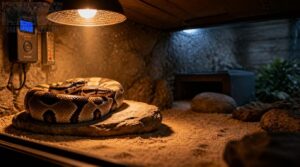
Pick one enclosure end, only one, for heat. Mount your lamp or mat there, positioned over one-third of the floor for basking zone setup. This starts thermal gradient initiation: warm end, cool end, nothing in between competing for heat.
Run thermostat control always. Check surface temperature at the basking spot daily. Insulate that end slightly to hold heat steady.
Place Hides in Both Zones

One heat source, two hides, no exceptions. Place a hot side hide near the basking spot, a cool side hide in the shaded corner.
Dual hides let your snake retreat without crossing open space. Space them for a 2–6°F gradient.
Keep entrances shaded, humidity 40–60%. Damp hide? Dry it now.
Create Species-Appropriate Temperature Differences

Every species runs its own thermostat. Ball pythons need 88–92°F hot, 78–82°F cool. Corn snakes: 82–88°F and 72–78°F. Boas: 84–90°F and 75–80°F.
Hatchlings run 2–4°F warmer, faster metabolisms demand it. Adults scale down gradually.
Never let nighttime lows drop below 72°F, metabolic slowdown follows fast. Match your gradient width to species biology, not guesswork.
Balance Substrate, Humidity, and Heat
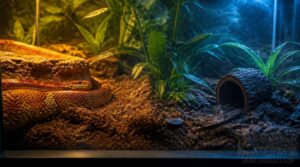
Numbers on a thermostat mean nothing if your substrate fights them. Dry substrate heats unevenly, creating hot patches near the heat mat. Moist substrate holds humidity but risks mold without airflow.
Coconut fiber or orchid bark buffers both. Keep depth at 2–4 inches. Skip water bowls on the hot side, they wreck your gradient stability fast.
Account for Enclosure Ventilation
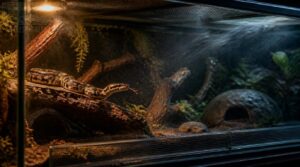
Since heat and air move together, ventilation shapes your gradient as much as any heater. Intake low, exhaust high, that’s your airflow optimization baseline for cross flow.
Angle vents away from the basking area, no direct drafts. Poor placement causes short circuits, stale air pools near hides. Balance vents to avoid humidity control swings and pressure siphoning at seams.
Choosing Safe Heating and Monitoring Equipment
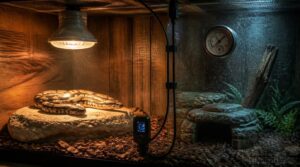
Equipment choice isn’t a matter of preference, it’s a matter of safety. The wrong heat source, or one running without a thermostat, can burn or kill your snake fast. Here’s what you need to get right before you plug anything in.
Heat Mats, Lamps, Radiant Panels
Three tools, three jobs. Heat mats warm from below, stuck to glass, run through a thermostat. Radiant panels hang overhead, spreading infrared evenly with no light — good for nighttime heating. Heat lamps create your basking zone but throw light, disrupting day-night cycles if left on. Match the tool to the gradient you’re building, not the other way around.
Match Heat Source to Enclosure
Size drives wattage, period. A 20-gallon tank needs less heat than a 6-foot enclosure, so match wattage to size ratio before buying anything. Undersized sources leave cold spots; oversized ones cook one corner. Check heat distribution uniformity with a gradient consistency check weekly.
- Measure floor space first
- Match wattage to volume
- Avoid single hot spots
- Verify thermal load matching
- Recheck probe placement often
Always Use a Thermostat
A thermostat isn’t optional gear, it’s the line between a controlled gradient and a fire hazard.
Automatic shutoff and failsafe alerts catch malfunctions before disaster hits.
Regulation keeps hot side output steady without manual checks.
Scheduling features cut energy waste, trimming utility bills over time.
Skip the thermostat, and you’re gambling on an unregulated heat mat.
Position Temperature Probes Correctly
A misplaced probe lies to you, and your snake pays for it.
Match probe placement height to where your snake actually rests, not the enclosure floor. Avoid heat sources directly underneath sensors; radiant flicker skews readings.
- Warm hide, chest height
- Cool zone, shaded rest spot
- Mid-enclosure, gradient checkpoint
Use solid thermal contact methods, run redundant probes, and stick to a strict calibration frequency—quarterly, minimum.
Avoid Heat Rocks and Hotspots
That decorative rock in the pet store aisle? It’s a burn waiting to happen. Heat rocks create hot spots exceeding 110°F, causing thermal burns your snake can’t escape.
Skip them entirely. Choose heat mats or radiant panels instead, paired with a thermostat for even basking zone control.
Check surface temps weekly with an infrared gun. Hotspot prevention beats emergency vet visits.
Hot and Cool Side Temperatures by Species
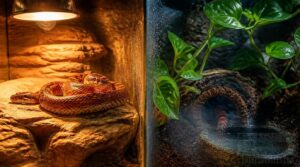
Not every snake wants the same thermostat setting. Species vary, and so do their metabolic demands, so guesswork isn’t good enough. Here’s what your hot and cool sides should read for the most common pet snakes.
Ball Python Temperature Range
Ball pythons need 88–92°F on the basking zone, 75–80°F on the cool zone. Juveniles run slightly hotter, up to 95°F, fueling growth. Never exceed 93°F sustained—dehydration and heat stress follow fast.
Use a thermostat and follow safe snake waste removal practices to prevent overheating and keep the enclosure hygienic.
For a full breakdown of ideal basking and ambient ranges across species, check out this guide to setting up your snake’s temperature gradient, which makes dialing in your setup much easier.
Nighttime lows shouldn’t dip below 72°F. Calibrate thermostats monthly against a separate thermometer. Balance humidity alongside temperature; dry heat stresses skin. Monitor both zones daily with dual probes.
Corn Snake Temperature Range
Corn snakes run cooler than ball pythons. Basking zone: 82–88°F. Cool zone: 72–78°F. Nighttime lows stay above 72°F.
- Digestive heat needs: peak enzyme activity near 85°F
- Metabolic rate zones shift as they roam the gradient
- Shedding temperature window favors mid-range warmth, not extremes
- Humidity-temperature balance prevents stuck sheds
Species-specific ranges matter—guessing invites trouble.
Boa Constrictor Temperature Range
Boas run warmer than corn snakes. Ideal Warm End: 85–90°F. Cool Retreat Temperature: 75–80°F, minimum 12–15°F differential.
| Zone | Target Range |
|---|---|
| Basking spot | 85–90°F |
| Cool retreat | 75–80°F |
| Nighttime low | 75–78°F |
| Never below | 72°F |
| Gradient span | 12–15°F |
Nighttime Temperature Management matters: dips below 72°F stall digestion. Species-specific ranges aren’t optional guesswork.
Hatchling Versus Adult Needs
Those boa numbers apply to grown animals. Hatchlings run their own rules: narrower gradient, 82–90°F warm and 75–78°F cool, plus 70–80% humidity for shedding.
- Faster metabolism, feeding every 2–3 days
- Weekly shedding, not monthly
- Higher dehydration risk
- Low stress tolerance — minimal handling
Species-specific ranges shift by age, not just species.
Nighttime and Seasonal Adjustments
Once the lights dim, your snake’s needs shift. Drop nighttime temperature 5–10°F below daytime highs, gradually, never abruptly.
| Season | Night Drop | Watch For |
|---|---|---|
| Winter | Larger | Freezing surfaces |
| Summer | Smaller | Overheating |
| Shift | Gradual | Stress signs |
Maintain 12-hour circadian light cycles. Keep temperature logging weekly. Seasonal enclosure adjustment prevents dangerous thermal variance in habitat.
Frequently Asked Questions (FAQs)
How do I know if my snake enclosure is too hot?
Funny thing: your snake won’t complain. Heat stress symptoms show first, like gaping or frantic pacing. Check cool side monitoring with digital thermometers, watch basking spots for 95°F+ readings, and set temperature alarm settings as backup.
Do snakes like cold or hot environments?
Neither, really. Your snake wants both, on its own schedule. Species-specific temperature ranges and daily thermoregulation behavior drive the choice, warm for digestion, cool for recovery. That’s the whole point of a hot side cool side snake habitat.
Why is my snake staying on the cool side?
A thousand alarm bells aren’t ringing, your snake’s just doing its job. Cool side retreat signals a too-hot basking spot, poor substrate temperature, or normal snake thermoregulation behavior balancing digestion against comfort within its natural temperature gradient.
What temperature should a snake’s hot side be?
Keep the hot side between 88–92°F, with a basking spot up to 95°F. Verify with thermostat calibration and probe checks — species-specific ranges vary, so match settings to your snake’s actual needs, not guesswork.
For hands-on guidance about minimizing feeding stress alongside proper heat management, ball python feeding tips and best practices walk you through everything step by step.
What should my snakes’ cool side be?
Think shade under a porch on a summer day. Your snake’s cool side retreat needs 72–80°F, species-dependent. Below 72°F risks sluggish digestion, regurgitation. This range allows for behavioral thermoregulation, lowers stress hormones, and completes the temperature gradient your enclosure demands.
How often should I replace heating equipment?
Replace heat mats every 3–5 years, incandescent lamps every 6–12 months, ceramic emitters every 2–3 years. Test thermostats annually. Any burning smell, flicker, or malfunction means immediate replacement, don’t wait for full failure.
Can I use multiple heat sources simultaneously?
Yes. Pairing a heat mat with a radiant panel or lamp works, but zone them: dual thermostat control per source, matched output, checked wiring capacity. Mismatched heaters risk hotspots or heat source malfunction — synchronize, don’t stack blindly.
What temperature changes occur during snake shedding?
Your snake’s shedding cycle temperature shifts subtly. Blue phase cooling drops activity first, then pre shed warmth kicks in near 85–92°F to activate enzymes. Skip the cool side, and dysecdysis risk climbs fast.
How do seasonal shifts affect enclosure temperatures?
Warm summers stretch your gradient thin; cold winters crush it flat. Lower basking spots 2–5°C for winter basking adjustments, watch nighttime temperature drops below 72°F, and recheck ventilation and heat balance weekly for seasonal gradient maintenance.
Do hatchlings need different temperature gradients than adults?
Neonates run hot, plain and simple. Steeper gradient requirements mean warm zones 2–4°F above adult ranges. Faster metabolic rate demands tighter thermoregulation, driving digestion, immune response, and growth rate optimization during those critical early months.
Conclusion
A snake owner once told me her ball python hadn’t moved in a week—turns out both zones sat at the same temperature. No gradient, no choice, no way to self-regulate. That coincidence shows up in most sick-snake calls I get: owners who built one climate instead of two.
Understanding hot side cool side snake habitat design isn’t decoration; it’s the line between a thriving animal and a slow emergency. Build the gradient. Your snake takes care of the rest.