This site is supported by our readers. We may earn a commission, at no cost to you, if you purchase through links.
A ball python without a proper hide isn’t just uncomfortable—it’s chronically stressed, and chronic stress quietly unravels everything: appetite disappears, shedding goes wrong, and a snake that should thrive starts merely surviving. Most keepers focus on heat lamps and substrate while the hide gets treated as an afterthought, a decorative rock dropped in the corner.
But the hide is perhaps the most psychologically important object in the enclosure.
Getting the best type of hide for ball pythons means understanding what ‘snug, dark, and secure’ actually looks like in practice—and knowing which products genuinely deliver it.
Table Of Contents
- Key Takeaways
- Why Ball Pythons Need Hides
- What Makes The Best Hide
- Choosing Size and Placement
- 10 Best Ball Python Hides
- 1. Exo Terra Large Snake Cave
- 2. Exo Terra Extra Large Reptile Cave
- 3. Zilla Bark Bends Terrarium Hide
- 4. Zilla Vertical Rock Cave Grey
- 5. Zilla X Large Terrarium Rock Den
- 6. Zilla Rock Lair Reptile Hide
- 7. Zilla Herp Hotel Terrarium Basking Hide
- 8. Pangea Medium Reptile Hide Box
- 9. Zoo Med Large Reptile Shelter Cave
- 10. Leoterra Ball Python Hide
- Cleaning and Replacing Hides
- Frequently Asked Questions (FAQs)
- What kind of hides do ball pythons like?
- How many hides does a ball python need?
- Is wood or PVC better for ball python enclosure?
- Does a ball python need a humid hide?
- How many hides should a ball python have?
- Can I use cardboard boxes as hides?
- Do ball pythons prefer warm or cool hides?
- Whats the ideal hide placement in the enclosure?
- Are rock hides better than wooden hides?
- Can DIY hides work as well as commercial ones?
- Conclusion
Key Takeaways
- A hide isn’t just décor — it’s the most psychologically important object in your ball python’s enclosure, directly affecting stress levels, feeding behavior, and shedding success.
- Your snake needs at least two hides placed on opposite ends of the enclosure to cover both thermal zones, with a third humid hide added if shedding problems keep coming up.
- The best hide fits snugly around your snake’s body (roughly 70–85% of its girth), has a single entrance, and is made from smooth, non-porous plastic or resin that’s easy to disinfect.
- Clean hides weekly, replace the humid hide’s moss every two to four weeks, and swap out any hide that shows cracks, sharp edges, persistent mold, or a hide that your snake has clearly outgrown.
Snakes that feel truly secure are more likely to breed successfully, making proper hide placement one of the simplest ways to support a healthy reproductive environment.
Why Ball Pythons Need Hides
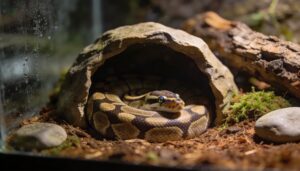
A hide isn’t just a decoration — it’s the single most important piece of furniture in your ball python’s enclosure.
If you’re not sure where to start, this guide to ball python hides for beginners breaks down exactly what to look for.
Without one, your snake is basically living in the open, and that constant exposure takes a real toll on its health and behavior.
Here’s what a good hide actually does for your ball python, and why getting it right matters.
Stress Reduction and Security
Ball pythons aren’t being dramatic — they genuinely need a dark enclosure with a quiet corner to feel safe.
Without that snug fit and low light retreat, stress builds fast, feeding stops, and glass-surfing starts.
A hide with rounded edges and a weighted base keeps things secure and easy to clean, giving your snake the calm, sheltered space it’s wired to seek.
Warm- and Cool-side Thermoregulation
Security isn’t the only reason hides matter — placement drives thermoregulation too. Your warm hide sits over a heat mat, targeting 88–92°F, while your cool hide stays at 76–80°F.
That thermal gradient placement lets your snake self-regulate by simply moving between the two.
A snug fit in each hide, paired with accurate thermostat sensor and temperature gradient monitoring, keeps microclimates stable and easy to clean consistently.
Humid Hide Benefits for Shedding
A third hide — your humid hide — takes a different job. It creates a localized humidity boost, usually 70–90%, inside a snug, moss-lined space.
That moss moisture retention hydrates old skin from within, making shedding friction reduction possible without soaking your whole enclosure.
Your snake will naturally seek it during the blue phase. Just keep it easy to clean and check weekly for mold prevention. Proper placement on the warm side enhances the localized high humidity for ideal shedding.
Support for Feeding and Digestion
Here’s the Support for Feeding and Digestion section:
Hides do more than calm your snake — they directly shape how well it eats and digests. Feeding hide proximity matters because a snake that feels exposed during feeding stays tense and may refuse the meal entirely. Once it swallows, digestive temperature stability depends on quick access to the warm hide. A snug fit and coil comfort substrate inside that hide keep your snake still and settled — exactly where digestion happens best.
A snake that feels exposed during feeding stays tense, refuses meals, and digests poorly without quick access to a warm, snug hide
- A secure hide near the feeding spot reduces low stress feeding failures before the first strike
- Snug fit inside the warm hide keeps your snake from restlessly repositioning post-meal
- Feeding behavior and hide use are linked — consistent placement builds a reliable routine
- Post meal humidity from a nearby humid hide prevents discomfort that disrupts rest
- Easy to clean surfaces support hygiene maintenance, so residue never drives your snake away from its resting spot
Natural Burrow Behavior in Captivity
Even in captivity, your ball python thinks like a wild animal — and wild ball pythons burrow. Understanding that shapes every hide decision you make.
| Behavior | Wild Trigger | Captive Solution |
|---|---|---|
| Nocturnal Burrowing Activity | Darkness and cooler temps | Snug fit hide on cool side |
| Burrow Site Fidelity | Familiar scent trails | Single entrance hide, consistent placement |
| Burrow Exploration Patterns | Novel terrain investigation | Multiple hides with natural look |
| Environmental Noise Sensitivity | Predator detection | Dense substrate, enclosed microenvironment |
| Substrate Preference Shifts | Humidity and temperature changes | Coconut shell humid hide option |
What Makes The Best Hide
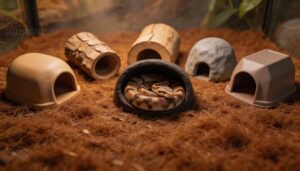
Not every hide is worth your money or your snake’s comfort. The best ones share a few key traits that make a real difference in how secure and healthy your ball python feels.
Here’s what to look for before you buy.
Snug Fit as The Top Priority
A hide that’s too roomy actually stresses your ball python out.
The ideal Coil Diameter Ratio sits at 70–85% of your snake’s girth, so the interior cradles rather than swallows it. Interior Taper Design gently hugs the mid-body, while proper Entry Hole Proportion keeps the tail from slipping back out.
- Your snake feels genuinely hidden, not just covered
- That snug contact mimics a real burrow’s reassuring pressure
- A Weighted Base Stability design means no scary tip-overs mid-coil
Single Entrance for Better Security
One entrance is all a good secure hide needs.
single offset opening gives your ball python concentrated monitoring of its surroundings — it can watch the whole room from one spot without feeling exposed on multiple sides.
That snug fit and single entrance design naturally prevent anything from "tailgating" in, keeping your snake calm, settled, and far less likely to stress-feed or glass-surf.
Strong, Tip-resistant Construction
A hide that tips over mid-exploration is a hide your snake won’t trust. A weighted base to prevent tipover keeps everything stable, so your snake always feels secure.
Look for weighted base footing, reinforced junctions, and strong, solid construction that stays put. Anti-tip brackets and secure mounting screws add extra sturdiness in active enclosures.
Material escalation — like reinforced polycarbonate — improves durability over time.
Safe, Smooth, Non-toxic Materials
Your snake’s skin is sensitive — so the materials inside that hide matter more than you’d think. Look for food-grade plastics, non-toxic wood with sealed finishes, and resin biocompatibility ratings that confirm no harmful off-gassing.
Smooth coating, rounded edges, and smooth interior surfaces prevent scale snags, while nonporous material keeps bacteria from settling in.
Recycled plastics and other safe, nontoxic materials can work well here too.
Easy-to-clean Plastic and Resin Surfaces
Cleaning a hide shouldn’t feel like a chore. Smooth plastic and natural resin surfaces resist staining and won’t absorb urine, so nonporous material benefits your routine immediately.
Snap-fit disassembly lets you take it apart without tools, while surface drainage channels prevent water pooling.
Anti-microbial finishes slow bacterial growth between cleanings, and heat transfer efficiency stays consistent — making smooth interior surfaces a practical win every week.
Dry Vs Humid Hide Functionality
Dry and humid hides serve different purposes — and your ball python needs both.
- Microclimate Stability: A humid hide keeps localized moisture above 70% without soaking your whole enclosure.
- Moisture Balance: Dry hides protect against mold while humid hides support clean sheds.
- Heat Retention: Warm-side placement in both styles maximizes their effectiveness.
- Ventilation Differences: Dry hides breathe freely; humid hides trap moisture intentionally.
- Hide Longevity: Easy to clean materials extend the life of both types.
Choosing Size and Placement
Getting hide placement right makes a bigger difference than most new keepers expect. The number of hides, where you put them, and how well they fit your snake all work together to keep your ball python calm and healthy.
Here’s what you need to know before picking your setup.
Two Hides Minimum Per Enclosure
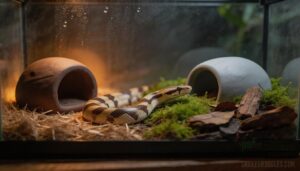
Two hides are the minimum — no exceptions. This isn’t optional padding; it’s a Redundant Hide Strategy that gives your ball python Behavioral Flexibility and Zone-specific Comfort across the enclosure.
With multiple hiding spots, your snake never has to trade security for thermoregulation. That balance keeps stress low, feeding consistent, and Enclosure Symmetry intact — which makes your whole setup work as intended.
Warm Hide Placement and Temperature Range
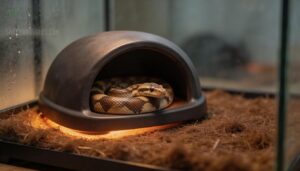
Your warm hide belongs directly over or beside your heat source — that’s Heat Source Alignment in practice. Inside, aim for 86–90°F using an infrared thermometer. Thermostat Probe Position matters here; place the probe where your snake actually rests. Material Heat Retention helps too — plastic and resin hold steady warmth better than thin pieces.
- Place the hide on the warm side only
- Target 86–90°F inside the hide
- Use a thermostat to prevent overheating
- Recheck temperatures with Seasonal Temperature Adjustments
Cool Hide Placement and Temperature Range
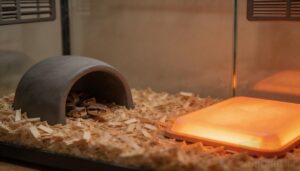
Once your warm hide is dialed in, the cool hide placement is just as important for a healthy temperature gradient. Set it at the far end — maximum Heat Distance from your heat source.
Target 76–80°F inside using accurate Thermometer Placement at substrate level. Good Ventilation Design and Substrate Insulation keep the Cool Zone Gradient stable without cold spots or condensation surprises.
When to Add a Third Humid Hide
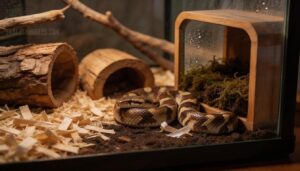
If your ball python keeps having incomplete sheds despite stable humidity, it’s time to think about a 3hide system for captive ball pythons. Add a third humid hide when Shed Cycle Timing reveals recurring issues across multiple coils.
Use Snake Position Tracking to find the driest microclimate, then place it there. Keep Enclosure Airflow Balance in check and apply Mold Prevention Strategies — replace moss every two to three weeks.
Hide Sizes for Hatchlings and Juveniles
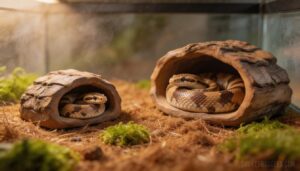
Sizing a hide for hatchlings and juveniles comes down to Weight‑Based Dimensions and Coil‑Fit Ratio — not guesswork.
Hatchlings under 150 g need an XS hide around 4″ × 3″, while juveniles between 150 and 500 g move up to roughly 5″ × 4″. These Stage‑Specific Measurements follow Size Increment Guidelines that keep the fit snug and secure, triggering Growth‑Triggered Upsizing only when your snake’s coil clearly outgrows the space.
Hide Sizes for Sub-adults and Adults
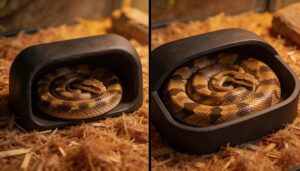
Most keepers get this wrong by upsizing too fast. Sub-adults (500–1,500 g) fit best in a medium hide around 6″ × 5″, while adult females over 1,500 g need a large hide near 8″ × 6″. Weight-Based Hide Selection keeps Adult Coil Dimensions snug — not roomy.
- Sub-adult Size Scaling: upgrade when the snake’s coils visibly spill over
- Adult females need gender-specific hide needs met with a larger footprint
- Adult males (600–900 g) stay comfortable in a medium
- Coil Clearance Ratio should stay tight, never spacious
Matching Interior Space to Coil Size
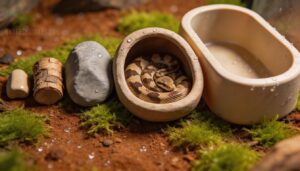
Think of the hide as a custom suit — it should fit, not swag. Coil Clearance Standards call for roughly 1 to 1.5 times the snake’s coil diameter, leaving just a slight Interior Space Buffer so it can shift without pinching.
| Growth Stage | Weight Range | Recommended Hide Size |
|---|---|---|
| Hatchling | Under 150 g | 4″ × 3″ |
| Juvenile | 150–500 g | 5″ × 4″ |
| Sub-adult | 500–1,500 g | 6″ × 5″ |
| Adult Female | Over 1,500 g | 8″ × 6″ |
| Adult Male | 600–900 g | 6″ × 5″ |
Apply these Size Matching Metrics at every Growth Stage Scaling checkpoint.
10 Best Ball Python Hides
Now that you know what to look for, picking the right hide comes down to finding one that fits your snake’s size, your setup, and your cleaning routine. The options below cover a solid range — from sturdy resin caves to easy‑clean plastic boxes — so there’s something here for every keeper.
Here are the ten best hides for ball pythons worth keeping on your radar.
1. Exo Terra Large Snake Cave
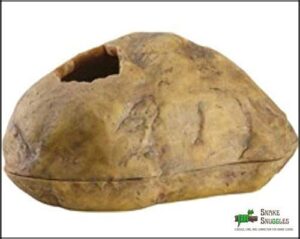
The Exo Terra Large Snake Cave is one of those hides that just works. It measures about 9.8 × 7.4 inches — a solid fit for a mid-sized ball python up to around four feet.
The removable top makes cleaning and health checks easy without turning your enclosure upside down. Toss in the included moss, dampen it, and you’ve got a functional humid hide too.
It’s stable, smooth inside, and blends naturally into most setups.
| Best For | Snake and lizard owners with medium-sized reptiles — think ball pythons up to 4 feet, corn snakes, or leopard geckos — who want a stable, easy-to-clean hide that doubles as a humid spot. |
|---|---|
| Material | Rigid plastic |
| Dimensions | 7.1×8.8×10.6 in |
| Removable Lid | Yes |
| Easy to Clean | Yes, smooth interior |
| Color | Brown |
| Weight | 3.15 lb |
| Additional Features |
|
- The removable lid makes feeding, health checks, and cleanouts quick and painless
- Weighted base stays put even on heat pads or under lighting — no tipping
- Doubles as a humid hide when you dampen the included moss, great for shedding
- The entrance is on the smaller side, so larger snakes over 4 feet may struggle to get in comfortably
- The solid plastic bottom can get hot on the warm side of the enclosure — watch your placement
- A few users mention the moss has an initial odor and feels scratchy until you clean it out
2. Exo Terra Extra Large Reptile Cave
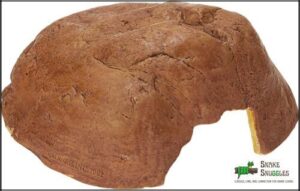
If your ball python is on the larger side, the Exo Terra Extra Large Reptile Cave gives them the room they actually need. At roughly 10.2 × 11 inches, it comfortably fits adult females without squeezing them into a space that causes stress.
The resin construction holds up well under strong lighting, and the smooth interior walls won’t snag scales.
Add some damp moss inside and it doubles as a humid hide.
For a full rundown of budget-friendly gear that won’t skimp on quality, check out this guide to affordable ball python supplies before you start shopping.
Just check the edges out of the box — a quick file fixes any sharpness.
| Best For | Adult ball pythons and larger reptiles that need a roomy, stress-free hide with the option to double as a humid hide. |
|---|---|
| Material | Resin |
| Dimensions | 10.23×11.02×4.33 in |
| Removable Lid | No |
| Easy to Clean | Yes, smooth surfaces |
| Color | Black |
| Weight | 2.09 lb |
| Additional Features |
|
- Spacious enough for adult females and other large reptiles without cramping them
- Holds up well under strong lighting — no warping over time
- Easy to turn into a humid hide by adding damp moss inside
- Edges can come sharp out of the box and may need a quick file before use
- Interior can get sticky or show wear after repeated washing or high-humidity exposure
- Large footprint won’t fit well in tanks smaller than 10 gallons
3. Zilla Bark Bends Terrarium Hide
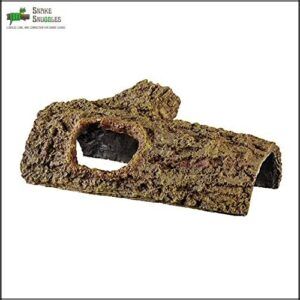
If you want something that looks at home in a natural-style setup, the Zilla Bark Bends Terrarium Hide is worth a look. The hand-crafted faux bark exterior actually blends in — not just functional plastic sitting in your enclosure.
The non-porous surface resists bacteria and cleans up easily with warm soapy water.
At $21.99 for the large size, it’s solid value.
One heads-up: check the top opening for sharp edges before placing it. A quick sand fixes that fast.
| Best For | Reptile owners who want a natural-looking hide that’s easy to clean and lets them keep an eye on their pet without disturbing it. |
|---|---|
| Material | Rigid plastic |
| Dimensions | 10.75x5x5.5 in |
| Removable Lid | No |
| Easy to Clean | Yes, non-porous exterior |
| Color | Brown |
| Weight | 0.92 lb |
| Additional Features |
|
- Faux bark design actually looks good in a natural setup
- Non-porous surface resists bacteria and wipes down fast
- Heavy and sturdy — won’t shift around once it’s placed
- Top opening may have sharp edges that need sanding before use
- Might be too small for larger snakes or adult ball pythons
- It’s plastic, so it won’t satisfy a natural wood aesthetic
4. Zilla Vertical Rock Cave Grey
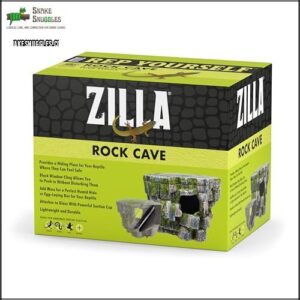
Not every hide needs to sit on the floor. The Zilla Vertical Rock Cave mounts directly to your glass with a suction cup, freeing up valuable floor space — a real plus in tighter setups.
At roughly 8.75 × 5.875 × 7.25 inches, it works best as a secondary feature for your ball python rather than a primary hide. The included black window cling lets you peek in without startling your snake.
Priced at $19.49, it’s an affordable way to add vertical enrichment.
| Best For | Arboreal reptiles like crested geckos, gargoyle geckos, and tree frogs that prefer hanging out off the ground. |
|---|---|
| Material | Hard plastic/foam |
| Dimensions | 7.9×5.5×6.3 in |
| Removable Lid | Yes |
| Easy to Clean | Yes, lightweight |
| Color | Grey |
| Weight | 1.09 lb |
| Additional Features |
|
- Mounts to the glass with a suction cup, so it doesn’t eat up any floor space
- The removable lid creates a dark hide, and the feeder cup insert makes feeding pretty convenient
- The black window cling lets you check on your animal without spooking it
- The suction cup can be finicky — it needs a clean, smooth glass surface and may slip over time
- On the larger side, so it can feel bulky in smaller enclosures
- Not every animal will actually use the hide interior, depending on their personality
5. Zilla X Large Terrarium Rock Den
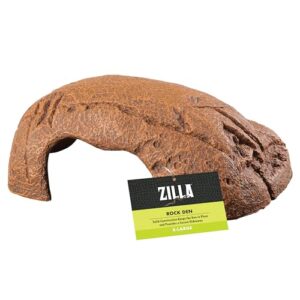
If your ball python is on the larger side, the Zilla X Large Terrarium Rock Den gives them real room to settle in. At 12.25 × 11.5 × 4.75 inches, it’s built for snakes that have outgrown smaller options.
The hand-crafted, non-porous plastic exterior mimics rock without trapping moisture or bacteria — easy to wipe down between cleanings.
At $38.67, it’s a solid investment for adult females, especially.
Just check the edges before placing it; a quick sand smooths any sharp spots.
| Best For | Reptile owners with small to medium-sized lizards or younger snakes who need a cozy, dark hide that mimics natural rock. |
|---|---|
| Material | Rigid plastic |
| Dimensions | 6x5x7 in |
| Removable Lid | No |
| Easy to Clean | Yes, warm soapy water |
| Color | Orange |
| Weight | Not specified |
| Additional Features |
|
- Non-porous plastic is a breeze to clean — just warm soapy water and you’re done
- Heavy and stable, so it won’t tip over when your reptile squeezes in and out
- The small opening blocks light well, giving your pet a genuinely dark retreat
- Interior is on the smaller side, so adult ball pythons or larger snakes will likely outgrow it fast
- Edges can come sharp out of the box — worth a quick sand before dropping it in the tank
- The complex inner shape can trap shed skin and waste, making deep cleaning a bit of a hassle
6. Zilla Rock Lair Reptile Hide
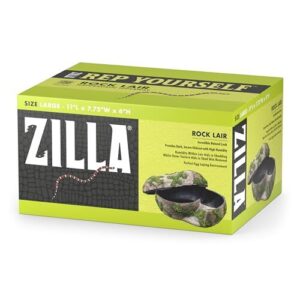
If your snake needs something with a bit more height and a humidity-friendly design, the Zilla Rock Lair is worth a look.
It’s made from durable resin with a realistic rock texture, smooth on the inside, so your python can move without irritating its scales.
The removable top makes health checks and substrate swaps genuinely easy.
At $49.99, it runs a little pricier, but the weighted build, humidity retention, and rough exterior — great for shedding — make it a practical all-rounder for small to medium ball pythons.
| Best For | Small to medium reptiles like leopard geckos and ball pythons that need a humid hide to support healthy shedding. |
|---|---|
| Material | Rigid plastic |
| Dimensions | 11x6x8 in |
| Removable Lid | Yes |
| Easy to Clean | Yes, smooth surfaces |
| Color | Grey |
| Weight | Not specified |
| Additional Features |
|
- Removable top makes health checks and substrate swaps quick and hassle-free
- Rough exterior doubles as a shedding post, helping your reptile shed more completely
- Weighted base stays put under heat lamps without sliding around
- Plastic construction is prone to chipping or cracking during shipping
- Humidity retention only works if you add damp substrate yourself — it’s not built-in
- A bit bulky and heavy, so repositioning inside the tank can be annoying
7. Zilla Herp Hotel Terrarium Basking Hide
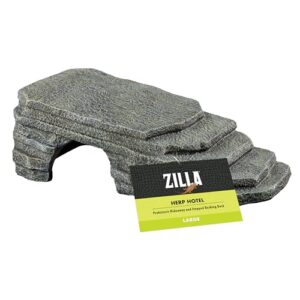
The Zilla Herp Hotel does something most hides don’t — it doubles as a basking platform. Your python gets a dark, enclosed cavity below and a wide, flat top surface above, so one piece covers two thermal zones.
It’s built from non-porous rigid plastic, which cleans up easily and won’t trap bacteria.
At $29.28 and measuring about 6.9 × 4.7 inches, it fits sub-adult setups well.
Just note the plastic surface retains heat less effectively than natural stone.
| Best For | Small to medium reptiles like leopard geckos or juvenile bearded dragons that need both a hide and a basking spot in one compact piece. |
|---|---|
| Material | Rigid plastic |
| Dimensions | 6.89×4.65×3.28 in |
| Removable Lid | No |
| Easy to Clean | Yes, warm soapy water |
| Color | Grey |
| Weight | 1.7 lb |
| Additional Features |
|
- Two-in-one design gives your reptile a shaded hide below and a flat basking surface on top
- Non-porous plastic resists bacteria and wipes clean in minutes
- Naturalistic look works in both desert and tropical setups
- Plastic holds heat poorly compared to stone or wood, so temperature gradients may be weaker
- The slick surface and small openings can be tricky for larger or more active lizards
- May need replacing as your reptile grows — it’s sized for smaller or younger animals
8. Pangea Medium Reptile Hide Box
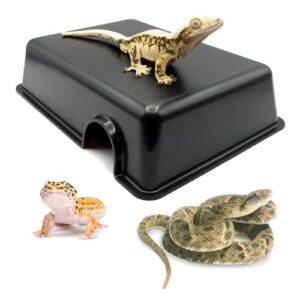
The Pangea Medium Reptile Hide Box is about as no-frills as it gets — and that’s exactly the point. Measuring 10 × 7 × 2.25 inches, it fits snugly inside standard 28–32 quart tubs, making it a natural pick for rack setups.
The 1/8-inch ABS plastic walls are thick enough to resist tipping, and the non-porous surface wipes clean in seconds. That offset entrance quietly does its job, keeping your python feeling tucked away rather than exposed.
Practical, durable, and straightforward.
| Best For | Reptile keepers using rack systems who want a simple, easy-to-clean hide for snakes, terrestrial geckos, skinks, or bearded dragons. |
|---|---|
| Material | Rigid plastic |
| Dimensions | 10x7x2.25 in |
| Removable Lid | No |
| Easy to Clean | Yes, smooth non-porous |
| Color | Black |
| Weight | 0.31 lb |
| Additional Features |
|
- Non-porous plastic makes cleaning and sanitizing quick and painless
- Offset entrance gives reptiles a real sense of security, helping reduce stress
- Fits neatly into standard 28–32 quart tubs, perfect for rack setups
- Larger snakes can shift or lift it, which defeats the purpose of a secure hide
- Might not be the right fit for hatchlings or fast-growing juveniles
- Similar hides can be found cheaper elsewhere if you shop around
9. Zoo Med Large Reptile Shelter Cave
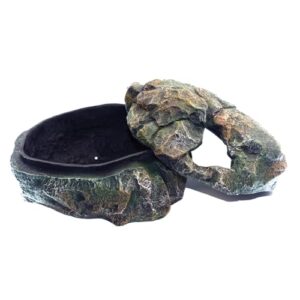
The Zoo Med Large Reptile Shelter Cave earns its spot by doing three jobs at once — dry hide, humid shedding retreat, and nesting cave.
The removable lid makes cleaning and egg checks easy without fully disrupting your snake.
Its ceramic build is heavier and more stable than plastic options, and you can pack it with damp sphagnum moss for a dedicated shed spot.
At around $62, it’s a solid investment for sub-adults and adult females who need reliable, snug shelter.
| Best For | Reptile keepers housing leopard geckos, corn snakes, or baby pythons who want a hide that doubles as a shedding spot and nesting cave. |
|---|---|
| Material | Ceramic |
| Dimensions | 6x12x11 in |
| Removable Lid | Yes |
| Easy to Clean | Yes, removable lid |
| Color | Black |
| Weight | 7.35 lb |
| Additional Features |
|
- Three functions in one — dry hide, humid shed box, and nesting cave — so you’re not buying separate accessories.
- Ceramic build is heavy enough to stay put, even on a heat mat or when your snake pushes against it.
- Removable lid makes egg checks and cleanouts quick and painless.
- At $62, it’s a noticeable step up in price compared to basic plastic hides that do roughly the same job.
- The lid can sit a bit loose on some units, which might be an issue with more active or escape-prone species.
- Ceramic can crack under prolonged high heat, so it’s best kept off the hottest part of the tank.
10. Leoterra Ball Python Hide
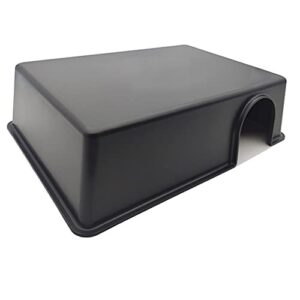
The Leoterra Ball Python Hide keeps things simple — and that’s exactly why it works.
At 16.5 × 10.6 × 4.3 inches, it gives adult ball pythons genuine room to coil without feeling exposed.
Since a secure hide matters just as much as floor space, this beginner’s guide to choosing reptile hides helps you pick one that fits your ball python.
The sealed top traps humidity well, so you can pack it with damp moss during shed season without worrying about moisture warping the hide.
Smooth plastic edges mean no scale snags, and cleanup takes minutes.
If your snake is prone to lift lighter hides, just add a little weight on top.
| Best For | Adult ball python owners who want a roomy, easy-to-clean hide that holds humidity well during shedding season. |
|---|---|
| Material | High-impact plastic |
| Dimensions | 16.5×10.6×4.3 in |
| Removable Lid | No |
| Easy to Clean | Yes, odor-free plastic |
| Color | Black |
| Weight | 0.88 lb |
| Additional Features |
|
- Spacious enough for large adult ball pythons to fully coil and feel secure
- Sealed top locks in humidity, making it great for shed support with damp moss
- Smooth plastic edges are safe on scales and wipe clean in minutes
- Heavier snakes can lift it, so you may need to add weight or anchor it down
- Size can feel smaller than expected — measure your snake before buying
- Plain black plastic won’t win any décor points if you prefer a natural-looking setup
Cleaning and Replacing Hides
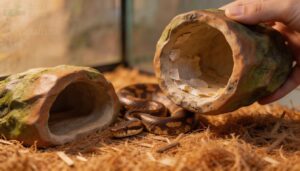
Keeping your ball python’s hides clean is one of those maintenance habits that directly affects their health and comfort. A dirty hide can harbor bacteria, mold, and old shed skin — none of which your snake needs to be sitting in.
Here’s what you need to know to stay on top of it.
Weekly Cleaning and Spot-cleaning Routine
A consistent cleaning routine is your first line of defense against bacterial contamination. Pull each hide weekly, wipe down high-touch areas with a microfiber cloth, and spot-clean any visible mess the same day it happens — fresh soils lift far easier than dried ones.
- Blot spills immediately; don’t rub
- Rotate microfiber cloths to avoid spreading residue
- Use a small tool caddy to keep supplies ready
- Daily dust control keeps buildup manageable
- Follow the same order every week for efficiency
Safe Disinfecting Methods for Reptile Hides
Once your hide is scrubbed clean, disinfection is straightforward — you just need to pick the right product. 3% Hydrogen Peroxide Application works well for routine sanitizing; it’s odor-free and reptile-safe.
For deeper bacterial contamination prevention, try a Chlorhexidine Dilution Ratio around 1:30. Bleach Safety Guidelines matter too — dilute to a 1:30 bleach solution, rinse thoroughly, and always meet the Full Drying Requirement before returning any hide.
Non-porous Material Preference makes all these cleaning protocols for hides far easier.
Humid Hide Moss Replacement Schedule
Your humid hide needs fresh sphagnum moss every two to four weeks — that’s your baseline Moss Replacement Frequency. Check it during cleanings: gray color, a musty smell, or crumbly texture signal it’s time.
For Moss Mold Detection, trust your nose first. Moss Moisture Monitoring is simple — a gentle squeeze should yield slight dampness, never dripping.
Good Moss Hygiene Protocol keeps shedding smooth.
Checking for Cracks and Sharp Edges
Once the moss is sorted, turn your attention to the hide itself.
Run your hand across every surface — that’s your Hand Feel Test — then hold it under strong light and rotate it slowly for a proper Light Angle Inspection.
Pay close attention to the Entrance Lip Check, since that spot takes the most wear.
Any sharp edges or failed Edge Smoothness Evaluation mean Crack Propagation Monitoring is already overdue.
When a Hide is Too Small
Once you’ve checked for cracks, look at how your snake actually uses the hide. If it’s squeezing through the entrance — that’s Entry Squeezing — or leaving its tail hanging out, the space is too tight.
Coil Constriction and Pressure Discomfort follow quickly, often causing Hide Avoidance.
Weight Gain Impact sneaks up quickly, so revisit your ball python hide selection criteria regularly using weight-based and age-specific hide sizing guidelines.
When to Replace Worn-out Hides
Size isn’t the only reason to swap out a hide.
Sharp Edge Risks from cracks can scrape scales, while Persistent Mold Growth and Surface Staining Persistence signal that your maintenance and cleaning protocols for hides aren’t enough anymore.
Warped Shape Issues and Entrance Stretching Problems reduce security.
Following a LongTerm Hide Replacement Schedule protects material durability, promotes bacterial growth prevention, and keeps your snake genuinely safe.
Frequently Asked Questions (FAQs)
What kind of hides do ball pythons like?
Ball pythons prefer secure, snug fit hides with a single entrance design — dark, enclosed spaces that mimic natural burrows.
They favor natural look textures, color camouflage, and tight interiors where every scale touches the wall.
How many hides does a ball python need?
Your ball python needs at least two hides — one on the warm side, one on the cool side.
This setup lets your snake thermoregulate without ever leaving the security of a hide, and our guide to the best ball python hides for bioactive setups covers plenty of natural-looking options.
This mimics the snug burrows they’d naturally seek out in the wild, so check out this guide to choosing the best ball python hides to find options that fit your snake’s size and enclosure.
That simple setup covers thermoregulation and security without forcing your snake to choose between the two.
Is wood or PVC better for ball python enclosure?
PVC wins for most keepers — it provides full Humidity Resistance, offers solid Thermal Insulation, and its Material Durability lasts decades.
Natural wood warps and molds fast.
For safe materials, you can clean and disinfect easily; PVC is the clear choice.
Does a ball python need a humid hide?
Yes, your ball python needs a humid hide.
Packed with damp sphagnum moss, it facilitates the shedding process through Microclimate Control, Humidity Monitoring, and Moss Moisture Management — keeping Scale Health intact and reinforcing natural Behavioral Indicators during shed cycles.
How many hides should a ball python have?
Your snake could spend its entire life hiding — so give it at least two hides: one on the warm side, one on the cool side, covering both thermal zones.
Can I use cardboard boxes as hides?
Cardboard boxes work as a short-term fix, but moisture absorption leads to mold growth risk and structural weakness fast. For a permanent snug fit, stick with plastic or resin.
Do ball pythons prefer warm or cool hides?
Ball pythons don’t prefer one over the other — they need both.
Your snake uses temperature preference and behavioral choice to move between the warm hide and cool hide as its needs shift throughout the day.
Whats the ideal hide placement in the enclosure?
Place one hide on the warm side, one on the cool side.
With hides on both ends, your snake can thermoregulate properly between the 88–92°F warm side and 76–80°F cool side — for more setup tips, check out this guide on how many hides a ball python actually needs.
That simple thermal gradient placement and hide positioning setup lets your python thermoregulate freely while staying secure, snug, and hidden at all times.
Are rock hides better than wooden hides?
Rock hides win in Weight Stability, Moisture Resistance, and easy disinfection.
Wooden hides offer Aesthetic Appeal, but risk warping and harboring bacteria.
For most keepers, a rock hide is the more practical, low-maintenance choice.
Can DIY hides work as well as commercial ones?
DIY hide solutions can absolutely match commercial hides in performance — as long as you nail the snug fit and single entrance design, use safe materials, and stay consistent with cleaning and maintaining ball python hides.
Conclusion
Like a calm harbor for a stormy sea, the right hide provides your ball python with a sense of security and tranquility. By choosing the best type of hide for ball pythons, you’re not just adding a decoration—you’re creating a sanctuary that promotes their well-being.
With the right hide, your snake can thrive, and you’ll enjoy a more rewarding and stress-free experience as a keeper. Your snake’s happiness starts here, with a snug, secure, and easy-to-clean hide.