This site is supported by our readers. We may earn a commission, at no cost to you, if you purchase through links.

A bearded dragon basking under a bulb isn’t absorbing warmth from the air around it. It’s catching electromagnetic waves head-on, the same way your skin heats up standing in sunlight on a cold day. That’s how reptile heat lamps work: they radiate infrared energy directly onto a cold-blooded body, bypassing ambient air entirely.
This distinction matters because your reptile’s survival depends on it. Ectothermic animals can’t generate their own body heat, so every basking session is a physiology lesson in radiant transfer. Get the wavelength, wattage, or placement wrong, and thermoregulation breaks down fast.
Understanding the mechanics behind that glow changes how you set up an enclosure, choose a bulb, and read a thermal gradient.
Table Of Contents
- Key Takeaways
- How Reptile Heat Lamps Work
- Main Types of Reptile Heat Lamps
- Creating Safe Temperature Gradients
- Controlling and Measuring Heat
- Top 3 Helpful Heating Tools
- Frequently Asked Questions (FAQs)
- Can you leave a reptile heat lamp on all night?
- Do reptile heat lamps use a lot of energy?
- What’s the difference between a basking lamp and a heat lamp?
- How long should heat lamps be on for snakes?
- How often should heat lamp bulbs be replaced?
- What wattage heat lamp does my enclosure need?
- Can heat lamps be mounted on screen tops?
- How much clearance do heat lamps require?
- How often should heat lamp fixtures be cleaned?
- Conclusion
Key Takeaways
- Heat lamps work by radiating infrared energy straight onto your reptile’s body, not by warming the surrounding air, which is why placement and wattage matter so much more than room temperature.
- A good enclosure needs a real gradient—a hot basking spot, a cooler retreat, and everything in between—so your reptile can move around and regulate its own body heat.
- Different bulb types serve different purposes: incandescent and halogen bulbs give off light and heat together, while ceramic emitters and infrared bulbs provide warmth without any glow, making them better for nighttime use.
- Reliable tools like dimming thermostats, infrared temperature guns, and digital probes take the guesswork out of heating, helping you confirm actual temperatures instead of just assuming your setup is working.
How Reptile Heat Lamps Work
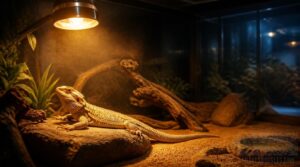
Reptiles can’t generate their own body heat, so your lamp is doing work their body can’t do alone. Understanding what’s actually happening inside that bulb, and where the heat goes once it leaves it, changes how you set up an enclosure. Here’s the science behind it, broken down piece by piece.
If you’re weighing wattage, bulb type, or placement, this buyers guide to the best heat lamps for snakes breaks down which setups actually mimic natural heat gradients.
Infrared Heat Explained
What exactly is heat you can’t see? Infrared radiation sits just beyond visible light, delivering direct surface heating rather than warming the air.
- Shortwave wavelengths carry visible light and intense heat
- Mid-to-longwave infrared trades glare for gradual, efficient warming
- Wavelengths span roughly 0.7 to 14 micrometers for reptile care
This heat transfer efficiency drives every basking bulb’s performance, setting up real thermoregulation benefits.
Infrared heat transfer occurs via electromagnetic waves without requiring a medium, as explained in the mechanism of infrared heat generation.
Basking and Body Temperature
That absorbed infrared energy has one job: raising body temperature above ambient air. Surface temperature during basking often runs several degrees higher than the surrounding air, speeding digestion and activity.
Basking duration matters too. Extended sessions without a cooler retreat risk overheating, which is exactly why a Temperature Gradient paired with reliable Thermostat Control gives reptiles room to self-regulate.
Light Versus Heat Output
Not every watt becomes warmth. Incandescent heat efficiency runs low, wasting energy as light; LEDs flip that ratio, producing minimal heat per watt. A reptile Heat Lamp depends on infrared spectrum output, not brightness.
- Incandescent basking bulbs: heavy heat, some light
- Halogen basking bulbs: efficient penetration
- Ceramic Heat Emitters: pure infrared, zero light
- LEDs: light-focused, poor heat source
- Wattage heat ratio varies by bulb design
Surface Warming Basics
Infrared radiation doesn’t heat air first; it strikes skin and substrate directly, driving conductive heat into tissue.
| Zone | Surface Temp Role |
|---|---|
| Basking spot | Peak radiant flux |
| Warm side | Moderate gradient |
| Cool side | Heat dissipation |
| Substrate | Stores/redistributes warmth |
This thermal gradient forms as your Heat Lamp for Reptiles warms one zone while enclosure materials release heat elsewhere.
Snake Thermoregulation Needs
Snakes can’t generate their own body heat, so basking behavior patterns drive survival. Your temperature gradient must let them move freely to regulate digestion and activity.
A properly set up basking zone paired with a cooler retreat gives snakes the freedom to self-regulate, a balance explained well in this complete guide to snake health and welfare.
- Ball pythons: 88–92°F warm side
- Corn snakes: wider tolerance range
- Boas: sustained warmth, cooler retreats
- Desert species: higher basking temps
- All species: cooler nighttime zones
Thoughtful heat lamp placement respects these species temperature preferences.
Main Types of Reptile Heat Lamps
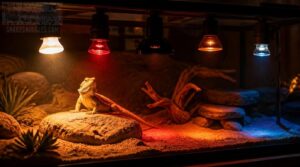
Not all heat lamps warm your enclosure the same way, and picking the wrong one can throw off your reptile’s whole thermal gradient.
Some bulbs push out visible light alongside heat, while others work in near darkness for round-the-clock warming.
Here’s a rundown of the five main types you’ll come across, and what sets each one apart.
Incandescent Basking Bulbs
Incandescent Basking Bulbs run on ordinary household current, heating a tungsten filament to cast both light and infrared warmth. Wattages span 40–150W, matched to enclosure size.
Heat distribution stays uneven: intense at the basking spot, tapering outward. Lifespan runs 3–6 months. Pair with a thermostat to lock in your temperature gradient without overheating.
Halogen Basking Bulbs
Halogen Basking Bulbs step up from incandescent basking bulbs by cycling tungsten gas for better halogen lifespan efficiency. Quartz construction delivers infrared A and B wavelengths straight to the basking spot, with real heat spectrum benefits.
Narrow beam angle adjustment concentrates warmth precisely. Ranging 25–100W, pair with thermostat control for a stable temperature gradient. Mount securely in heat-rated fixtures—safe mounting practices prevent wobble and breakage.
Ceramic Heat Emitters
No glowing bulb, no flicker—just steady radiant warmth.
Ceramic heat emitters convert electricity directly into long-wave infrared (4–10 micrometers), warming surfaces rather than air. Their hollow ceramic body resists thermal shock, lasting 2–5 years versus months for incandescent bulbs. Wattages span 25–150W.
Pair with a dimming thermostat for stable gradients, and always use ceramic-rated sockets—standard fixtures can melt.
Infrared Heat Bulbs
A faint red or purple glow is all you’ll see—most of the output is pure infrared heat, converting over 85% of electrical energy directly into radiant warmth.
Thermal penetration stays shallow, ideal for basking spots without overheating.
Lifespan runs shorter than ceramic emitters, so pair with a dimming thermostat to steady your temperature gradient and protect enclosure heating consistency.
Deep Heat Projectors
Want heat that reaches muscle, not just skin? Deep Heat Projectors deliver infrared A and B wavelengths for true thermal regulation, with no visible light disrupting photoperiod.
Their internal reflector creates wide beam coverage while staying energy efficient—a 50W model can outperform 100W ceramics. Thermostat compatible by design, they need one to prevent overshoot and maintain a stable temperature gradient for consistent enclosure heating.
Creating Safe Temperature Gradients
A single heat source doesn’t heat an enclosure evenly, and that’s the point. Your reptile needs options: a hot end, a cool end, and a gradient in between to move through as it pleases. Here’s how to set up each zone correctly.
Uneven heat is the goal: a hot end, a cool end, and a gradient your reptile can roam between
Basking Spot Placement
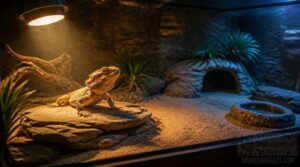
Place the basking spot at one end of the enclosure, never centered, so a thermal gradient forms naturally.
Choose a sturdy platform—flat rock or basking ledge—that holds full body weight without tipping.
Keep the area obstacle-free, angle the heat source downward, and make sure clear paths to hides and water for easy thermoregulation.
Warm Side Temperatures
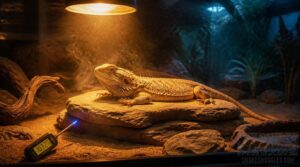
Once you’ve anchored the basking spot, the rest of the warm side gradient should fall between 85–95°F, tapering 5–15°F below basking peaks. Bearded dragons run hotter (95–105°F); corn snakes and ball pythons hold steady near 88–92°F.
Verify with a probe at basking level, and recalibrate after any bulb swap or lamp distance change.
Cool Side Temperatures
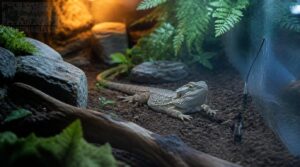
The cool side isn’t an afterthought — it’s where digestion and recovery happen. Keep it 8–15°F below basking, with stable ambient air near 72–79°F. Ventilation gaps and reflective panels curb heat creep.
- Skip heat elements on this end entirely
- Use loose substrate to prevent hot spots
- Monitor with a digital probe, not stick-ons
- Check readings at multiple heights
Snake-specific Heat Ranges
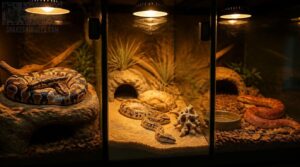
No single basking spot temp fits every snake. Ball pythons thrive near 90–95°F with 80°F ambient air, desert species push 95–100°F, and corn snakes prefer a cooler 85°F basking zone.
Hatchling needs run slightly warmer across the board — basking around 90–95°F keeps growth on track. Match your thermal gradient setup to the species, not a generic chart.
Nighttime Heating Needs
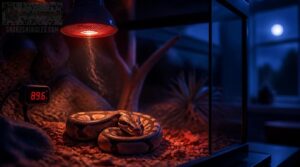
When the lights go off, your snake’s heat needs don’t disappear — they just shift. Nighttime heating should hold nocturnal temperature zones a few degrees below daytime basking, using Ceramic Heat Emitters or Infrared Heat Bulbs for light-free warmth.
- Set night thermostat settings 2–3°F lower
- Choose overnight heat sources without visible glow
- Preserve sleep cycle warmth zones
- Monitor night gradients with digital probes
- Avoid direct hotspots over resting snakes
Controlling and Measuring Heat
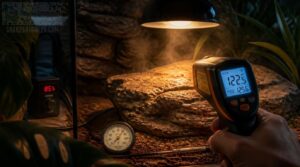
Getting the temperature right takes more than picking a bulb and hoping for the best. You need reliable tools to set, verify, and fine-tune every degree in the enclosure. Here’s what that control actually looks like in practice.
Thermostat Probe Placement
Get probe placement wrong, and your thermostat will lie to you. Position it 1–2 inches from the basking surface, on the same plane your reptile occupies—never in drafts or above the enclosure. In racks or multi-source setups, dedicate one probe per zone.
Calibrate against a reference thermometer first, check daily, and replace probes quarterly to keep readings trustworthy.
Dimming Versus On-off Thermostats
Two thermostat types govern your basking spot: on-off and dimming. On-off units cut power abruptly, causing swings. Dimming thermostats modulate voltage, holding tighter temperature zones and easing bulb stress.
Choose based on:
- Fluctuation tolerance – dimming wins
- Budget – on-off costs less
- Bulb lifespan – dimming extends it via reduced thermal cycling
Infrared Temperature Gun Use
A thermostat controls average heat, but only an infrared temperature gun confirms what’s actually happening on the basking surface versus ambient air.
Hold it 5–15 cm away, check emissivity (0.95 for organic surfaces), and avoid glossy rock or glass—reflective surfaces skew readings. Recalibrate after drops or extreme heat exposure. Scan multiple basking spots, not just one, to verify your gradient’s accuracy.
Digital Probe Thermometers
Where infrared guns read surfaces, digital probe thermometers track ambient air monitoring around the clock.
Choose blunt or flat probe tips for accurate placement against substrate, not glass.
Thermistor sensors balance accuracy and response time comparison better than slower RTDs.
Look for backlit displays, auto power management, and calibration checks to keep readings trustworthy season after season.
Bulb Distance Adjustments
Move a bulb two inches closer, and basking temps can jump several degrees fast. That’s the power of the inverse square relationship.
Use adjustable mounts for quick distance calibration. Start at manufacturer specs, measure with your probe, then nudge fixture positioning until the basking spot hits target range. Recheck monthly, since decor rearrangement shifts gradients and safety distance checks always matter.
Top 3 Helpful Heating Tools
Knowing the theory behind heat and gradients only gets you so far without the right gear in hand. The tools you choose determine how precisely you can control temperature and how easily you can monitor it day to day. Here are three products worth having on hand for any reptile setup.
1. Lucky Herp 150W Ceramic Heat Emitter
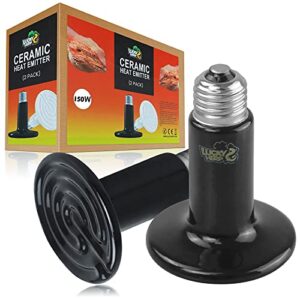
When nocturnal heat is the goal, this ceramic emitter delivers light-free infrared warmth, ideal for crested geckos or ball pythons after dark. It reaches full temperature in about four minutes, with warmth noticeable within ten seconds.
Rated for 10,000 hours, the 150W E26 unit fits standard fixtures. Keep at least 30cm between bulb and animal, use a ceramic-rated socket, and pair it with a thermostat, since ceramic emitters run continuously and can overheat enclosures without regulation.
| Best For | Reptile, amphibian, poultry, and small mammal owners who need steady nighttime warmth for their enclosures without disrupting their animals’ sleep with visible light. |
|---|---|
| Reptile Suitable | Yes |
| Power Rating | 150W |
| Temperature Function | Heat Emission |
| Display/Indicator | None |
| Safety Features | Distance Requirement |
| Installation Type | E26 Screw Fit |
| Additional Features |
|
- Emits heat only, with no visible light, so it won’t interrupt pets’ natural sleep cycles
- Heats up fast, reaching full temperature in about 4 minutes and noticeable warmth in just 10 seconds
- Long-lasting and durable, with a heavy-duty ceramic housing rated for up to 10,000 hours
- Provides no UV output, so supplemental lighting is needed for animals that require it
- Requires a quality ceramic lamp holder, and frequent on/off cycling can shorten its lifespan
- Needs careful placement, with at least 30cm of distance required between the bulb and the animal for safety
2. Etekcity Infrared Laser Temperature Gun
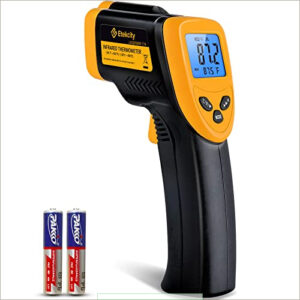
Knowing your ceramic emitter runs hot is one thing; proving it hits target temp is another. That’s where this laser gun earns its keep.
Point, click, read — under 0.5 seconds, accurate within a few percent. Adjustable emissivity (0.1–1.0) works with rock, wood, or metal alike.
Keep it at the recommended 14-inch distance for a reliable spot size. It won’t read your gecko’s center temp, but for checking basking surfaces, it’s indispensable.
| Best For | Reptile keepers, home cooks, and DIY-ers who need a fast, no-contact way to check surface temperatures on basking spots, grills, engines, or HVAC units. |
|---|---|
| Reptile Suitable | Yes |
| Power Rating | Battery Powered |
| Temperature Function | Temperature Measurement |
| Display/Indicator | Backlit LCD Screen |
| Safety Features | Non-Touch Measurement |
| Installation Type | Handheld |
| Additional Features |
|
- Rapid sub-0.5-second readings with adjustable emissivity (0.1–1.0) for accuracy across different materials
- Wide temperature range (-58°F to 842°F) covers everything from fridges to ovens and engines
- Backlit LCD screen makes readings easy even in low light
- Not suitable for measuring human or pet body temperature directly
- Accuracy depends on maintaining the recommended 14-inch distance and 12:1 spot ratio
- Reads an average surface area rather than one precise point, so small targets can be tricky
3. BN-LINK Digital Heat Mat Thermostat Controller
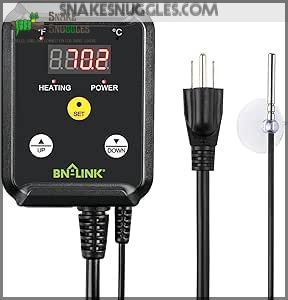
A temperature gun tells you what’s happening now. This controller decides what happens next.
The BN-LINK thermostat regulates heat mats up to 1000W, cutting power automatically once your set point is reached. Set it 2–3°F below basking target, and it holds steady with a built-in buffer to prevent constant cycling.
Its 6-foot probe reaches multi-zone setups easily, and the grounded 3-prong plug matters in humid enclosures. ETL listed, straightforward three-button interface — no guesswork required.
| Best For | Hobbyists and small-scale growers who need reliable, hands-off temperature control for seed germination, reptile enclosures, incubators, or fermentation projects like home brewing and sourdough. |
|---|---|
| Reptile Suitable | Yes |
| Power Rating | 1000W Max Load |
| Temperature Function | Temperature Control |
| Display/Indicator | LED Display |
| Safety Features | Auto Shutoff |
| Installation Type | Probe and Cord |
| Additional Features |
|
- Automatically cuts power once the set temperature is reached, preventing overheating
- Simple 3-button interface with Fahrenheit/Celsius switching and a bright LED display for easy monitoring
- ETL listed for safety, with a temperature range of 40–108°F (4–42°C) to suit many uses
- Only works with heating devices — no cooling or dual-function support
- Probe and controller can’t be exposed to water or moisture, limiting placement options
- Maximum load is capped at 1000W, so it’s not suited for higher-power setups
Frequently Asked Questions (FAQs)
Can you leave a reptile heat lamp on all night?
Generally, no. Bright bulbs disrupt sleep cycles and natural photoperiod. Instead, rely on ceramic heat emitters or deep heat projectors for background warmth without light, keeping nights dark while maintaining species-appropriate ambient temperatures.
Do reptile heat lamps use a lot of energy?
Not really. A 100-watt bulb run 12 hours daily costs roughly $3–4 monthly. Ceramic emitters and LED lamps sip even less power, so most hobbyists spend less heating a reptile than running a standard desk lamp.
What’s the difference between a basking lamp and a heat lamp?
A basking lamp pairs visible light with heat, creating a bright spot your reptile can see and approach. A heat lamp emits mostly infrared, raising ambient temperature without the glow — better for nighttime or light-sensitive setups.
How long should heat lamps be on for snakes?
Run your snake’s lamp on a 12-hour on, 12-hour off cycle using a timer. Keep daytime under 14 hours—longer stretches raise stress and push enclosure temperatures too high, disrupting healthy thermoregulation.
How often should heat lamp bulbs be replaced?
Wondering if that bulb still has life left in it? Replace incandescent bulbs every 3–6 months, halogen every 6–12 months, and ceramic emitters every 12–24 months, adjusting sooner if temps drift or output dims noticeably.
What wattage heat lamp does my enclosure need?
Match wattage to tank size: 20 gallons need 25-75W, 40 gallons run 50-100W, and anything over 75 gallons calls for 100-150W. Cooler rooms or screen tops push you toward the higher end.
Can heat lamps be mounted on screen tops?
Technically, yes — but your reptile pays the price. Screen tops dissipate heat rapidly and weaken mesh over time. Mount heat sources inside the enclosure instead; it delivers steadier basking temps and far fewer safety headaches.
How much clearance do heat lamps require?
Keep at least 12 inches from combustibles for standard bulbs, up to 16 inches for high-wattage fixtures. Non-combustible surfaces need only 8 inches. Ceramic emitters tolerate closer placement; incandescent and halogen bulbs demand more room.
How often should heat lamp fixtures be cleaned?
Wipe exteriors weekly in dusty habitats; deep clean every 3-6 months otherwise. Sandy enclosures may need monthly attention. Always unplug and cool fixtures first, and check for dust buildup that raises fire risk.
Conclusion
Basking bulbs don’t just shed light—they seal the deal on survival. Once you grasp how do reptile heat lamps work, every wattage choice and gradient reading becomes second nature instead of guesswork.
Your dragon’s basking spot, your snake’s cool retreat, your thermostat’s steady hum—these aren’t separate tasks. They’re one system, tuned to biology. Master the radiant transfer, and thermoregulation stops being a puzzle. It becomes second nature, for you and the reptile depending on it.