This site is supported by our readers. We may earn a commission, at no cost to you, if you purchase through links.

I’ve seen more bearded dragons come into my clinic for thermal burns and metabolic bone disease caused by bad temperature guesswork than almost any other preventable issue. Owners eyeball the basking spot, assume it’s warm enough, and don’t realize the surface reading and the air reading can differ by 20 degrees or more. That gap is where trouble starts.
Bearded dragons are cold-blooded, so their entire digestion, immune function, and activity level hinge on hitting precise thermal gradients. Guessing isn’t husbandry, it’s a gamble with your dragon’s health.
The right reptile thermometers for bearded dragons take that guesswork out of the equation entirely. Below, I’ll walk you through the tools that actually hold up in a terrarium, where to place them, and the exact numbers your dragon needs to thrive.
Table Of Contents
- Key Takeaways
- Best Bearded Dragon Thermometer Types
- Top 8 Reptile Thermometers Reviewed
- 1. Digital Mini Hygrometer Thermometer Monitor
- 2. Digital reptile thermometer and hygrometer
- 3. Kizen Infrared Handheld Temperature Gun
- 4. TempPro TP50 Digital Hygrometer
- 5. Mini Digital Hygrometer Thermometer Set
- 6. Govee Bluetooth Indoor Hygrometer Thermometer
- 7. Etekcity Infrared Laser Temperature Gun
- 8. Zoo Med Digital Terrarium Thermometer
- Key Buying Features
- Correct Probe Placement
- Ideal Bearded Dragon Readings
- Frequently Asked Questions (FAQs)
- What kind of thermometer is best for bearded dragons?
- Do I need a thermometer for my bearded dragon?
- What is the leading cause of death in bearded dragons?
- What temperature should a bearded dragon be kept at?
- How often should I calibrate reptile thermometers?
- Can wrong temperatures cause metabolic bone disease?
- Why does my dragons basking spot fluctuate?
- Do heat bulbs affect thermometer accuracy over time?
- How many thermometers does one enclosure need?
- Conclusion
Key Takeaways
- Surface and air temperatures can differ by 20°F or more, so relying on a single ambient reading risks thermal burns or metabolic bone disease from an inaccurate basking spot.
- Combining a digital probe thermometer for ambient/surface temps with an infrared temperature gun for spot-checks gives the most reliable dual verification of basking zones.
- Analog dial gauges should be avoided since they drift 15–20°F and suffer from parallax error, making digital sensors the clear upgrade for accuracy.
- Bearded dragons need specific target ranges—basking spots at 95–110°F (higher for babies), cool sides at 75–85°F, nighttime drops to 59–75°F, and humidity at 30–40%—which should be confirmed with monthly thermometer calibration.
Best Bearded Dragon Thermometer Types
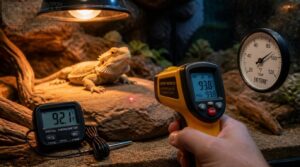
Not all thermometers are created equal, and picking the wrong type can leave your dragon’s basking spot dangerously off-target. Some tools measure air, some measure surface heat, and some do both jobs at once. Here’s a breakdown of the main types you’ll want to know before choosing your setup.
For the most reliable readings, digital probe thermometers placed at both the basking spot and cool hide beat analog dials every time, and this guide to regulating snake temperature needs breaks down exactly where to position each sensor.
Digital Probe Thermometers
Digital probe thermometers are the workhorse of reptile enclosure monitoring. A thermocouple sensor sits on the basking surface while the display stays outside the glass, giving continuous readings without disturbing your dragon. Response times run 2–5 seconds, fast enough to catch fluctuations.
Look for models with min/max data logging and solid battery life, so you’re not guessing about basking surface temperature swings overnight. These devices use electronic components to provide quick and accurate readings.
Infrared Temperature Guns
Infrared temperature guns let you spot-check basking surface temperature without touching a thing. Point one at a rock or branch, and the thermopile sensor reads infrared radiation instantly.
Check your emissivity setting—shiny surfaces skew readings. Watch distance-to-spot ratios too; the Etekcity 774‘s 12:1 ratio keeps your measurement spot accurate, catching hotspots caused by aging bulbs before they cause thermal burns.
Hygrometer Thermometer Combos
Combo units solve two problems at once—one sensor tracks temperature, the other humidity, so you’re not juggling separate gadgets in your reptile enclosure.
Most digital hygrometer thermometer combos read humidity within ±2-5%, some with min/max memory or basic data logging capabilities. Look for weatherproof housing design, since condensation is common. Bearded dragons need low humidity (30-40%), so accuracy here directly protects respiratory health.
Bluetooth Smart Monitors
Bluetooth Smart Monitors take combo units a step further by pushing readings straight to your phone. Most use BLE connectivity within about 10 meters, offering real-time data visualization, smart alerts, and CSV export. The Govee hygrometer thermometer stores up to two years of history. Sensor battery life often runs several months, and threshold alerts catch dangerous swings before your bearded dragon does.
Avoid Analog Dial Gauges
If you’ve still got a dial gauge stuck to the glass, it’s time to retire it. Bimetallic springs drift 15–20°F, and parallax error makes readings worse from an angle.
- Slower to read than digital
- Requires manual calibration
- Prone to mechanical drift
A digital thermometer and hygrometer gives bearded dragons the temperature accuracy your reptile enclosure monitoring actually needs.
Top 8 Reptile Thermometers Reviewed
Now that you know what to look for, let’s put those features into practice.
Below are eight thermometers and hygrometers that consistently hold up in real bearded dragon enclosures, from basic probe units to Bluetooth-enabled monitors. Each one fits a different budget and setup, so you can match the right tool to your dragon’s needs.
1. Digital Mini Hygrometer Thermometer Monitor
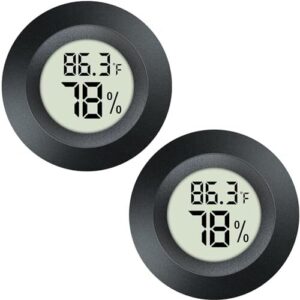
Small enclosures need small tools, and this mini hygrometer thermometer fits that job well. It updates readings every 10 seconds through 24 vents, giving you near real-time tracking of ambient temperature and humidity together.
The compact circular design (1.81" x 1.81") tucks into tight tank corners without blocking light. One-touch °F/°C conversion and a clear LED display make daily checks simple, while LR44 batteries last up to 8 months—minimal upkeep for consistent monitoring.
| Best For | reptile keepers, aquarium owners, and greenhouse or terrarium enthusiasts who need reliable, real-time temperature and humidity tracking in a small enclosure. |
|---|---|
| Digital Display | LED digital display |
| Dual Temp Scale | Fahrenheit and Celsius |
| Battery Powered | LR44 button batteries |
| Compact Size | 1.81″ x 1.81″ |
| Temp Range | 32°F to 158°F |
| Reptile Habitat Use | Reptile terrariums |
| Additional Features |
|
- Updates readings every 10 seconds for near real-time monitoring
- Compact circular design fits easily into tight spaces without blocking light
- One-touch °F/°C conversion with a clear, easy-to-read LED display
- Needs 1–2 hours to acclimate before readings become accurate
- Small form factor can make the display harder to read from a distance
- Batteries need replacing roughly every 8 months
2. Digital reptile thermometer and hygrometer
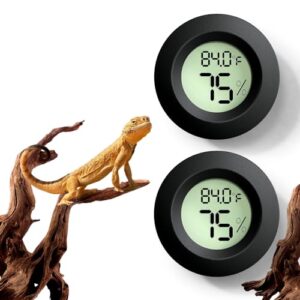
This tiny resin unit packs both sensors into a 1-inch frame, mounting with adhesive dots on glass or mesh. It samples every 5 seconds, tracking -58°F to 158°F and 10-99% humidity in one glance.
A single 1.5V button cell powers it roughly 90 days. That’s enough for bearded dragons, leopard geckos, or ball pythons, though only one unit in a two-pack includes °F/°C conversion—check before buying if that matters to you.
Pairing this hygrometer with a reliable thermometer is especially handy if you’re keeping snake breeds that stay small and easy to house, since compact enclosures can shift humidity fast.
| Best For | Reptile, spider, and crustacean owners who want a compact, easy-to-mount way to track both temperature and humidity in enclosures like bearded dragon, leopard gecko, ball python, chameleon, or axolotl habitats. |
|---|---|
| Digital Display | Round LCD display |
| Dual Temp Scale | Fahrenheit and Celsius |
| Battery Powered | 1.5V button cell |
| Compact Size | 1 inch length |
| Temp Range | -58°F to 158°F |
| Reptile Habitat Use | Reptile enclosures |
| Additional Features |
|
- Monitors both temperature and humidity in one small, round display
- Fast 5-second sampling gives quick, up-to-date readings
- Simple adhesive mounting means no drilling or complicated setup
- Battery lasts only about 90 days, requiring frequent replacement
- Fahrenheit/Celsius conversion is only included on one unit in a two-pack
- Humidity accuracy range (±5%) is fairly wide for precise monitoring
3. Kizen Infrared Handheld Temperature Gun
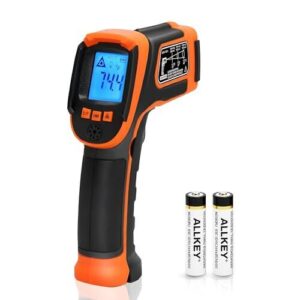
Ever wonder why your dragon’s basking rock reads fine on the probe but still isn’t helping digestion? The probe may be missing the actual hot spot. The Kizen infrared gun solves that by scanning rocks and branches from a distance, no contact needed.
With a 12:1 distance-to-spot ratio and adjustable emissivity, it reads shiny décor and matte substrate alike. Point, pull the trigger, get an instant surface number. It won’t replace your ambient probe, but it catches hidden hot spots or cool patches your combo unit can’t see.
| Best For | Reptile owners who want to pinpoint exact hot spots and cool zones in their enclosure rather than relying on a single ambient probe reading. |
|---|---|
| Digital Display | Backlit LCD screen |
| Dual Temp Scale | Fahrenheit and Celsius |
| Battery Powered | 2 AAA batteries |
| Compact Size | 6.2 inches long |
| Temp Range | -58°F to 1112°F |
| Reptile Habitat Use | Surface monitoring |
| Additional Features |
|
- Instant, no-contact readings make it easy to scan rocks, branches, and décor from a distance
- Adjustable emissivity (0.1–1.0) means accurate results on both matte substrate and shiny surfaces
- Backlit LCD and laser pointer make it simple to aim and read in dim tank lighting
- Needs about 14 inches of distance from the target for the most accurate reading
- Measures surface temperature only, so it won’t replace a dedicated ambient probe
- Not designed for measuring body temperature, so it’s a spot-check tool rather than a full monitoring solution
4. TempPro TP50 Digital Hygrometer
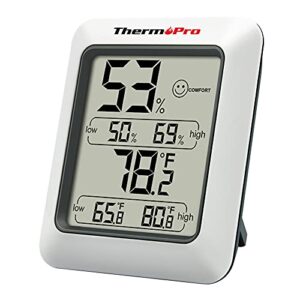
Simplicity is the TP50’s whole pitch. One screen, current temp and humidity, no fuss. Accuracy runs ±1°F and ±2-3%RH, with readings refreshed every 10 seconds, so you’ll catch swings before they become a problem.
A built-in comfort indicator flags dry or wet conditions at a glance, useful for beginners still learning what "normal" looks like. Runs on a single AAA battery.
Just don’t mistake it for a data logger. It shows daily highs and lows, but that’s the extent of its memory.
| Best For | Anyone who wants a simple, no-fuss way to keep tabs on indoor temperature and humidity, whether that’s for everyday comfort, a greenhouse, a terrarium, or storage spots like a fridge or humidor. |
|---|---|
| Digital Display | Touchscreen LCD |
| Dual Temp Scale | Selectable F/C |
| Battery Powered | 1 AAA battery |
| Compact Size | 0.84″ x 2.62″ |
| Temp Range | Wide indoor range |
| Reptile Habitat Use | Reptile terrariums |
| Additional Features |
|
- Easy-to-read touchscreen with a comfort indicator that shows dry, comfortable, or wet conditions at a glance
- Reliable accuracy (±1°F, ±2-3%RH) with readings updated every 10 seconds
- Compact, magnetic tabletop design with switchable °F/°C display and IPX5 splash resistance
- No long-term data logging, it only tracks daily highs and lows
- Runs on a single AAA battery that will need periodic replacement
- Branding inconsistencies (ThermoPro vs. TempPro) could cause some confusion when purchasing
5. Mini Digital Hygrometer Thermometer Set
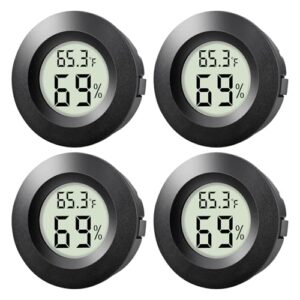
Two sensors, one setup, twice the coverage. This is where these mini sets earn their keep — a matched pair reading basking and cool zones on separate displays, no averaging or guesswork involved.
Each unit runs on button-cell batteries (think LR44), lasting 6-12 months. Expect ±1°C accuracy and roughly 5% RH tolerance — fine for general monitoring, though not lab-grade.
Auto shut-off preserves battery life. Compact, magnetic-backed, and easy to tuck into canopy corners without cluttering your enclosure’s aesthetic.
| Best For | Reptile keepers and hobbyists who need reliable dual-zone temperature and humidity tracking for tanks, terrariums, or incubators without dealing with complicated setup. |
|---|---|
| Digital Display | Round LCD display |
| Dual Temp Scale | Fahrenheit and Celsius |
| Battery Powered | Battery powered |
| Compact Size | 2.33 oz weight |
| Temp Range | -58°F to 158°F |
| Reptile Habitat Use | Reptile tanks |
| Additional Features |
|
- Dual sensors let you monitor basking and cool zones separately, so there’s no guessing or averaging
- Compact, magnetic-backed design tucks neatly into canopy corners without cluttering the enclosure
- Auto shut-off and long-lasting button-cell batteries (6–12 months) mean less maintenance
- Requires manual switching between Celsius and Fahrenheit rather than automatic conversion
- Small screen size can be hard to read from a distance
- Accuracy (±1°C, ~5% RH) is fine for general use but not precise enough for lab-grade monitoring
6. Govee Bluetooth Indoor Hygrometer Thermometer
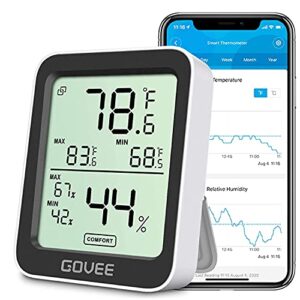
If you want data, not just a snapshot, this is your unit. The Swiss-made sensor hits ±0.3°C and ±3% RH accuracy, with a 60-meter Bluetooth range to your phone.
The Govee Home app logs trends over time — handy for catching slow humidity creep before it causes scale rot. Coin-cell batteries keep it running for months. It’s not a basking-zone tool, but for tracking your enclosure’s overall climate, it’s hard to beat.
| Best For | Reptile and terrarium owners, or anyone monitoring baby rooms, greenhouses, wine cellars, or basements who wants detailed long-term climate tracking rather than just a quick reading. |
|---|---|
| Digital Display | 3-inch LCD display |
| Dual Temp Scale | Fahrenheit and Celsius |
| Battery Powered | Rechargeable/battery powered |
| Compact Size | 2.5″ x 3.1″ |
| Temp Range | Standard indoor range |
| Reptile Habitat Use | Terrarium monitoring |
| Additional Features |
|
- Swiss-made sensor delivers high accuracy (±0.54°F temperature, ±3% RH humidity)
- 20-day historical graphs plus 2-year CSV export make it easy to spot slow trends like humidity creep
- Real-time app alerts notify you the moment conditions drift outside your preset range
- No Wi-Fi support — you’re limited to Bluetooth only
- Bluetooth range tops out at 164 feet (50 meters), and even less with walls or obstructions in the way
- Connection can drop entirely if you go beyond the unobstructed range
7. Etekcity Infrared Laser Temperature Gun
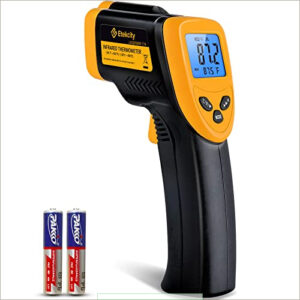
Tracking humidity trends is one thing, but you still need to verify actual basking surface temps — that’s where this tool earns its keep. The Etekcity Lasergrip 774 reads from -58°F to 716°F with a 12:1 distance-to-spot ratio, so you can check rocks and branches without touching them.
Point, click, done. It won’t catch shifting temps over time, but it’s incredibly reliable for confirming basking spots aren’t overheating your dragon or falling short of digestion needs.
| Best For | Reptile owners who need a quick, no-contact way to confirm basking spots are hitting the right temperature for their pet’s health. |
|---|---|
| Digital Display | Backlit LCD screen |
| Dual Temp Scale | Fahrenheit and Celsius |
| Battery Powered | 2 AAA batteries |
| Compact Size | 6.14 x 3.15 x 1.57 in |
| Temp Range | -58°F to 842°F |
| Reptile Habitat Use | Reptile care |
| Additional Features |
|
- Wide temperature range handles everything from chilly hides to hot basking rocks
- Non-contact laser design keeps things safe and easy for quick daily checks
- 12:1 distance-to-spot ratio allows accurate readings from a comfortable distance
- Only captures a single moment in time, so it won’t track temperature shifts throughout the day
- Requires maintaining the correct distance ratio for accurate results
- Reads an average surface area rather than one exact point, which may miss small hot or cold spots
8. Zoo Med Digital Terrarium Thermometer
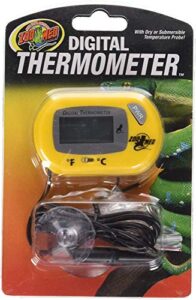
Rounding out the list is a classic for a reason. The Zoo Med Digital Terrarium Thermometer uses a remote probe design, with suction cups anchoring the sensor inside the enclosure while the LCD display stays dry outside.
It reads -10°F to 140°F in both scales, covering basking spots and cool zones alike. The probe resists moisture, so damp substrate won’t skew readings. Setup takes minutes, and repositioning is just as easy — handy when you’re comparing microclimates or fine-tuning your dragon’s thermal gradient.
| Best For | Reptile and amphibian keepers who want an accurate, easy-to-place thermometer for monitoring both air and water temperatures across a terrarium’s basking and cool zones. |
|---|---|
| Digital Display | Digital LCD display |
| Dual Temp Scale | Fahrenheit and Celsius |
| Battery Powered | Battery powered |
| Compact Size | 5.25 x 0.75 x 3.3 in |
| Temp Range | Standard aquatic range |
| Reptile Habitat Use | Terrarium monitoring |
| Additional Features |
|
- Waterproof, submersible probe works great for monitoring both terrarium air and water temperatures
- Dual Fahrenheit/Celsius readout with a wide range (-10°F to 140°F) covers basking spots and cool zones alike
- Simple suction-cup mounting makes it quick to set up and reposition when comparing microclimates
- Only one unit included per pack, so monitoring multiple zones means buying more than one
- Lightweight plastic construction may feel less durable than sturdier materials
- Intended for adult use, so it’s not designed with kid-friendly setup in mind
Key Buying Features

Picking the right thermometer isn’t just about brand names or price tags. What matters is whether the device actually holds up to the specific demands of a bearded dragon enclosure. Here’s what to check before you buy.
Temperature Range Coverage
Range coverage matters more than most owners realize. Your thermometer needs to read comfortably above your basking target and below your nighttime lows, since sensor saturation can produce false readings at the extremes.
Most reptile thermometers cover 32–120°F, which controls seasonal shifts and diurnal cycles without gaps. Check calibration accuracy periodically so extreme value tracking stays reliable year-round.
Humidity Accuracy Levels
A good digital hygrometer should hold ±1 to ±3 percent RH accuracy, which is the range worth demanding from any humidity sensor you buy.
Capacitive and resistive sensors drift differently over time, so calibration against known reference points matters. Temperature compensation and hysteresis both affect readings, meaning cheap units can misjudge relative humidity even when temperatures look stable.
Fast Sensor Response
A one-to-two second lag is all it should take for a quality digital thermometer to catch a basking spot swing. Microprobe design efficiency and thin sensing elements reduce thermal mass, minimizing thermal lag between your dragon’s zones.
- Sub-second MEMS response
- Low hysteresis thermistors
- Reduced sensor drift
- Real-time data updates
Slow sensor response latency means missed temperature precision, risking burns or chills.
Battery Life Expectations
Most digital reptile thermometers run on small lithium cells rated for 300–1000 charge cycles, dropping to 80–90% capacity around cycle 500. Heat near basking lamps accelerates degradation, so mount units away from direct heat.
| Chemistry | Cycle Life |
|---|---|
| LiFePO4 | Highest |
| NMC | Moderate |
Avoid overcharging—voltage stress shortens lifespan. Expect battery replacement every 6–12 months for reliable bearded dragon monitoring.
Secure Mounting Options
A wobbly thermometer gives you wobbly data. Suction cup reliability matters most on glass enclosures—look for a 2.5 kg load rating. Magnetic mounting and non-skid pads stop sliding, while telescoping tracks add mounting versatility for shifting basking zones.
Mount at proper height, manage cables safely away from curious bearded dragons, and check adhesive durability ratings before trusting any mount long-term.
Correct Probe Placement
Owning a great thermometer won’t help much if it’s sitting in the wrong spot. Placement is what turns a good reading into an accurate one, and accuracy is what keeps your dragon safe. Here’s exactly where each probe and gun needs to go.
A thermometer can only tell you the truth if it’s placed correctly, which is exactly why terrarium thermometer accuracy matters so much for snake health.
If you’re deciding between probe types, this digital vs analog terrarium thermometer accuracy comparison breaks down why that calibration drift actually matters for your dragon’s basking spot.
Basking Zone Monitoring
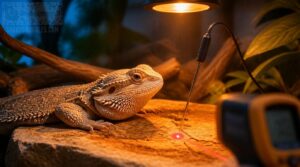
Your dragon’s basking spot is where digestion happens, so accuracy matters most. Place a probe directly on the surface, not the air above it. Confirm readings with an infrared thermometer for surface heat verification, since bulb aging can quietly drop temps. This keeps your thermal gradient stability intact and helps with proper digestion without guesswork.
Cool Side Readings
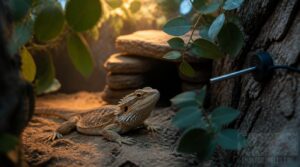
Cool spots matter as much as hot ones — this is where your dragon retreats to avoid heat stress. Mount the sensor at torso-height sensor placement, away from lamps, to catch true air temperature.
- Confirms thermal gradient stability
- Tracks microclimate data trends
- Helps with nighttime cooling cycles
A digital thermometer here rounds out your reptile enclosure’s temperature gradient, giving your bearded dragon reliable relief.
Middle Zone Checks
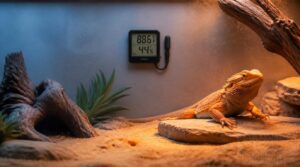
Between hot and cool sides sits a zone dragon owners often skip — don’t. Vertical center placement, roughly mid-height, confirms ambient air accuracy across your reptile enclosure.
Mount here, away from decor or vents, and you’ll catch true thermal gradient stability readings. A digital thermometer with humidity monitoring works best. Follow standard sensor mounting safety practices — secure cables, avoid glass contact — so your middle zone data stays trustworthy.
Surface Versus Air Temperature

Middle-zone air readings tell only half the story. Your basking spot’s surface absorption rate can run 20°F hotter than the surrounding ambient air temperature, since radiant heat impact hits directly while convection cooling affects air more gradually.
A basking spot’s surface can run 20°F hotter than the surrounding air, so ambient readings alone tell only half the story
Use both:
- Temperature probe for ambient air
- Infrared thermometer for basking surfaces
- Compare readings for thermal gradient accuracy
- Recheck weekly for microclimate variability
Avoid Glass-only Readings
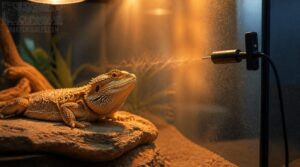
Glass reflects radiant heat from your bulbs, so a sensor pressed against the tank wall reads hotter than the actual air. That’s glass temperature inaccuracies at work, plus thermal lag delaying results by minutes.
Mount your digital thermometer with probe 2–4 inches off the glass, facing open air near the basking spot for real surface temperature accuracy and honest calibration.
Ideal Bearded Dragon Readings
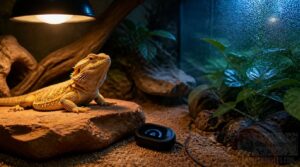
Owning a good thermometer only helps if you know what numbers you’re actually aiming for. Bearded dragons need different targets depending on their age, the zone you’re checking, and even the time of day. Here’s a quick breakdown of the readings that keep your dragon healthy and comfortable.
Adult Basking Temperatures
Digestion runs on heat, and an adult bearded dragon needs a basking surface between 95–105°F to break down food properly.
- Verify with an infrared thermometer, not guesswork
- Keep the cool side near 75–85°F
- Watch for lethargy above 110°F
- Dark substrate absorbs heat faster
- Confirm gradient stability daily
A digital thermometer with probe catches drift before it becomes a problem.
Baby Basking Temperatures
Five to ten degrees hotter than an adult’s spot, a baby dragon’s basking surface should run 105–110°F to fuel rapid growth. Freshly hatched babies often need the top end, near 115°F.
Infrared spot-checking confirms accuracy since young dragons overheat fast. Watch for gaping or lethargy, and adjust the gradient by five-degree steps until basking behavior normalizes.
Cool Side Air Range
Cool side air range should sit between 75–85°F, giving your bearded dragon somewhere to cool down without stalling metabolism.
- A shaded log corner
- Gentle airflow across open floor space
- Steady humidity near 30-40%
- No direct basking light bleed
- A probe mounted mid-height
Good airflow patterns prevent stagnant pockets, supporting thermoregulation efficiency and healthy digestion once your dragon retreats from the heat.
Safe Nighttime Drops
Wondering how cold is too cold at night? Adult dragons tolerate a safe drop to 59–75°F, mimicking natural desert cooling without stressing digestion.
Sudden temperature fluctuations, though, cause more harm than a steady overnight dip. Use your digital thermometer and hygrometer combo to confirm the drop stays gradual, protecting habitat temperature regulation while your dragon rests undisturbed until morning basking resumes.
Healthy Humidity Range
Dry desert air isn’t the goal—balance is. Keep humidity between 30–40% for healthy adults, adjusting seasonally to avoid respiratory infections or poor shedding.
- Winter: 30–45%
- Summer: below 55%
- Shedding support: 40–50%
- Danger zone: above 60% RH
- Juvenile risk: below 30%
Monitor substrate moisture and microclimate stability with a reliable hygrometer for consistent enclosure safety.
Frequently Asked Questions (FAQs)
What kind of thermometer is best for bearded dragons?
Digital probe thermometers paired with a hygrometer combo give you the best accuracy for enclosure safety. Skip analog dials entirely, they run 15-20°F off. Pair one with an infrared gun for quick basking-spot checks and reliable temperature and humidity monitoring.
Do I need a thermometer for my bearded dragon?
A pilot wouldn’t fly blind without instruments—so don’t guess your dragon’s world either. Yes: a thermometer and hygrometer are essential, guarding against thermal burns, poor digestion, and metabolic bone disease by confirming real basking zone and gradient temperatures.
What is the leading cause of death in bearded dragons?
Cardiovascular disease tops the list, causing roughly 34% of deaths in a 52-case review, with sepsis and neoplasia close behind. Consistent temperature and humidity monitoring helps prevent heat stress and metabolic disease that strain organ systems long-term.
What temperature should a bearded dragon be kept at?
Think of your dragon’s enclosure like a house with rooms of different purpose: a kitchen for digestion and a bedroom for rest. Keep basking zones near 100–108°F, cool sides around 79–84°F, nighttime dips to 64–72°F, supporting healthy thermal gradients.
How often should I calibrate reptile thermometers?
Monthly calibration keeps accuracy tight. Test digital probes with an ice bath (32°F) and boiling water (212°F) checks; run infrared cross-checks weekly during lamp swaps.
Log every result—drift beyond ±1°F means it’s time to recalibrate or replace.
Can wrong temperatures cause metabolic bone disease?
Yes. Wrong temperatures slow your bearded dragon’s metabolic rate, causing calcium absorption failure and poor nutrient processing.
A proper thermal gradient, verified with an accurate thermometer, prevents these bone mineralization risks and lowers metabolic bone disease risk a lot.
Why does my dragons basking spot fluctuate?
An aging bulb loses output gradually.
Lamp distance shifts and seasonal room changes (HVAC, sunlight) swing basking zone heat.
Substrate absorption adds variation too.
Consistent thermometer and heat lamp monitoring catches these temperature swings before your bearded dragon’s comfort suffers.
Do heat bulbs affect thermometer accuracy over time?
A probe left inches from a basking bulb for months can drift several degrees off. Radiant heat bias and sensor housing degradation cause slow bulb-induced calibration errors—so recheck thermometer accuracy after any heat lamp placement change.
How many thermometers does one enclosure need?
Two is your minimum for real dual-zone monitoring, but three adds a midpoint check for gradient verification. This setup catches false readings, confirms your basking zone and cool side gradient, and gives multi-sensor redundancy against a single faulty hygrometer or thermometer.
Conclusion
Your dragon won’t hand you a written complaint about its basking spot being ten degrees short—it’ll just stop eating, or worse. Guesswork dressed up as husbandry is still guesswork.
The right reptile thermometers for bearded dragons replace that gamble with hard numbers you can trust, day after day. Place your probes correctly, check both zones daily, and adjust before problems start. That’s not luck—that’s precision. Master the gradient, and your dragon’s health stops being a question mark.