This site is supported by our readers. We may earn a commission, at no cost to you, if you purchase through links.

Your bearded dragon basks under the perfect lamp, looking content. Meanwhile, the dial gauge stuck to the glass reads 95°F, while the actual basking surface hits 118°F. That gap isn’t a rounding error, it’s a burn risk waiting to happen.
Cheap thermometers drift, lag, and lie by up to 10 degrees once humidity or calibration slips. For cold-blooded pets who can’t regulate their own body heat, that’s the difference between thriving and quietly suffering.
Picking the right terrarium thermometers for beginners means understanding thermistors, probe placement, and what those blinking numbers actually mean, before your snake or gecko pays the price for guesswork.
Table Of Contents
- Key Takeaways
- Why Terrarium Thermometers Matter for Snakes
- Top 10 Terrarium Thermometers for Beginners
- 1. Digital Hygrometer Thermometer Indoor Outdoor
- 2. Dual Digital Reptile Thermometer Hygrometer
- 3. Mini Digital Hygrometer Thermometer 2 Pack
- 4. Repti Zoo Dual Thermometer Hygrometer
- 5. Aquaneat Digital Aquarium Thermometer
- 6. BSRESIN Reptile Thermometer Hygrometer 2 Pack
- 7. Mini Digital Temperature Humidity Meters 4 Pack
- 8. Reptile Thermometer Hygrometer Dual Sensor
- 9. QZQ LED Reptile Thermometer Humidity Gauge
- 10. Reptile Terrarium Digital Thermometer Hygrometer
- Where to Place a Thermometer in a Terrarium
- How to Read Thermometer Displays Correctly
- Setting The Right Temperature Gradient
- Frequently Asked Questions (FAQs)
- Where to place a thermometer in a terrarium?
- What is the easiest thermometer to use?
- How to measure temperature in terrarium?
- What temperature should a terrarium be kept at?
- How often should I replace terrarium thermometer batteries?
- Can I use a household thermometer for terrariums?
- How do I calibrate a digital terrarium thermometer?
- What causes inconsistent readings between two placed thermometers?
- How much do quality terrarium thermometers typically cost?
- Conclusion
Key Takeaways
- Cheap thermometers can drift up to 10 degrees off, and since your reptile can’t regulate its own body heat, that gap can mean the difference between thriving and getting burned.
- Always place one probe directly on the basking surface and another in the cool hide, since air temperature and surface temperature can differ by 6-12°F and both need checking together.
- Digital probes give the fastest, most reliable readings, while dial thermometers lag and drift, and infrared guns only catch surface spots without measuring air temperature.
- Calibrate regularly using the ice bath and boiling point methods, and let the tank settle for 30 to 120 minutes before trusting any reading, since even a 1°C gap means it’s time to recalibrate.
Why Terrarium Thermometers Matter for Snakes
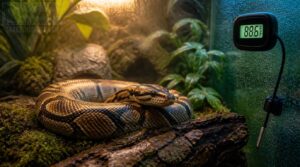
Your snake can’t tell you it’s too hot or too cold, so the thermometer does the talking. Get the reading wrong and you’re not managing a habitat, you’re guessing with a living animal’s health on the line. Here’s what actually works, starting with ten beginner-friendly picks worth your money.
This guide to choosing the best snake cage thermometers breaks down which types give accurate readings and which ones lead you astray.
Accurate Readings for Snake Health
A snake can’t tell you it’s too cold. The thermometer does that job, and a bad reading is a lie, not a reading. Sensor calibration drift of even 2°F throws off your whole gradient.
A bad thermometer reading isn’t a reading at all—it’s a lie your snake can’t afford
Track temperature fluctuation analysis and humidity-temperature correlation together — species temperature range means nothing without both numbers holding steady.
Proper placement guidelines recommend positioning probes at both the warm and cool ends of the enclosure to monitor temperature gradients effectively. Proper placement guidelines are essential for accurate readings.
Digital Vs Dial Vs Infrared Types
Three tools, three jobs. A digital probe uses a thermistor for fast, precise readings, updating in seconds. A dial thermometer relies on a bimetal coil, slower and prone to drift without calibration. An infrared gun reads surface temps instantly but skips air temperature entirely.
- Digital: best accuracy, fastest response
- Dial: cheap, but sluggish
- Infrared: instant surface spot-checks
- None replace proper probe placement
- Calibration keeps every type honest
Waterproof Probes for Humid Tanks
None of that matters if moisture kills the sensor. Tropical setups demand a waterproof temperature probe — stainless steel housing, sealed cable jacket, tested seal integrity. Corrosion prevention isn’t optional near water bowls or misting systems.
A submersible aquarium thermometer experiences humidity percentage swings without drifting. For dual thermometer placement, put one waterproof probe in the humid hide, one standard probe on the basking surface.
Top 10 Terrarium Thermometers for Beginners
Picking the right thermometer means matching the sensor type to your setup, not just grabbing whatever’s cheapest on the shelf. Some snakes need tight humidity control, others just need a reliable dual-zone readout, and the ten picks below cover both. Here’s what actually works, starting with the basics.
1. Digital Hygrometer Thermometer Indoor Outdoor
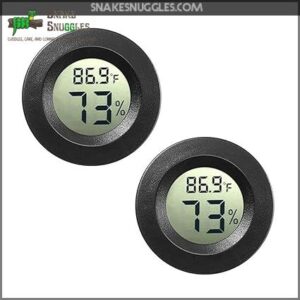
A single sensor doing double duty is where most beginners should start. This indoor/outdoor hygrometer thermometer reads humidity from 10% to 99% RH and temperature from -58°F to 158°F, updating every 10 seconds through 24 ventilation holes.
Two LR44 button cells run it for up to 10 months. The 25mm LCD is easy to read at a glance, and switching between Fahrenheit and Celsius takes one button press. Accuracy runs ±1°F and ±3% RH, plenty tight for tracking daily conditions.
For a closer look at how this model stacks up against the Serundo and Wacool alternatives, our guide to terrarium thermometers for small apartments breaks down the details.
| Best For | Beginners who want an easy, all-in-one way to track temperature and humidity in spaces like terrariums, greenhouses, or humidors. |
|---|---|
| Measures Temperature | Yes |
| Measures Humidity | Yes |
| Power Source | 2x LR44 |
| Mounting Method | Freestanding |
| F/C Switchable | Yes |
| Reptile Habitat Use | Yes |
| Additional Features |
|
- Wide measurement range covering 10%–99% RH and -58°F to 158°F
- Long battery life, up to 10 months per LR44 cell
- Easy-to-read 25mm LCD with simple Fahrenheit/Celsius switching
- Humidity readings can lag behind fast environmental changes
- Accuracy drops in higher ambient temperatures, especially for humidity
- Not waterproof or weatherproof, limiting it to indoor and sheltered use
2. Dual Digital Reptile Thermometer Hygrometer
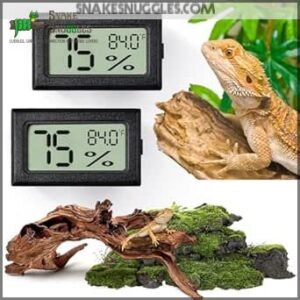
Two zones, two truths. This unit puts a probe in your basking spot and a remote sensor in the cool retreat, giving you a real-time dual readout instead of guessing whether the gradient actually exists.
Both readings show on one LCD screen, in °F or °C, with min/max memory logging fluctuations since your last reset. Probes run water resistant, so misting won’t kill them.
That’s the whole point of dual sensing: no cross-contamination between your warm and cool data.
| Best For | Reptile and amphibian keepers who want an easy, no-fuss way to track temperature and humidity across two separate zones of their terrarium. |
|---|---|
| Measures Temperature | Yes |
| Measures Humidity | Yes (2 units) |
| Power Source | Replaceable battery |
| Mounting Method | Adhesive |
| F/C Switchable | Yes |
| Reptile Habitat Use | Yes |
| Additional Features |
|
- High-precision chip delivers accurate temperature readings within ±0.9 °F (±0.5 °C)
- Bright LED display makes it easy to read at a glance, even at night
- Tool-free adhesive backing means simple, cordless installation with no wiring clutter
- Humidity accuracy isn’t specified, which may not suit keepers of humidity-sensitive species
- Adhesive can lose its hold over time on very wet or textured surfaces
- Requires a battery that isn’t included, and the expected battery life isn’t disclosed
3. Mini Digital Hygrometer Thermometer 2 Pack
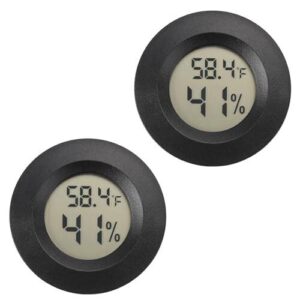
When space is tight, buying two of something small beats one of something bulky. This pack gives you a sensor for the warm hide and one for the cool side, each built into a compact housing with an integrated probe, no dangling wires to snag.
Just remember to keep each probe at least an inch from the mat and check placement against this guide to positioning thermometers in a snake enclosure, since a misplaced sensor can read up to 20°F off.
The blue-backlit LCD stays readable in dim rooms. Expect roughly ±1°C accuracy and ±5% RH, fine for hatchling tubs or quarantine bins where every inch matters.
| Best For | Reptile and amphibian keepers, greenhouse growers, and hobbyists who need reliable dual temperature and humidity tracking in tight spaces like terrariums, basements, or 3D printing setups. |
|---|---|
| Measures Temperature | Yes |
| Measures Humidity | Yes |
| Power Source | 2x LR44 |
| Mounting Method | Freestanding |
| F/C Switchable | Yes |
| Reptile Habitat Use | Yes |
| Additional Features |
|
- Automatic updates every 10 seconds keep temperature and humidity readings current without manual refreshing
- Switchable Fahrenheit/Celsius display and long-lasting LR44 batteries (up to 9 months each) add convenience
- Compact, lightweight design (0.04 kg) fits easily into small enclosures like terrariums or storage bins
- Not built for lab-grade precision, so critical applications may need a calibrated backup instrument
- Small screen size can be hard to read from a distance or in low-light settings
- Limited operating range (0°C to 70°C, 10% to 99% RH) may not suit extreme environments
4. Repti Zoo Dual Thermometer Hygrometer
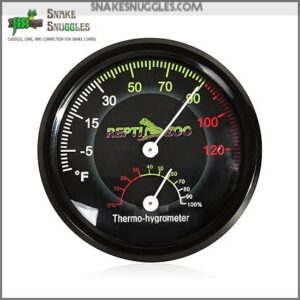
Once you need two sensors reading two different zones, this unit earns its keep. The dual sensor design tracks ambient air and probe temperature at once, so you catch basking and retreat readings on a single screen, labeled A and B.
Suction cups mount it to glass without adhesive residue. Humidity and temperature display together in Celsius or Fahrenheit, and a backlight helps you check numbers after lights-out without a flashlight.
| Best For | Reptile and amphibian keepers who want to monitor both ambient and basking-zone conditions in terrariums, vivariums, hatchers, brooders, or propagators from a single display. |
|---|---|
| Measures Temperature | No |
| Measures Humidity | Yes |
| Power Source | Battery-free |
| Mounting Method | Adhesive |
| F/C Switchable | Not specified |
| Reptile Habitat Use | Yes |
| Additional Features |
|
- Dual sensor design lets you track ambient air and probe temperature at the same time, labeled A and B for easy comparison
- Suction cup mounting attaches securely to glass without leaving sticky adhesive residue behind
- Backlit display shows temperature and humidity in Celsius or Fahrenheit, making nighttime checks easy without extra lighting
- No published measurement range or accuracy tolerance is listed for temperature or humidity readings
- Plastic housing offers limited impact resistance compared to metal gauge alternatives
- Not designed for outdoor use or high-humidity environments beyond typical indoor setups
5. Aquaneat Digital Aquarium Thermometer
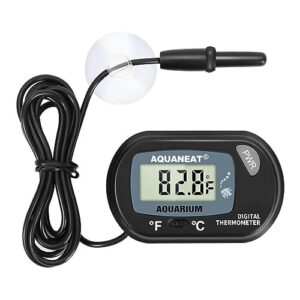
Water snakes and semi-aquatic setups need a probe built for full submersion, and that’s exactly what this one does. The probe stays underwater while the display sits dry outside the glass, held by a suction cup along the tank wall.
Range runs -58°F to 158°F, accurate within 1°C. Switch between Celsius and Fahrenheit anytime, and you’ll get a real-time LCD readout, no guesswork on heater calibration or fish health checks.
| Best For | Aquarium, terrarium, and hydroponic hobbyists who want an easy, accurate way to monitor water temperature and fine-tune heater settings. |
|---|---|
| Measures Temperature | Yes (probe) |
| Measures Humidity | No |
| Power Source | 1x LR44 |
| Mounting Method | Suction cups |
| F/C Switchable | Yes |
| Reptile Habitat Use | Yes |
| Additional Features |
|
- Wide temperature range with ±1°C accuracy keeps readings dependable for both freshwater and marine setups
- Submersible probe with suction cup mounting makes placement secure and hassle-free
- Switchable Celsius/Fahrenheit display offers quick, flexible readouts right after power-on
- Display unit isn’t waterproof, so it has to stay outside the tank at all times
- Cord junction can wear out over time, especially with frequent repositioning
- No backlight means the screen can be harder to read in dim lighting
6. BSRESIN Reptile Thermometer Hygrometer 2 Pack
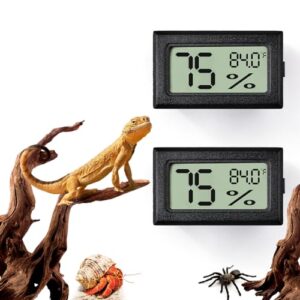
Two zones, two readings, no compromise: that’s the pitch behind this pack. Each unit reads -58°F to 158°F at ±1°F, plus humidity from 10-99% RH at ±5% accuracy, updating every 5 seconds.
The adhesive backing sticks inside glass in seconds, and the button cell battery runs roughly 90 days per unit. Fahrenheit only, no Celsius toggle. Fine for most keepers, but check specs first if you’ve grown used to switching units.
| Best For | Reptile owners who want to track temperature and humidity in multiple zones of a terrarium, incubator, or storage container for pets like bearded dragons, leopard geckos, or ball pythons. |
|---|---|
| Measures Temperature | Yes |
| Measures Humidity | Yes |
| Power Source | Button cell |
| Mounting Method | Adhesive |
| F/C Switchable | No (F only) |
| Reptile Habitat Use | Yes |
| Additional Features |
|
- Wide temperature range (-58°F to 158°F) with solid ±1°F accuracy
- Easy adhesive mounting lets you place units in multiple zones within one enclosure
- Long-lasting battery life at roughly 90 days per unit, with readings updating every 5 seconds
- Fahrenheit only, with no option to switch to Celsius
- Humidity accuracy (±5%) may be inconsistent compared to dedicated hygrometers
- Adhesive backing can weaken over time, especially in high-humidity environments
7. Mini Digital Temperature Humidity Meters 4 Pack
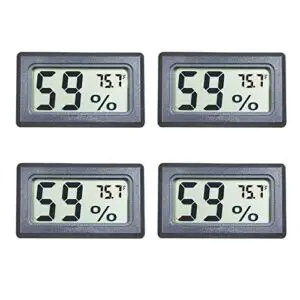
Four zones, one glance, zero guesswork. This pack covers a full rack or a multi-terrarium setup, each sensor reading 32-158°F alongside 10-99% RH on its own LCD screen.
Probes reposition easily as you rearrange hides or add climbing branches, and LR44 batteries keep units running over a year. Sampling lands every 10-60 seconds depending on model, so drift shows up fast.
Mounting stands or adhesive pads handle placement, whether you’re wall-mounting near a rack or tucking one into a corner.
| Best For | Reptile owners, musicians, and anyone managing multiple small enclosures who wants an at-a-glance way to track temperature and humidity across several zones at once. |
|---|---|
| Measures Temperature | Yes |
| Measures Humidity | Yes |
| Power Source | 2x LR44 |
| Mounting Method | Freestanding |
| F/C Switchable | Not specified |
| Reptile Habitat Use | Yes |
| Additional Features |
|
- Compact design fits easily into tanks, guitar cases, and other tight spaces
- Long battery life of 12-18 months means less maintenance
- Wide temperature and humidity range suits fridges, closets, greenhouses, and more
- No backlight, so readings can be hard to see in low light
- Battery compartment can be tricky to open without tools
- Accuracy drops off at very low humidity levels below 15% RH
8. Reptile Thermometer Hygrometer Dual Sensor
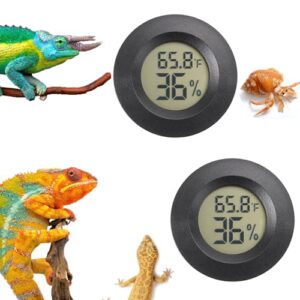
Rack setups are one thing, but a single terrarium with a tricky gradient needs its own solution: two probes, one screen. This unit runs sensors into both the basking spot and the cool retreat, showing both readings side by side so you catch a gradient collapse in seconds, not hours.
Built-in humidity tracking rounds it out, useful for shedding checks. Independent probe calibration on some models keeps zones honest even when one sensor drifts faster than the other.
| Best For | Reptile owners who need to monitor both temperature and humidity across a terrarium’s basking and cool zones without guesswork. |
|---|---|
| Measures Temperature | Yes |
| Measures Humidity | Yes |
| Power Source | 2x button cell |
| Mounting Method | Adhesive |
| F/C Switchable | Yes |
| Reptile Habitat Use | Yes |
| Additional Features |
|
- Tracks temperature and humidity at the same time with a quick 10-second response
- Simple no-wire installation using double-sided adhesive tape
- Compact design fits easily into multiple spots, even in taller enclosures
- Small font size can make the display hard to read for some users
- A handful of units have reportedly failed after just two weeks of use
- Adhesive may weaken over time, especially in high-humidity environments
9. QZQ LED Reptile Thermometer Humidity Gauge
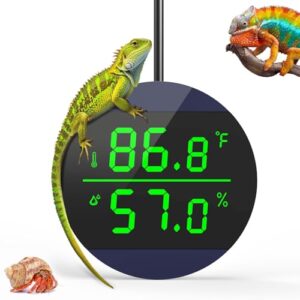
Dual probes are great, but sometimes you just want visibility from across the room. The QZQ LED gauge does that job well, with a bright display readable in low light, running off USB power instead of batteries.
Range hits 32-140°F (±1.8°F) and 5-99% RH (±5%), fine for bearded dragons or geckos. Adhesive mounting works, though it’s tough to remove later. Some buyers report display segments dimming over time, so check it against a second thermometer occasionally.
| Best For | Reptile and invertebrate keepers who want at-a-glance temperature and humidity readings from across the room for enclosures like bearded dragons, crested geckos, snakes, lizards, and jumping spiders. |
|---|---|
| Measures Temperature | Yes |
| Measures Humidity | Yes |
| Power Source | USB powered |
| Mounting Method | Adhesive/USB cable |
| F/C Switchable | Not specified |
| Reptile Habitat Use | Yes |
| Additional Features |
|
- Bright LED display stays readable in both low-light and well-lit rooms
- USB power means no batteries to replace, ideal for long-term habitat monitoring
- Covers a wide range (32-140°F, 5-99% RH) suitable for most common reptile setups
- Some units have reported dim or non-functioning display segments over time
- Adhesive mount is strong enough to risk surface damage or leave residue when removed
- Requires a nearby USB power source, which may limit placement options
10. Reptile Terrarium Digital Thermometer Hygrometer
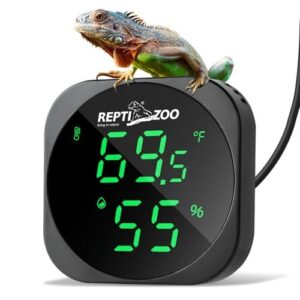
Rounding out the list is a straightforward combo unit built for anyone who just wants reliable numbers without extra bells and whistles. It reads temperature from 32-140°F and humidity from 10-99% RH, wide enough to cover most snake, gecko, or amphibian setups.
The LCD screen stays easy to read against tank backgrounds, and suction-style mounting keeps it put without damaging glass. It’s a solid budget pick if your only goal is dependable, no-fuss monitoring.
| Best For | Reptile and amphibian keepers who want a no-frills, accurate way to track temperature and humidity in their terrarium. |
|---|---|
| Measures Temperature | Yes |
| Measures Humidity | Yes |
| Power Source | USB powered |
| Mounting Method | Velcro/adhesive |
| F/C Switchable | Not specified |
| Reptile Habitat Use | Yes |
| Additional Features |
|
- Covers a wide range (32-140°F and 10-99% RH), suitable for most snake, gecko, and amphibian setups
- LED backlit display makes nighttime checks easy without disturbing nocturnal pets
- Flexible 55.2-inch USB cable with on/off switch allows convenient sensor placement
- Readings can be off by ±2-3°F and ±5-10% RH compared to calibrated devices
- Not waterproof, so it needs to be kept away from direct water spray or submersion
- Requires a separate USB power adapter, which isn’t included in the box
Where to Place a Thermometer in a Terrarium
A thermometer only tells the truth if it’s sitting in the right spot. Slap it on the wrong surface, and you’re basically reading the temperature of nothing that matters to your snake. Here’s where placement actually counts, zone by zone.
Basking Probe on Surface

Skip this probe and you’re guessing. The basking surface probe needs direct skin contact with what the snake actually lies on, not the air above it.
Placement checklist:
- Set probe under the basking spot
- Confirm full surface contact
- Skip areas hit by direct lamp beams
- Choose water-resistant materials
- Recheck weekly for gradient accuracy
Verify thermal equilibrium before trusting any reading.
Shaded Hide Probe Placement
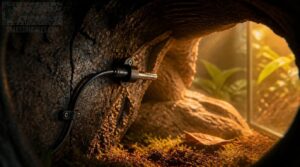
Retreat zones lie, too, if you place the probe wrong. Set the shaded hide probe mid-height inside the hide, angled toward the warm side, avoiding substrate contact that insulates readings cool.
Check hide ventilation stays open, mind probe orientation angle toward hide center, and secure it — probe depth calibration matters for microclimate consistency and accurate temperature gradient readings behind the basking surface probe.
Avoiding Direct Lamp Exposure
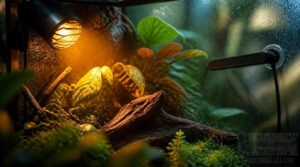
A probe sitting in a direct beam gives you a lie, not a reading — radiant heat spikes it false-high. Angle probes away from line-of-sight, use lamp shielding or guards to redirect heat sideways, and favor indirect heating spots.
Install the thermometer horizontally, keep sensor protection in mind, and reduce glare by positioning heat sources behind enclosure furniture.
Dual Probe Warm and Cool Zones
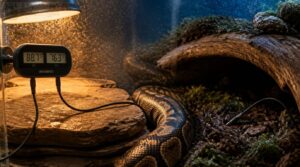
Since one probe never tells the full story, run two: warm zone on the basking surface, cool zone in the shaded hide, spaced 4 inches apart minimum.
- Confirms a real gradient, not guesswork
- Flags sensor drift early
- Tracks daily swings via logging
- Protects your snake’s thermoregulation
Diverging readings beyond normal margins mean check placement immediately.
Arboreal Multi-level Readings

Tree-dwelling species live in layers, so one probe misses most of the story. Run a three-level setup: canopy, mid-level, ground.
Canopy often reads 2-6°F warmer. Space probes 6-12 inches apart for vertical temperature profiling, mix sensor types for cross-validation, and check readings during light cycle shifts to catch enclosure drift before it harms your snake.
How to Read Thermometer Displays Correctly
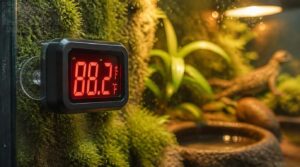
A good thermometer is only as useful as your ability to read it right. Placement gets your probe where it needs to be, but the display still has to earn your trust every time you glance at it. Here’s what to check before you take that number as gospel.
If the digits look faint or erratic, it’s worth comparing notes with a guide to choosing a reliable digital thermometer for home use before assuming your device is broken.
Checking Display Mode and Battery
Glance at the screen before you trust it: display mode verification first, battery second. Confirm Celsius or Fahrenheit matches your target range, check the battery indicator, and watch for low battery warnings.
- Wrong mode = wrong action
- Dead battery = no data
- Stale refresh rate = false confidence
An error code or sluggish display refresh rate means recalibrate before reading again.
Confirming Thermal Equilibrium Accuracy
A number on screen means nothing until the tank settles. Give it 30 to 120 minutes for thermal equilibrium, watching drift drop below 0.1°C per minute for 15 straight minutes.
Run a second digital probe alongside a calibrated reference. Any gap over 1°C means recalibrate — that reading’s a lie, not data.
Reviewing Logged Min and Max Values
Calibration confirmed, now check the MinMax function. This log tracks temperature fluctuation over hours or days, flagging sensor drift and extreme conditions instantly.
Keep logging intervals consistent — sporadic checks skew trend pattern recognition. A rising daily min suggests heater malfunction; a narrowing min-max gap warns of overheating risk before it becomes dangerous.
Low Battery Warning Signs
That min-max log means nothing if the battery’s dying underneath it.
Watch for a battery icon that won’t clear even after fresh batteries, unstable readings under load, and timers firing late or not at all.
Logging retention gets shaky too — data drops after power cycles. Below 3.0 volts, replace the cell. No debate.
Setting The Right Temperature Gradient
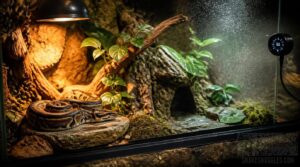
A good thermometer only helps if you know what numbers to aim for. Every zone in your terrarium, from the basking spot to the cool retreat, has its own target range your snake depends on. Here’s how to dial in that gradient correctly.
Basking Zone Target Range
Nail the basking spot and everything else falls into place. Ideal basking range runs 88–110°F depending on species—bearded dragons want 100–110°F, corn snakes 90–95°F, leopard geckos 88–92°F.
Surface Temperature Check matters most: read the actual perch, not nearby air. Keep gradient design consistent, avoid hot spots, and watch basking behavior daily for stress signs.
Cool Retreat Zone Target Range
The basking side gets the glory, but the cool retreat zone is where digestion and shedding actually stabilize. Target 75–85°F, with corn snakes settling near 80°F.
Place your cool hide probe far from the lamp. Humidity here softens surface heat swings, keeping your thermal gradient balanced and honest.
Nighttime Temperature Drop Expectations
Lights off doesn’t mean thermostat off. A 4–8°F nighttime drop mimics natural cycles and keeps thermal gradient stability intact.
Clear, calm nights push drops toward 15°F; humid rooms limit it to single digits. Desert species tolerate 8–12°F swings, tropical species need gentler 2–6°F declines.
Track minimums nightly. Sudden drops beyond species tolerance signal drafts, not weather.
Air Versus Surface Readings
Two thermometers, two truths. Air readings show what your snake breathes; surface readings show what it lies on—and lamps can push these several degrees apart.
Place air probes mid-level, surface probes flat on the basking panel. Expect surface temps 6–12°F warmer during lamp-on hours. Read both together, not separately, to confirm your gradient’s actually working, not just guessed at.
Species-specific Gradient Adjustments
One gradient doesn’t fit every species. Desert species need a steeperate snakes require vertical readings at multiple heights; slender-bodied species do best with shallower steps; venomous species** tolerate tighter margins, since overheating turns dangerous fast. Humidity shifts the math too—moisture-loving species want warmer basking zones paired with damp retreats nearby. Match probe placement to your species’ actual habits, not a generic chart.
Frequently Asked Questions (FAQs)
Where to place a thermometer in a terrarium?
Like scouting camp spots before pitching a tent, probe placement decides everything: warm surface probe on the basking substrate, shaded probe inside the hide, both clear of lamps, mapping true warm and cool zones for gradient stability.
What is the easiest thermometer to use?
Grab a digital probe with an LCD screen and simple button setup. Easy operation, clear display, quick readings within seconds, minimal setup, and a 10 to 140°F range make it the most easy-to-use terrarium tool for beginners.
How to measure temperature in terrarium?
It’s not rocket science: place a digital probe at the basking surface and one in the cool retreat, track the temperature gradient, check humidity percentage, and watch for sensor drift between calibrations.
What temperature should a terrarium be kept at?
Aim for a basking spot of 90-95°F, a cool zone near 72-79°F, and let nights drop 3-8°C. That gradient width lets your snake dial in its own preferred optimum temperature.
How often should I replace terrarium thermometer batteries?
It’s not "when it dies." Battery voltage drops before failure, so watch the battery indicator monthly. Replace every 6-12 months baseline, sooner (4-6 months) with daily checks, continuous logging, or warm tanks accelerating drain.
Can I use a household thermometer for terrariums?
Technically yes, but it’s not built for the job. General household probes miss humidity readings, lack waterproofing, and can’t handle a terrarium’s microclimates, giving you a temperature accuracy problem instead of real thermoregulation data.
How do I calibrate a digital terrarium thermometer?
Sensor drift can turn your digital probe into a bald-faced liar. Use the ice bath method (0°C), boiling point method (100°C), and salt solution verification for humidity, then apply a calibration offset adjustment before rechecking probe placement across your gradient.
What causes inconsistent readings between two placed thermometers?
Two probes rarely agree: airflow variation, substrate heat transfer, humidity sensor impact, and calibration mismatch all skew readings. Probe sensor differences (surface vs. air) and placement in different microclimates explain most gaps between dual thermometer setups.
How much do quality terrarium thermometers typically cost?
Budget 8 to 25 USD for basic single-probe units, 15 to 40 for dual-probe digital models. Hygrometer combos run 12 to Skip anything under 8, that’s a lie, not a reading.
Conclusion
Trust, but verify, that old adage fits every terrarium. A dial gauge might soothe your eyes, but it won’t stop a slow burn on delicate skin.
Reliable terrarium thermometers for beginners aren’t optional gear, they’re the line between a guess and a fact. Place probes correctly, calibrate often, and check readings like your pet’s health depends on it, because it does.
Nail the temperature, and every other part of reptile care gets noticeably easier.