This site is supported by our readers. We may earn a commission, at no cost to you, if you purchase through links.

A forehead thermometer can read a full degree off just because you walked in from a cold porch. Sweat, a ceiling fan, or a few extra inches of distance can do the same. Meanwhile, a $15 sensor taped inside a snake enclosure can quietly tell you the warm side has slipped to 78°F overnight.
The right digital thermometers for home use depend on what you’re measuring: a sick child, a hot pan, or a room that has to stay steady. Accuracy, display, alerts, and upkeep all shift with that purpose.
Here are ten tested options, matched to the job each one does best.
Table Of Contents
- Key Takeaways
- Choose Home Thermometers by Measurement Purpose
- 10 Digital Thermometers for Home Use
- 1. AcuRite Indoor Humidity Temperature Monitor
- 2. TempPro Digital Indoor Thermometer Hygrometer
- 3. SensorPush HT.w Temperature Humidity Sensor
- 4. TempPro TempAir Digital Hygrometer Thermometer
- 5. Govee WiFi Thermometer Hygrometer H5051
- 6. Govee H5100 Hygrometer Thermometer 3 Pack
- 7. La Crosse Technology Wireless Thermometer Black
- 8. Taylor Digital Indoor Comfort Monitor
- 9. Non-Contact Forehead Thermometer
- 10. Non-Contact Digital Thermometer for All Ages
- Compare Digital Thermometer Accuracy and Consistency
- Evaluate Displays, Alerts, and Smart Connectivity
- Position and Use Home Thermometers Correctly
- Compare Thermometer Maintenance and Long-Term Costs
- Frequently Asked Questions (FAQs)
- Conclusion
Key Takeaways
- Pick your thermometer by the job it needs to do, since a room monitor, a surface infrared gun, and a fever thermometer each measure something different and aren’t interchangeable.
- If you’re protecting something like a snake enclosure or a cold cellar, choose a unit with alerts, min/max memory, and app connectivity, because a quiet overnight drop matters more than screen type.
- Forehead and infrared readings can swing with sweat, drafts, and distance, so confirm surprising results with a contact thermometer, and don’t rely on them alone for elderly or immunocompromised family members.
- Placement, cleaning, and battery life decide how much you can trust and afford a thermometer, so mount room sensors on an interior wall at 1.2 to 1.5 meters, wipe probes with 70% alcohol, and check an ice-water test now and then.
Choose Home Thermometers by Measurement Purpose
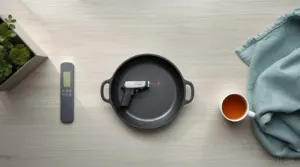
The right thermometer depends on what you’re measuring, and a model that’s great for one job can be a poor fit for another.
If you’re setting up a reptile habitat, this guide to whether a snake tank needs a thermometer explains why reliable temperature readings matter and which features are worth paying for.
Below, you’ll find three common purposes: room and enclosure monitoring, surface spot checks, and human fever readings. Pick the one that matches your need, and the options that follow will be easier to sort through.
Room and Snake Enclosure Monitoring
A reptile’s health depends on a gradient, not a single number, so you need two readings at once. Place one probe on the warm side and one on the cool side, at substrate level. Because reptiles are ectothermic, they rely on external heat sources to regulate body temperature, which is why a proper temperature gradient matters.
Corn snakes need 78-82°F warm and 68-72°F cool. Choose a unit with dual-probe sensors and these three features:
- A night alert for drops below 65°F
- Min/max memory for overnight checks
- Remote display outside the enclosure
Surface Temperature Spot Checks
Probes show air, but a basking spot or heat mat needs a surface reading. A surface thermometer using infrared temperature sensing gives it instantly, no contact required.
Hold it perpendicular, within its 12:1 range.
| Check | Distance | Watch for |
|---|---|---|
| Vent | 6 in. | Dust |
| Wiring | 12 in. | Glare |
Polished metal skews readings, so adjust emissivity first. Check calibration yearly, especially after drops.
Human Fever and Body Temperature
Surfaces are one thing, but a person is another. For human fever detection, a non-contact forehead thermometer is quick, though it reads skin, not internal temperature. Fever starts at 100.4°F (38°C).
- Look for clinical accuracy standards of ±0.2°F
- Hold it steady and perpendicular.
- Avoid drafts, sweat, and movement.
Elderly or immunocompromised relatives may show a weaker fever, so trust symptoms too.
10 Digital Thermometers for Home Use
The ten models below cover the two jobs most homes need a thermometer for: tracking room and enclosure conditions and checking a person’s temperature.
Each one gets a quick look at what it does well and where it falls short, so you can match a pick to your own use.
Start with the first entry and work down until one fits your setup.
1. AcuRite Indoor Humidity Temperature Monitor
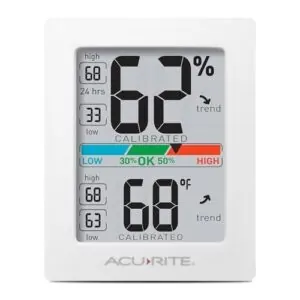
Picture a baby nursery where the room feels fine to you, but the crib sits near a drafty window. A small monitor on the dresser tells you the truth in seconds, without guessing.
This one reads temperature within ±0.5°F and humidity within ±2% between 10% and 90%. A comfort scale flags low, OK, or high levels, and the display refreshes every 10 seconds. You can set it on a table, hang it, or stick it to metal.
Reviews on battery life and durability are mixed, and some users report failure within three months.
| Best For | Anyone who wants a simple, affordable way to keep an eye on temperature and humidity in spaces like nurseries, kitchens, greenhouses, or wine cellars, or around items like cigars, guitars, and plants. |
|---|---|
| Temperature Accuracy | ±0.5°F |
| Humidity Measurement | Yes, ±2% RH (10%-90%) |
| Power Source | N/A |
| Unit Switching | N/A |
| Refresh Rate | Every 10 seconds |
| Weight | 0.27 grams |
| Additional Features |
|
- Reads temperature within ±0.5°F and humidity within ±2% RH between 10% and 90%
- Comfort meter shows at a glance whether humidity is low, OK, or high, and the display updates every 10 seconds
- Works on a tabletop, on a wall, or on a magnet, and can be self-calibrated for places like sheds or pool rooms
- Customer feedback on battery life and durability is mixed
- Some users report the device failing within three months
- Accuracy drops to ±4% RH at the extremes (0%-9% and 91%-99% RH)
2. TempPro Digital Indoor Thermometer Hygrometer
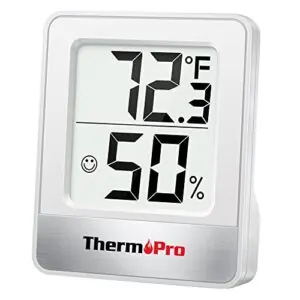
A small white monitor like this one fits almost anywhere, measuring just 0.7 inches wide and 2.6 inches tall and weighing 35 grams. Its face icon shows DRY, COMFORT, or WET conditions, so you can read the room at a glance.
Most beginner-friendly thermometers cost between $8 and $25, with the best reliability usually landing around $12 to $18.
It refreshes every 10 seconds. Accuracy is ±1°F/°C for temperature and ±2–3% for humidity, which suits nurseries, grow tents, kitchens, offices, and cellars. Keep it indoors only.
There’s no app or wireless link, and no battery details are listed, so check the packaging before you buy.
| Best For | Parents, plant growers, and anyone who wants a small, simple monitor to check temperature and humidity at a glance in indoor spaces like nurseries, grow tents, kitchens, offices, or cellars. |
|---|---|
| Temperature Accuracy | ±1°F/°C |
| Humidity Measurement | Yes, ±2–3% RH |
| Power Source | N/A |
| Unit Switching | N/A |
| Refresh Rate | Every 10 seconds |
| Weight | 35 g |
| Additional Features |
|
- The face icon shows DRY, COMFORT, or WET conditions, so you can read the room at a glance.
- Its compact size (0.7" W x 2.6" H) and light weight (35 g) let it fit almost anywhere.
- It updates every 10 seconds, with accuracy of ±1°F/°C for temperature and ±2–3% RH for humidity.
- It is designed for indoor use only.
- It has no wireless connectivity or app integration.
- No battery type or lifespan information is provided.
3. SensorPush HT.w Temperature Humidity Sensor
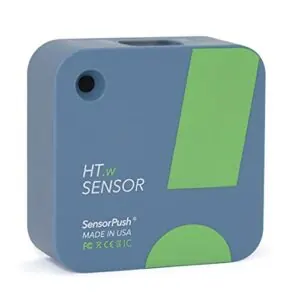
Sensors this light, at just 23 g, tuck into freezers, greenhouses, wine cellars, and reptile terrariums without fuss. This one tracks temperature, humidity, heat index, dew point, and VPD, and its water-resistant body works indoors or outdoors.
It logs 45 days of data on board, with unlimited storage in the app, and Bluetooth reaches up to 100 m in line of sight. Remote access needs the G2 WiFi Gateway, sold separately.
Expect 1 to 2 years from the battery.
| Best For | Anyone who wants to keep an eye on temperature and humidity in freezers, greenhouses, wine cellars, or reptile terrariums and is happy to add a separate gateway if they need remote access. |
|---|---|
| Temperature Accuracy | N/A |
| Humidity Measurement | Yes |
| Power Source | Battery, 1-2 year life |
| Unit Switching | N/A |
| Refresh Rate | N/A |
| Weight | 23 g |
| Additional Features |
|
- Tracks temperature, humidity, heat index, dew point, and VPD in a 23 g, water-resistant body that works indoors or outdoors
- Stores 45 days of data on board, with unlimited storage in the app
- Bluetooth reaches up to 100 m in line of sight, and the battery typically lasts 1 to 2 years
- Some customers report Bluetooth connection issues
- Reviews on battery life and value for money are mixed
- Remote access and cloud storage need the G2 WiFi Gateway, which is sold separately
4. TempPro TempAir Digital Hygrometer Thermometer
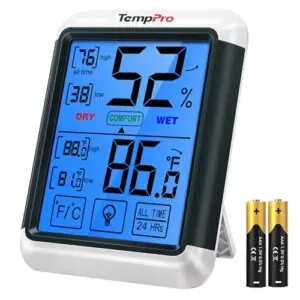
Picture a plant room where the heat mat kicks on at night and the air gets stuffy by morning. You’d want a quick glance, not a login screen. That’s where this unit fits.
The 4-inch display shows bold digits you can read from across the room, and the front-touching buttons let you change settings without lifting it off the wall. It tracks max and min readings for 24 hours and all time.
Accuracy is ±1°F and ±2% RH, updating every 10 seconds. It has no Wi-Fi or app, and it’s for indoor use only.
| Best For | Plant growers and homeowners who want a simple, wall-mounted gauge to check indoor temperature and humidity at a glance, without apps or Wi-Fi. |
|---|---|
| Temperature Accuracy | ±1°F |
| Humidity Measurement | Yes, ±2% RH |
| Power Source | Batteries included |
| Unit Switching | °F/°C |
| Refresh Rate | 10 seconds |
| Weight | N/A |
| Additional Features |
|
- Large 4-inch display with bold digits that are easy to read from across the room
- Front-touching buttons let you change settings without taking the unit off the wall
- Tracks max and min temperature and humidity for 24 hours and all time
- No Wi-Fi, smart connectivity, or app integration
- No data logging export, so readings can’t be saved or reviewed elsewhere
- Limited to indoor use only
5. Govee WiFi Thermometer Hygrometer H5051
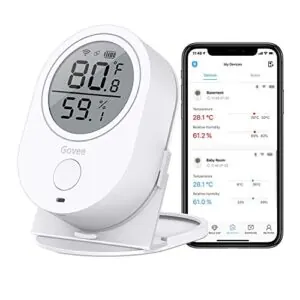
Say you’re growing orchids in a spare room and need to know the second humidity dips or the temperature climbs while you’re away at work. That’s where this one earns its place.
It connects to 2.4GHz WiFi or Bluetooth, shows temperature and humidity on its LCD, and sends app alerts when readings cross thresholds you set. Accuracy is ±0.54°F for temperature and ±3% for humidity. It stores over two years of data you can export as CSV.
It can’t join 5GHz networks, and some owners report battery and WiFi stability problems.
| Best For | Hobbyists and growers, such as greenhouse or wine cellar owners, who want to remotely monitor temperature and humidity and get app alerts when readings drift out of range. |
|---|---|
| Temperature Accuracy | ±0.54°F (±0.3°C) |
| Humidity Measurement | Yes, ±3% RH |
| Power Source | N/A |
| Unit Switching | N/A |
| Refresh Rate | N/A |
| Weight | N/A |
| Additional Features |
|
- Connects over 2.4GHz WiFi or Bluetooth and sends app alerts when readings pass your preset thresholds
- Shows temperature and humidity on its LCD, with ±0.54°F temperature accuracy and ±3% humidity accuracy
- Stores over two years of data that you can export as CSV
- Doesn’t support 5GHz WiFi networks
- Owners report mixed results on battery life and WiFi connection stability
- User feedback on measurement accuracy and value for money is mixed
6. Govee H5100 Hygrometer Thermometer 3 Pack
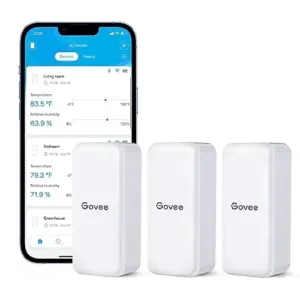
Need eyes on several small spaces at once? This three-pack covers that.
Each compact sensor, just 0.95" wide and 2.21" tall, uses Swiss-made parts rated ±0.54°F and ±3% humidity, and it reads from -4°F to 140°F.
Bluetooth sends readings to the Govee Home app, where you can set preset alerts, view curve graphs, and export two years of CSV data. Add the H5151 Hub for Wi-Fi reach.
Reliability is the catch. Users report short battery life and failures within weeks.
| Best For | People who want to keep an eye on temperature and humidity in several small spaces at once and are fine with a budget sensor that may need frequent battery changes. |
|---|---|
| Temperature Accuracy | ±0.54°F |
| Humidity Measurement | Yes, ±3% RH (0%-99%) |
| Power Source | N/A |
| Unit Switching | N/A |
| Refresh Rate | N/A |
| Weight | 0.04 kg |
| Additional Features |
|
- Swiss-made sensors with ±0.54°F temperature accuracy and ±3%RH humidity accuracy
- Govee Home app offers preset alerts, curve graphs, and 2-year data export via CSV
- Compact size (0.95" W x 2.21" H) and a wide range of -4°F to 140°F for indoor and outdoor use
- Battery life reportedly lasts only a few months
- Some users report Bluetooth and Wi-Fi connectivity issues
- Some units have reportedly failed within weeks of purchase
7. La Crosse Technology Wireless Thermometer Black
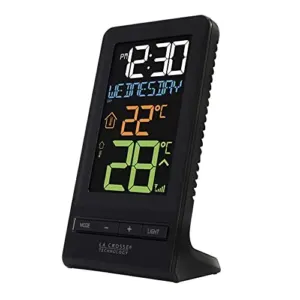
Want to know what’s happening outside without bundling up to check? This wireless model puts an outdoor reading on your indoor display, in either °F or °C.
The color LCD has an adjustable backlight (HI/LO/OFF), and it tracks daily highs, lows, and trends for indoor temperature too. Power it with four AA batteries or the included 5.0V AC adapter.
Be realistic about the limits. Outdoor readings may run 7-9°F high, the sensor’s battery may drain quickly, and the screen can glare in dark rooms.
| Best For | People who want to check outdoor temperature from inside their home and are fine with a basic display that may need some calibration in their head. |
|---|---|
| Temperature Accuracy | N/A |
| Humidity Measurement | N/A |
| Power Source | 4 AA or AC adapter |
| Unit Switching | °F/°C |
| Refresh Rate | N/A |
| Weight | 7.2 ounces |
| Additional Features |
|
- Wireless outdoor sensor shows temperature on your indoor display in °F or °C
- Tracks daily highs, lows, and trends for indoor temperature
- Runs on 4 AA batteries or the included 5.0V AC adapter
- Outdoor readings may run 7-9°F higher than the actual temperature
- Outdoor sensor battery may drain quickly
- Screen can look too bright in dark rooms, even on the lower backlight setting
8. Taylor Digital Indoor Comfort Monitor
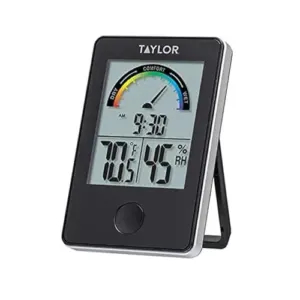
If your main concern is indoor conditions rather than the outdoors, this one keeps things simple. A five-level color comfort indicator shows at a glance whether humidity and temperature are in a good range, readable from across the room.
It covers 14°F to 122°F and 20% to 90% RH, with a clock and min/max memory recall for daily swings. At 2.36" by 3.54" and 2.4 ounces, it suits nurseries and offices.
Know the trade-offs: no backlight, some users report accuracy gaps, and it runs small.
| Best For | People who want a simple, easy-to-read monitor for the temperature and humidity inside their home, office, or nursery. |
|---|---|
| Temperature Accuracy | N/A |
| Humidity Measurement | Yes, 20%-90% RH |
| Power Source | N/A |
| Unit Switching | N/A |
| Refresh Rate | N/A |
| Weight | 2.4 ounces |
| Additional Features |
|
- A five-level color comfort indicator shows at a glance whether conditions are in a good range, even from across the room
- Min/max memory recall tracks the day’s temperature and humidity swings
- Built-in clock with a 12/24-hour display option
- No backlight, so it’s hard to read in low light
- Some users report accuracy discrepancies in temperature and humidity readings
- The compact size (2.36" x 3.54") may be smaller than some users expect
9. Non-Contact Forehead Thermometer
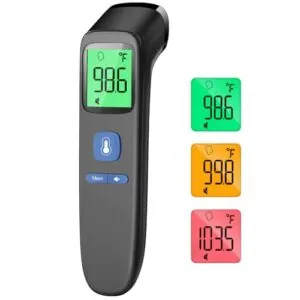
Moving from room readings to people, this ANMEATE model is built for forehead checks only. It gives a reading in 1 second, which helps when a child won’t sit still.
A three-color backlight (green, yellow, red) flags a fever at a glance, and mute mode keeps a sleeping baby undisturbed. It stores 35 readings, switches between ℉ and ℃, and runs on two included AAA batteries.
Keep expectations realistic. Users report mixed accuracy feedback and some inconsistent readings, so repeat the check if a number surprises you.
| Best For | Parents and caregivers who want a fast, quiet forehead thermometer for checking on kids and sleeping babies, and who don’t mind repeating a reading when a number looks off. |
|---|---|
| Temperature Accuracy | N/A |
| Humidity Measurement | N/A |
| Power Source | 2 AAA included |
| Unit Switching | ℉/℃ |
| Refresh Rate | 1 second |
| Weight | N/A |
| Additional Features |
|
- Gives a reading in 1 second, which helps with children who won’t sit still
- Three-color backlight (green, yellow, red) flags a fever at a glance, and mute mode keeps a sleeping baby undisturbed
- Stores 35 readings, switches between ℉ and ℃, and comes with two AAA batteries included
- Users report mixed feedback on accuracy
- Some users see inconsistent readings, so you may need to repeat the check
- Works on the forehead only, so it can’t be used for other types of measurement
10. Non-Contact Digital Thermometer for All Ages
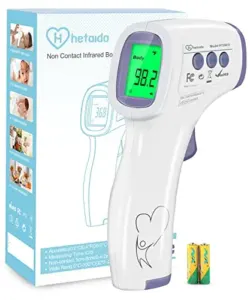
This one covers a wider range of jobs than the last. It reads a person’s temperature from 2 to 3.15 inches away in about 1 second, and it’s made for babies, kids, adults, and elders alike. You can also point it at a room, an object, or a liquid, which makes it handy for a warm bottle.
It runs on two included AAA batteries, switches between °F and °C, and uses a three-color backlight with a fever alarm. Accuracy is ±0.2℃, though some users report inconsistent readings. A 12-month replacement or refund warranty helps.
| Best For | Families with babies, kids, or elders who want a quick no-contact thermometer that can also check room, object, and liquid temperatures, such as a warm bottle. |
|---|---|
| Temperature Accuracy | ±0.2℃ |
| Humidity Measurement | N/A |
| Power Source | 2 AAA included |
| Unit Switching | °F/°C |
| Refresh Rate | 1 second |
| Weight | N/A |
| Additional Features |
|
- Reads temperature in about 1 second from 2 to 3.15 inches away, with ±0.2℃ stated accuracy
- Has a three-color backlight with a fever alarm, switches between °F and °C, and runs on two included AAA batteries
- Comes with a 12-month replacement or refund warranty
- Some users report inconsistent accuracy readings
- Feedback on battery life is mixed
- Feedback on value for money is mixed
Compare Digital Thermometer Accuracy and Consistency

Once you’ve picked a model, the next question is how far you can trust its numbers. Specs vary more than you’d expect.
Quality contact thermometers hold an accuracy range of about ±0.2°F when tested between 98°F and 102°F. Typical home units claim ±0.4°F, and industrial-style sensors often sit near ±0.5°F. That gap matters when you’re judging a low fever, but it’s irrelevant for a living room.
Site and method shift results too. Oral readings average 98.6°F, rectal runs 0.5 to 1°F higher, and axillary runs lower. Infrared forehead scans swing with sweat, drafts, and distance, so confirm surprising results with a contact probe. If you’re new to all this, a quick ice water test can reveal whether your thermometer has drifted, and this beginner-friendly digital thermometer comparison walks through how to run it.
For measurement consistency, digital contact models win. Keep sensors clean, since neglect causes drift, and remember home units can’t be recalibrated.
Evaluate Displays, Alerts, and Smart Connectivity

Displays decide how often you’ll actually check a reading. A backlit display helps in a dim nursery, basement, or reptile room, but it drains batteries faster. E-ink screens like the one on the Govee H5103 sip power and stay readable in sunlight, though you’ll need a lamp at night.
Alerts matter more than screen type if you’re protecting something. App-connected digital models such as Govee and SensorPush send a push notification when temperature or humidity crosses your limit, which suits a snake enclosure or a cold cellar. Some units also beep on the device itself.
Check the range before you buy. Bluetooth connectivity usually reaches 164 to 328 feet, while WiFi lets you monitor from anywhere. Data logging, up to two years free on some Govee models, helps you spot slow trends.
Position and Use Home Thermometers Correctly
Mount your room thermometer at 1.2 to 1.5 meters on an interior wall, where it’s away from the cold air near the floor and the warm layer near the ceiling. Keep it clear of sunlight, vents, radiators, appliances, and drafts from windows or doors, since any of them can skew the reading. If your readings still seem off after relocating the device, common causes of inaccurate hygrometer readings include heat sources, drafts, and sensor drift, and it can take a while to stabilize.
For body readings, small habits decide accuracy:
- Oral temperature: Clean the tip, rest it in the pocket under your tongue, and keep your mouth closed until the beep.
- Wait 5 minutes after hot or cold drinks.
- Forehead models: Hold the device 2 to 3 cm away, over clear skin.
- Ear models: Pull the ear back and out, and check for wax.
Axillary temperature works as a quick first check, but follow up if the number worries you.
Compare Thermometer Maintenance and Long-Term Costs
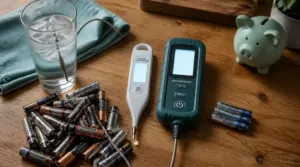
A thermometer that costs $12 can end up costing more than one priced at $30. The difference usually shows up after the box is open.
Batteries are the biggest recurring expense. A unit that burns through four AA cells in 40 hours means about 100 batteries a year, roughly $90. A model rated for 500 hours on three cells needs only six, around $5.40. Check the rated battery life before you buy, and favor auto shut-off.
A cheap thermometer that devours batteries can quietly cost you far more over a year than a pricier one that sips power
Calibration matters less than you’d think. Home units rarely allow it, so replace one that drifts. An ice-water check costs nothing and catches errors around ±1°C.
Sturdy, water-resistant builds often last three to five years, so wipe them after use and keep them dry.
Frequently Asked Questions (FAQs)
Can you use one thermometer on multiple family members?
Picture a thermometer passed from a feverish toddler to a sibling and then to you, carrying whatever the first mouth left behind. Yes, you can share one, but only with care.
Wipe contact probes with a 70% alcohol swab after every use, and let them dry. A non-contact forehead model skips the problem entirely.
How do you properly clean a thermometer between uses?
Why risk passing germs around when cleaning takes under a minute? Wipe the probe tip with 70% isopropyl alcohol, covering it fully, then let it air dry. Use soap and water first for oral or rectal probes.
Should you take temperature before or after activity?
Your body is like a car engine after a drive: hot and not telling the truth. Take your temperature reading before activity, or wait an hour after heavy exercise and 30 minutes after light movement.
Do ear thermometers need replacement lens filters?
Yes, they do. A fresh lens filter keeps earwax off the sensor window, which protects accuracy and stops germs from passing between users. Braun models won’t work without one, so swap it out before every reading.
Conclusion
Check the purpose first, the specs second, and the price last.
The best digital thermometers for home use aren’t the priciest ones. They’re the ones built for your job, placed correctly, and trusted only within their limits.
A steady room sensor, a quick surface check, and a fever reading each ask for something different. Pick one that fits, keep the battery fresh, and recheck odd numbers twice. Then rest easy, a trusted number protects everyone.