This site is supported by our readers. We may earn a commission, at no cost to you, if you purchase through links.
Your snake’s eyes turn milky blue, its skin dulls to gray, and it vanishes into its hide for days. Don’t panic—this is snake blue phase, a natural biological process, not illness. Beneath that clouded spectacle, ecdysial fluid pools between old and new skin, scattering light and blurring vision temporarily.
That blindness explains the hiding, the defensive strikes, the sudden reliance on heat-sensing pits over sight. Vision drops sharply during this stage, so your snake navigates by touch and chemical cues instead.
Understanding this phase—its timeline, its signs, its habitat demands—means the difference between calm confidence and needless worry when the blue hits.
Table Of Contents
- Key Takeaways
- What is The Snake Blue Phase?
- Signs Your Snake is in Blue
- How Blue Phase Affects Snake Behavior
- Blue Phase Timeline Before Shedding
- Ideal Blue Phase Habitat Conditions
- Feeding and Handling During Blue
- Common Blue Phase Shedding Problems
- When Blue Phase Needs Veterinary Care
- Frequently Asked Questions (FAQs)
- What is the blue phase in snakes?
- How long after the blue phase does a snake shed?
- What are the 5 stages of a snakes life cycle?
- Which smell do snakes hate?
- Can multiple snakes shed at the same time?
- Does blue phase happen more in captivity or wild?
- Can stress trigger an early or unexpected shed?
- Do all snake species go through a blue phase?
- Is it normal for sheds to come in one piece?
- Conclusion
Key Takeaways
- Blue phase is a normal part of shedding, not illness—fluid builds up between old and new skin, temporarily clouding your snake’s eyes and dulling its color for about 9 to 14 days.
- Vision drops to nearly zero during this stage, so your snake relies on heat-sensing pits and tongue-flicking instead of sight, and often hides, strikes defensively, or refuses food as a result.
- Keeping humidity between 60-80% and temperatures stable (86-90°F warm side, 72-78°F cool side) is key to a clean shed and helps prevent problems like retained eye caps or patchy sheds.
- Skip handling and feeding until your snake’s eyes clear, and call a vet if blue phase drags past 10 days or you notice open-mouth breathing, sunken eyes, or multiple retained eye caps.
What is The Snake Blue Phase?
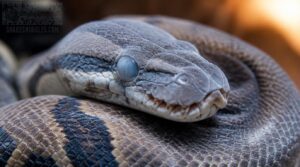
Your snake’s cloudy eyes and faded skin aren’t random—they’re part of a precise biological process. Understanding what’s actually happening beneath the surface changes how you respond to it. Here’s what defines the blue phase, piece by piece.
This same fluid buildup also explains the timing of a healthy shed cycle, which you can explore further in this guide on how often snakes should shed for optimal skin health.
Definition of The Blue Phase
A milky-eyed snake isn’t sick — it’s molting. Blue Phase is a physiological checkpoint: fluid layer formation between old and new skin causing ocular fluid accumulation and skin opacity.
This triggers:
- Epidermal separation process
- Skin regeneration function
- Parasite removal mechanism
- Milky blue eyes as vision is reduced
Don’t second-guess these signs — they’re normal prep for shedding, not distress.
Blue phases exhibit temperature-dependent Bragg reflections in the visible spectrum due to periodic defect arrangements. Temperature and Phase Dependencies
Fluid Separating Skin Layers
So how does that fluid actually get between the layers? It comes down to skin architecture.
The stratum corneum barrier holds lipid-rich lamellae up top, while keratinocyte lipid regulation below controls water movement.
Intercellular lipid bilayers gate the flow, and dermal fluid diffusion pushes hydration outward — epidermal hydration control decides how much separating fluid actually builds.
Purpose Before Ecdysis
That lipid diffusion doesn’t happen for no reason: it’s the engine behind the molting preparation stage.
Ecdysial fluid buildup drives three things at once:
- Skin regeneration — fresh epidermis forms underneath
- Parasite removal — mites and bacteria lift away with the old layer
- Growth without scaling — snakes expand without adding new scales
Every blue phase you’ll witness fulfills this epidermal separation phase.
Why Eyes Appear Blue
So why blue, specifically? It’s spectacle fluid mimicking iris optics — separation fluid scatters short wavelengths like Rayleigh scattering in the sky, while low stromal melanin (a genetic trait in true blue-eyed irises) lets that scattering dominate.
During blue phase, the spectacle itself turns milky, not the eye’s pigment — a temporary optical effect, not a permanent color shift.
Temporary Vision Impairment
Can your snake even see right now? Barely. Spectacle fluid scatters light so heavily that sight drops to near zero — nothing like human transient blindness from vascular disruption or migraine aura, just mechanical blockage.
Expect:
- Blurred, shadowy vision
- Startle-prone reactions
- Heavy reliance on heat-sensing
- Increased tongue-flicking
Clear phase restores sight before eye cap shedding completes the cycle.
Signs Your Snake is in Blue
Blue phase doesn’t announce itself with one single change—it shows up as a cluster of clues across your snake’s eyes, skin, and behavior. Some signs are obvious at a glance, others need a closer look to catch. Here’s exactly what to watch for.
Milky Blue-Gray Eyes
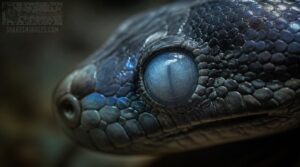
That milky haze isn’t the eye itself clouding over — it’s fluid pooling beneath the spectacle. Melanin distribution and iris fiber depth still shape the base tone, but light scattering washes it into gray. Bright rooms bring out blue; dim corners emphasize gray.
Either way, vision impairment is real: don’t second-guess these signs, or handle a snake that can’t see you coming.
Dull, Faded Skin
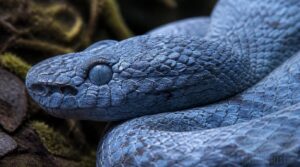
Run a finger along your snake’s back during blue phase, and you’ll notice it right away: the sheen is gone. Scales turn matte and gritty, almost sandpaper-like, as surface moisture drops and pigment movement slows.
Watch for these shifts:
- Grayish, washed-out color
- Rough, uneven scale texture
- Patchy brightness across the body
This dullness reverses once shedding completes.
Pinkish Belly Color
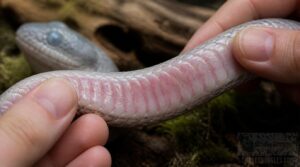
Flip your snake gently and check the belly: a faint rosy blush often shows up against the pale ventral scales. This comes from blood vessels sitting closer to the skin’s surface, a normal ventral color mechanism during blue phase, not illness.
Handling briefly intensifies it, since blood flow influence rises with activity. Track it alongside milky blue eyes as a husbandry observation cue.
Rough Scales and Wrinkles
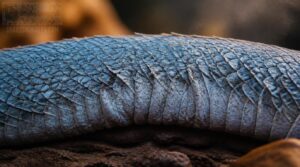
Run your fingers along the body: that sandpaper feel isn’t your imagination. Loosening scales and epidermal separation drive this skin texture shift, worsened by low humidity.
- Faded luster where light once caught the scales
- Fine ridges tracing each dorsal row
- A slightly gritty, unfamiliar surface
- Pronounced wrinkling along the midline
- Belly folds that smooth once hydration improves
Humidity control minimizes excess roughness, keeping wrinkles manageable before shedding.
Reduced Appetite and Activity
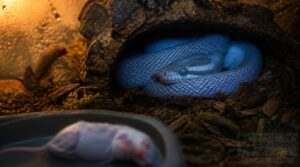
Skipping meals isn’t stubbornness — it’s biology. Appetite drop pairs with metabolic slowdown as your snake conserves energy for shedding, not digestion.
Expect a roughly 50% dip in activity, more hiding behavior, and less interest in food entirely. This is energy conservation at work, tied to temporary vision impairment. Feeding resumption follows once blue clears, so don’t panic over a skipped meal or two.
How Blue Phase Affects Snake Behavior
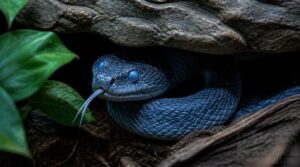
A snake that can’t see clearly doesn’t just sit still and wait it out: its whole behavior shifts. Instinct takes over, and you’ll notice patterns that look nothing like its usual confident self. Here’s what to expect during those blind, vulnerable days.
Increased Hiding and Seclusion
Ever notice your snake vanish for days? Blindness breeds caution — snakes lean hard into their hiding instinct, tucking into rock stacks or PVC hides rather than risking open ground. This isn’t laziness; it’s survival math.
Reduced movement activity follows naturally, with over 80% of the day spent secluded. Keep hides plentiful, quiet, and undisturbed — crowding or noise triggers deeper withdrawal.
Defensive Striking or Musking
Cornered snakes don’t stay passive. When approached during blue phase, defensive behavior escalates fast — striking or musking to halt an attack before it lands.
Watch for:
- Defensive stance alignment with a compact guard
- Block redirection absorbing impact, dissipating energy
- Musking as chemical deterrent
This isn’t aggression — it’s stress from blindness. Skip handling entirely; maintain safe distance until eyes clear.
Wall-Hugging Movement
Once striking fades, watchfulness shifts to how your snake actually moves. Blind or not, it hugs enclosure walls, following every contour closely. This isn’t clumsiness — surface contact mechanics keep a low center of gravity, while ventral scale grip prevents slipping. Reduced air resistance near walls aids orientation during vision impairment. Skip handling; let this instinctive navigation continue undisturbed.
More Frequent Tongue Flicking
Watch the tongue now — it’s working overtime. With eyesight fading, your snake leans hard on chemical cue sampling, flicking rapidly to build a scent map of its enclosure. Humidity shifts alter how molecules travel, prompting more frequent touches.
This sensory compensation isn’t random; it’s environmental exploration filling the gap vision left behind, and a useful health indicator worth watching.
Reliance on Heat Sensing
Since eyes go milky, pit organs take over as primary navigation tools. Infrared sensing reliance spikes—your snake tracks warm targets by thermal contrast alone, detecting differences as fine as 0.01°C.
- Heat seeking behavior increases near warm zones
- Thermal prey detection sharpens despite blindness
- Warm target tracking replaces visual hunting
- Thermal gradient awareness guides movement
- Sensory compensation helps safe navigation
This behavioral adaptation keeps your snake capable, not helpless.
Blue Phase Timeline Before Shedding
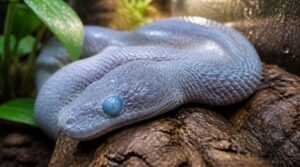
Shedding isn’t a single event—it’s a sequence, and knowing where your snake sits in that sequence tells you what to expect next. Timing varies more than most keepers realize, from the first pink belly to the final papery shed left behind in the enclosure. Here’s how that timeline actually breaks down, stage by stage.
Early Pre-Blue Signs
The blue phase doesn’t arrive overnight: subtle scale dulling and early eye haze creep in first. Appetite decline and a slight belly color shift often show up days earlier, alongside reduced tongue flicking.
Your snake’s skin looks dull and faded, and increased hiding paired with mild defensive behavior signals the real transformation is close behind.
Typical Blue Phase Duration
Nine to fourteen days covers most cases, though factors affecting duration vary widely.
Younger snakes often clear in 7–10 days; adults stretch to 5–14. Humidity 70–80% and stable temperature speed things along, while nutritional status beforehand matters too.
Dry, stressful setups risk a prolonged blue phase—up to 18 days, with vision impairment lingering the whole stretch.
The Clear Phase
Here’s the tell: eyes and skin shift from milky to translucent, signaling skin transparency onset is complete. Scale texture softens from sandpaper-rough back toward smooth, and eye color clears from blue-gray toward near-normal.
Activity level drop reverses slightly, though your snake still favors hiding. Humidity importance doesn’t fade here—keep it at 70–80% until the actual skin shedding process begins.
Time Until Final Shed
Counting down from that first cloudy glance, expect the final shed 1 to 14 days out, with most healthy snakes clearing within 4–10 days. Stable warmth, humidity 70–80%, and species patience matter here.
Clear phase onset—eyes and skin regaining transparency—usually precedes actual shedding by 1–3 days. Rushed conditions delay it; don’t second-guess these signs.
Once you spot those signs, set up a damp moss-filled hide on the cool side, since a humid hide for ball python shedding helps the skin come off in one clean piece.
Species and Age Differences
No two snakes shed on the same clock. Hatchlings and juveniles cycle through blue phase faster—monthly growth spurts demand it—while subadults and adults slow considerably.
Smaller species flash brighter blue; larger ones fade duller with age. Consider:
- Juvenile eye clarity degrades faster
- Adults tolerate stress calmer
- Fast growers shed more often
- Older snakes recover slower
Ideal Blue Phase Habitat Conditions
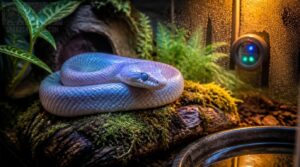
Your snake can’t control the blue phase, but you control the enclosure — and that makes all the difference. Getting the setup right isn’t complicated, it just means hitting a few specific targets at once. Here’s what your habitat needs to have dialed in.
Correct Humidity Range
Sixty percent humidity, give or take: that’s the number separating a clean shed from a stuck one. Keep the enclosure between 60 to 75 percent, with moist hides pushing toward 70-80. Mist once or twice daily; verify with a hygrometer near the hide, not the room.
| Humidity Zone | Target Range |
|---|---|
| Ambient enclosure | 60–70% |
| Moist hide | 70–80% |
| Danger zone | Below 50% |
Stable Temperature Gradient
Humidity keeps the skin pliable, but a stable temperature gradient drives the thermal regulation behind shedding itself.
Warm side 86–90°F, cool side 72–78°F — don’t let it swing during blue phase.
Place heat sources to avoid direct exposure, then monitor with digital thermometers at multiple points.
Species tolerance varies, so insulate walls and check readings morning and night.
Moist Hide Setup
Get temperature dialed in, then give your snake somewhere damp to retreat.
A moist hide, a small opaque tub with a lid, holds damp sphagnum moss on the cool side. Punch small ventilation holes, keep substrate moist (not soaked), and clean every 2–4 weeks.
That setup sustains humidity between 60–90%, exactly what a proper shedding environment demands during blue phase.
Fresh Drinking Water
A shallow, heavy dish next to the shedding box matters as much as that damp moss.
Snakes drink and sometimes soak, so swap water daily and skip distilled — trace minerals support hydration health benefits during fluid shifts. Room-temperature water avoids shock. Basic tap, dechlorinated or filtered, meets safety standards without fuss. Clean bowls prevent bacterial buildup during this vulnerable stretch.
Safe Textured Shedding Surfaces
A rough surface isn’t optional decor — it’s the friction your snake needs to peel loose skin during blue phase. Multi-directional micro-textures (0.5–2mm) prevent snagging.
5 features to check:
- Non-toxic, mold-resistant material
- Shallow ridges, no sharp edges
- Covers 25%+ of floor space
- Weekly wear inspection
- Easy to clean and sanitize
Feeding and Handling During Blue
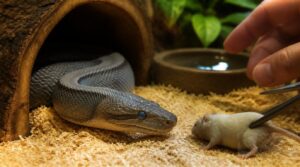
Blue phase doesn’t just change how your snake looks — it changes how you should interact with it. Feeding and handling decisions made this week can either support a smooth shed or complicate one. Here’s what to keep in mind before you reach into the enclosure.
Why Snakes Refuse Food
Why won’t your snake eat during blue? Feeding inhibition during shed is normal biology, not illness. Reduced vision impairs strike accuracy, while digestive slowdown, stress from handling, and hormonal shifts compound appetite decline.
| Trigger | Effect on Feeding |
|---|---|
| Vision loss | Missed strikes |
| Hormonal shift | Suppressed hunger |
| Handling stress | Avoidance behavior |
| Digestive slowdown | Voluntary fasting |
Offering Food Safely
Should you feed at all during blue? Most keepers wait until shedding completes, since feeding inhibition during shed often ends in regurgitation.
If your snake does strike, offer prey 10–15% smaller than usual, pre-warmed in a 10–15 minute water bath, in a smooth-sided container away from hides. Watch 15–30 minutes; remove refusals promptly.
Avoiding Handling Stress
Picking up a blue-phase snake is like asking someone to walk a tightrope blindfolded—technically possible, but needlessly cruel. Skip handling entirely during this stretch.
Handling a blue-phase snake is like walking someone blindfolded across a tightrope—so skip it entirely until vision returns
If contact’s unavoidable, use gentle body support, a calm voice, and keep it under two minutes. Then retreat to a stress-free recovery space. Vision’s near zero; don’t second-guess these signs.
Minimizing Enclosure Disturbance
Think of your snake’s enclosure as a den, not a display case: less traffic, less noise, less stress.
- Keep background sound under 40 decibels
- Skip decor changes during blue phase
- Use a visual barrier at the viewing side
- Time cleaning for the clear phase
- Avoid strong scents near the habitat
Stable humidity and a quiet humidity hide matter more now than your curiosity does.
Safe Post-Shed Handling
The blue phase ends, but your job isn’t quite done: wash your hands before any post-shed handling to avoid transferring oils onto fresh skin. Support the entire body when lifting, and inspect the shed for tears or retained eye caps.
Offer clean water, then minimize handling for several hours—stable humidity matters more than your curiosity does now.
Common Blue Phase Shedding Problems
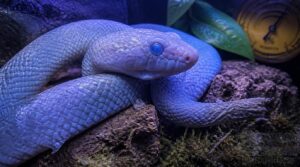
Most blue phase sheds go smoothly, but not all of them do. When something’s off, it usually traces back to one of a handful of husbandry gaps. Here’s what to watch for and why each one matters.
Low Humidity and Dehydration
Dry air is the single biggest saboteur of a clean shed. When humidity drops below 50%, transepidermal water loss spikes, skin turns brittle, and layers fuse instead of separating.
Watch for:
- Flaky, wrinkled scales
- Sluggish, gaping breathing
- Reduced urination
Mist daily, monitor with a hygrometer, and keep water fresh — dehydration compounds fast during blue phase.
Retained Eye Caps
Dehydration doesn’t just crack skin — it can leave the eye caps stuck fast. Below 50% humidity, that thin corneal scale won’t lift cleanly, clouding vision and inviting irritation.
| Cause | Effect |
|---|---|
| Low humidity | Cap adheres |
| Rough substrate | Irritation |
| Handling stress | Delayed shed |
Never pull a stuck cap — moist hides and vet care resolve it safely.
Patchy or Incomplete Sheds
Eye caps aren’t the only casualties of a rough shed — patches of dead skin can cling anywhere on the body.
Low humidity swings, cramped enclosures, and poor substrate texture all worsen friction, leaving skin stuck instead of sliding free. Keep humidity between 60–70%, offer varied textures, and monitor hydration closely. Gentle rehydration soaks and a well-furnished enclosure resolve most patchy shedding complications without stressing your snake.
Prolonged Blue Phase
Sometimes the milky eyes just won’t clear on schedule.
A prolonged blue phase can stretch shedding duration past two weeks, especially in older snakes or unstable enclosures. Keep humidity between 60–70%, watch for lethargy or gaping, and don’t second-guess these signs. Retained eye caps often follow. If it drags past ten days, veterinary consultation is warranted.
When Blue Phase Needs Veterinary Care
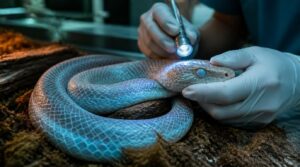
Most blue phases resolve on their own, no vet visit required. But certain signs cross the line from normal to concerning, and don’t second-guess these signs when you spot them. Here’s what should send you to a reptile vet, not just your calendar.
If your snake’s hiding feels off — paired with wheezing, swollen jaw, or unusual lethargy — recognizing when a hiding snake is seriously sick can help you act before a minor issue becomes critical.
Blue Lasting Over Ten Days
Ten days is your cutoff, not a suggestion. Once extended blue phase passes that mark, vision impairment and shedding duration concerns compound — humidity impact on blue skin becomes critical, retained eye caps grow likelier, and incomplete sheds follow.
Watch behavioral shifts in long blue phases: extreme lethargy or refusal to move signals a prolonged shedding delay. Don’t second-guess these signs — call a reptile vet.
Open-Mouth Breathing
Watch the jaw, not just the eyes: gaping or labored mouth breathing during blue phase signals respiratory distress, not routine shedding effort. Healthy snakes breathe through their nostrils.
Open-mouth breathing paired with wheezing or clicking sounds means veterinary intervention is urgent — humidity impact aside, this points to infection or airway compromise requiring immediate reptile vet care.
Sunken Eyes or Wrinkling
A hollow, wrinkled look during blue phase isn’t cosmetic — it’s dehydration, not aging or fat loss. Skin turgor drops fast without moisture.
Check for:
- Sunken orbits
- Loose neck folds
- Dry, tacky scales
- Reduced skin bounce
- Lethargy
Don’t second-guess these signs: raise humidity immediately and offer fresh water. Untreated dehydration worsens shedding problems fast.
Persistent Retained Eye Caps
One retained cap is a nuisance; three or four stacked together is a real threat. Each incomplete shed leaves another layer, trapping debris and raising infection risk with every cycle.
Don’t wait it out. A vet uses magnification for careful eye cap inspection and removal, then prescribes antiseptic drops. Prevent recurrence with strict humidity control and monitor healing closely afterward.
Appetite Loss After Shedding
A snake that skips meals post-shed isn’t broken — it’s recovering. Most resume eating within 1 to 2 weeks; stress-related refusal, dehydration, and shed discomfort all play a role.
- Offer smaller prey sizes
- Keep enclosure disturbances minimal
- Wait for appetite recovery timeline to pass 3 weeks
Beyond that, with ongoing weight loss, don’t second-guess these signs — call your vet.
Frequently Asked Questions (FAQs)
What is the blue phase in snakes?
Ever notice your snake’s eyes turning cloudy the same week its colors fade? That’s no coincidence — it’s fluid separating old skin from new, a natural biological function preparing your snake for shedding, temporarily clouding the eye spectacle and dulling scales.
How long after the blue phase does a snake shed?
Once eyes clear, expect shedding within 1 to 4 days—younger snakes often shed in 1–3 days, adults 3– Humidity, species, and handling all shift this shedding timeline, so don’t second-guess these signs.
What are the 5 stages of a snakes life cycle?
Like chapters in one long book: egg development, hatchling survival, juvenile growth, adult reproduction, and senior aging. Each stage brings new shedding frequency, growth cycles, and blue phase episodes that mark skin regeneration all the way through.
Which smell do snakes hate?
Cinnamon, clove oil, vinegar, garlic, and citrus peels top the list of scents snakes avoid. These overwhelm their chemical sensing organs, but during shedding, added stress from strong odors can trigger unnecessary defensive behavior — best avoided near a shedding enclosure.
Can multiple snakes shed at the same time?
Yes, when housed nearby with matching humidity, temperature, and feeding schedules. This shedding synchrony stems from shared environmental cue alignment, not interaction. Species timing variability still applies, so don’t expect every snake in the room to shed on cue.
Does blue phase happen more in captivity or wild?
Picture two actors on stage: one under studio lights, one battling wind and rain. Captivity’s steady humidity between 60-70% and controlled shedding environment make blue phase more visible than wild reptile care, where harsh conditions mask its true frequency.
Can stress trigger an early or unexpected shed?
Absolutely — handling stress, temperature swings, or poor humidity can push cortisol-like responses that speed up epidermal loosening. This often triggers premature or patchy sheds, cutting the blue phase short and disrupting the normal shedding cycle’s timing.
Do all snake species go through a blue phase?
No — species shedding variation is real. Some display milky blue eyes clearly, others show only a faint gray tint, and morph influence (especially in albinos) can mask the color shift almost entirely during preshedding.
Is it normal for sheds to come in one piece?
A whole shed looks broken, yet it’s the healthiest sign there is: proper skin separation and hydration let the old layer release intact, like prefabricated one-piece delivery—no gaps, no retained eye caps, no incomplete sheds.
Conclusion
Picture your snake shedding its clouded veil, emerging with scales bright as polished glass and eyes sharp and clear again. That transformation is the whole point of snake blue phase explained through biology, not mystery.
Ten to fourteen days of blindness, hiding, and dulled color end in one clean shed. Trust the process, don’t rush the humidity, don’t force a feeding. Your snake isn’t sick. It’s simply becoming new again, one cycle at a time.