This site is supported by our readers. We may earn a commission, at no cost to you, if you purchase through links.

Stick your hygrometer six inches from the heat lamp, and it’ll lie to you every single day. That small oversight skews readings low, tricking you into cranking up humidity while your snake sits in a bone-dry hide. Placement isn’t a minor detail — it’s the difference between data you can trust and numbers that send you chasing ghosts.
Get hygrometer placement snake tank setups wrong, and you risk stuck sheds, retained eyecaps, even respiratory stress from humidity swings you never saw coming.
The fix is simpler than you’d think, once you know where your snake actually spends its time.
Table Of Contents
- Key Takeaways
- Why Hygrometer Placement Matters
- Best Snake Tank Placement Steps
- Adjust Placement by Enclosure Type
- Top 4 Snake Tank Hygrometers
- Maintain Accurate Humidity Readings
- Frequently Asked Questions (FAQs)
- Where to place a hygrometer in a snake tank?
- Where is the best place to put a hygrometer?
- Is 40 humidity too low for ball python?
- Do you put a thermometer in the hide or basking spot?
- What happens if the humidity is too high in a snake tank?
- How do hygrometers affect snake respiratory health?
- Can humidity sensors work with smart home systems?
- What humidity levels suit egg incubation setups?
- How often should hygrometer batteries be replaced?
- Do substrate types change ideal sensor placement?
- Conclusion
Key Takeaways
- Position your hygrometer at your snake’s actual resting height, 2-4 inches above the substrate and away from heat lamps, water bowls, and vents, since nearby heat, moisture, or airflow can skew readings and mask real conditions.
- Different enclosure types need different sensor placement, with terrestrial tanks requiring mid-tank mounting, arboreal setups needing wall‑mounted sensors near perches, and large enclosures needing multiple sensors to track warm, cool, and mid‑height zones.
- Poor humidity readings can lead to real health problems, including stuck sheds, retained eyecaps, and respiratory stress from mold growth or humidity swings that go unnoticed.
- Keeping readings accurate long-term requires ongoing upkeep, including calibrating new sensors with a salt solution, cross‑checking monthly with a second sensor, cleaning gently, replacing batteries every 6‑9 months, and repositioning near the humid hide during shedding.
Why Hygrometer Placement Matters
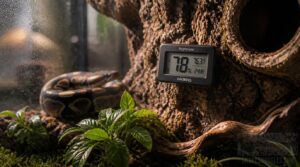
Where you put your hygrometer can make the difference between an accurate reading and a false sense of security. A few inches in the wrong direction, and you’re basing your snake’s care on numbers that don’t reflect reality. Here’s what proper placement actually protects, and why it deserves more thought than most owners give it.
For the most reliable results, place the sensor at mid-level in the enclosure, away from basking spots, following this step-by-step guide to boa constrictor humidity control.
Prevent Misleading Humidity Readings
Where you put your hygrometer decides whether you’re managing real conditions or chasing phantom numbers.
Hygrometer placement determines whether you’re tracking real humidity or simply chasing phantom numbers
Sensor placement bias creeps in fast: tuck it near a vent, and airflow interference skews readings low; rest it on damp substrate and you get localized moisture spikes instead of true air humidity.
Even a well-calibrated humidity sensor gives poor placement bad data—accuracy starts with location, not just the device itself.
Significant placement differences can cause a 2–5% RH variance, which is within normal sensor tolerance according to sensor placement impact guidelines.
Protect Healthy Shedding Cycles
Getting placement right isn’t just about accuracy—it directly protects your snake’s shedding cycle. A stable 60-70% RH near the resting zone keeps skin pliable, supporting skin elasticity hydration and easier removal.
- Prevents retained eyecaps
- Reduces stuck shed
- Helps temperature-humidity interaction
- Signals healthy shedding indicators
Watch substrate moisture management too—damp bedding skews readings while still affecting your reptile enclosure’s actual humidity.
Avoid Respiratory Humidity Risks
Poor placement near stagnant air pockets invites mold spore growth and microbial buildup, both hard on mucous membrane health.
Rapid humidity spikes—say, after a splashy water bowl refill—can irritate airways fast. That’s why humidity monitoring devices belong away from dead-air corners.
Skipping calibration checks lets sensors drift, masking real risk. Good humidity troubleshooting habits catch problems before they become a respiratory infection.
Match Your Snake’s Microclimate
Once air quality is covered, think about where your snake actually lives—desert species like rosy boas thrive in a humidity level of 30-50%, while tropical ball pythons need 70-80% during shedding. Your reptile enclosure microclimate should mirror these species’ humidity needs.
Poor placement flattens vertical moisture gradients, so position sensors where your snake naturally rests for real humidity measurement accuracy.
Best Snake Tank Placement Steps
Now that you know why placement matters, let’s get your hygrometer in the right spot. A few small adjustments can mean the difference between accurate readings and guesswork. Here are five steps to help you place it with confidence.
Place Near Snake Resting Height
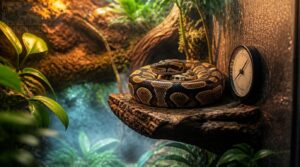
Your snake spends most of its time at one spot, so that’s exactly where your hygrometer belongs. Resting height microclimates matter more than average tank readings, since they reflect real vent humidity and surface moisture tied to shedding cycles.
This spot sits within the enclosure’s thermal gradient, giving you a stable baseline for tracking humidity levels accurately, day after day, without constant guesswork.
Keep Above Damp Substrate
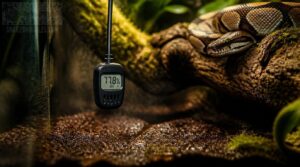
Right above damp substrate, sensors often pick up sensor moisture bias, reading humidity levels far higher than what your snake actually experiences at rest.
Direct contact invites condensation on sensor surface and gradual drift, so hover the probe an inch or two clear of moisture accumulation.
This keeps you measuring ambient zones honestly, not just substrate saturation risks, giving true 30-50% readings instead of skewed spikes from poor placement.
Avoid Heat Lamps
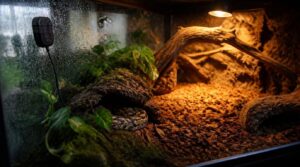
Heat lamps throw off localized heat bias that skews your humidity gauge, making dry air near the bulb read as if it’s within that ideal 30-50% range.
Keep your sensor at least 12 inches from any lamp to dodge thermal interference risks and sensor accuracy drift.
Radiant heat impact turns careful monitoring into guesswork, so poor placement here undermines every reading you take.
Stay Away From Water Bowls
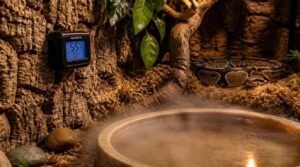
Water evaporating from a bowl creates a tiny humidity bubble that can trick your sensor into reporting humidity spikes that don’t reflect the whole tank.
Keep your hygrometer a few inches away from any bowl:
- Prevents false high readings
- Avoids moisture-related sensor drift
- Reduces bacterial contamination exposure
- Ensures accurate humidity readings
This distance keeps calibration steady and your 30-50% target trustworthy, without bowl-driven humidity fluctuations muddying the picture.
Check Warm and Cool Sides
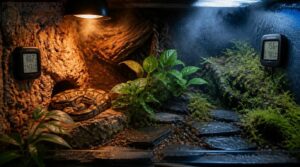
Your snake tank naturally splits into two microclimates, so one hygrometer can’t tell the whole story.
Place a second sensor near the basking area and one on the cooling zone to catch both humidity levels across the thermal gradient. Substrate humidity influence and airflow differ side to side, so cross-checking readings keeps your monitoring schedule honest and your temperature gradient truly stable.
Adjust Placement by Enclosure Type
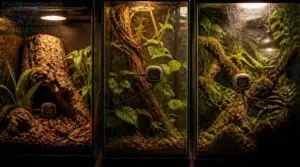
No two snake enclosures are exactly alike, and your hygrometer placement shouldn’t be either. The right spot depends on whether you’re working with a terrestrial setup, an arboreal climber, or something in between. Here’s how to fine-tune placement for each type of tank you might have.
Terrestrial Snake Tanks
Ground-dwelling species need their hygrometer where they actually live: 3–4 inches above the substrate, mid-tank. This spot reflects true relative humidity near the enclosure footprint your snake uses daily, not the drier air rising toward the lid.
Keep the sensor clear of heat mats and water bowls. Since substrate moisture varies by zone, placing it centrally gives the most honest humidity monitoring schedule for daily checks.
Arboreal Snake Setups
Climbing species live vertically, so your hygrometer should too. Attach it to the middle side wall, a few inches above the substrate near a primary perch, securing it with zip ties so climbing branch stability isn’t compromised.
This captures the true arboreal microclimate, not the drier canopy air up top. Aim for that 30–50% baseline (higher for tropical species) as part of your regular humidity monitoring schedule.
Humid Hide Monitoring
Humid hides need their own hygrometer, separate from your main sensor, since readings inside can run several percent higher than ambient air.
Track hide moisture trends weekly:
- Check for condensation buildup
- Verify shedding cycle progress
- Feel substrate dampness
- Watch for mold
- Confirm localized humidity gradients stay stable near resting height
Large Enclosure Gradients
One hide sensor won’t cut it once your tank grows past 4 feet—horizontal gradient zones form between warm and cool ends. Vertical stratification matters too, since warm air rises.
| Zone | Sensor Placement | Watch For |
|---|---|---|
| Warm end | Near basking side | Boundary layer effects |
| Cool end | Opposite wall | Changing gradient shifts |
| Mid-height | Center enclosure | Surface moisture interaction |
Screen Lid Considerations
Screen lids change the humidity math entirely. They boost airflow 60-80% versus solid tops, which helps prevent mold but speeds evaporation near mesh openings.
Place your hygrometer probe away from direct lid gaps, closer to the humid hide, and expect daily fluctuations of 5-15%. Balance ventilation with misting frequency rather than sealing the lid—your snake needs breathable air, not a sauna.
Top 4 Snake Tank Hygrometers
Getting placement right only matters if the hygrometer itself gives you numbers you can trust. Not every model does that job equally well, especially with the ±2-3% accuracy your snake’s health depends on. Here are four options worth considering for your setup.
1. Repti Zoo Digital Terrarium Thermometer
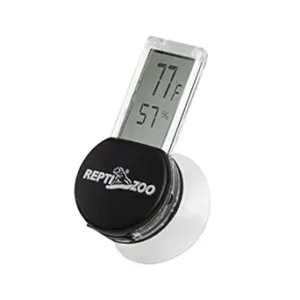
Two readings, one glance — that’s the appeal of the Repti Zoo Digital Terrarium Thermometer. Its large LCD tracks temperature (-10°C to 70°C) and humidity (10-90% RH) together, with min/max memory so you can spot overnight swings without babysitting the tank.
Dual suction cups let you mount it front or side, near your snake’s resting height for accurate readings.
One caveat: the manufacturer doesn’t specify exact accuracy tolerances, so pair it with periodic manual checks for peace of mind.
| Best For | Reptile, amphibian, and insect keepers who want a simple way to monitor both temperature and humidity in their vivarium at a glance. |
|---|---|
| Display Type | LCD |
| Mounting Method | Suction Cup |
| Power Source | 2 AA Batteries |
| Measures | Temp & Humidity |
| Housing Material | Glass/Plastic |
| Primary Use | Vivarium Monitoring |
| Additional Features |
|
- Displays temperature and humidity together on one easy-to-read LCD screen
- Dual-position suction cups allow flexible mounting on front or side glass
- Comes with a spare AA battery for over a year of standby use
- Manufacturer doesn’t specify exact temperature and humidity measurement ranges
- LCD screen can be harder to read in direct sunlight or bright ambient light
- Suction cup grip may weaken on dirty, textured, or curved glass surfaces
2. Repti Zoo Dual Thermometer Hygrometer
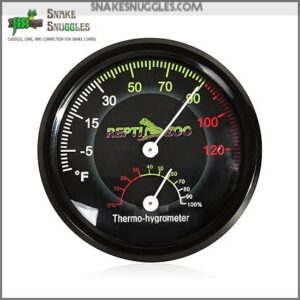
Suction-cup mounting makes the Repti Zoo Dual Thermometer Hygrometer easy to reposition as your snake’s needs shift. It reads 0-100% RH and roughly -5°F to 120°F, with ±5% humidity accuracy — a bit looser than dedicated hygrometers, so use it for general trends rather than precise shedding decisions.
The digital LCD updates within seconds, and color-coded segments help you spot problems at a glance. Splash-resistant sensors handle typical enclosure moisture fine, though you’ll want to keep it off wet substrate for accurate readings.
| Best For | This gauge is best for reptile and amphibian keepers who want a simple, no-fuss way to keep an eye on temperature and humidity in terrariums, vivariums, hatchers, brooders, or propagators. |
|---|---|
| Display Type | Dual Gauge |
| Mounting Method | Adhesive |
| Power Source | Battery-Free |
| Measures | Temp & Humidity |
| Housing Material | Rigid Plastic |
| Primary Use | Terrarium Monitoring |
| Additional Features |
|
- Battery-free design means no replacements or upkeep required
- Dual gauges let you monitor both temperature and humidity from one unit
- Color-coded segments make it easy to read conditions at a glance
- No published measurement range or accuracy tolerance is provided
- Adhesive backing may lose its grip over time on textured or curved surfaces
- Plastic housing isn’t as durable or impact-resistant as metal alternatives
3. Repti Zoo Digital Thermometer Hygrometer
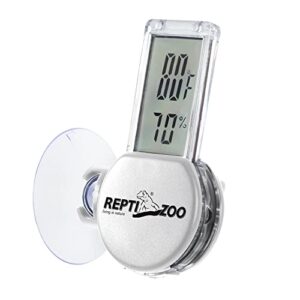
A no-frills option, this model reads temperature and humidity together on one easy-to-read LCD, updating every five seconds so you’re never guessing about current conditions.
Its suction cup mounts to front or side glass, and the ±5% RH accuracy suits general monitoring rather than fine-tuned shedding prep. Button-cell battery power keeps it lightweight, lasting several months under normal use. Just keep the display away from direct moisture, and check periodically that suction still holds firm.
| Best For | Reptile, amphibian, and terrarium owners who want a simple, reliable way to keep tabs on temperature and humidity without fussing over complicated setup. |
|---|---|
| Display Type | LCD |
| Mounting Method | Suction Cup |
| Power Source | 2 AA Batteries |
| Measures | Temp & Humidity |
| Housing Material | Not Specified |
| Primary Use | Reptile Terrarium |
| Additional Features |
|
- Large backlit LCD makes readings easy to check at a glance, even in low light
- High/low alarm thresholds help catch unsafe conditions before they become a problem
- Flexible mounting with a power suction cup plus dual-mount options for different enclosure setups
- ±2°F and ±5% RH accuracy isn’t tight enough for precision scientific use
- Relies on AA batteries, so performance can dip as they wear down
- Suction cup may not hold well on rough or porous surfaces, requiring a backup mounting option
4. Compact Reptile Thermometer Hygrometer
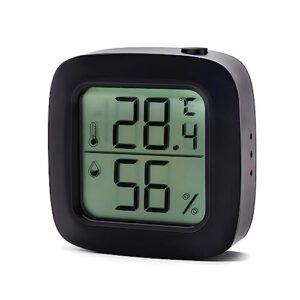
Small enough to tuck into a corner without disturbing decor, this gauge covers -10°C to 50°C and 20-90% RH with suction cups or clips for glass, wood, or plastic walls.
Backlit LCD digits stay readable across the room, and separate sensors track ambient air versus substrate microclimate, so you catch dry pockets before they cause trouble.
One LR44 battery runs it for months, with a low-battery warning that saves you from silent drift. Great for small enclosures needing quick, reliable spot-checks.
| Best For | Reptile and amphibian keepers who want a compact, easy-to-mount gauge for monitoring temperature and humidity in tanks, terrariums, or incubators. |
|---|---|
| Display Type | LCD |
| Mounting Method | Adhesive |
| Power Source | Coin Cell |
| Measures | Temp & Humidity |
| Housing Material | ABS Plastic |
| Primary Use | Reptile/Amphibian Tanks |
| Additional Features |
|
- High accuracy (±0.1°C, ±5% RH) keeps sensitive habitats within safe ranges
- Compact, lightweight design with double-sided adhesive for quick, damage-conscious mounting
- Large LCD display makes readings easy to check at a glance
- Requires a separate coin-cell battery that isn’t included
- Small screen size can be tricky to read in bright ambient light
- Adhesive backing may leave residue or harm delicate glass surfaces upon removal
Maintain Accurate Humidity Readings
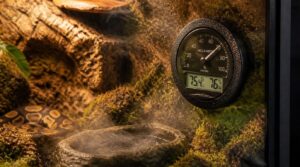
Getting the right hygrometer in the right spot is only half the job. Even the best sensor drifts over time and needs a little upkeep to stay trustworthy. Here’s how to keep your readings accurate, week after week.
Calibrate Before First Use
Calibrate before first use, and you’ll trust every reading that follows. Fresh sensors can drift during manufacturing, so baseline accuracy matters from day one.
Use a salt solution (75% RH) to establish reference values. Power on, wait 20-30 minutes, adjust until readings match, then confirm with a second point.
Document the offset, date, and conditions for future audits and your regular calibration schedule.
Cross-check Monthly Readings
Even a well-calibrated hygrometer can drift over time, which is why monthly cross-checks matter. Pick the same date, same spot, same height each month, and log readings with a second sensor for comparison.
Watch for gradual drift rather than one-off blips. If numbers stray beyond tolerance, recheck within 24 hours and note any environmental shifts alongside your shedding observations.
Clean Sensor Gently
Dust and grime skew readings fast. Wipe your digital hygrometer’s sensor with a soft, lint-free swab, using a sensor-safe cleaning fluid, never spraying liquid directly onto it. Blow away loose dust gently rather than pressing hard.
Clean monthly, or whenever readings seem off. Afterward, verify with a test reading, catching drift, streaks, or error codes before they throw off your calibration.
Replace Weak Batteries
A wiped sensor still lies if its power source is fading. Watch for a battery low warning, sluggish readings, or erratic jumps — classic replacement indicators. Swap in fresh alkaline or lithium cells matching your digital hygrometer’s specs, keeping voltage stability steady.
Check contacts for corrosion first. Good battery management for sensors means labeled spares, stored cool and dry, ready whenever your snake tank readings start drifting.
Reposition During Shedding
Fresh batteries mean nothing if your hygrometer sits in the wrong spot once shedding starts. Move it closer to the shedding microclimate—near the humid hide—to track real conditions your snake experiences.
This helps gradual humidity adjustment, mitigating eye-cap retention and preventing skin injury. Monitoring molt progress this way keeps humidity levels accurate, reduces moisture stress, and helps you apply humidity control techniques exactly when your snake tank needs them most.
Frequently Asked Questions (FAQs)
Where to place a hygrometer in a snake tank?
Mount it at your snake’s resting height, 2–4 inches above substrate, away from water bowls and heat lamps. This spot avoids localized humidity spikes and gives accurate readings matching your species’ ideal humidity range.
Where is the best place to put a hygrometer?
Sensing the right spot is half the battle. The sweet spot sits at your snake’s resting height, clear of water bowls and damp substrate, allowing proper sensor airflow while avoiding drafts and localized bias in your microclimate mapping.
Is 40 humidity too low for ball python?
Yes, 40% sits below the ideal 55-70% range and risks shedding difficulty and dehydration symptoms. Ball pythons need consistent humidity, not levels drifting toward the 30-50% zone reptiles like corn snakes tolerate better.
Do you put a thermometer in the hide or basking spot?
Both, actually. Track basking surface accuracy on the hot spot and add hide microclimate monitoring for security zones. Comparing readings verifies your thermal gradient, ensuring proper sensor placement height and avoiding localized bias in temperature monitoring.
What happens if the humidity is too high in a snake tank?
Too much moisture invites mold growth and bacterial colonies in your substrate, triggering respiratory infections, incomplete shedding, and scale rot. Watch for wheezing or lethargy—these signal fungal contamination brewing, so ventilate promptly to keep your snake breathing easy and shedding cleanly.
How do hygrometers affect snake respiratory health?
The gentlest air can still choke a lung if it’s too dry.
Accurate humidity readings keep mucus membranes hydrated and airways stable, supporting efficient gas exchange — outside a 30–50% range, snakes face respiratory stress triggers, stagnant air risks, and real humidity-related distress.
Can humidity sensors work with smart home systems?
Absolutely — a smart hygrometer with WiFi or Bluetooth connectivity links to Home Assistant or SmartThings, enabling remote humidity alerts, automation trigger logic for humidifiers, and secure data privacy through local control instead of cloud dependence.
What humidity levels suit egg incubation setups?
Egg incubation calls for 45–55% RH early on, rising to 50–65% mid-term, then spiking to 70–90% during lockdown—species-specific targets vary, so match your setup accordingly and monitor egg weight loss for accuracy.
How often should hygrometer batteries be replaced?
Nothing kills the mood like a "low battery" blink mid-shed check—your snake doesn’t care about voltage drift.
Swap AAA alkaline cells every 6–9 months; wireless or logging models drain faster, so check low-battery indicators monthly and recalibrate after replacing.
Do substrate types change ideal sensor placement?
Yes—substrate moisture pockets and composition shift local readings noticeably. Loose coconut fiber holds dampness differently than gravel, causing sensor dust accumulation and drift.
Deep or aging substrate creates vertical humidity stratification, so reposition sensors to match your species’ true humidity range.
Conclusion
A keeper once moved her hygrometer six inches, from the tank wall to her snake’s favorite coil, and watched false "dry" readings vanish overnight.
That’s the real lesson behind hygrometer placement snake tank success: proximity to your snake’s actual world, not the enclosure’s edges. Sensors don’t lie, but poor positioning does.
Place yours where your snake breathes, rests, and sheds. Honest readings start with honest placement, every single time.
- https://www.thebiodude.com/blogs/reptile-and-amphibian-lighting-faqs-and-help/how-to-place-thermometer-and-hygrometer-probes
- https://reptilinks.com/blogs/news/how-to-measure-reptile-enclosures-temperature-humidity-and-uv
- https://www.visionproducts.us/blog/5-easy-ways-to-control-humidity-in-a-reptile-enclosure