This site is supported by our readers. We may earn a commission, at no cost to you, if you purchase through links.

A boa constrictor that won’t eat, stays hidden, or develops a dull, patchy shed isn’t being difficult—it’s telling you the temperature is off.
These snakes are hardwired to seek warmth within a narrow band, and even a few degrees of drift can push them into a metabolic slowdown that mimics illness.
For large boas especially, a single probe on a budget stick thermometer simply won’t capture what’s happening across four or six feet of enclosure.
Getting the thermal gradient right means knowing your warm side from your cool side, your daytime targets from your nighttime dips, and your humidity during a shed cycle from your baseline.
The right reptile thermometer for large boa constrictors makes that picture clear at a glance—and the models below are worth your attention.
Table Of Contents
- Key Takeaways
- Top 6 Boa Thermometers
- Boa Temperature and Humidity Targets
- Digital Vs Analog Readings
- Probe Placement and Mounting
- Thermostat Integration and Care
- Frequently Asked Questions (FAQs)
- What temperature should a snake thermostat be?
- What’s the best thermometer for reptiles?
- How often should boa enclosures be recalibrated seasonally?
- Can thermometers detect dangerous temperature spikes overnight?
- What signs indicate a thermometer is failing?
- Do large enclosures need multiple thermometers simultaneously?
- How does shedding behavior signal inaccurate humidity readings?
- Conclusion
Key Takeaways
- A boa’s refusal to eat, excessive hiding, or poor shedding often signals a temperature problem—not illness—so getting your thermal gradient right is the first thing to fix.
- Digital thermometers beat analog every time for large enclosures: they catch overnight temperature swings, hold tighter accuracy, and let you monitor both the warm and cool sides simultaneously.
- Probe placement matters as much as the thermometer itself—keep sensors one to two inches above the substrate, at least 12 inches from heat sources, and always use two probes in enclosures longer than four feet.
- Pair your thermometer with a thermostat, calibrate before first use, and swap batteries every six months—because a thermometer you can’t trust is more dangerous than having none at all.
Top 6 Boa Thermometers
Keeping tabs on your boa’s environment doesn’t have to be complicated, but choosing the right thermometer makes a real difference. The six models below cover a range of budgets, mounting styles, and features worth knowing about.
If you’re also managing a classroom setup, reptile heat mats designed for educational environments pair well with a reliable thermometer to keep temperatures consistent and safe.
Here’s what stood out for large boa setups in 2026.
1. Flukers Digital Thermometer Hygrometer
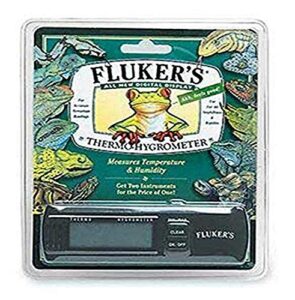
Fluker’s Digital Thermometer Hygrometer earns its spot on this list by keeping things simple without sacrificing reliability.
It tracks both temperature and humidity on a clear LCD display, and the MAX/MIN memory lets you review overnight lows without hovering over the enclosure.
At roughly 4 inches long, it tucks neatly onto glass or acrylic without crowding your boa’s space.
Accuracy sits around ±0.5°C for temperature, though humidity can drift ±5–10%—worth noting if you’re chasing tight parameters.
| Best For | Reptile and amphibian owners who want a no-fuss, affordable way to monitor both temperature and humidity in one place. |
|---|---|
| Display Type | Digital LCD |
| Measures Humidity | Yes |
| Measures Temperature | Yes |
| Mounting Method | Adhesive backing |
| Housing Material | Plastic |
| Color | Black |
| Additional Features |
|
- Tracks both temp and humidity on a single, easy-to-read LCD screen
- Super compact at around 4 inches, so it fits without eating up enclosure space
- Cheap enough to buy a few and place them at different spots in the enclosure
- Humidity readings can drift by ±5–10%, so it’s not the best pick if you need precision
- The adhesive backing can give out over time, which is a real concern with climbing animals
- Some users report the humidity sensor failing within just a few weeks of use
2. Zoo Med Dual Thermometer Hygrometer
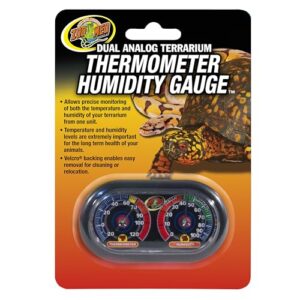
If you want simpler and battery-free, the Zoo Med Dual Thermometer Hygrometer (TH27) is worth a look. It reads both temperature and humidity on color-coded analog dials, mounts with a Velcro backing, and never needs a battery change. That last part matters more than you’d think during a busy week.
The tradeoff is accuracy — analog gauges can drift up to 15% on humidity, so don’t rely on this alone if your boa is mid-shed or showing signs of respiratory stress.
| Best For | Budget-conscious reptile and amphibian keepers who want a simple, battery-free way to keep tabs on both temperature and humidity at a glance. |
|---|---|
| Display Type | Analog dial |
| Measures Humidity | Yes |
| Measures Temperature | Yes |
| Mounting Method | Velcro pad |
| Housing Material | Rigid plastic |
| Color | Black |
| Additional Features |
|
- Displays both temperature and humidity on one unit — no juggling two separate gauges
- Totally battery-free, so it’s one less thing to worry about
- Velcro backing makes it easy to move around and spot-check different areas of the enclosure
- Analog humidity readings can drift several percent, making it unreliable for species with precise humidity needs
- No calibration option, so accuracy can slip over time — especially in wetter setups
- Build quality feels a bit flimsy, and the Velcro can lose its grip after extended use
3. Repti Zoo Digital Terrarium Thermometer Hygrometer
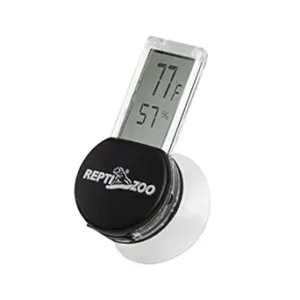
When precision matters more than simplicity, the Repti Zoo Digital Terrarium Thermometer Hygrometer steps up. It tracks temperature from -4°F to 176°F and humidity from 10% to 95% RH, with accuracy within ±1°F and ±5% — solid numbers for a large boa enclosure.
The external probe on a long cable lets you position it away from heat sources, and the suction‑cup mount repositions easily.
The built‑in alarm alerts you when temps or humidity drift outside your set thresholds, which is genuinely useful.
| Best For | Reptile keepers who want a reliable, budget-friendly way to keep an eye on both temperature and humidity in one simple device. |
|---|---|
| Display Type | Digital LCD |
| Measures Humidity | Yes |
| Measures Temperature | Yes |
| Mounting Method | Suction cup |
| Housing Material | Glass and plastic |
| Color | White |
| Additional Features |
|
- Comes with a spare battery and lasts up to a year, so you’re not swapping cells every few months
- Easy to reposition thanks to the suction cup — no sticky residue, no commitment
- Clear LCD readout makes it quick to check conditions and adjust heating or misting on the fly
- The suction cup can lose its grip on acrylic or textured glass, which is frustrating if your tank isn’t standard glass
- Not waterproof, so a stray splash from a misting system can cause real problems
- Some users report the battery draining faster than expected or the display cutting out after a few months
4. TempPro TP49 Digital Hygrometer Thermometer
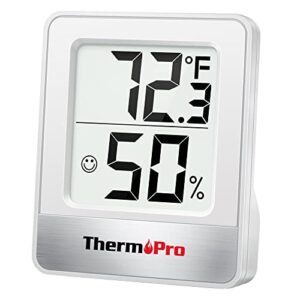
If you want something budget-friendly without sacrificing reliability, the TempPro TP49 is worth a serious look. At $9.49, it refreshes every 10 seconds, reads humidity within ±2–3% RH, and temperature within ±1°F — accurate enough for daily body monitoring.
The face-icon comfort display gives you an instant read without squinting at numbers. It sits on a tabletop, hangs on a wall, or sticks to a magnetic surface, so placement isn’t a headache.
For full guidance on dialing in your snake’s environment, corn snake care and temperament tips walk you through the thermal gradient your animal actually needs to thrive.
| Best For | Anyone who wants a no-fuss, affordable way to keep tabs on indoor temperature and humidity — great for nurseries, home offices, or humidity-sensitive spaces like guitar rooms. |
|---|---|
| Display Type | Digital LCD |
| Measures Humidity | Yes |
| Measures Temperature | Yes |
| Mounting Method | Stand / magnet / hook |
| Housing Material | Plastic |
| Color | White |
| Additional Features |
|
- Dirt cheap at $9.49, making it easy to grab a few and cover multiple rooms
- Updates every 10 seconds so you’re always seeing current conditions, not stale data
- Three mounting options (stand, magnet, hook) means it fits pretty much anywhere
- Accuracy can slip at humidity extremes, so it’s not the best pick for precision-critical setups
- Battery life is a mystery — no info on how long it lasts before you’re swapping cells
- The TempPro/ThermoPro branding overlap is a bit confusing if you ever need warranty support
5. Inkbird ITH10 Digital Temperature Hygrometer Monitor
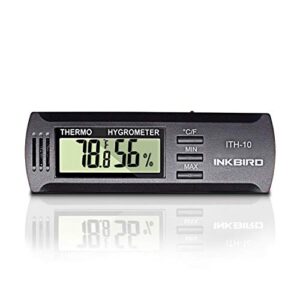
The Inkbird ITH10 punches above its weight for such a small device. Weighing barely 9 grams, it slips into tight spots — along enclosure walls or behind hides — without crowding your boa’s space.
It displays temperature and humidity simultaneously, and the daily min/max memory lets you spot overnight dips before they become a problem.
Accuracy sits at ±1°C and ±3% RH, solid for routine monitoring.
Just note it can’t be manually calibrated, so cross-check it against a reference unit first.
| Best For | Reptile keepers, guitar owners, or anyone who needs a no-fuss way to keep tabs on temperature and humidity in a small, enclosed space. |
|---|---|
| Display Type | Digital LCD |
| Measures Humidity | Yes |
| Measures Temperature | Yes |
| Mounting Method | Velcro built-in |
| Housing Material | Plastic |
| Color | Unspecified |
| Additional Features |
|
- Tiny and light (just 9g) — fits anywhere without getting in the way
- Shows temp and humidity at the same time, with min/max memory to catch overnight swings
- At $12.99, it’s hard to beat the value for basic environmental monitoring
- No manual calibration option, so you’ll want to verify it against a reference before trusting it fully
- Real-world accuracy can drift a bit beyond the stated specs, especially on humidity
- Minimal, unbranded packaging may leave you second-guessing whether you got the real thing
6. Paizoo LED Reptile Thermometer Hygrometer
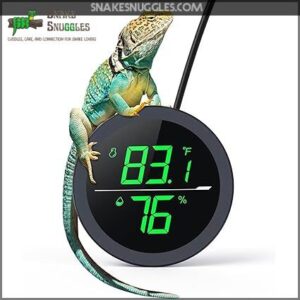
The Paizoo stands out for one simple reason: that 3-inch LED display is genuinely easy to read at a glance, day or night, without opening the enclosure.
It runs on USB power with a 140 cm cable and mounts cleanly using 3M adhesive tape — no tools, no fuss.
Temperature accuracy holds within ±1°F, though humidity readings above 80% RH can drift.
For large boa enclosures where visibility matters, it’s a practical, low‑maintenance choice worth considering.
| Best For | Reptile keepers with large terrariums who want an easy-to-read, no-fuss monitor they can check at a glance without disturbing their animals. |
|---|---|
| Display Type | HD LED backlit |
| Measures Humidity | Yes |
| Measures Temperature | Yes |
| Mounting Method | 3M double-sided tape |
| Housing Material | Acrylic |
| Color | Black |
| Additional Features |
|
- Big 3-inch backlit display is easy to read day or night, even from across the room
- Simple USB-powered setup with adhesive mounting — no drilling, no tools needed
- Tracks both temperature and humidity in one unit, keeping your enclosure info in one place
- Humidity readings above 80% RH can drift, which matters a lot for tropical or high-moisture setups
- Needs a free USB port nearby — the cord can get awkward in tight or minimalist builds
- Some users report sensor or display issues over time, so long-term reliability isn’t guaranteed
Boa Temperature and Humidity Targets
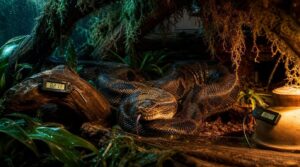
Getting the temperature and humidity right isn’t guesswork — it’s the foundation of a healthy boa. Every stage of your boa’s life calls for slightly different conditions, and knowing those numbers keeps you in control.
Here’s exactly what your enclosure needs to hit at each life stage.
Hatchling Boa Temperature Ranges
Hatchlings need more heat than most keepers expect. Keep your warm side between 82–86°F, with a cool side around 75–79°F — that temperature gradient aids digestion and stress‑free movement.
A digital thermometer makes monitoring frequency easy and precise. For ideal care, aim for the summer hotspot temperature target of 88–92 °F.
- Nighttime cooling to 72–75°F is safe with steady humidity
- Feeding temperature timing matters — maintain 82–86°F post‑meal
- temperature spikes above 90°F and adjust quickly
Juvenile Boa Temperature Ranges
As your boa constrictor moves past that hatchling stage, the temperature range shifts slightly — but gradient stability matters just as much. Aim for 82–90°F on the warm side and 73–79°F on the cool side.
| Zone | Target Range |
|---|---|
| Warm Side | 82–90°F (28–32°C) |
| Basking Spot | 90–95°F (32–35°C) |
| Cool Side | 73–79°F (23–26°C) |
A digital thermometer makes temperature drift monitoring straightforward. Nighttime cooling to 70–75°F is fine, and a feeding heat boost keeps digestion efficient.
Adult Boa Day and Night Ranges
Adult boas run on a reliable Circadian Temperature Cycle — warm days, cooler nights, steady rhythm.
Keep the Activity Zone Preference in mind: a warm side at 82–88°F helps digestion and the Feeding Heat Boost post‑meal, while Nighttime Cooling Rate brings temps to 72–78°F naturally.
That night temperature drop also strengthens the Shedding Humidity Link, supporting clean, complete sheds.
Warm Side and Cool Side Gradient
Think of the enclosure as two climates sharing one roof. Your boa constrictor needs a warm side basking spot at 90–95°F and a cool side around 75–80°F, creating Thermal Gradient Stability through deliberate Heat Source Positioning.
Digital thermometer readings on both ends confirm the gradient holds, supporting Behavioral Gradient Responses — digestion on the warm side, rest on the cool.
Ideal Humidity Range for Large Boas
Humidity follows temperature just as closely as heat does. For large boas, keep relative humidity between 55 and 75 percent — nudging toward 65–85 percent during shedding for smoother Shedding Humidity Management.
Your substrate choice drives Substrate Moisture Impact, while Ventilation Humidity Balance prevents mold buildup.
Use reliable Humidity Monitoring Tools and smart Humidity Gradient Design to avoid dehydration and maintain proper humidity levels throughout.
Digital Vs Analog Readings
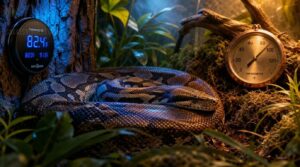
Choosing between digital and analog isn’t just a matter of preference — it actually affects how accurately you can monitor your boa’s environment. Each type has real strengths and a few trade-offs worth knowing before you commit.
Here’s how they stack up across the factors that matter most for large enclosures.
Accuracy Differences Between Digital and Analog Gauges
Regarding temperature accuracy, digital and analog gauges aren’t even in the same league. A digital ThermoHygrometer delivers Resolution Precision down to decimal-level readings, while an Analog Thermometer can drift up to 15% — a serious risk for your boa constrictor’s health.
Parallax Error, Sensor Drift, and lack of Temperature Compensation make analog less reliable without regular Calibration Frequency checks.
| Feature | Digital reptile thermometer | Analog Thermometer |
|---|---|---|
| Temperature accuracy | ±0.5–1.0 °F | Up to 15% off |
| Sensor Drift | Minimal with compensation | Gradual mechanical wear |
| Parallax Error | None | Common |
Min and Max Temperature Tracking
Beyond accuracy, a good digital thermometer earns its place through programmable min/max temperature logging. That max/min function quietly records every overnight dip and afternoon spike, so you’re never guessing what happened while you slept.
A digital thermometer’s min/max logging catches every overnight dip and spike you slept through
For boa constrictor temperature monitoring, this matters more than most keepers expect.
| Feature | Basic Digital Thermometer | Enhanced Digital Thermometer |
|---|---|---|
| Tracking Frequency Settings | Fixed intervals | Customizable (1–5 min) |
| Alert Threshold Customization | None | Upper/lower limits |
| Data Export Formats | None | CSV / app sync |
Multi-Point Tracking and Battery Impact Logging round out the best units, giving you a full enclosure picture without constant manual checks.
Humidity Reading Consistency
Tracking min/max temps tell part of the story — but humidity accuracy is where most keepers hit a wall. Capacitive sensor choice matters here: digital hygrometers hold tighter tolerances, while analog hygrometers can drift 15% without warning.
Sensor drift mitigation through regular sensor calibration keeps readings trustworthy. Condensation impact, cable length effects, and reading variability all shape what your display actually shows.
| Factor | Digital Hygrometer | Analog Hygrometer |
|---|---|---|
| Humidity Accuracy | ±2–5% | ±10–15% |
| Calibration Frequency | Every 3–6 months | Monthly or more |
| Condensation Impact | Moderate | High |
When Analog Gauges Still Make Sense
Don’t count analog out just yet.
For keepers who want Battery‑Free Reliability, a Dual Analog Gauge covering both an Analog Thermometer and Analog Humidity Gauge delivers Instant Hazard Zones at a glance — no screens, no batteries. Harsh‑Environment Durability and Simple Field Calibration make them backup-worthy in any reptile enclosure.
| Benefit | Analog Gauge | Digital Unit |
|---|---|---|
| Power Needed | None | Batteries required |
| Hazard Zone Visibility | Color-coded dial | Numeric reading |
| Field Serviceability | Easy Serviceability | Specialized tools |
Why Digital Models Suit Large Enclosures Better
Once your enclosure grows beyond four feet, a single analog dial simply can’t tell you what’s happening across the full temperature gradient.
Digital Thermometers with Expandable Sensor Networks give you Real-time Heatmaps, Centralized Data Logging, and Automated Fault Detection — all from one display.
| Digital Advantage | Why It Matters |
|---|---|
| Remote Temperature Sensor | Monitors exact basking zones |
| Predictive Maintenance alerts | Catches probe drift early |
Probe Placement and Mounting
Even the best thermometer gives you bad data if the probe isn’t sitting in the right spot. Where you place it — and how you mount it — makes a real difference in what you’re actually reading.
Here’s what to know before you stick anything to the glass.
Best Probe Height Above Substrate
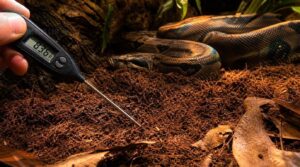
Keep your temperature probe placement between one to two inches above the substrate for reliable substrate temperature measurement in your boa constrictor’s enclosure.
That small gap matters — airflow influence and temperature lag both shift readings when the probe sits too low or too high.
Account for substrate thickness effect when your bedding runs deep, and always perform probe height calibration after any setup change to maintain accurate reptile enclosure temperature control.
Warm Side Versus Cool Side Placement
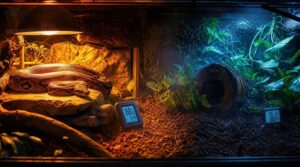
Place one probe on the warm side and another on the cool side to capture your full temperature gradient. Aim for 82–90°F on the warm end and 72–79°F on the cool retreat.
Gradient uniformity depends on smart heat source spacing and substrate conductivity, so position each probe mid-enclosure height, away from walls, where airflow management and lighting positioning won’t skew your boa constrictor’s temperature probe placement readings.
Avoiding Direct Heat Source Interference
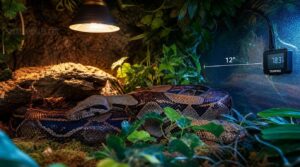
Think of your probe as a thermometer in the shade — it needs protection from direct radiant heat to give you an honest reading.
Apply radiant shielding and maintain heat source separation of at least 12 inches between your basking spot and sensor. Use non-reflective surfaces nearby, route cables carefully with cable heat management practices, and create thermal buffer zones so your temperature probe placement guidelines actually deliver reliable thermal gradient detection.
Suction Cup, Velcro, and Tabletop Mounting
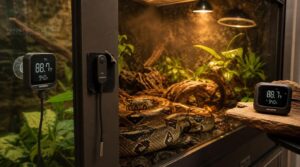
Your mounting choice matters more than you’d think. Suction cups offer strong seal integrity on glass walls, but mounting stability drops in high-humidity enclosures where adhesive degradation is common with Velcro backing.
surface compatibility before committing — smooth glass favors suction cups, while textured panels need alternative mounting methods for temperature and humidity sensors. Tabletop mounting options work well outside the enclosure for reference monitoring.
Securing Wires in Large Boa Enclosures
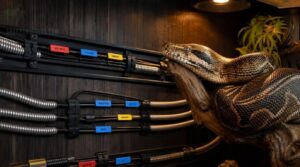
Wires are just as important as your mounting options.
Large enclosures mean longer runs, so route cables through lockable cable channels along the back wall, using grommet sealants where they enter.
Wrap exposed sections in anti-chewing sleeves, and rely on a 6-foot cable for remote sensor integration and cable length flexibility.
Color-coded labels keep everything traceable.
Quarterly wire audits to catch wear early.
Thermostat Integration and Care
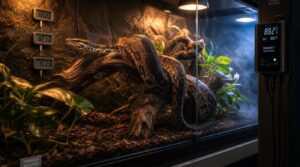
A good thermometer tells you what’s happening in the enclosure, but a thermostat is what actually keeps your boa safe. Pairing them correctly — and keeping both in good shape — makes the difference between a stable setup and a guessing game.
Here’s what you need to know about integrating your thermometer with a thermostat and keeping everything running reliably.
Pairing Thermometers With Reptile Thermostats
Your thermometer and thermostat work best as a team, not as independent tools. Pairing a digital thermometer with thermostat integration gives you real-time feedback, alarm configuration when temps drift, and data logging for spotting patterns over days.
For large enclosures, multi-zone synchronization lets you monitor warm and cool sides independently.
Always check wiring integrity weekly — loose connections quietly undermine your boa constrictor’s temperature control.
Matching Probes to Heaters and Wattage Limits
Your probe material durability matters more than most keepers realize — metal probes handle sustained heat far better than plastic ones.
For heater power matching, don’t exceed 80% of your circuit’s wattage capacity to prevent circuit overload issues.
Always perform a voltage rating check on your reptile heating system, and add a safety fuse to protect your boa constrictor’s heat source selection.
Calibrating Before First Use
Once you’ve sorted your wiring, calibration is your next step — and skipping it is a gamble with your boa’s health.
Before trusting any digital thermometer or analog thermometer, run a Reference Standard Comparison against a certified reference unit:
- Power on and allow 30 minutes for Warm-up Stabilization before checking anything
- Perform a Sensor Drift Check by comparing your temperature probe reading against a reference thermometer
- Confirm temperature sensor accuracy stays within ±1°F of the standard
- Recheck Calibration Frequency after any enclosure move or power outage
- Log every result in a Calibration Log for ongoing accountability
Battery Life and Replacement Planning
Battery-powered monitors are only as reliable as the cells inside them. Most reptile thermometers run on CR2032 or LR44 coin cells, delivering a battery lifespan of 6–12 months under normal conditions — though humidity above 60% can shorten that by 15–25%. Watch for Battery Indicator Alerts early and keep a Spare Battery Stock on hand.
| Factor | Impact | Tip |
|---|---|---|
| High humidity (60–80%) | Up to 25% reduced life | Check Battery Type Compatibility; use sealed compartments |
| Heat exposure (above 35°C) | Gradual capacity loss | Keep units away from direct heat |
| Contact corrosion | Inconsistent readings | Apply Corrosion Prevention Tips; wipe contacts at each change |
Build a Scheduled Maintenance Calendar — swap batteries every six months, aligning changes with thermostat calibration cycles for synchronized, dependable monitoring.
Water Resistance, Cleaning, and Long-term Maintenance
Most reptile thermometers are water-resistant, not waterproof — an important distinction in a humid boa enclosure. Wipe units down with a damp microfiber cloth; never submerge them.
Build a Gasket Replacement Schedule into your routine, and run monthly Seal Integrity Checks on probe cables.
Use Condensation Management Strategies like slight elevation and proper ventilation, and always choose Corrosion-Resistant Materials with solid Battery Compartment Sealing.
Frequently Asked Questions (FAQs)
What temperature should a snake thermostat be?
Think of your thermostat as a thermos — it holds the right heat steady. For a boa constrictor, set your temperature setpoint between 88°F and 92°F on the warm side.
What’s the best thermometer for reptiles?
For choosing the right reptile thermometer and hygrometer, Fluker’s Digital Thermometer stands out — solid sensor response time, easy-to-use user interface, and reliable temperature control range make it the smartest pick overall.
How often should boa enclosures be recalibrated seasonally?
Most keepers recalibrate once a year, but your boa actually needs seasonal recalibration — every three months — to reflect natural temperature and humidity shifts and keep your calibration interval tips and seasonal adjustment checklist current.
Can thermometers detect dangerous temperature spikes overnight?
Yes — modern thermometers with rapid response sensors detect overnight temperature fluctuations within seconds.
Set alarm threshold settings to catch overheating early, and rely on data logging frequency to review your boa constrictor’s full temperature schedule.
What signs indicate a thermometer is failing?
Erratic readings, display flicker, sensor drift, and slow response are the clearest warning signs.
Physical damage, failed calibration, and shortened battery life confirm it’s time to replace your thermometer before temperature fluctuations put your boa at risk.
Do large enclosures need multiple thermometers simultaneously?
Absolutely — for large enclosures, one thermometer isn’t enough. You need at least two to capture the full temperature gradient and catch sensor drift before it becomes a real problem.
How does shedding behavior signal inaccurate humidity readings?
Your boa’s shedding behavior is one of the most reliable humidity sensors you’ll ever have — ironically more honest than your actual gauge.
Shedding Moisture Spikes from skin oil residue create Microclimate Hotspots that trigger Shedding Sensor Drift, producing Localized Humidity Bias that masks real dehydration risks and moldy enclosure conditions.
Conclusion
Like a compass that keeps you from wandering off course, the right reptile thermometers for large boa constrictors give you the clarity to act before problems develop. Your boa can’t tell you the warm side dropped two degrees overnight—but a reliable digital unit with dual probes will.
Choose a model that matches your enclosure size, mount your probes correctly, and trust the readings.
Consistent temperatures aren’t a luxury for large boas; they’re the foundation of a long, healthy life.