This site is supported by our readers. We may earn a commission, at no cost to you, if you purchase through links.

Corn snakes outlive most dogs—15 to 20 years is standard, with some reaching longer under good care.
That single fact changes how you think about bringing one home.
This isn’t a starter pet you’ll outgrow; it’s a long-term commitment wrapped in copper and rust-colored scales.
What makes them worth it is corn snake temperament: consistently calm, tolerant of handling, and far less reactive than most reptiles their size.
A well-kept corn snake at 4–5 feet is manageable, predictable, and genuinely interesting to care for.
The answers ahead cover everything from enclosure setup to feeding schedules and common health concerns.
Table Of Contents
- Key Takeaways
- Corn Snakes as Beginner Pets
- Corn Snake Temperament and Handling
- Corn Snake Enclosure Setup
- Feeding, Shedding, and Health
- Top 10 Corn Snake Care Products
- 1. Repti Zoo 50 Gallon Glass Terrarium
- 2. ReptiChip Coconut Substrate for Reptiles
- 3. Zilla Reptile Shale Rock Den
- 4. iPower Hydroponic Seedling Heat Mat Thermostat
- 5. Exo Terra Large Reptile Water Dish
- 6. iPower Digital Heat Mat Thermostat Controller
- 7. iPower Reptile Under Tank Heater
- 8. TempPro TP50 Digital Hygrometer Thermometer
- 9. Corn Snakes Comprehensive Owner’s Guide
- 10. Complete Corn Snake Care Handbook
- Frequently Asked Questions (FAQs)
- What is the biggest trouble with corn snakes as pets?
- Is it hard to take care of a corn snake?
- Are corn snakes beginner friendly?
- Are corn snakes friendly?
- How difficult is it to take care of a corn snake?
- What is the temperament of a corn snake?
- Can corn snakes live together peacefully?
- What causes corn snakes to refuse food?
- How do corn snakes reproduce and breed?
- Do corn snakes require special winter care?
- Conclusion
Key Takeaways
- Corn snakes live 15–20 years and reach 4–5 feet, so bringing one home is a long-term commitment that rewards consistent care, not just beginner curiosity.
- Their naturally calm temperament makes handling straightforward, but trust builds session by session—short, gentle, 1–2 times weekly keep your snake relaxed and your confidence growing.
- A secure enclosure with an 85 °F warm side, 70–75 °F cool side, and 40–60% humidity covers the core needs that directly affect feeding, shedding, and overall health.
- Feeding frozen-thawed prey on a 10–14‑day adult schedule, paired with early attention to stress signs like refusal to eat or mouth breathing, prevents most common health problems before they escalate.
Corn Snakes as Beginner Pets
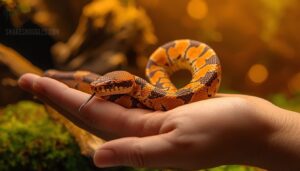
Corn snakes have earned their reputation as one of the best starter reptiles for good reason. They’re calm, manageable in size, and don’t demand the complex care routines that trip up so many first-time keepers.
If you’re ready to get started, a well-stocked corn snake starter kit for new owners takes the guesswork out of setting up their first enclosure.
Here’s a closer look at what makes them such a natural fit — and what you should realistically expect before bringing one home.
Why Corn Snakes Are Popular for First-time Keepers
Corn snakes have earned their reputation as the go-to beginner snake for good reason. Their docile corn snake temperament and behavior make handling approachable, their simple nutrition requirements mean no complex feeding routines, and their easy maintenance keeps daily care manageable.
Add affordable cost of ownership, stunning morph variety, and a welcoming beginner community — and it’s clear why so many first-time keepers choose them.
A proper 20‑30 gallon enclosure ensures enough space for an adult corn snake.
Calm Temperament and Docile Behavior
What makes these snakes genuinely beginner-friendly is their calm docile temperament. Most adults stay loose and relaxed when lifted — a clear posture indicator of comfort.
With consistent handling frequency of 1–2 sessions weekly, your scent becomes familiar rather than threatening through natural scent familiarization.
Temperature influence matters too; a well-regulated enclosure keeps stress low.
Juveniles may release musk early on, but that fades with routine, gentle contact.
Pros and Cons of Corn Snake Ownership
That calm temperament comes with a practical upside — corn snakes rank among the most low maintenance reptiles available to beginner snake hobbyists. Cost of ownership stays manageable, with monthly feeding and substrate running $20–$55. Morph variety means you’ll find colors suited to any preference.
The main cons: a 15–20 year time investment and limited pet compatibility with curious dogs or cats.
Size, Lifespan, and Long-term Commitment
That 15–20 year commitment deserves a closer look before you bring one home. Adult size variability means most reach 4–5 feet, though genetics and feeding history influence the final length. Longevity factors like stable temperatures and low stress extend lifespan considerably.
For commitment planning, keep these in mind:
- Growth rate peaks in year one, adding 12–18 inches
- Maturity timeline runs 18–24 months
- Minimum habitat size scales from 20 to 40+ gallons as they grow
What New Owners Should Expect
Expect a real adjustment period in those first few weeks — the learning curve is shorter than most pets, but it’s still there. Initial setup costs run $150–$400, and routine establishment takes a month or two.
Your snake needs time to settle before handling begins, so patience is part of the time commitment.
Once the rhythm clicks, corn snake temperament and behavior make daily care genuinely straightforward.
Corn Snake Temperament and Handling
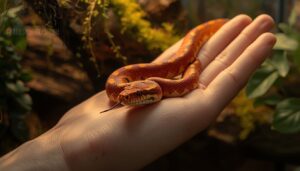
Getting to know your corn snake’s personality is one of the most rewarding parts of being a reptile keeper. These snakes follow recognizable patterns in how they behave, respond to stress, and warm up to regular handling — and understanding those patterns makes a real difference.
Understanding your corn snake’s patterns of behavior transforms every handling session from guesswork into genuine connection
Here’s what you need to know about their temperament and how to handle them safely.
Typical Personality and Activity Patterns
docile but active personality that often surprises first-time keepers. Their crepuscular activity means nighttime activity peaks — you’ll notice more exploring after the room quiets down.
Temperature-driven movement guides where they roam, while scent tracking helps them investigate new objects. Hide preference patterns stay consistent once they feel secure, and musk release triggers are rare unless they feel genuinely cornered.
How Juveniles Behave Vs. Adults
Juveniles pack a stronger exploration drive than adults, moving quickly after any tank change and striking prey with intense target focus. Their bluffing tactics — tail vibration, sudden musking — come fast but fade quickly.
Adults settle into steadier routines, feeding more calmly and escalating defensively far slower.
Pre-shed retreat looks similar across both ages, though tolerance development through consistent handling shapes long-term behavior more than age alone does.
Signs of Stress or Discomfort
Your snake doesn’t always make stress obvious, but the signs are there once you know what to watch for. Defensive posture — a tightened coil with the head raised — is often the first signal.
Mouth breathing, musk emission, refusal to eat, and regurgitation episodes point to deeper discomfort. Recognizing these signs of stress and illness in corn snakes early keeps minor issues from becoming serious health problems.
Building Trust Through Gentle Handling
Trust isn’t demanded — it’s earned, session by session. Using a Consistent Routine and Pre-Handling Calm approach lays the groundwork for a relaxed snake and a confident keeper.
- Practice Gentle Capture — approach slowly from the side, never above
- Provide Full Body Support across both hands
- Keep early sessions to 5–10 minutes
- Focus on Signal Reading — stillness means comfort, stiffening means stop
- Repeat sessions 1–2 times weekly at the same time
Safe Handling Rules for Beginners
A few simple rules go a long way.
Use a Supportive Hand Position — one hand near the middle, one supporting the rear third — and keep handling sessions to 5–10 minutes.
Always set your snake on a Non‑Slip Handling Surface like a towel.
Wash your hands before and after for Post‑Handling Hygiene, and keep feeding times separate to Avoid Feeding Association.
When to Avoid Handling
Knowing when not to handle is just as important as knowing how.
- Post-feeding stress is real — wait at least 48 hours after meals to prevent regurgitation
- Pre-shed cloudiness signals reduced vision; your snake may strike defensively
- Fresh shed sensitivity means new skin needs a day to settle
- Temperature extremes make handling unsafe and increase agitation
- Illness recovery — respiratory infections, mouth rot, or other stress signs mean rest, not handling
Corn Snake Enclosure Setup
Getting your corn snake’s enclosure right is the foundation of everything else — good feeding, easy shedding, and a calmer snake all start here. The setup doesn’t have to be complicated, but a few key details really do matter.
Here’s what you need to know to build an enclosure your snake will actually thrive in.
Best Enclosure Size for Juveniles and Adults
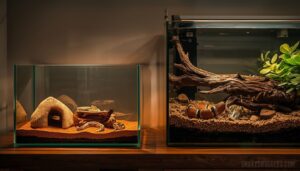
Choosing the right enclosure size matters more than most beginners expect. Juveniles need at least a 20-gallon tank — a 10‑gallon minimum habitat size simply doesn’t support healthy growth scaling or natural movement.
Adults require a 40‑gallon enclosure with a floor footprint of at least 48 by 18 inches. Volume guidelines and vertical space both factor into long-term comfort, and proper ventilation needs should always guide your final choice.
Secure Lid and Escape Prevention

Corn snakes are natural escape artists, and a 40-gallon tank means nothing if the lid isn’t locked down properly. Look for a secure locking lid with a Magnetic Snap Closure and a Lid Gasket Seal along every edge — gaps larger than a quarter-inch are invitations.
Reinforced Corner Design, Escape-proof Vent Placement, and weekly Edge Gap Inspection keep your escapeproof habitat truly secure.
Warm Side and Cool Side Temperatures

Once the lid is locked, temperature becomes your next priority.
Aim for 85 °F on the warm side and 70–75 °F on the cool side — that Side Temperature Difference gives your snake real thermoregulation choices.
A thermostat-controlled heat source prevents dangerous spikes.
Use a reliable thermometer for Temperature Logging on both ends, because a proper Thermal Gradient Width is what keeps digestion and behavior on track.
Humidity Control for Healthy Shedding
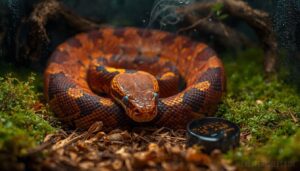
Humidity control is where many first-time keepers stumble. Keep the enclosure between 40–60% normally, then raise it to 60–70% during pre-shed humidity periods — when your snake’s eyes go cloudy.
A hygrometer placement near the snake’s resting spot gives you the most accurate reading.
Use a humidity hide setup with damp sphagnum moss for shedding assistance without soaking the whole substrate.
Misting timing matters: mist lightly, then let it dry to avoid excess moisture buildup.
Hides, Substrate, and Enclosure Décor

Think of your enclosure décor as your snake’s whole world — every element should serve a purpose.
- Cork Bark Hides offer snug retreats that reduce shed stress; place one on each end for full-range temperature access.
- Coconut Fiber Substrate maintains a natural humidity pocket design without sogginess, outperforming aspen shavings for moisture balance.
- Branch Climbing Enrichment and non-toxic plant décor add mental stimulation, your snake will genuinely use.
Lighting and Heat Source Basics

Unlike many reptiles, corn snakes don’t need UVB or special UV light necessity setups — ambient room lighting manages their day-night cycle just fine.
For heat, an under-tank heater or heat mat paired with thermostat placement at the warm-side surface keeps your temperature gradient accurate and safe.
Ceramic heat emitters work well overnight without disrupting the light cycle, and infrared lamp timing matters if your heat lamp emits visible light.
Heat mat safety always means using a thermostat — never run one unregulated.
Feeding, Shedding, and Health
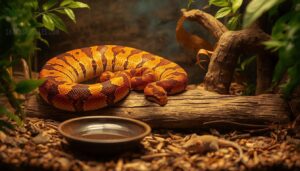
Feeding and health care are where a lot of new owners second-guess themselves—and that’s completely normal.
Getting the basics right, from prey size to shedding support, makes a real difference in how your snake thrives long-term.
Here’s what you need to know across each key area.
Diet and Prey Size by Age
Corn snakes eat rodents throughout their entire lives, but prey size should always match their mid-body girth — that’s the core feeding size rule.
Hatchlings start on pinky mice, then juvenile prey scaling kicks in gradually as they grow.
Adult gape limits and body condition matching guide your prey selection over time, keeping digestion smooth and body condition strong.
Feeding Schedule for Hatchlings and Adults
Hatchling feeding frequency starts at every 5–7 days — newly hatched corn snakes burn energy quickly and need consistent meals to grow. Juveniles shift to every 7–10 days as prey size scaling increases. Adult meal intervals settle around every 10–14 days.
Watch body condition closely; weight-based adjustments help you decide whether to feed sooner or hold off.
Shedding recovery feeding resumes once the shed is fully completed.
Frozen-thawed Feeding Safety
Frozen rodents are the safest choice — but thawing methods matter more than most keepers realize.
Follow these hygiene protocols every time:
- Thaw in the refrigerator overnight or under cold running water — never at room temperature, where bacterial risks rise quickly.
- Use feeding tongs, never bare hands, to prevent cross‑contamination.
- Prioritize immediate feeding timing — microwave‑thawed prey must be used right away.
- Clean all surfaces that contacted thawed frozen rodents afterward.
- Discard uneaten prey; leftovers cause oral infections and other health issues requiring veterinary care.
Water, Hydration, and Soaking Needs
A clean water dish on the cool side covers most of your snake’s hydration needs without any fuss. Dish Placement Strategy matters here — room-temperature water discourages bacterial growth and won’t chill your snake after it moves away.
Cleaning Frequency Protocol means replacing water every 2–3 days. Soak Timing Guidelines suggest watching for voluntary soaking before sheds, not forcing it daily.
Shedding Problems and Humidity Support
Stuck shed — or dysecdysis — usually traces back to low humidity at the wrong moment.
Keep these five steps in your routine:
- Place a moist hide on the warm side for reliable moist hide placement
- Track readings with a humidity gauge for consistent humidity gradient monitoring
- Use moisture-retaining substrate for substrate moisture buffering
- Maintain 40–60% humidity for stuck shed prevention
- Note your snake’s shedding frequency timing — juveniles shed every 4–6 weeks
Shedding and humidity requirements stay manageable when your shedding process and humidity management work together through steady humidity control.
Common Health Issues and Vet Care
Even with good humidity habits in place, health problems can still appear.
Respiratory Infections, Mouth Rot, Mite Infestations, and Internal Parasites are the most common health issues in captive corn snakes — each requiring prompt veterinary care and common illnesses often need a reptile‑experienced vet to treat properly.
| Condition | Warning Signs | Next Step |
|---|---|---|
| Respiratory Infections | Bubbling, clicking, open-mouth breathing | Vet visit within 48 hours |
| Mouth Rot | Swelling, yellow discharge, odor | Stop self‑treating; see a vet |
| Mite Infestations | Rubbing, restlessness, poor feeding | Treat snake and enclosure together |
| Internal Parasites | Weight loss, regurgitation, poor appetite | Fecal test before any medication |
| Emergency Care | Lethargy, inability to move, repeated regurgitation | Contact emergency reptile clinic immediately |
Cleaning and Disease Prevention
Keeping up with sanitation protocols is your first line of defense. Remove feces and shed skin right away, wash your hands thoroughly after every enclosure contact, and use a reptile-safe disinfectant — correct dilution and contact time matter. Sanitizing enclosure surfaces monthly cuts bacterial load substantially.
Quarantine protocols for new arrivals — 60 to 90 days minimum — protect against mite control issues and respiratory infections spreading.
Top 10 Corn Snake Care Products
Getting the right gear makes a real difference when you’re setting up for a corn snake. The products below are tried-and-true picks that cover everything from housing and heat to humidity and hydration.
Here’s what’s worth your attention.
1. Repti Zoo 50 Gallon Glass Terrarium
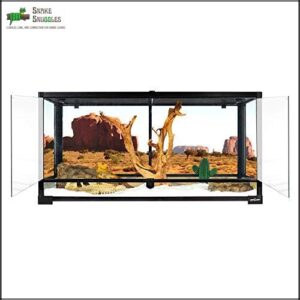
The Repti Zoo 50 Gallon Glass Terrarium gives your corn snake exactly what it needs — room to move, stable temperatures, and a secure setup you can trust.
Its 36" × 18" × 18" tempered glass build fits adults comfortably, while the raised bottom accommodates an under-tank heater without any workarounds.
Front doors open independently, so feeding stays low-stress for both of you. Mesh side panels and a screen top support airflow, though you may need to seal gaps if your snake is small or climbs aggressively.
| Best For | Reptile keepers housing medium to large species like corn snakes, bearded dragons, or ball pythons who want a versatile enclosure that works for both arid and humid setups. |
|---|---|
| Product Type | Glass Terrarium |
| Price Range | Premium |
| Beginner Friendly | Yes |
| Corn Snake Suitable | Yes |
| Easy Maintenance | Moderate |
| Language | English Only |
| Additional Features |
|
- The 36" × 18" × 18" tempered glass build gives adults plenty of room, and the raised bottom fits an under-tank heater without any modifications.
- Front doors open independently, making feeding and cleaning way less stressful — no awkward top-down reaches.
- Works as a desert or rainforest setup thanks to the waterproof base, and you can stack them if you ever want to expand.
- Mesh side panels make it tough to hold high humidity — you’ll likely need to cover them with tape or panels if you’re keeping a tropical species.
- Some users have reported cracked glass on arrival, misaligned doors, or missing hardware right out of the box.
- Assembly instructions are English-only, and the open cable-lock holes can be a real escape risk if you’ve got a clever climber.
2. ReptiChip Coconut Substrate for Reptiles
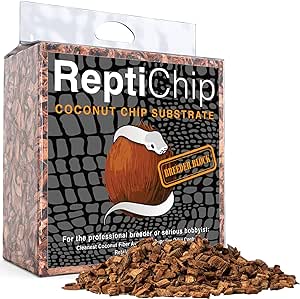
Regarding bedding, ReptiChip Coconut Substrate earns its place in any corn snake setup. Each compressed brick — about 10 lb — expands 3–4 times its size once you add water, filling a 40‑gallon enclosure without hassle.
The coconut husk chips hold humidity between 40–60%, support healthy shedding, and absorb waste odors effectively.
It’s dust‑free, organic, and free of dyes or synthetic additives, so sensitive respiratory systems stay clear.
Spot‑cleaning every few days keeps things tidy, and the substrate stays fresh for weeks between full changes.
| Best For | Reptile and amphibian keepers who want a low-maintenance, natural substrate that keeps humidity steady and odors down — especially great for ball pythons, corn snakes, and similar species. |
|---|---|
| Product Type | Coconut Substrate |
| Price Range | Mid-Range |
| Beginner Friendly | Yes |
| Corn Snake Suitable | Yes |
| Easy Maintenance | Low |
| Language | None Required |
| Additional Features |
|
- Expands 3–4x from a single brick, so one purchase goes a long way and storage is a breeze.
- Holds moisture really well and helps with shedding, cutting down on how often you need to intervene.
- Organic, dust-free, and odor-absorbing — comfortable for your pet and easy to live with in your home.
- Costs more upfront than basic coconut or aspen options, which can sting if you’re on a budget.
- Takes some time and water to fully expand, so it’s not an instant setup when you’re in a hurry.
- The chunky texture isn’t ideal for species that like to burrow deep, and freshly opened bags can kick up some dust.
3. Zilla Reptile Shale Rock Den
The Zilla Shale Rock Den gives your corn snake exactly what it instinctively looks for — a secure, enclosed space to retreat from light and activity.
Measuring 9 × 6.5 × 3.5 inches, it fits comfortably in a 40-gallon setup and works on both the warm and cool sides of the enclosure.
The non-porous plastic exterior resists bacterial growth and cleans easily with warm, soapy water.
Its realistic stone texture blends naturally into most terrarium layouts without looking out of place.
| Best For | Corn snake owners with small to mid-size juveniles who want a natural-looking hide that’s easy to clean and works on either side of the enclosure. |
|---|---|
| Product Type | Rock Hide |
| Price Range | Budget |
| Beginner Friendly | Yes |
| Corn Snake Suitable | Yes |
| Easy Maintenance | Low |
| Language | None Required |
| Additional Features |
|
- Non-porous plastic resists bacteria and wipes down in seconds with warm, soapy water
- The realistic stone look blends right into most terrarium setups without looking cheap or out of place
- Works on both the warm and cool side, so you’ve got flexibility in how you arrange the tank
- Interior space is limited, so it’ll likely be too cramped once your corn snake hits adulthood
- Some buyers report a noticeable chemical smell right out of the box — give it a good wash before use
- Color and finish can vary from the product photos, and a few users have noted rough mold-line edges
4. iPower Hydroponic Seedling Heat Mat Thermostat

Temperature control is the part most beginners underestimate — and the iPower Heat Mat Thermostat combo takes the guesswork out of it.
The mat covers 10 × 20 inches and pairs with a digital thermostat that lets you dial in a precise warm-side temperature anywhere between 40 °F and 108 °F.
The detachable probe reads ambient heat and cycles the mat on or off to hold your target consistently.
It’s a reliable, low-cost way to maintain that 85 °F warm side your corn snake needs.
| Best For | Beginner reptile keepers who want reliable, hands-off temperature control without spending a lot on equipment. |
|---|---|
| Product Type | Heat Mat & Thermostat |
| Price Range | Budget |
| Beginner Friendly | Yes |
| Corn Snake Suitable | Yes |
| Easy Maintenance | Low |
| Language | English Only |
| Additional Features |
|
- Dial in temps between 40–108 °F with a digital readout — no guessing involved.
- The detachable probe keeps the mat cycling on and off automatically to hold your target.
- Works beyond reptiles too — seed starting, fermentation, sourdough, you name it.
- Readings can run 5–7 °F off from actual surface temp, so a backup thermometer is a good idea.
- The probe and thermostat have to stay dry, which takes some planning in humid setups.
- No adhesive backing, so the mat can shift around until it warms up and you get it weighted down.
5. Exo Terra Large Reptile Water Dish

Hydration is easy to overlook, but corn snakes need fresh, clean water available at all times. The Exo Terra Large Reptile Water Dish does that job well — its heavy, food-grade resin construction resists tipping even when your snake moves around or digs nearby substrate.
The smooth, non-porous interior wipes clean quickly, which matters more than it sounds when you’re doing weekly maintenance. Built-in safety steps let smaller animals climb out safely, and the realistic rock exterior blends naturally into any terrarium setup.
| Best For | Corn snake and medium-to-large reptile owners who want a stable, easy-to-clean water dish that stays put and looks good in the enclosure. |
|---|---|
| Product Type | Water Dish |
| Price Range | Mid-Range |
| Beginner Friendly | Yes |
| Corn Snake Suitable | Yes |
| Easy Maintenance | Low |
| Language | None Required |
| Additional Features |
|
- Heavy construction keeps it from tipping when your snake moves around or digs nearby
- Smooth interior wipes down fast and doesn’t hold onto bacteria or biofilm
- Built-in safety steps help smaller critters climb out if they fall in
- Actual dimensions may not match what’s listed, so double-check before buying
- Could be too deep for very small species that struggle to reach the surface
- Rigid plastic means it won’t fit into oddly shaped or tight enclosure corners
6. iPower Digital Heat Mat Thermostat Controller

Without a thermostat, heat mat is just a gamble. The iPower Digital Heat Mat Thermostat Controller takes that risk off the table — it monitors your enclosure’s temperature through a metal-tipped probe and cuts power to the mat once your set point is reached.
You can dial in anywhere from 40 °F to 108 °F, and the LED display shows real-time readings so you always know what’s happening inside. It retains your settings after a power interruption, which is a small but genuinely useful feature.
| Best For | Anyone who uses heat mats for reptiles, seedlings, fermentation, or brooding and wants reliable temperature control without babysitting it. |
|---|---|
| Product Type | Thermostat Controller |
| Price Range | Budget |
| Beginner Friendly | Yes |
| Corn Snake Suitable | Yes |
| Easy Maintenance | Low |
| Language | English Only |
| Additional Features |
|
- Holds your set temperature between 40°F and 108°F and cuts power automatically when it gets there — no overheating, no guessing.
- Remembers your settings after a power outage, so it plays nicely with smart plugs and timers.
- Works with a wide range of plug-in heaters, mats, and lamps as long as they stay under 1000W.
- It’s a simple on/off thermostat, so temps can swing a few degrees before the mat kicks back on.
- The probe can’t get wet — no submerging it in water or soggy soil or you’ll kill the sensor.
- It can only cut power to cool things down; it can’t boost a weak heating element to warm things up faster.
7. iPower Reptile Under Tank Heater
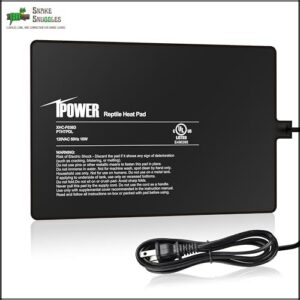
The thermostat controls the power, but the iPower Reptile Under Tank Heater is what actually delivers that warmth.
The 8 × 12 inches, 16-watt pad uses a PTC heating film that spreads heat evenly across the surface — no hot spots, no cold patches.
Its 3M adhesive bonds firmly to glass or plastic, and the rubber feet let you side-mount it safely.
Always pair it with a thermostat; without one, it can overheat your snake’s enclosure.
| Best For | Reptile and amphibian keepers who want a reliable, low-profile heat source for 30–40 gallon tanks without running a whole room heater. |
|---|---|
| Product Type | Under Tank Heater |
| Price Range | Budget |
| Beginner Friendly | Yes |
| Corn Snake Suitable | Yes |
| Easy Maintenance | Low |
| Language | English Only |
| Additional Features |
|
- PTC heating film spreads warmth evenly — no hot spots to worry about
- 3M adhesive and rubber feet give you a solid, flexible mounting setup
- Waterproof surface holds up well in humid terrariums and cleans easily
- No built-in thermostat, so you’ll need to buy one separately to avoid overheating
- Once that adhesive is down, moving it is a real hassle
- Can’t sit flat on a solid surface — must be side-mounted or elevated to stay safe
8. TempPro TP50 Digital Hygrometer Thermometer
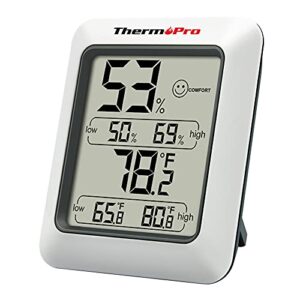
Once you’ve got your heat sorted, knowing exactly what’s happening inside that enclosure is the next piece of the puzzle.
The TempPro TP50 reads both temperature and humidity simultaneously, updating every 10 seconds with ±1°F and ±2–3%RH accuracy — precise enough to catch a humidity dip before it turns into a stuck shed.
It stores daily highs and lows, mounts via tabletop stand or magnetic backing, and runs on a single AAA battery.
Small, reliable, and genuinely useful.
| Best For | Reptile keepers and indoor gardeners who need a simple, reliable way to keep tabs on temperature and humidity without any tech fuss. |
|---|---|
| Product Type | Thermometer/Hygrometer |
| Price Range | Budget |
| Beginner Friendly | Yes |
| Corn Snake Suitable | Yes |
| Easy Maintenance | Low |
| Language | None Required |
| Additional Features |
|
- Updates every 10 seconds with solid accuracy, so you catch problems before they affect your animals or plants
- Tracks daily highs and lows, giving you a clear picture of how conditions shift throughout the day
- Flexible mounting options and a single AAA battery make it easy to place anywhere without dealing with cords
- No backlight, so reading it in a dim room or vivarium setup can be a hassle
- Small screen means you’re not reading it from across the room
- Clearing the high/low records requires pulling the battery — there’s no reset button
9. Corn Snakes Comprehensive Owner’s Guide

Once your monitoring tools are dialed in, having solid reference material ties everything together.
The Corn Snakes Extensive Owner’s Guide, authored by renowned breeders Bill Love and Kathy Love, covers everything from enclosure setup and feeding schedules to morph genetics and breeding protocols — all in 224 pages built for real keepers.
At $16.99 for a used copy, it’s a practical shelf reference you’ll return to across your snake’s 15–20 year lifespan, not just during that first nervous week.
| Best For | New corn snake owners who want one solid book to guide them from setup to breeding, and hobbyists serious about producing specific morphs. |
|---|---|
| Product Type | Care Book |
| Price Range | Budget |
| Beginner Friendly | Yes |
| Corn Snake Suitable | Yes |
| Easy Maintenance | N/A |
| Language | English Only |
| Additional Features |
|
- Written by actual breeders, so the advice on genetics and morph history goes way deeper than your typical care sheet
- Covers the full lifespan of ownership — enclosures, feeding, health, breeding — all in one place
- At $16.99 used, it’s a cheap reference you’ll keep coming back to for 15–20 years
- Written to U.S. standards, so some medication and vet info won’t translate well if you’re outside the States
- Only available in English
- If you only feed frozen/thawed, the live-feeding sections won’t apply to you
10. Complete Corn Snake Care Handbook

If you want something even more approachable for newer keepers, the Complete Corn Snake Care Handbook fills that gap well. At $12.80 for 176 pages, it covers enclosure setup, feeding schedules, shedding support, and common health issues in plain, easy-to-follow language.
It won’t replace a vet, and it focuses exclusively on corn snakes — but that narrow focus is actually its strength. For a beginner building confidence, it reads less like a textbook and more like a knowledgeable friend talking you through the basics.
| Best For | New snake owners who want a friendly, no-fluff guide that builds real confidence fast. |
|---|---|
| Product Type | Care Book |
| Price Range | Budget |
| Beginner Friendly | Yes |
| Corn Snake Suitable | Yes |
| Easy Maintenance | N/A |
| Language | English Only |
| Additional Features |
|
- Covers all the essentials — enclosure setup, feeding, shedding, and health issues — in plain, easy language
- Narrow focus on corn snakes means every page is actually relevant to what you need
- At $12.80 for 176 pages, it’s an affordable reference you’ll actually reach for
- Print only, so you can’t search it quickly when your snake is mid-shed and you’re in a panic
- Useless if you keep any other reptile species — it’s corn snakes or nothing
- Won’t replace a vet for anything serious, so budget for professional care on top of the book
Frequently Asked Questions (FAQs)
What is the biggest trouble with corn snakes as pets?
Enclosure escapes are the biggest headache — one loose lid and your snake is gone. Keeping temperatures steady between 70–85 °F and preventing gaps demands consistent attention most beginners underestimate.
Is it hard to take care of a corn snake?
Corn snake care isn’t hard once you nail the basics.
Keep temperatures steady, feed pre-killed prey on schedule, and clean the enclosure regularly — most beginners adapt within the first few weeks.
Are corn snakes beginner friendly?
Yes, corn snakes are widely considered one of the best starter reptiles. They’re non-venomous, calm, easy to feed, and manageable in size — a genuinely forgiving choice for first-time snake owners.
Are corn snakes friendly?
Most corn snakes are genuinely calm and tolerant — they rarely bite, often explore your hands with quiet curiosity, and settle easily with regular, gentle handling sessions.
How difficult is it to take care of a corn snake?
As the saying goes, "good things take time, not effort."
Corn snake care is refreshingly straightforward — a secure enclosure, frozen-thawed mice every 10–14 days, and basic temperature monitoring covers most of what you’ll need daily.
What is the temperament of a corn snake?
In general, corn snakes are calm, docile, and non-venomous — which is exactly why they’re a top pick for first-time snake owners. Most adults rarely strike unless they feel genuinely threatened.
Can corn snakes live together peacefully?
Peaceful cohabitation sounds appealing, but corn snakes are solitary by nature and usually do better alone.
Shared enclosures create stress, feeding competition, and disease risk — separate tanks are the safer, more reliable choice.
What causes corn snakes to refuse food?
Several things can trigger food refusal—shedding cycles, stress from handling or enclosure changes, incorrect prey temperature, or illness.
If your snake skips more than two meals, check husbandry first, then consult a vet.
How do corn snakes reproduce and breed?
Corn snakes reach breeding readiness around 2–3 years old. Males court females through chin-rubbing and tail alignment, then mating occurs. Females lay 10–30 eggs roughly 30 days later.
Do corn snakes require special winter care?
Not really. Keep the enclosure warm year-round — 85 °F on the warm side, 70–75 °F on the cool side — and your snake won’t need any seasonal adjustments.
Conclusion
Corn snake temperament and care reward patience more than they demand expertise. These animals don’t ask for much—steady warmth, a secure space, consistent feeding, and hands that move slowly and with purpose.
What they give back is quiet and lasting: a creature that genuinely settles into your routine over years, not weeks. If you’ve read this far, you’re already thinking like a keeper who’s in it for the long haul. That’s exactly the right start.
- https://image.petmd.com/files/2024-12/1730300-24-10-PMD-CornSnakeCareSheet.pdf?VersionId=C85M2VWn84MucQ1nerMeMYFQ3gfu0JZS?utm_source=petmd.com&utm_campaign=caresheet&utm_medium=PDF
- https://reptile-database.reptarium.cz/species?genus=Pantherophis&species=guttatus
- https://www.virginiaherpetologicalsociety.com/reptiles/snakes/corn-snake/