This site is supported by our readers. We may earn a commission, at no cost to you, if you purchase through links.

Corn snakes tolerate a wide range of conditions, but humidity is one variable that punishes neglect fast. Get it wrong, and your snake ends up with stuck shed cutting off circulation to its tail tip, or worse, a respiratory infection that needs a vet visit to fix.
Do corn snakes need extra humidity at home? The short answer is yes, but only in specific ranges and situations. Too dry causes problems. Too wet causes different ones. Knowing where that balance sits, and how to hold it consistently, is what separates a thriving snake from one that struggles through every shed.
Table Of Contents
- Key Takeaways
- Do Corn Snakes Need Extra Humidity?
- What Humidity Level is Best?
- How Should You Measure Enclosure Humidity?
- How Can You Raise Humidity Safely?
- How Does Shedding Change Humidity Needs?
- When Does Humidity Become Unhealthy?
- Frequently Asked Questions (FAQs)
- How to keep corn snakes humid?
- Is 90 too hot for a corn snake?
- What is the best bedding for a corn snake?
- How cold is too cold for a corn snake?
- Do hatchlings need different humidity than adults?
- Can tap water be used for misting?
- Does humidity affect a corn snakes appetite?
- How does enclosure size impact humidity stability?
- Are bioactive setups better for maintaining humidity?
- Conclusion
Key Takeaways
- Corn snakes don’t need a constantly humid enclosure — they need a dedicated humid hide packed with damp moss so they can seek higher moisture on their own terms.
- Keep ambient humidity between 40–60% day-to-day, and raise the humid hide interior to 65–75% only during active shedding to prevent stuck shed without creating conditions that invite mold or scale rot.
- Use two digital hygrometers — one at snake eye level in the main enclosure and one inside the humid hide — because placement errors give you false readings that lead to bad decisions.
- Hatchlings need 60–70% relative humidity to support frequent shedding cycles, while adults do fine at 40–60%, so don’t apply a one-size approach across different life stages.
Do Corn Snakes Need Extra Humidity?
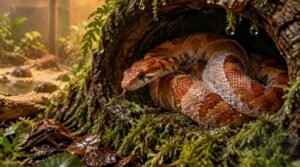
Why does humidity matter for a corn snake? These snakes come from the southeastern United States, where conditions shift between dry uplands and moist woodlands. Their skin needs adequate moisture to shed cleanly, and without it you risk stuck shed, which can cut off circulation to toes and the tail tip.
A moist hide placed over damp sphagnum moss gives your snake a dedicated spot to soften its skin before and during each shed.
Corn snakes don’t need continuously high enclosure humidity, though. What they need is access to a microclimate with elevated moisture, usually through a humid hide. This lets them self-regulate and seek higher humidity on their own terms without you turning the whole enclosure into a swamp.
Corn snakes don’t need a swamp—just a humid hide they can retreat to on their own terms
Humidity control for corn snakes is always less about constant saturation and more about giving your snake reliable access to the right conditions.
What Humidity Level is Best?
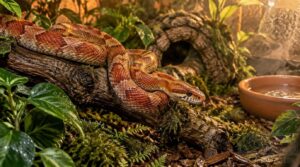
Now that you understand the microclimate principle, here are the actual target numbers. Corn snake Humidity Requirements aren’t complicated, but precision matters.
Keep 40-60 ambient humidity across the main enclosure. This range keeps healthy skin and respiratory function without creating conditions where mold thrives. During active shedding, you’ll want to push higher inside the humid hide specifically:
- Humid hide interior targets 65-75 during shed
- Cool side of the enclosure can stay at the lower end
- Warm hide microclimate normally sits around 50-55
- Never let ambient humidity exceed 70 for extended periods
- A digital hygrometer confirms your actual readings at a glance
That localized spike covers exactly what your snake needs during shed, without flooding the entire enclosure with excess moisture.
A dedicated humid hide, as detailed in this guide to common ball python shedding problems, gives your snake a controlled retreat without raising humidity levels across the whole enclosure.
How Should You Measure Enclosure Humidity?
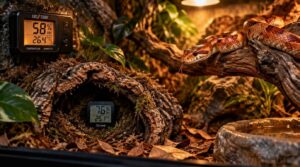
Those numbers only mean something if you’re actually measuring them correctly. A digital hygrometer is your go-to tool here, and placement matters just as much as the device itself.
- Mount one sensor at snake eye level on the warm side to track general enclosure humidity
- Place a second sensor inside the humid hide to capture the distinct microclimate reading
- Avoid positioning sensors directly above water bowls or near vents, which skew readings
- Check hygrometer accuracy after battery changes or repositioning, and recalibrate as needed
- Log daily min/max readings to spot humidity trends rather than relying on a single snapshot
Two sensors give you the full picture: 40-60 ambient humidity across the main enclosure, and 65-75 during shed inside the hide.
How Can You Raise Humidity Safely?
Raising humidity safely comes down to a few targeted adjustments rather than one sweeping fix. Each of the methods below targets a different part of the enclosure, so you can layer them or use just what your setup needs. Start with whichever factor is furthest off, then fine-tune from there.
Add a Humid Hide
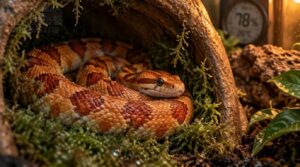
Think of a humid hide as a moist refuge your snake steps into whenever it needs to.
Unlike passive enclosure misting, a humid hide delivers concentrated moisture exactly when your snake signals it’s ready to shed — watch for those telltale behavioral and physical cues to know when one is overdue.
While 40-60 ambient enclosure humidity works fine day to day, it won’t be enough during a shed cycle. Place the hide on the warm side, lined with damp moss, and it creates a localized zone your snake uses entirely on its own terms.
Choose Moisture-Retaining Substrate
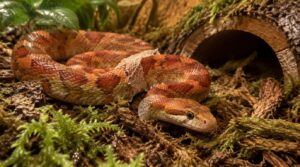
Picking a moisture-holding substrate does more for humidity control than any gadget will.
Mix cypress mulch with sphagnum moss, aim for 2 to 3 inches deep, and keep the mix consistently damp but never soggy. You’ll get a natural microclimate that carries your snake through a shed cycle cleanly, cutting the real risk of dysecdysis, especially beneath a humid hide.
Adjust Water and Ventilation
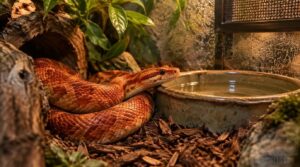
Balancing your water dish size and enclosure ventilation is where effective humidity control actually starts. A larger dish boosts evaporation quickly; better airflow counters it. Spotting condensation on the glass means moisture is clearly outpacing ventilation.
Pair moisture-retaining substrate with a well-sized water dish to consistently hit your humidity targets. If you don’t account for both, you’ll almost always overcorrect.
Manage Seasonal Changes
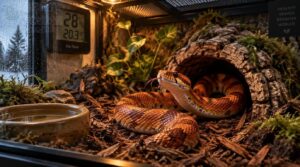
Imagine your corn snake’s enclosure humidity dropping all December with no changes on your end. Seasonal changes in ambient air cause this, and you’ll miss it without a plan.
- Monitor humidity levels weekly as seasons shift
- Dampen substrate when readings dip
- Partially close vents to reduce airflow
- Focus microclimate control in the hide
- Factor in thermal cycling for habitat simulation
How Does Shedding Change Humidity Needs?
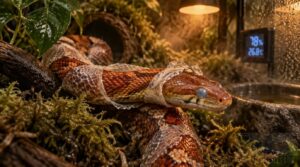
Your corn snake’s eyes cloud milky white, its skin shifts dull and chalky, and the enclosure humidity that worked fine last week suddenly isn’t cutting it. Shedding cycle management means proactively adjusting conditions before the process stalls.
During pre-shed and active shedding, target 65-75 during shed to support clean epidermal separation. Here’s exactly what to focus on:
- Place a humid hide packed with damp sphagnum moss inside the warm side.
- Bump ambient humidity to 60-70% for 1-2 days if shedding slows.
- Monitor daily with a digital hygrometer positioned at enclosure level.
- Return to your baseline humidity immediately after the shed completes.
Incomplete removal causes stuck shed, and repeated failures lead to dysecdysis, a condition that damages skin tissue over time.
When Does Humidity Become Unhealthy?
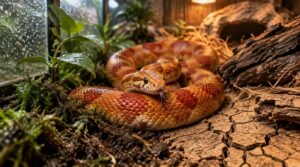
Humidity can hurt your snake in either direction, not just when it’s too low. Both extremes cause real health problems, and knowing the signs helps you course-correct before things get serious. Here’s what to watch for.
Signs Humidity is Too Low
Stuck shed is the clearest warning. If your snake exits a shed with patches clinging at the nose or tail tip, it’s a sign humidity ran too low. Check your digital hygrometer placement since readings near vents mislead you.
Low humidity risks dehydration. A humid hide during the 65-75% during shed window can prevent retained skin before it’s a problem.
Signs Humidity is Too High
Too much moisture is just as damaging as too little. Watch for mold issues on substrate or decor, condensation pooling on glass, and a persistent musty smell. A soggy humid hide, scale rot on your snake’s belly, or a respiratory infection showing as wheezing or mucus confirms humidity has crossed the line. Your digital hygrometer shouldn’t read above 60% consistently.
When to Contact a Vet
Some symptoms won’t resolve with a substrate swap or a humidity tweak. Seek veterinary advice if a respiratory infection develops (wheezing, open-mouth breathing, persistent mucus), if retained shed lingers on the eyes or tail tip, or if shed recurs across multiple cycles. Keep a husbandry log** to show your vet, since documented patterns help rule out systemic illness faster.
Frequently Asked Questions (FAQs)
How to keep corn snakes humid?
Keep a humid hide in the enclosure year-round and bump moisture levels temporarily during any shedding period. A moisture-retaining substrate paired with a digital hygrometer gives you consistent humidity control without soaking the whole enclosure.
Is 90 too hot for a corn snake?
90°F is the absolute ceiling for corn snake temperatures, not a target. Your basking temperature should sit between 85°F and 88°F, giving your snake plenty of room to thermoregulate safely without risking dangerous heat stress.
Maintaining proper thermal gradients is just one part of overall husbandry, and you should also monitor humidity during shedding cycles to make sure levels reach around 70% for a smooth, complete shed.
What is the best bedding for a corn snake?
Cypress mulch is your strongest moisture-retaining substrate, and aspen shavings are a close second, staying naturally low-dust and drying quickly. Paper-based bedding also works well. Avoid cedar and oak, as both can harm your snake.
How cold is too cold for a corn snake?
Below 70°F, your corn snake’s digestion shuts down completely. That’s when ectothermic biology starts working against you. A night temperature drop below 65°F means your snake can’t thermoregulate, and regurgitation becomes a very real risk.
Do hatchlings need different humidity than adults?
Yes, they do. A hatchling needs 60–70% relative humidity to support cuticle hydration and frequent shedding cycles. Adults manage fine at 40–60%. That gap matters for proper reptile husbandry, so don’t apply a one-size approach.
Can tap water be used for misting?
Tap water works, but treat it first with a reptile water conditioner like ReptiSafe. Chloramine doesn’t evaporate on its own. For cleaner nozzles and zero guesswork, distilled or RO water is the smarter long-term choice.
Does humidity affect a corn snakes appetite?
Moderate humidity in the 40-60% RH range won’t directly suppress your corn snake’s appetite on its own. What causes feeding refusal is environmental stress from severe humidity swings, particularly when conditions climb above 70% RH.
How does enclosure size impact humidity stability?
Enclosure volume directly shapes overall humidity consistency. Larger setups absorb moisture fluctuations more gradually because the air mass naturally buffers rapid changes. Smaller enclosures swing hard and fast, making environmental stability much harder to maintain.
Are bioactive setups better for maintaining humidity?
Bioactive setups do a lot of the work for you. Live plants and moisture-holding substrate create passive humidity, and that natural microclimate creation complements proper corn snake temperature gradients for better reptile health maintenance overall.
Conclusion
A corn snake that sheds cleanly, eats well, and breathes without effort is one whose owner got the basics right. Do corn snakes need extra humidity at home? Yes, but within a range, not a rigid number you chase obsessively.
Keep it between 40 and 60 percent. Bump it higher during sheds. Fix problems before they escalate. Your setup doesn’t need to be complicated; it just needs to be consistent.