This site is supported by our readers. We may earn a commission, at no cost to you, if you purchase through links.

A snake stuck mid-shed is stressful for both of you, and nine times out of ten, low humidity is the culprit. Whether you’re keeping a ball python or a corn snake, getting moisture levels right isn’t guesswork; it’s one of the most predictable parts of reptile care once you understand what drives it.
Do snakes need a fogger for humidity? Not always, but sometimes a fogger is exactly what closes the gap between "close enough" and stable. The right tool depends on your species, your setup, and your substrate, and the wrong combination can cause more problems than it solves.
Table Of Contents
- Key Takeaways
- Do Snakes Need a Fogger for Humidity?
- Match Humidity to Your Snake Species
- Maintain Safe Humidity With or Without Foggers
- Top 5 Foggers for Snake Enclosures
- Frequently Asked Questions (FAQs)
- How do I get my snakes’ humidity down?
- Is 90 degrees too hot for a snake?
- What is a good fogger for snakes?
- Does a reptile fogger help with humidity?
- Can foggers replace a water dish for snakes?
- How do I stop fogger condensation on glass?
- Are foggers safe for baby or juvenile snakes?
- Can two snakes share one fogger in cohabitation?
- Conclusion
Key Takeaways
- Most snakes don’t need a fogger—smart design choices like moisture-retaining substrate (coconut fiber, cypress mulch), covered hides, and a humid hide with damp sphagnum moss can hold steady humidity without constant misting.
- Match humidity to your species: tropical snakes like ball pythons need 60–80% relative humidity, while desert species like corn and king snakes thrive at 40–60%, and going too high for them invites respiratory infections. Since airflow affects how well an enclosure holds moisture, learning how to set up proper snake enclosure ventilation helps you keep humidity steady without stagnant air.
- If you do use a fogger, pair it with good ventilation and timed bursts rather than continuous running, since stagnant dampness causes condensation, mold, and respiratory risk—especially for baby snakes with smaller lungs.
- A digital hygrometer checked daily is your most important tool: stay within 5–10% of your target range, because even 10–15% humidity swings can trigger bad sheds in tropical species.
Do Snakes Need a Fogger for Humidity?
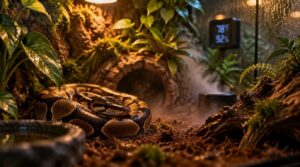
How often do you actually need a reptile fogger? Honestly, less than most snake keepers assume. Snakes don’t require continuous fogging to thrive, and running one nonstop is more likely to create problems than prevent them.
Foggers raise humidity fast, but that speed has a real catch. Poor ventilation combined with constant misting creates condensation, mold, and serious respiratory risk for your snake. That’s not humidity control, that’s a swamp. Pairing your fogger with a ventilation screen lid lets excess moisture escape before it turns into the kind of stagnant dampness that invites mold and illness.
Timing matters more than you’d think — a ball python humidity control guide can help you dial in fog duration and misting frequency before moisture levels spiral out of hand.
Your snake enclosure can hold steady humidity through smart design choices instead. Think moisture-retaining substrate, covered hides, and a digital hygrometer to track your readings. A controlled humidification plan beats a fogger running on autopilot every single time. Reserve your reptile fogger for when your setup truly needs the boost.
A controlled humidification plan beats a fogger on autopilot every single time
Match Humidity to Your Snake Species
Getting that "boost" right depends entirely on which snake you’re keeping. Species-specific humidity isn’t a single fixed number, it’s a range built around your animal’s natural habitat, and getting it wrong causes real, visible problems.
Tropical snakes like ball pythons and Amazon tree boas want 60–80% relative humidity inside their enclosure. Drop below that consistently and you’ll see stuck sheds and stressed animals.
Desert snakes are a completely different story. A corn snake or king snake thrives between 40–60% humidity levels, and pushing it higher invites respiratory infections you’d rather avoid. A reptile humidity controller thermostat takes the guesswork out of staying within that 40–60% sweet spot for your corn or king snake.
Think of it like checking the weather before packing for a trip. Know your species first, then build the right humidity levels into your snake enclosure from day one.
Maintain Safe Humidity With or Without Foggers
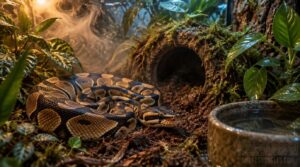
Once you know your species’ range, keeping it there is the real work. A reptile fogger is one tool, but it’s not the only one.
Substrate moisture does a lot of heavy lifting. Coconut fiber and cypress mulch hold water well, releasing it slowly and keeping enclosure humidity stable without constant misting. A water bowl on the warm side boosts evaporation naturally.
For humidity control without a fogger, try a humid hide packed with damp sphagnum moss. It gives your snake a private microclimate for sheds without soaking the whole setup.
Whatever method you use, consistent humidity monitoring matters most. Place a digital hygrometer near the cool end and check it daily. Stay within 5-10% of your target humidity levels.
If you’re weighing which misting setup best suits your enclosure, this guide to reptile misting systems for automated humidity control covers key features worth comparing before you buy.
Top 5 Foggers for Snake Enclosures
Not every fogger is built the same, and the wrong pick can cause more problems than it solves. These five options cover a solid range of budgets, tank sizes, and output levels. Pick the one that fits your setup and your snake’s needs.
1. Zoo Med Repti Fogger Ultrasonic Humidifier
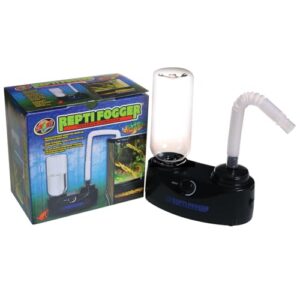
Here’s a number worth remembering: humidity swings of just 10–15% can trigger bad sheds in tropical species. That’s where the Zoo Med Repti Fogger earns its keep.
It’s an ultrasonic unit that pumps out cool mist without heat, and the adjustable rheostat lets you dial output up or down like a weatherman forecasting fog. You get a one-liter bottle, a no-spill valve for painless refills, and compatibility with the Zoo Med HygroTherm controller for hands-off precision.
Size-wise, it fits small to mid-sized terrariums, measuring 10.1" x 6.2" x 9.8". It shines with chameleons, anoles, dart frogs, and tropical geckos.
Two caveats before you buy. The safety shut-off only works when the base is full and the float is active, so check it. And some owners report inconsistent mist or a defective rheostat, though warranty replacement covers that. Pair it with good airflow and a timer, and you’ve got a solid, quiet workhorse.
| Best For | Keepers of small to mid-sized terrariums housing humidity-loving species like chameleons, anoles, dart frogs, and tropical geckos who want adjustable, hands-off misting. |
|---|---|
| Tank Capacity | 1 liter |
| Auto Shut-off | Yes |
| Noise Level | Variable |
| Adjustable Output | Yes |
| Color | Blue |
| Dimensions | 10.1″ x 6.2″ x 9.8″ |
| Additional Features |
|
- Adjustable rheostat lets you fine-tune fog output for precise humidity control.
- No-spill valve makes bottle removal and refilling quick and mess-free.
- Compact ultrasonic design works out of the box and pairs with the Zoo Med HygroTherm controller for automated climate management.
- Safety shut-off only functions when the base is full and the float is active, so it requires monitoring.
- The rheostat has a history of defects that sometimes require warranty replacement.
- Some owners report inconsistent mist production and variable noise levels.
2. BETAZOOER Reptile Ultrasonic Humidifier Mister
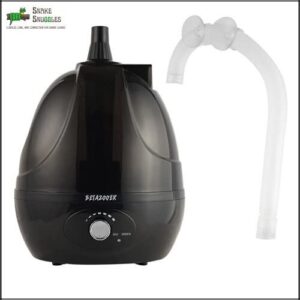
The BETAZOOER Reptile Ultrasonic Humidifier Mister packs a 2.5-liter tank into a compact unit that runs continuously once powered. Its adjustable mist output dial lets you fine-tune fog production, and the dry-run auto-shutoff protects the transducer when the reservoir empties.
The extension tubes stretch from 1.3 to 5.3 feet, giving you flexibility to route fog exactly where your snake needs it. One catch: refilling means disconnecting the hose adaptor, and some users have reported durability issues after months of use.
| Best For | Reptile and amphibian keepers who need quiet, consistent humidity in vivariums, glass tanks, PVC cages, or aquariums. |
|---|---|
| Tank Capacity | 2.5 liters |
| Auto Shut-off | Yes |
| Noise Level | Low-noise |
| Adjustable Output | Yes |
| Color | Black |
| Dimensions | 6″ x 7.8″ x 11.4″ |
| Additional Features |
|
- Adjustable mist output dial gives you precise control over fog levels to match your pet’s needs
- Dry-run auto-shutoff protects the unit when the tank runs empty, adding a layer of safety
- Low-noise operation keeps the environment calm for sensitive reptiles and amphibians
- Runs continuously with no built-in timer, so you’ll need an external controller for automated schedules
- Refilling the tank requires disconnecting the hose adaptor, which can be inconvenient
- Some users report mechanical failures and electrical shorts after extended use, raising durability concerns
3. VIVOSUN Reptile Terrarium Humidifier Fogger
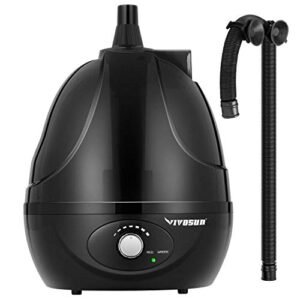
Three misting speeds (100, 200, or 300 ml/hour) give you genuine control over humidity. The detachable tube design means you can even use it as a standalone home humidifier, and the hose stretches from 1.5 to 5 feet with suction cup mounting. A 2.5-liter tank paired with auto shut-off keeps things manageable.
That said, durability’s a real concern. Customer reports flag potential failure within two weeks, and the hose requires tilting to work. Treat it as a capable budget buy.
| Best For | Reptile, amphibian, and hermit crab owners who want adjustable humidity control on a budget. |
|---|---|
| Tank Capacity | 2.5 liters |
| Auto Shut-off | Yes |
| Noise Level | Quiet |
| Adjustable Output | Yes |
| Color | Black |
| Dimensions | N/A |
| Additional Features |
|
- Three misting speeds (100, 200, 300 ml/hour) let you dial in the exact humidity level your pets need
- Large 2.5-liter tank with auto shut-off means less frequent refills and no dry-run damage
- Detachable tube doubles as a standalone home humidifier, adding flexibility beyond the terrarium
- Customer reports suggest it may fail within two weeks, raising serious durability concerns
- The hose needs to be tilted to function properly, which limits clean and flexible placement
- Mixed reviews on build quality make it a risky long-term investment
4. Evergreen Reptile Fogger Humidifier 2L
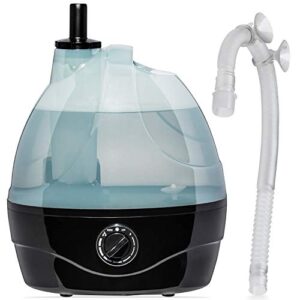
The Evergreen Reptile Fogger Humidifier 2L punches above its weight as a budget option. Its 2-liter water tank runs for several hours before you need a refill, and the ultrasonic mist output stays cool so it won’t throw off your enclosure’s temperature balance. You also get an automatic shut-off to protect the unit when water runs low, plus a no-spill valve for easy, mess-free refills.
Just a heads up: some owners report leaks and units failing around the one-year mark.
| Best For | Reptile owners looking for an affordable, quiet humidifier for tortoise, snake, or frog enclosures. |
|---|---|
| Tank Capacity | 2 liters |
| Auto Shut-off | Yes |
| Noise Level | Quiet |
| Adjustable Output | Yes |
| Color | Black/Clear |
| Dimensions | 8.5″ x 8.5″ x 8.5″ |
| Additional Features |
|
- 2-liter tank provides several hours of runtime before needing a refill
- Automatic shut-off prevents damage when water runs low
- Ultrasonic mist stays cool, so it won’t disrupt your enclosure’s temperature
- Some users report leakage issues during normal use
- Units may fail around the one-year mark
- Water can deplete quickly depending on how much mist output you need
5. BETAZOOER Top-Fill Reptile Humidifier
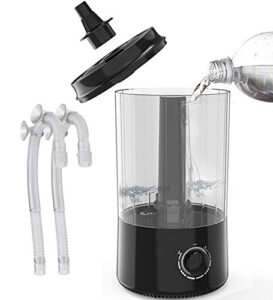
Refilling a fogger shouldn’t feel like defusing a bomb. The top-fill design here fixes exactly that: just pour water in from the top, no awkward flipping or disassembly.
You get a 3.8-liter tank pushing up to 320 ml of mist per hour, with extension tubes stretching up to 5.3 feet for flexible positioning inside any enclosure. Dry-run protection shuts it off automatically when the tank empties.
If you’re torn between this setup and a full misting system, our fogger vs. misting system comparison breaks down which works better for different snake enclosures.
The real catch? Some users report units dying after just one week of use.
| Best For | Reptile and amphibian owners who want a large-capacity, easy-to-refill humidifier and don’t mind keeping a close eye on long-term durability. |
|---|---|
| Tank Capacity | 3.8 liters |
| Auto Shut-off | Yes |
| Noise Level | Silent |
| Adjustable Output | N/A |
| Color | Transparent |
| Dimensions | 14.65″ x 8.78″ x 7.68″ |
| Additional Features |
|
- Top-fill design makes refilling and cleaning quick and hassle-free
- Generous 3.8-liter tank with up to 5.3-foot extension tubes offers flexible placement in almost any enclosure
- Dry-run protection automatically shuts the unit off when water runs out, preventing damage
- Some units stop producing mist after just a week of use, raising reliability concerns
- Plastic components have been reported to break or fall off within days of use
- At least one user experienced the tank needing to be emptied manually every five minutes during operation
Frequently Asked Questions (FAQs)
How do I get my snakes’ humidity down?
Think of your enclosure like a sweaty gym locker. Crack it open. Boost ventilation first, add vents or adjust your screen top. Check your humidity levels with a hygrometer and swap to a drier substrate.
Is 90 degrees too hot for a snake?
Brief 90°F spikes? Mostly fine for many species. But sustained high heat absolutely wrecks thermoregulation, tanks humidity, and hammers your snake’s respiratory health. Always give your tropical snake a cool retreat and solid enclosure ventilation.
What is a good fogger for snakes?
Imagine a gentle cloud of mist rolling through your snake’s home every hour. The Zoo Med Repti Fogger works for small enclosures well, while the BETAZOOER ultrasonic fogger covers larger tanks with its dual nozzle design.
Does a reptile fogger help with humidity?
Yes, a reptile fogger actively raises enclosure humidity by dispersing fine water particles right into the air. It’s a solid reptile husbandry tool, especially when your substrate alone can’t consistently hit your snake’s target range.
Can foggers replace a water dish for snakes?
Can fog quench thirst? A reptile fogger boosts relative humidity, but snake enclosure humidity control doesn’t cover actual hydration at all. Your snake still needs a water dish to drink and soak. Fog simply can’t.
How do I stop fogger condensation on glass?
Glass sweats when your enclosure’s surface temperature drops below the dew point. Pull the fogger away from the front panel, use short timed bursts instead of continuous misting, and add ventilation to cut condensation fast.
Are foggers safe for baby or juvenile snakes?
Baby snakes have smaller lungs and tracheas, so they’re far more sensitive to sudden humidity spikes. Use short, intermittent cycles with distilled water, and position the fogger so no droplets land directly on your juvenile.
Can two snakes share one fogger in cohabitation?
Cohabitation doesn’t rule it out. One fogger can work if your setup spreads moisture evenly across both zones. Use at least two sensors, aim fog at walls instead of snakes, and watch for humidity hotspots.
Conclusion
Foggers aren’t magic, and they’re not always the answer. Do snakes need a fogger for humidity? Only when your enclosure can’t hold steady levels another way. Good substrate, a sealed lid, and a reliable gauge will handle most situations before you ever need to plug anything in.
But when tropical species demand 80% or dry winters fight your setup, a fogger fills the gap. Match the right tool to your animal, and clean sheds follow.