This site is supported by our readers. We may earn a commission, at no cost to you, if you purchase through links.

A ball python can refuse every meal you offer for weeks, and the culprit often isn’t food, stress, or handling. It’s a basking spot sitting three degrees too cool. When your snake can’t warm its body to at least 29°C after eating, digestion stalls, and that half-processed meal can rot in its stomach.
This is why accurate temperature matters for ball pythons more than almost any other husbandry detail. Their bodies run on borrowed heat, and your enclosure is that heat source. Below, you’ll find the exact numbers, tools, and fail-safes that keep your python digesting, feeding, and thriving.
Table Of Contents
- Key Takeaways
- Why Does Accurate Temperature Matter?
- What Temperatures Do Ball Pythons Need?
- Why is a Thermal Gradient Essential?
- How Should Enclosure Temperatures Be Measured?
- What Happens When Temperatures Are Wrong?
- How Can You Maintain Stable Temperatures?
- Frequently Asked Questions (FAQs)
- Is 93 too hot for ball python?
- Is 80 degrees too cold for a ball python?
- Is 90 degrees too hot for a snake?
- What is the perfect temperature for a ball python?
- Can heat mats be used without a thermostat?
- Are heat rocks safe for ball pythons?
- Which heat source works best overnight?
- How does humidity affect temperature needs?
- What causes temperature swings in an enclosure?
- Conclusion
Key Takeaways
- Ball pythons need a proper thermal gradient: warm side 88–92°F, cool side 78–82°F, and a basking surface of 92–95°F, so they can thermoregulate, digest efficiently, and stay healthy.
- If your snake can’t reach at least 29°C (about 85°F) after eating, digestion stalls and a half-processed meal can rot in its stomach, so even a few degrees of error can cause refused meals within days.
- Measure temperatures correctly by placing digital probes at mid-height on each side (off hides and substrate), using an infrared thermometer for surface readings, and calibrating your equipment every three months.
- Never run heat mats or heat rocks without a thermostat—use a primary thermostat plus a secondary high-limit fail-safe set 5–8°C above your basking setpoint to prevent burns, dehydration, and dangerous spikes.
Why Does Accurate Temperature Matter?

Ask any experienced keeper what makes or breaks ball python health, and temperature control tops the list. These snakes are ectotherms, meaning they depend entirely on their environment for thermal regulation. When your enclosure’s warmth matches their needs, digestion runs smoothly, appetite stays strong, and shedding comes off in clean, complete pieces.
Getting the gradient right matters just as much as the numbers themselves, and our ball python temperature gradient guide walks you through setting up warm and cool zones properly.
Get it wrong, and problems appear fast. A few degrees too cool can slow metabolism within 24 to 72 hours, causing refused meals and incomplete digestion. Chronic heat errors raise stress hormones, which weakens the immune system and disrupts normal behavior.
Even a few degrees of error can slow your ball python’s digestion within days, weakening immunity and triggering refused meals
Accuracy matters just as much as the numbers themselves. A reliable thermometer placed correctly, checked regularly, gives you the confidence that your snake’s temperature gradient is doing its job every single day.
What Temperatures Do Ball Pythons Need?

Getting your ball python’s temperatures right comes down to three numbers you’ll check every day. Each zone of the enclosure has a different purpose, so each one has its own target range. Let’s walk through the warm side, cool side, and basking surface so you know exactly what to aim for.
Warm-Side Ambient Range
Keeping your warm side temperatures between 28–32°C gives your ball python the warmth it needs to feed and digest properly. Aim for day-to-day swings of no more than 2–3°C, since rapid changes disrupt shedding and metabolism.
If your enclosure setup runs cool, a stable hot spot of 32–34°C maintained through thermostat control keeps the temperature gradient reliable.
Cool-Side Ambient Range
Once your warm side’s dialed in, the cool-side ambient temperature should sit between 21–29°C (70–85°F). This cooler zone completes the temperature gradient your snake needs to self-regulate.
Getting these numbers right is much easier with a quality thermostat, so it’s worth comparing thermostat types for snakes before you buy.
Aim for stability within 2–3°C. Place a thermometer at the cool end of your enclosure setup for accurate temperature monitoring. Sustained drops below this range stress your snake more than brief fluctuations do.
Basking Surface Range
Your basking surface temperature should sit between 32–40°C (89–104°F), noticeably hotter than the surrounding warm side. This localized hotspot completes the temperature gradient your snake needs for proper digestion.
Give your heat source 15–30 minutes to reach that target, then check it with a thermometer before your snake settles in. You’ll want thermostat control to prevent dangerous spikes above 40°C.
Why is a Thermal Gradient Essential?
Picture your python’s enclosure as a landscape, not a single climate. In the wild, ball pythons move between sun-warmed surfaces and shaded retreats, and they rely on that variety to thrive. A proper temperature gradient lets your snake practice thermoregulation, the same behavior it would use naturally.
Getting those details right matters most during breeding season, so a snake breeding lighting and enclosure setup guide can help you fine-tune your temperatures, humidity, and UVB placement.
Pairing a warm basking spot with a cooler hide on the opposite end is the foundation, and this ball python temperature gradient guide walks through exact heat placement and overnight stability.
Here’s what a good thermal gradient gives you:
- Efficient digestion, since your python can visit the basking spot after eating to power its metabolism.
- Safe cooling, because a cooler refuge lets it shed excess heat and avoid dangerous overheating.
- Natural behavior, as shuttling between zones keeps appetite, activity, and shelter-seeking instincts sharp.
Without distinct warm and cool areas, your snake can’t fine-tune its body temperature. That constant compromise causes stress, poor feeding response, and weakened immunity. Balance your heat source carefully so one end stays warm while the other offers genuine relief.
How Should Enclosure Temperatures Be Measured?
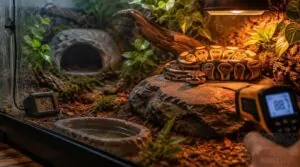
Knowing your temperatures is only half the battle; measuring them correctly is what keeps your snake safe. You’ll need the right tools in the right places, because a reading taken at the wrong spot can mislead you completely.
Let’s walk through thermometer placement, infrared surface checks, and a simple calibration schedule you can follow.
Digital Thermometer Placement
Here’s a placement cheat sheet for your digital thermometer:
| Probe location | What it tells you |
|---|---|
| Warm side, mid-height | Warm-side ambient |
| Cool side, mid-height | Cool-side ambient |
| Near heat mat airflow | Effective warm gradient |
| Shielded from lamp glare | Unbiased air reading |
| Same spot every check | Consistent temperature verification |
Keep probes off hides and substrate, since microclimates skew readings. Good probe placement accuracy makes every temperature measurement trustworthy, and consistent thermometer positioning gives you reliable temperature verification.
Infrared Surface Checks
Think of your infrared thermometer as a camera flash, freezing one instant of heat. Aim it at the basking surface temperature, not the air.
Hold it 2–4 cm above the substrate at the hot side’s midline, and sample a 20–30 cm wall segment to catch hot spots.
Remember, your thermometer reads surface temperature, so readings may run a few degrees above ambient.
Equipment Calibration Schedule
A thermometer is like a watch that slowly loses time, you won’t notice the drift until you’re late. Calibrating thermometers every three months keeps readings reliable.
Check your thermostat probe against a trusted reference. If your programmable thermostat shows more than 2°F off, replace or recalibrate it. Log each temperature calibration result to spot growing drift across your temperature probes.
What Happens When Temperatures Are Wrong?

Wrong temperatures don’t just make your ball python uncomfortable; they trigger a chain of real health problems. When the basking spot drops below 85°F, digestion slows a lot, meaning your snake sits with unprocessed food, risking regurgitation and serious infection.
A temperature gradient that swings more than 3 to 5°F daily puts your snake’s stress hormones into overdrive. You’ll notice a reduced feeding response first, then gradual weight loss over weeks. If the heat source runs too hot, above 92°F, dehydration and respiratory irritation follow surprisingly quickly.
Nighttime temps below 75°F suppress immune function, leaving your python vulnerable to bacterial and fungal infections. These signs can often creep up slowly, so consistent temperature control monitoring is your most reliable warning system.
How Can You Maintain Stable Temperatures?
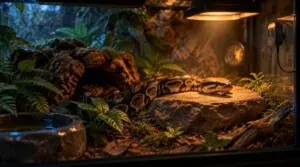
Consistency is what separates a thriving ball python from a stressed one. Your enclosure heating needs to run like a well-tuned system, not a guessing game.
Start by anchoring everything to thermostat-controlled systems that hold your heat source within ±0.5°C of the setpoint. That precision actively protects the temperature gradient you’ve carefully built across the enclosure.
Three habits that lock in temperature stability:
- Use a UPS to sustain heat output during unexpected power interruptions for at least 30 minutes.
- Seal drafts and insulate walls so the enclosure retains warmth between heating cycles.
- Set a secondary high-limit thermostat 5–8°C above your basking setpoint as a built-in fail-safe.
Calibrate your probes at least quarterly so the readings you trust are actually accurate.
Frequently Asked Questions (FAQs)
Is 93 too hot for ball python?
Short answer: 93°F is fine as a basking surface temperature, but it’s too warm as constant warm-side ambient heat. Aim for 88–92°F ambient, and give your snake a cooler zone around 78–82°F.
Is 80 degrees too cold for a ball python?
Oh, 80 degrees, your python’s dream vacation, right? Not quite. 80°F is too cool for a warm side. Aim for 88–92°F ambient, keep cool side temperatures at 78–82°F, and add a 90–95°F basking surface.
Is 90 degrees too hot for a snake?
No, 90°F isn’t too hot for your snake’s warm side. It sits comfortably within the ideal 88–92°F range, as long as your thermal gradient offers a cooler zone so your ball python can regulate its temperature.
What is the perfect temperature for a ball python?
There’s no single perfect number, but aim for a basking spot of 92–95°F, warm-side ambient air temperature of 88–92°F, and a cool side at 78–82°F, creating a proper temperature gradient.
Can heat mats be used without a thermostat?
No, never run a heat mat without a thermostat. Unregulated mats can exceed 90°F, causing burns and dehydration. Always pair your heat mat with a thermostat probe in the warm zone for reliable temperature control and heat source safety.
Are heat rocks safe for ball pythons?
No, heat rocks aren’t safe for ball pythons. They lack reliable thermostats, develop dangerous hotspots, and can cause burns. Instead, use a thermostat-controlled heat source that provides a proper temperature gradient and a safe basking spot.
Which heat source works best overnight?
Think of a radiant heat panel as moonlight, gently warming from above. For overnight use, it’s your best heat source: pair it with a thermostat probe for steady temperature control, and add substrate insulation for better heat retention.
How does humidity affect temperature needs?
Humidity changes everything! When humidity levels rise, your ball python needs a slightly warmer basking surface to offset evaporative cooling. In drier air, keep the ambient air temperature a touch cooler, protecting your temperature gradient.
What causes temperature swings in an enclosure?
You might assume a single good heater solves everything, but temperature fluctuation usually comes from placement near drafts, poor insulation, a faulty thermostat probe, undersized heating equipment, or substrate that cools quickly after lights-off.
Conclusion
Picture your python coiled on a warm rock, stomach working through a meal, everything moving at the pace heat allows. That image is the whole point of why accurate temperature matters for ball pythons.
Your thermometer isn’t a gadget; it’s a window into digestion. Check your readings weekly, trust infrared spot checks, and adjust before problems start. Do that, and you’ll rarely see a refused meal again.