This site is supported by our readers. We may earn a commission, at no cost to you, if you purchase through links.

Corn snakes escape more often than they get sick—and that fact alone tells you where most keepers go wrong. A lid that "seems secure" is a trail of shed skin two days later and a snake behind your refrigerator.
But once you nail the housing, the rest of the essentials for keeping a corn snake healthy fall into a logical rhythm: the right temperatures, correctly-sized prey, a clean substrate, and a quick eye for anything that looks off. These aren’t complicated rules. They’re a short list of specific habits that separate thriving snakes from stressed ones.
Table Of Contents
- Key Takeaways
- Choose Safe Corn Snake Housing
- Maintain Proper Heat and Humidity
- Feed The Right Prey Safely
- Use Healthy Substrate and Cleaning
- Monitor Health, Handling, and Stress
- Frequently Asked Questions (FAQs)
- How to keep a corn snake healthy?
- Do corn snakes like to be misted?
- What is the biggest trouble with corn snakes as pets?
- Do corn snakes need daily care?
- How long do corn snakes typically live?
- Can corn snakes coexist with other snake species?
- Do corn snakes need UVB lighting to thrive?
- How do I safely handle a defensive corn snake?
- What are the best enrichment activities for corn snakes?
- Conclusion
Key Takeaways
- Escape-proofing your enclosure is the first real test of corn snake ownership — a lid that "seems secure" isn’t secure enough.
- Warm side at 82–86°F, cool side at 75–82°F, and a thermostat on every heat mat: these three numbers prevent most health problems before they start.
- Always feed frozen-thawed prey with tongs, size prey to no wider than your snake’s thickest point, and don’t touch the snake for 48 hours after it eats.
- Daily water changes, monthly disinfection, and knowing what a healthy snake looks like are what separate keepers who rarely see a vet from those who visit often.
Choose Safe Corn Snake Housing
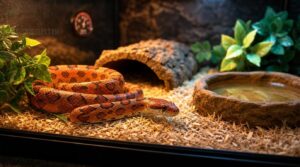
Getting the enclosure right is the first thing you do for your corn snake’s long-term health. A few specific choices determine whether your snake stays safe, stress-free, and thriving.
This corn snake habitat setup guide walks you through each of those choices so nothing important gets missed.
Here’s what you need to set up the housing correctly. The enclosure ensures your snake’s well-being, so prioritize this step for optimal care.
Minimum Enclosure Size for Juveniles and Adults
Size matters more than you’d think. Juvenile snakes thrive in a 20-gallon long enclosure, but adult snakes require a minimum of a 40-gallon enclosure—which is roughly 48 inches by 24 inches. This approach integrates Space Shift Planning into your budget from the start. Ensuring a minimum floor space of at least 0.5 m² per small animal aligns with welfare guidelines.
Strategic enclosure planning involves:
- Expandable Juvenile Enclosure: Start small, upgrade before 12 months
- Adult Square Footage: 48" × 24" facilitates full thermal gradient movement
- Footprint Flexibility + Growth Scaling: Match enclosure size to body length continuously
Escape-proof Lids and Secure Doors
Once your enclosure is sized right, keeping your snake inside it becomes the next priority. Corn snakes are surprisingly strong and persistent escape artists.
Snap-fit lids, gasketed seals, and cam-lock straps provide reliable enclosure security. Reinforced hinges with a positive stop prevent door flex.
Avoid magnetic-only closures — they fail under sustained pressure. Secure lids aren’t optional; escape prevention is what keeps your snake safe.
Proper Tank Length for Healthy Movement
Tank length shapes everything about how your snake moves. In a 40-gallon tank, the floor length ratio matters more than volume — your corn snake needs room to fully extend, turn, and travel between zones without pinching.
Good enclosure design principles prioritize:
- Uninterrupted travel corridor design between warm and cool ends
- Turning space width so body curves stay gradual, not sharp
- Burrow path length and movement zone distribution throughout usable floor space
Warm-side and Cool-side Hide Placement
Your corn snake requires dual hide spots — one on the warm side, one on the cool side. Position each hide where substrate-level temperature checks confirm the correct zone: 80–85°F warm side, 70–78°F cool side.
Gradient-based hide positioning allows your snake to thermoregulate without exposure. Ensure concealed entrance sizing accommodates your snake fully inside.
Maintain dual-zone hide balance to keep both ends equally appealing.
Humid Hide for Shedding Support
During shedding, your corn snake needs more than ambient humidity levels — it requires a dedicated moisture pocket. Place a non-porous hide filled with damp sphagnum moss or coconut fiber on the warm side for gradient-aware hide location. This microclimate maintains around 70% humidity, preventing stuck shed.
Practice substrate moisture management by replacing contents weekly and follow microbe-safe cleaning routines to eliminate bacterial risk.
Branches, Cork Bark, and Foliage for Enrichment
Adding branches, cork bark, and foliage transforms a bare tank into a living environment your corn snake will actually use.
- Climbing Pathways — span branches from cool to warm zones for natural movement
- Texture Variation — cork bark’s grip enables confident climbing
- Visual Barriers — naturalistic plantings create hiding spots that reduce stress
Maintain decor hygiene monthly. Replace anything soft or discolored immediately.
Maintain Proper Heat and Humidity
Getting the temperature and humidity right is probably the most important thing you can do for your corn snake. Too hot, too cold, or too dry — any of these can cause real health problems fast.
Here’s what you need to monitor and maintain inside the enclosure.
Ideal Warm-side Temperature Range
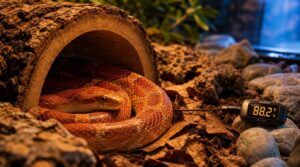
Your warm side should sit between 82–86°F — that’s the sweet spot for digestion and daily activity. Place your temperature probe at hide level, not mid-air, for accurate readings.
Thermostat calibration matters here; an unchecked heat source drifts fast. A reliable thermostat control keeps the basking spot steady without swings.
Temperature stability strategies beat constant manual adjustments every time.
Safe Cool-side Temperature Range
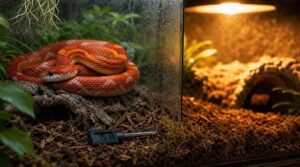
The cool side needs to stay between 75–82°F — that’s your snake’s recovery zone after basking. Gradient monitoring keeps both temperature zones honest.
Place your thermostat probe at substrate level to catch real conditions.
Watch for heating leak control issues and draft prevention problems that quietly shift the cool side.
Seasonal temperature tweaks may be needed as room conditions change.
Nighttime Temperature Limits
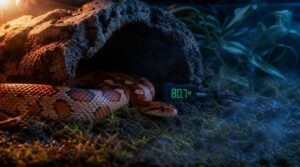
Nights aren’t a free pass to let things slide. Your corn snake’s nighttime temperatures need to stay between 65–70°F — that’s your minimum night threshold. Drop below 65°F and digestion slows dangerously.
Keep these four things locked in:
- Probe positioning matters — place probes near hides, not heat sources
- Night drop should be gradual, never sudden
- Night gradient stability means warm-side hides stay warmer than cool-side hides
- Nighttime humidity balance shifts overnight, so monitor both temperature and humidity together
Using Thermostats With Heat Mats
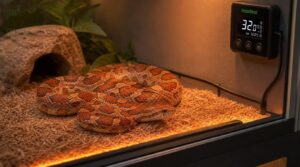
A heat mat without a thermostat is like a car with no brakes — functional until it isn’t. Always plug your heat mat into a digital thermostat.
Proper thermostat setup is critical. Probe placement determines accuracy: position it directly on the warm-side substrate surface. Additionally, configure hysteresis settings to prevent rapid on/off cycling, ensuring stable temperature regulation.
Safety hinges on compatibility and organization. Match wattage carefully, ensuring the mat’s wattage stays within the thermostat’s rated limit. For cable management, route cables along enclosure edges to avoid hazards and maintain a tidy setup.
Before introducing your snake, conduct overheat testing. Verify with an independent thermometer to confirm the system operates within safe temperature ranges.
| Thermostat Factor | What to Do |
|---|---|
| Probe Placement | On warm-side substrate surface |
| Hysteresis Settings | Prevents rapid cycling |
| Wattage Matching | Mat wattage within thermostat’s rated limit |
| Cable Management | Route along back edges |
| Overheat Testing | Verify with independent thermometer |
Ceramic Heat Emitters and Basking Lamps

Beyond the heat mat, ceramic heat emitters and basking lamps provide precise control over your temperature gradient. Ceramic heat emitters deliver infrared heat without light, making them ideal for maintaining nighttime temperatures without disrupting your snake’s natural cycle. Basking lamps, on the other hand, ensure adequate daytime warmth.
Both setups demand careful implementation: fixture compatibility, wattage matching to your thermostat, and guard installation are essential to prevent direct contact with the bulb. This safeguards your snake from potential burns while ensuring consistent thermal regulation.
Why Heat Rocks Are Unsafe
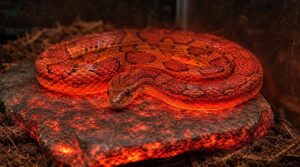
Skip heat rocks entirely — they’re one of those products that look convenient but fail in practice. Three reasons they don’t work:
- Surface hotspots cause localized burns even when air temperature looks fine
- Thermostat bypass means no real temperature regulation
- Uneven gradients from hidden failures disrupt thermoregulation completely
Your snake can’t move away from a floor-level heat source it’s resting directly on.
Daily Thermometer and Hygrometer Checks
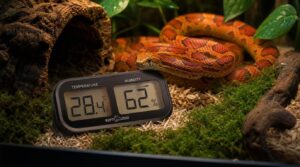
Your instruments only help if you trust them. Place each digital thermometer and hygrometer sensor at snake level — not pressed against bedding — for accurate temperature monitoring and humidity management.
Check readings at the same time daily; consistent timing makes comparisons reliable. Use min‑max logging to catch overnight drifts.
Set alert thresholds so small shifts don’t quietly become big problems.
Build a weekly calibration routine.
Raising Humidity During Shedding

Your hygrometer gives you the data — now act on it. When your corn snake goes into shed, bump humidity to around 70%. A warm-side humid hide manages microclimate optimization without soaking the entire tank.
To set this up effectively:
- Damp sphagnum moss works best inside the hide
- Replace moss when dry or soiled
- Avoid overloading the misting schedule — keep conditions damp, not saturated
- Ensure the humidity sensor is placed at snake level for accurate monitoring
- Spot-clean wet areas to manage mold risks
Consistent maintenance ensures a healthy shedding environment while preventing excess moisture buildup.
Feed The Right Prey Safely
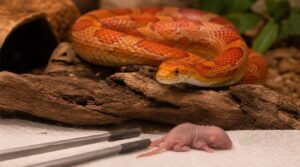
Feeding a corn snake sounds simple — and it mostly is, once you know the rules. But get a few key details wrong and you’re looking at regurgitation, stress, or a snake that flat-out refuses to eat.
Here’s what you actually need to know to get it right every time.
Feeding Schedule by Corn Snake Age
Age drives everything about your corn snake’s feeding schedule. Hatchling feeding frequency starts at every 5–7 days — their growth rate demands it. Juvenile meal intervals stretch to every 7–10 days as metabolism settles. Adult maintenance schedules run every 10–21 days. Senior diet adjustments mirror adults but lean toward the longer end.
Skipped meals? Follow a simple meal skipping protocol: wait, retry, don’t force it.
Choosing Correct Prey Size
Prey size is where many keepers trip up. The Width Matching Rule keeps it simple: prey diameter shouldn’t exceed your snake’s widest body point. A useful Gape-to-Prey Ratio target is 1.5x that width — max.
Aim for roughly 10% of body weight as your Prey Weight Percent.
Use Incremental Size Steps as your snake grows.
Watch for Feeding Struggle Signals: slow swallowing, stalled prey, or regurgitation means go smaller next time.
Frozen-thawed Mice Versus Live Prey
Frozen-thawed mice consistently outperform live alternatives, and clinical evidence strongly supports this preference. Live rodents pose significant risks, including parasite transmission and physical injuries. A defensive mouse can inflict puncture wounds on a snake, leading to potential secondary infections. Frozen-thawed options eliminate these dangers entirely, offering superior safety and hygiene. They also ensure better long-term prey acceptance and simplify thawing protocols.
Frozen-thawed mice eliminate live prey risks entirely, offering corn snakes safer meals and better long-term feeding success
The advantages of frozen-thawed mice are clear when compared directly:
- Parasite risk: Freezing kills many parasites that live prey carries.
- Wound hazards: No bites, no scratches, no secondary infections.
- Scent cues: Warmed frozen-thawed mice trigger reliable feeding responses.
- Enclosure contamination: No live rodent hiding, soiling, or gnawing.
Even small pinkie mice can bite hatchlings, reinforcing the need for frozen-thawed solutions. Stick with this safer, more controlled feeding method.
Safely Thawing and Warming Rodents
Thawing frozen or thawed prey incorrectly is one of the fastest ways to stress your snake. To avoid this, use the Water Bath Method: place the rodent in a Sealed Bag and submerge it in lukewarm water. This ensures even thawing and prevents bacterial growth.
| Step | Target |
|---|---|
| Thaw water temperature | Lukewarm only |
| Warm after thawing | Body temperature |
| Prevent hot spots | No microwave |
| Time and Temperature Control | Feed immediately |
Using Feeding Tongs
Good feeding tongs are your best tool for safe, stress-free meals. Grip-Enhanced Tips hold prey firmly during Angled Presentation, letting you simulate natural Prey Motion Simulation without putting your fingers in strike range.
- Keep tongs dedicated to feeding only — Tool Hygiene prevents Cross Contamination from enclosure debris
- Use angled tips to present prey at hide entrances
- Move prey slightly to trigger a confident strike
- Hold steady once the snake latches
- Clean and dry tongs after every use
Avoiding Handling After Meals
After your snake takes prey, step back and leave it alone. A 24–48 hour wait isn’t optional — it’s how digestion actually works. Keep the enclosure quiet, skip lid-opening checks, and monitor swallow completion before walking away. Limit post-feed disturbances completely.
That single habit, built into your feeding guidelines and post-meal handling protocols, prevents most regurgitation problems before they start.
Preventing Regurgitation and Digestive Stress
Regurgitation usually traces back to three things: prey too large, temperatures too low, or the snake disturbed mid-digestion.
Keep your consistent feeding location stable, maintain that controlled thermal rise on the warm side, and protect a low-vibration environment for 48 hours post-meal.
Undisturbed post-feeding periods and calm ambient lighting aren’t extras — they’re what makes your feeding guidelines actually work.
When Supplements May Be Needed
Most corn snakes eating quality frozen-thawed rodents don’t need supplements. However, certain conditions may necessitate additional nutritional support.
- Rapid growth in juveniles can outpace calcium intake
- Chronic illness or parasite burden reduces nutrient absorption
- Prey nutrient gaps from inconsistent feeder sources
- Low-calcium diet may require monthly calcium powder dusting
- Growing snakes benefit most from growth rate monitoring and adjusted dietary guidelines
Growing snakes, in particular, demand careful observation and tailored feeding protocols to ensure optimal development.
Use Healthy Substrate and Cleaning
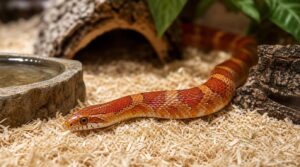
What is on the floor of your snake’s enclosure matters more than most people think. The wrong substrate — or a dirty one — can lead to respiratory problems, scale rot, and a very unhappy snake.
Here’s what you need to know about choosing the right bedding and keeping things clean.
Best Substrates for Corn Snakes
Substrate selection for corn snakes matters more than most keepers realize. Aspen bedding is a solid go-to — aspen shavings stay low-dust, absorb moisture well, and support natural burrowing.
Coconut fiber controls humidity beautifully during shed cycles.
Cypress mulch mimics forest floor conditions nicely.
A blended substrate combining aspen and coconut fiber offers the best of both.
Paper bedding works well for hatchlings or quarantine setups.
Substrates to Avoid Completely
Not every substrate is a safe pick. Cedar shavings and pine shavings top the no-go list — their resinous oils and phenols are directly toxic to snakes. Substrate toxicity from cedar or pine shavings hits fast.
Fragrant wood bedding isn’t better; it releases airborne compounds that trigger respiratory issues. Fine sand causes impaction, while chunky bark injures skin and traps moisture pockets.
Safe substrate choices prevent respiratory issues before they start.
Proper Substrate Depth for Burrowing
Burrowing isn’t optional for corn snakes — it’s hardwired behavior. Aim for a burrow layer thickness of 3–4 inches, measured from the enclosure floor up.
Uniform substrate depth across both warm and cool sides keeps hide-integrated burrow spaces functional. Tunnel stability matters too: a DIY mix holds its shape better than loose aspen alone.
Proper substrate selection directly enhances your snake’s sense of security.
Spot-cleaning Waste and Shed Skin
Catching waste early is critical. Use a dedicated scoop or paper towel—sanitary tool use prevents bacterial spread across the substrate. Lift waste efficiently and discard it immediately.
For shed skin, practice gentle shed extraction, removing only what lifts freely. Forced pulling can tear scales, so avoid aggressive handling. Prioritize checking the belly, tail tip, and head area during routine spot checks.
Always change gloves after every session to maintain hygiene.
Daily Water Dish Care
Clean water isn’t optional — it’s daily. Stagnant water grows bacteria fast, so swap it out completely every 24 hours. Material selection matters: ceramic or stainless steel wins over plastic every time.
Your daily water dish checklist:
- Empty and rinse thoroughly
- Scrub with dedicated brush
- Refill with room-temperature water
- Confirm dish positioning stays clear of humid hide
- Follow disinfection protocol weekly for biofilm control
Full Substrate Replacement Schedule
Spot cleaning buys you time — but it doesn’t buy you forever. Loose substrate absorbs waste below the surface where you can’t see or smell it yet.
Plan a regular replacement every 4–8 weeks as your baseline. Use odor-based triggers too: persistent smell after spot cleaning means change it now.
Stagger your change days across enclosures. This ensures consistent maintenance without overwhelming your schedule.
Reset substrate depth fully each time — this combines mold prevention timing and thickness reset timing, safeguarding enclosure health.
Monthly Enclosure Disinfection
Once a month, perform a full enclosure cleaning and disinfection protocol. Begin by pulling everything out and scrubbing all surfaces—this removes buildup that blocks disinfectants from working effectively.
Mix your bleach solution with proper dilution accuracy, ensuring every corner is coated. Always respect the contact time specified on the label to guarantee disinfection efficacy.
Afterward, rinse thoroughly according to rinsing requirements. Follow drying procedures meticulously before reassembling the enclosure. Remember: Your cleaning and maintenance routine only works when you don’t skip steps.
Preventing Mold, Bacteria, and Scale Rot
Mold and bacteria thrive where warmth meets trapped moisture — exactly the conditions inside a poorly ventilated enclosure. Prioritize air circulation, water dish stability, and humid hide moisture control to disrupt this environment. Don’t let substrate stay soggy; substrate drainage prevents scale rot before it starts.
Regular spot cleaning removes waste daily, while humidity control and substrate selection for corn snakes form the foundation of infection prevention. Combine these with a consistent cleaning protocol to maintain a healthy habitat.
Monitor Health, Handling, and Stress
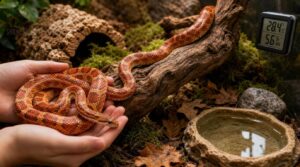
Keeping a corn snake healthy means knowing what "normal" actually looks like for your snake. Once you’ve got that baseline, spotting trouble early becomes second nature.
Here’s what to watch for across eight key areas.
Signs of a Healthy Corn Snake
A few quick checks tell you everything. Clear eyes, smooth scales, and active behavior are your baseline — if your corn snake has all three, you’re probably doing something right.
Watch for:
- Regular shedding in mostly one clean piece
- Consistent appetite with no repeated refusals
- Stable weight and coordinated movement
These are your core health monitoring signals.
Respiratory Infection Warning Signs
When health monitoring shifts from routine to urgent, respiratory infection warning signs are hard to miss. Labored breathing, wheezing sounds, and mucus discharge around the nostrils are your clearest red flags. These symptoms demand immediate attention.
Lethargy and appetite loss together — not separately — signal a real problem. This combination indicates a critical decline in health. Rapid decline can follow within days, making timely intervention essential. Don’t wait.
These common health issues require a reptile vet, fast. Seeking professional care promptly can prevent severe outcomes.
Scale Rot Symptoms and Prevention
Scale rot follows a pattern you can catch early. Watch for belly discoloration, ventral ulcers, crusted scales, or a foul odor near damaged skin.
These symptoms signal deeper issues. These health warning signs point directly to humidity control failures or poor substrate selection.
Act quickly to address environmental causes. Fix moisture levels fast — maintain humidity at 40–50% under normal conditions. Spot-clean waste daily to prevent bacterial buildup.
The root cause is often wet substrate sitting against ventral scales, creating persistent dampness that compromises skin health.
Stuck Shed and Retained Eye Caps
Stuck shed is another health warning sign that links directly back to humidity levels. If your snake’s eyes still look cloudy after the shedding process is complete, that’s a retained spectacle — and it needs attention.
- Raise humidity to ~70% and offer a shedding soak
- Check for mites; mite management prevents disrupted sheds
- Consider nutrient supplementation if sheds are consistently poor
- Vet intervention performs stubborn spectacle removal safely
Healthy Weight and Body Shape
Weight tracking tells you more than growth charts ever will. Run your fingers gently along your snake’s mid-body monthly — ribs shouldn’t jut out, and the spine should feel present but cushioned. Body condition scoring is straightforward: a healthy corn snake looks loaf-shaped, not triangular or sausage-like.
Hydration significantly impacts appearance too; dehydrated snakes appear thinner almost overnight. Seasonal weight shifts happen, but feeding frequency impact compounds quickly.
Safe Handling Frequency and Technique
Most adult corn snakes tolerate handling two to four times weekly — but technique matters as much as timing. Follow these four fundamentals:
- Handling Session Timing — Wait 48 hours after feeding. Pre-feeding rest keeps digestion stress-free.
- Two-Point Support — One hand mid-body, one near the head. No tail-only holds.
- Quiet Handling Environment — No dogs, cats, or loud rooms nearby.
- Hand Hygiene Protocol — Wash before and after every session.
Reducing Stress Through Proper Habitat Design
Your snake’s environment does most of the stress management work for you. Consistent Layout matters — don’t rearrange hides or decor once your snake learns its routes. Quiet placement away from foot traffic and loud devices reduces chronic disturbance.
Practice lighting control with a true day-night cycle.
Vibration dampening and minimal rearrangement, combined with environmental enrichment and hiding spots, keep your corn snake calm, secure, and genuinely settled.
When to Contact a Reptile Veterinarian
Don’t play the waiting game with your corn snake’s health — reptiles hide illness until it’s serious.
Call a reptile vet immediately if you notice:
- Open-mouth breathing, wheezing, or mucus — respiratory issues escalate fast.
- Bloody droppings, persistent appetite loss, or swollen abdomen — gut trouble needs fast evaluation.
- Vent prolapse or severe swelling anywhere — these require same-day veterinary attention, no exceptions.
Frequently Asked Questions (FAQs)
How to keep a corn snake healthy?
Keep the enclosure clean, the temperatures dialed in, and the feeding schedule consistent. Pair that with routine health monitoring and veterinary screening, and your corn snake will genuinely thrive.
Do corn snakes like to be misted?
Corn snakes tolerate misting but don’t crave it. Keep humidity around 40–50% normally. During shedding, bump it to 70%. A humid hide beats daily misting every time.
What is the biggest trouble with corn snakes as pets?
The biggest trouble isn’t the snake — it’s knowledge gaps.
Inconsistent monitoring of temperature gradient needs and humidity levels causes most common health issues, including shedding problems and respiratory issues, before owners even realize something’s wrong.
Do corn snakes need daily care?
Check temperature gradient, humidity levels, water dish, and do a quick morning visual inspection.
Spot-clean waste and confirm humidity hide availability.
Note feeding refusal or odd activity patterns.
How long do corn snakes typically live?
Most pet corn snakes live 10–15 years, though with solid veterinary care and good genetics, 20+ years isn’t rare. The record sits at 32 years. Wild individuals rarely reach
Can corn snakes coexist with other snake species?
Don’t do it. Corn snakes are solitary by nature. Housing them with other species risks predation, disease transmission, and territory competition. Keep yours alone — species-specific care is simply safer.
Do corn snakes need UVB lighting to thrive?
UVB lighting isn’t required, but it aids Vitamin D3 synthesis and overall wellness.
A consistent photoperiod timing of 10–12 hours mimics natural daylight, which is a solid alternative for maintaining your corn snake’s circadian rhythm.
How do I safely handle a defensive corn snake?
Move slowly, support the full body, and keep sessions under 10 minutes. Read defensive cues like hissing or tight coiling — those mean stop. Wash hands before and after every session.
What are the best enrichment activities for corn snakes?
Puzzle feeding, scent trails, and rotating décor satisfy your corn snake’s behavioral enrichment needs.
Add a shallow water feature and seasonal variations in hides to keep habitat enrichment fresh.
Ensure handling and enrichment practices are consistent.
Conclusion
Once you’ve got the hang of it, the essentials for keeping a corn snake healthy aren’t a burden—they’re a routine.
Lock the lid, maintain the correct temperatures, feed appropriately sized prey, keep the substrate clean, and monitor your snake weekly for any signs of illness. Consistently following these five steps will rarely result in a sick animal.
Most corn snakes that end up at a vet clinic got there because one small habit slipped. Don’t let that happen to you.