This site is supported by our readers. We may earn a commission, at no cost to you, if you purchase through links.

Corn snakes don’t survive on luck. From the pine flatwoods of Florida to Appalachian ridgelines pushing past 6,000 feet, Pantherophis guttatus has spent millennia fine-tuning exactly what it needs from its environment—specific temperatures, particular substrates, the right kind of darkness to feel secure. That precision doesn’t disappear in captivity.
Most husbandry mistakes trace back to the same root cause: treating the enclosure as decoration rather than functional habitat. A corn snake without proper thermal gradients can’t digest its food efficiently. One without adequate cover and microhabitat complexity stays chronically stressed, even if it’s eating.
Getting the corn snake habitat right is both simpler and more specific than most guides suggest.
Table Of Contents
- Key Takeaways
- Corn Snake Natural Habitat
- Ideal Corn Snake Enclosure
- Temperature and Humidity Needs
- Best Corn Snake Substrate
- Hides, Climbing, and Enrichment
- Frequently Asked Questions (FAQs)
- Are corn snakes difficult to care for?
- Do corn snakes prefer to burrow or climb?
- Where do corn snakes mostly live?
- What is the best habitat for a corn snake?
- Should I mist a corn snake?
- How often should you mist a corn snake enclosure?
- What do I need for a corn snake set up?
- What do corn snakes like in their cage?
- Do corn snakes need a basking light?
- Can corn snakes live together?
- Conclusion
Key Takeaways
- Corn snakes require a deliberate thermal gradient—88–92°F on the warm side and 75–85°F on the cool side—because as ectotherms, they depend entirely on environmental temperature to digest food and shed properly.
- Enclosure size must scale with the snake’s life stage, ranging from 18 inches for hatchlings up to 60–72 inches for adults, with floor space equal to at least twice the animal’s body length to prevent chronic stress.
- Substrate choice directly affects hydration, burrowing behavior, and skin health, with aspen shavings, cypress mulch, and coconut husk performing well—while pine and cedar release volatile acids that damage the respiratory tract.
- A functional habitat requires at minimum two snug hides (one warm, one cool), climbing branches, and 3–4 inches of loose substrate, because physical complexity and microhabitat variety are what allow corn snakes to express natural behavior and self-regulate stress.
Corn Snake Natural Habitat
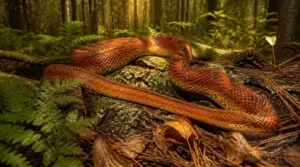
Before you can build the right habitat for your corn snake, it helps to understand where this species actually comes from. Pantherophis guttatus is a remarkably adaptable animal, native to a surprisingly wide range of environments across the eastern United States. Here’s a closer look at the natural settings that have shaped this species.
From scrubby coastlines to old farm buildings, corn snake natural habitat and range spans far more territory than most keepers realize.
Southeastern United States Range
Stretching from southern New Jersey down through the Carolinas and into the Florida Keys, the corn snake (Pantherophis guttatus) commands an impressively broad geographic range.
Its territory spans Coastal Plain wetlands, Piedmont mixed forests, Gulf estuary margins, and Appalachian ridgelines exceeding 6,000 feet in elevation — a spread that reveals just how adaptable this species genuinely is. Much of this region is characterized by a humid subtropical climate that influences local ecosystems.
Forests, Fields, and Farms
Within that broad range, corn snakes occupy hardwood forests, pine-wiregrass flatwoods, and mixed woodlands — but they’re equally at home where trees give way to open fields and working farmland.
Agricultural landscapes, particularly those integrating agroforestry or silvopasture systems, create layered microhabitats that suit them well. Rodent populations concentrated around crops make these field-farm interfaces reliable foraging corridors for Pantherophis guttatus year-round.
Barns and Abandoned Buildings
Farmland naturally draws corn snakes toward its structures. Abandoned barns and outbuildings — with their cracked siding, rotted sills, and dark interior voids — replicate the thermal refugia and concealment these snakes exploit in the wild.
Rodent-rich granaries make such sites prime foraging grounds. Structurally compromised floors and exposed debris create real safety hazards, but for Pantherophis guttatus, they’re ideal microhabitat anchors.
Logs, Burrows, and Crevices
Beyond barn walls, Pantherophis guttatus relies on subsurface microhabitats — fallen logs, rodent burrows, and rock crevices — for thermal regulation and predator avoidance. Burrow entrances average 2 to 4 inches in diameter, with interior tunnels curving away from the surface to obscure visibility.
Leaf litter and root networks regulate moisture inside these retreats, buffering humidity and temperature simultaneously.
Why Cover Matters
Think of dense cover as your snake’s first line of defense against stress. Visual barriers within the enclosure suppress threat responses, directly improving feeding regularity and digestion.
Textured microhabitats — bark, cork, layered substrate — create humidity pockets that soften shed skin, reducing the risk of dysecdysis. Without them, even a well-heated enclosure fails where it matters most.
Ideal Corn Snake Enclosure
Choosing the right enclosure is one of the most consequential decisions you’ll make for your corn snake’s long-term health.
Getting the basics right from the start pays off enormously, so it’s worth reviewing practical corn snake habitat and health tips before you invest in any setup.
The options available today vary considerably in size, material, and design — and each factor plays a real role in how well your snake settles in. Here’s what to keep in mind when evaluating each one.
Minimum Size by Age

Size dictates security. A corn snake tank size that’s too small creates chronic stress, while one matched to your snake’s life stage helps with healthy thermoregulation and confident movement.
Pair the right tank size with corn snake substrate options that support burrowing and humidity to give your snake a setup that truly works from the ground up.
- Hatchlings need enclosures at least 18 inches long, 12 inches tall
- Juveniles require 24 to 36 inches of length for active growth
- Subadults thrive in 36 to 48 inch vivarium setups with climbing room
- Young adults need 48 to 60 inches for full-body extension
- Adults require 60 to 72 inches long, minimum 20 inches tall
Floor Space Requirements
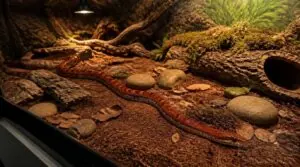
Three dimensions define a functional vivarium setup, but floor space does the heaviest lifting. Your corn snake needs unobstructed movement corridors — room to turn, coil, and forage — not just a footprint large enough to house hides.
As your snake grows from 12 to 48 inches, floor area scales accordingly, reducing both stress behaviors and the need for premature enclosure upgrades.
Secure Escape-proof Lids
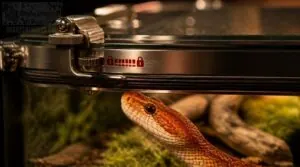
Corn snakes are remarkably persistent escape artists — a fact every keeper learns the hard way. Your enclosure means nothing without a pry-resistant locking lid that engages fully and shows tamper-evident indicators when disturbed. Silicone or EPDM gaskets maintain even compression across the rim, preventing both drafts and escapes.
For captive maintenance, stainless steel hinges resist corrosion in humid terrarium conditions reliably.
Glass, PVC, or Wood
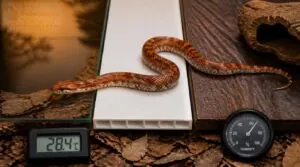
Your enclosure material shapes every microclimate decision that follows. Glass offers wonderful visibility and resists humidity staining, though its weight demands a sturdy lid frame. PVC’s multi-chamber profiles retain heat efficiently, reducing energy loss — a genuine advantage in cooler rooms. Wood delivers thermal inertia and natural aesthetics, but untreated surfaces warp under sustained humidity without aquarium-grade sealing.
- Glass cleans effortlessly but runs heavy
- PVC resists mold and cuts heating costs
- Wood insulates well yet demands regular refinishing
- All three require gasket-sealed, escape-proof lids
Room for Natural Movement
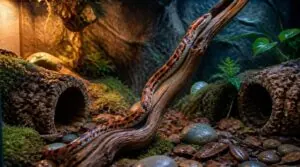
A snake that can’t move freely is a snake under chronic stress. Your enclosure needs open floor area sized to at least twice the animal’s body length, with obstacle-free routes between hides.
Corn snakes traverse ground and vertical surfaces alike, so climbing branches aren’t decorative — they’re functional microhabitat. Keep surfaces clear, pathways unobstructed, and every inch purposeful.
Temperature and Humidity Needs
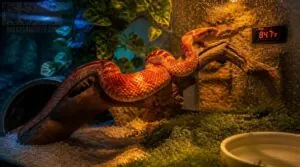
Getting the climate inside your corn snake’s enclosure right isn’t guesswork—it’s one of the most important things you can do for their long-term health.
Corn snakes are ectotherms, meaning they depend entirely on their environment to regulate body temperature, digest food, and shed properly. Here’s what you need to maintain across five key areas.
Warm Basking Area
Your corn snake’s basking spot should reach 88 to 92°F, giving it the thermal energy needed for digestion and metabolism. A flat slate tile or commercial basking surface material distributes radiant heat evenly — stable, non-slip, and burn-resistant.
Use a thermostat safety control to cycle your heat lamp automatically, maintaining that precise zone without overheating the enclosure.
Cool-side Temperature Range
While the basking zone aids digestion, the cool side is where thermoregulation actually completes its loop. Target 75 to 85°F during the day — a range that keeps your corn snake active without metabolic stress.
- Place digital thermometers at multiple points to catch warm pockets
- Use a thermostat-regulated heat source to stabilize the gradient
- Avoid substrates that insulate and silently push cool-side temps upward
Safe Nighttime Drops
Once the lights go out, nocturnal heating still matters. Nighttime temperatures can safely drop, but not below 60°F — ideally staying between 60°F and 68°F to sustain basic thermal gradient function without stressing metabolism.
A low-wattage ceramic heat emitter works well here, producing warmth without disruptive light, maintaining microclimate management across the enclosure floor where your snake actually rests.
Healthy Shedding Humidity
Humidity is where thermal management meets skin biology. Keep relative humidity between 40 and 60 percent under normal conditions, nudging it toward 60 to 70 percent when your snake enters pre-shed.
A moist hide — packed with damp sphagnum moss — gives targeted moisture without saturating the whole enclosure. Sustained levels above 70 percent risk respiratory irritation and mold, so balance matters.
Digital Monitoring Tools
Guessing at your thermal gradient is risky. A digital thermometer anchors reptile husbandry and keeps temperature regulation precise.
- Real-time dashboards show live readings
- Anomaly detection alerts catch unsafe drops
- Asset inventory automation tracks your sensors
- Security log aggregation records condition history
- Your ideal tank setup runs on data
Synthetic transaction testing — routine sensor checks — validates that every reading stays trustworthy.
Best Corn Snake Substrate
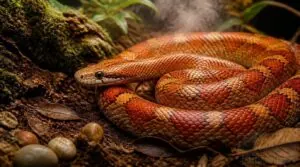
Substrate is one of those decisions that affects nearly every aspect of your corn snake’s daily life — from hydration and burrowing comfort to skin health during shedding.
Not every material sold at pet stores is actually safe or appropriate, so it’s worth knowing exactly which options hold up. Here are the substrates that consistently deliver the right balance of safety, moisture retention, and natural feel.
Aspen Shavings
Aspen shavings are among the most reliable substrates for corn snake bedding. Low aromatic oil content means no respiratory irritation — a real advantage over pine or cedar. They absorb moisture well yet dry quickly, supporting stable humidity without waterlogging.
Store them sealed; old or damp shavings lose their dust-control properties fast, compromising your terrarium maintenance routine.
Cypress Mulch
Cypress mulch earns its place as a premium corn snake bedding through genuine performance. Its fibrous structure retains moisture effectively — reducing evaporation by 15–40% — which stabilizes humidity levels without constant misting.
Decomposition is slow, often lasting 12–24 months, so terrarium maintenance stays manageable. It’s also naturally low-dust and can deter certain ground-dwelling pests, making it a dependable, aesthetically consistent substrate choice.
For a deeper refresh, following a step-by-step terrarium deep cleaning routine helps maintain the substrate’s natural benefits while keeping your setup truly thriving.
Coconut Husk Bedding
Coconut husk bedding offers something cypress mulch can’t fully match: slow, even moisture release that stabilizes humidity without waterlogging the substrate. Its fibrous texture lets corn snakes burrow naturally while cushioning their coils.
Non-toxic and free of pine oils, it won’t irritate respiratory tissue. Maintenance stays simple — spot-clean the surface layer and refresh as needed.
Burrowing Depth
Depth matters more than most keepers realize. Aim for 3 to 4 inches of substrate so your corn snake can fully submerge — this isn’t decorative; it’s functional microhabitat design.
- Thermal stability improves as deeper layers buffer surface temperature swings
- Moisture retention increases with depth, supporting healthy shedding cycles
- Predator avoidance instincts are satisfied, visibly reducing stress behaviors
Soil density directly limits how effectively a snake excavates, so loose, clumped substrates outperform compacted ones every time.
Pine and Cedar Risks
Pine and cedar might seem like natural choices, but both release volatile aromatic acids — plicatic acid from cedar, abietic acid from pine — that actively irritate your corn snake’s respiratory tract. Prolonged exposure risks genuine airway damage.
| Bedding | Risk Level | Safer Alternative |
|---|---|---|
| Cedar shavings | High | Cypress mulch |
| Pine shavings | High | Aspen shavings |
| Softwood blends | Moderate–High | Coconut husk |
Skip them entirely.
Hides, Climbing, and Enrichment
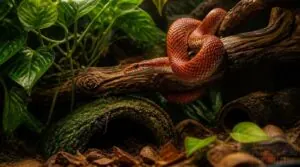
A well-structured enclosure goes beyond temperature gradients and substrate choices — it’s also about giving your corn snake the physical complexity it naturally seeks.
In the wild, Pantherophis guttatus navigates layered microhabitats, from ground-level retreats to elevated perches, and your setup should reflect that behavioral range. Here are the key elements to incorporate.
Warm and Cool Hides
Two hides are non-negotiable: one on the warm side at roughly 85–90°F, one on the cool side around 72–78°F. Each should fit snugly around your snake’s girth — full body contact delivers the security it instinctively seeks.
Smooth plastic or ceramic surfaces clean easily and hold stable temperatures. Scrub weekly with reptile-safe cleaner, dry completely, and your microhabitat stays hygienic and functional.
Branches and Climbing Vines
Once your hides are placed, think vertically. Pantherophis guttatus climbs actively in the wild, and branch-and-vine matrices replicate that instinct indoors.
Anchor branches measuring 1.5–2.5 cm in diameter securely — constant movement demands stable contact points throughout the enclosure.
- Choose untreated hardwood or synthetic perches; avoid pine.
- Select non-toxic vines sized for wrapping without restricting movement.
- Vary heights to create a layered vertical matrix.
- Inspect joints weekly; re-tighten any loosened fasteners immediately.
Plants for Visual Cover
Plants break up sightlines inside the enclosure the same way dense shrubs do outdoors — creating the layered microhabitat complexity Pantherophis guttatus instinctively seeks.
Opt for non-toxic evergreen species with thick, opaque foliage. Fast-growing ground cover fills substrate-level gaps, reducing exposed open space that triggers stress responses.
Stagger plant heights to build visual depth rather than a single flat screen.
Cork Bark Retreats
Where plants create visual depth through foliage, cork bark adds three-dimensional microhabitat structure that P. guttatus actively exploits. Its irregular contours and crevices function as a naturalistic hide box, buffering humidity swings and stabilizing microclimate conditions around the retreat.
The textured surface doubles as a climbing grip, while its moisture resistance keeps the substrate beneath cleaner between maintenance cycles.
Stress-reducing Habitat Design
Think of your enclosure as a sensory environment, not just a box. Muted, naturalistic tones and indirect light reduce visual noise, while cork and wood textures lower stress during handling.
A snake’s enclosure is a sensory environment — muted tones, natural textures, and indirect light are its calm
Multiple hides at different microclimates let your snake self-regulate arousal without defensive posturing. Rotate enrichment items gradually — novelty sustains curiosity without overwhelming a species wired for cautious, methodical exploration.
Frequently Asked Questions (FAQs)
Are corn snakes difficult to care for?
Ironically, the species notorious for escaping enclosures is among the easiest reptiles to keep. Corn snakes don’t demand specialized equipment, tolerate routine handling well, and routinely reach 15 to 20 years in captivity with straightforward husbandry.
Do corn snakes prefer to burrow or climb?
Corn snakes are semi-terrestrial by nature — they burrow when seeking shelter or thermal stability and climb when basking or exploring. Most individuals show a personal preference, so your enclosure should support both behaviors equally.
Where do corn snakes mostly live?
Native to the southeastern and central United States, corn snakes thrive across woodlands, pine flatwoods, farmlands, and agricultural edges — anywhere rodent prey is plentiful and structural cover like logs, barns, or rock crevices stays within reach.
What is the best habitat for a corn snake?
The best habitat mirrors its wild origins — a secure enclosure with a thermal gradient, controlled humidity, safe substrate, and enrichment for climbing, giving your corn snake every condition it needs to thrive.
Should I mist a corn snake?
Does your snake really need a spray bottle pointed at it regularly? Rarely. A large water dish controls ambient moisture well enough. Reserve light misting for shedding episodes only — prolonged wet bedding invites scale rot fast.
How often should you mist a corn snake enclosure?
For most setups, light misting once or twice daily is sufficient. During shedding, a brief humidity increase to 60–70% helps sloughing. A moist hide takes care of localized needs without saturating the whole enclosure.
What do I need for a corn snake set up?
A complete corn snake setup needs an escape-proof enclosure, a heat lamp, two hide boxes, a water dish, aspen or cypress substrate, feeding tongs, and basic cleaning supplies like a spot-cleaning scoop and reptile-safe disinfectant.
What do corn snakes like in their cage?
Give a creature what it needs, and it thrives."
Corn snakes favor warm and cool hides, climbing branches, naturalistic substrate for burrowing, and a steady thermal gradient — elements that reduce stress and invite natural behavior.
Do corn snakes need a basking light?
A basking light isn’t strictly required, but it helps digestion and metabolism by maintaining a 88–92°F basking spot. A ceramic heat emitter works equally well, while UVB remains optional with no firm consensus on necessity.
Can corn snakes live together?
Technically, yes — but housing two corn snakes together is a calculated risk most experienced keepers quietly avoid. Separate enclosures remain the safest, simplest choice for long-term health.
Conclusion
Like Antaeus, who drew his strength from contact with the earth, your corn snake draws its vitality from habitat that mirrors its origins. Every hide placed, every thermal gradient calibrated, every substrate layer deepened is a deliberate act of ecological translation.
A well-designed corn snake habitat doesn’t just sustain—it allows the animal to express the full behavioral repertoire evolution built into it. Get the environment right, and everything else follows naturally.