This site is supported by our readers. We may earn a commission, at no cost to you, if you purchase through links.

Breeding a corn snake too early risks more than a small clutch—it may permanently compromise a female with years of potential breeding ahead. Corn snakes’ fertility age is not a fixed number but a threshold determined by weight, condition, and hormonal readiness, factors age alone cannot confirm.
A 14-month-old male might exhibit courtship behavior while lacking the bodily reserves to ensure reliable fertility. Similarly, a female at 24 months weighing only 220 grams faces a real risk of egg binding. These examples underscore how age misleads when physical and hormonal maturity lag.
Understanding a snake’s true readiness—not just its age—transforms decisions about breeding. Knowing where your snake actually stands shifts the focus to proactive care, ensuring both health and reproductive success.
Table Of Contents
- Key Takeaways
- Corn Snake Fertility Age Timeline
- Male Corn Snake Breeding Readiness
- Female Corn Snake Breeding Readiness
- Risks of Breeding Too Early
- Factors That Affect Fertility Age
- Confirming Successful Reproduction
- Frequently Asked Questions (FAQs)
- How old do corn snakes have to be to breed?
- When do corn snakes reach sexual maturity?
- Is a corn snake fully grown?
- What factors affect corn snake breeding success?
- How to tell if corn snake eggs are fertile?
- At what age do corn snakes lay eggs?
- How many eggs does a healthy female lay?
- Can two males safely cohabitate before breeding season?
- How long should males rest between pairings?
- What lighting schedule supports corn snake reproduction?
- Conclusion
Key Takeaways
- Age alone doesn’t confirm breeding readiness — weight (300g+), length (36"+), and body condition must all align before you pair any corn snake.
- Breeding a female under 250g risks egg binding, small clutches, and long-term reproductive damage that compounds across every future cycle.
- Males mature around 18 months, but reliable fertility demands 24 months and stable weight — early courtship behavior isn’t proof the body is ready.
- Brumation, thermal gradients, feeding consistency, and genetics each shifts the maturity timeline, meaning two snakes raised identically can still develop months apart.
Corn Snake Fertility Age Timeline
Corn snakes don’t hit a single magic birthday where they’re suddenly ready to breed — maturity is a moving target shaped by weight, length, and how well you’ve managed their care. Males and females follow different timelines, and a snake that looks full-grown isn’t necessarily ready to pair.
A male might hit puberty young, but size and condition matter more than age — corn snake breeding age and readiness goes deeper into why rushing it can do more harm than good.
Here’s how the fertility window actually unfolds in captivity.
Typical Sexual Maturity Age in Captivity

Most captive corn snakes hit sexual maturity between 18 and 24 months—but don’t mistake a calendar for a readiness checklist.
Hormone maturation markers, growth velocity indicators, and metabolic rate effects all shape that timeline. Key benchmarks to track include:
- Age: 18–24 months average
- Weight: 250–350 g (females), 180–250 g (males)
- Photoperiod influence: consistent light cycles matter
- Sexual dimorphism timing varies individually
- Genetics drives real variation — some reach readiness closer to 2 or 3 years
Male Fertility Age Versus Female Fertility Age

Males outpace females on the corn snake sexual maturity timeline by roughly six months. Hormonal maturation curves show testosterone rising in males well before female ovarian development begins.
Age-Related Gamete Quality and Paternal Age Effects matter less here than in mammals, but timing still differs.
| Metric | Male Corn Snakes | Female Corn Snakes |
|---|---|---|
| Average breeding age | 18–24 months | 24–30 months |
| Minimum weight | 200–300 g | 300 g |
| Breeding longevity comparison | Fertile earlier, longer | Later start, higher demand |
| Maternal oocyte decline | Not applicable | Clutch size drops with age |
| Breeding readiness criteria | Hemipenal development | Post-brumation shed + weight |
Why Age Alone Does Not Confirm Breeding Readiness

Age tells you one thing. It doesn’t tell you everything. Even a snake that hits the 18-month mark can fall short in hormonal markers, energy balance, or body condition scores for reproductive health. Stress levels suppress reproductive signals. Genetic variation creates outliers. Without proper seasonal signaling — including brumation — the corn snake’s sexual maturity timeline means little. Breeding readiness criteria for corn snakes demand the full picture.
Age marks a milestone, not a finish line — readiness demands the full picture
In avian studies, total egg volume was identified as the strongest predictor of breeder age.
How Captive Care Can Speed or Delay Maturity

A tight temperature gradient — 85 °F warm side, 75 °F cool side — accelerates metabolism and can drive sexual maturity as early as 18 months. Pair that with a consistent seasonal photoperiod and proper lighting schedule, and reproductive signaling sharpens noticeably.
Poor substrate hygiene, excessive handling frequency, and weak dietary nutrient balance do the opposite — they stall the average breeding age reliably.
Male Corn Snake Breeding Readiness

Males often get overlooked in breeding discussions, but their readiness matters just as much as the female’s. Getting the timing wrong can cost you a whole season.
Here’s what to check before you introduce him to any female.
Minimum Age for Reliable Male Fertility
Most male corn snakes hit hormonal milestones around 18 months, but don’t mistake early courtship behavior for reliable fertility. Spermatogenesis onset and testosterone thresholds vary with genetic variability and seasonal hormone cycles — meaning the sexual maturity timeline in corn snakes isn’t calendar-driven.
The minimum age for responsible breeding is 18 months minimum, with 24 months offering more consistent hormonal readiness across most individuals.
Ideal Male Weight Before Pairing
Weight tells part of the story — body condition tells the rest. For male corn snakes, 300 grams is your target, but muscle tone and fat distribution matter just as much as the scale. Use body condition scoring to confirm he’s truly ready.
Weight stability over several weeks, backed by feeding consistency, confirms genuine reproductive readiness.
A stress-free environment is equally critical to ensure his overall health and readiness.
Minimizing handling and loud disturbances during courtship and post-mating recovery helps your snakes stay calm through each stage of the corn snake breeding timeline.
Early Fertility Risks in Young Males
Pairing too soon carries real consequences. Even when a young male shows courtship behavior, his internal systems may not be ready.
Risks of early breeding in corn snakes include:
- Sperm motility issues — testicular lag means inconsistent sperm quality
- Hormonal instability — fluctuating androgens disrupt spermatogenesis
- Heat sensitivity — temperature swings impair reproductive function
- Premature pairing injury — stress-induced infertility from repeated handling
Physical Signs of Male Reproductive Maturity
You can see reproductive maturity before any courtship begins. Look for these physical markers:
| Physical Sign | Maturity Indicator |
|---|---|
| Hemipenal Development | Visible hemipenal base swelling |
| Tail Length Extension & Subcaudal Scale Count | Longer tail, higher scale count than females |
| Testicular Enlargement & Scent Gland Swelling | Broader tail base, increased activity |
These structural changes confirm reproductive health far more reliably than age alone.
Courtship Behaviors That Suggest Fertility
Fertility announces itself through behavior. A ready male wastes no time — he initiates courtship within 20 to 60 seconds of introduction. Watch for rapid tail flicks, increased activity, and intensified tongue flicking as he tracks the female. Scented cheek rubbing and synchronized body coils follow shortly after. Bright head coloration signals peak hormonal output.
When she responds by lifting her tail, receptive behavior is confirmed.
Female Corn Snake Breeding Readiness

Females are the bottleneck in any breeding program—get their timing wrong and the whole season falls apart.
Unlike males, they need more than just age before they are ready; weight, length, and body condition all have to line up. Here’s what to look for before you pair your female.
Minimum Safe Age for Breeding Females
Don’t let hormonal maturity age fool you — a female corn snake can cycle before her body is ready to carry eggs safely.
True breeding readiness in female corn snakes means reaching all three thresholds:
- 24–30 months of age minimum
- Full skeletal development stage confirmed
- Ovulation readiness age aligned with nutritional age synergy
Rush it, and you’re gambling with her life.
Recommended Weight and Length Benchmarks
Numbers don’t lie — and for female corn snakes, two matter most: 300 grams and 3 feet long. These aren’t arbitrary weight gain thresholds.
Below 300 g, egg development strains her reserves dangerously. Under 36 inches, skeletal maturity is suspect.
Track your weight target schedule every 3–4 months. Ratio monitoring guidelines catch stagnation early.
Body condition scoring confirms breeding readiness when both benchmarks align.
The “rule of Threes” for Safer Breeding
Weight and length get you close — but the rule of threes seals the decision. Before pairing, a female needs three years, 300 grams, and 3 feet.
Beyond that, Triple Health Checks, a Three-Month Window of observation, and a Three-Step Quarantine post-pairing protect her long-term.
Triad Record Keeping and a Triad Compatibility Review aren’t paperwork — they’re your prebreeding health check in practice.
Body Condition Score and Fat Reserves
The rule of threes tells you when to pair — body condition scoring determines readiness. A female scoring 4–5 on a 5-point scale possesses the fat reserves breeding demands. Use tail fat palpation and mid-section fat distribution to confirm her condition.
Seasonal BCS fluctuations are normal, but a pre-breeding health check must confirm a strong muscle-fat ratio before introducing a male.
Why Females Mature Later Than Males
Female corn snakes mature later because biology demands it. An estrogen surge drives reproductive organ development, but the hormonal axis lag means her hypothalamic-pituitary signals activate weeks behind a male’s testosterone rise. Growth plate timing closes later in females, extending their growth window. Neural development pace and fat reserve threshold requirements add more time.
Specifically, four mechanisms drive this delay:
- Hormonal axis activation runs 6–12 weeks behind males
- Estrogen-driven skeletal maturation extends the growth period
- Fat reserve threshold for viable clutch production requires more time to accumulate
- Female body fullness benchmarks demand greater total mass than male fertility minimums
Sex differences in corn snake breeding age aren’t arbitrary — they reflect real physiological demands tied to growth rate and hormonal regulation.
Risks of Breeding Too Early

Breeding a corn snake before she’s truly ready isn’t just risky — it can cause lasting damage. Females under 250 g are physically unprepared for the demands of egg production, and the consequences show up fast.
Here’s what you’re actually risking when you pair too early.
Egg Binding in Underweight Females
Egg binding isn’t just bad luck — it’s often a direct consequence of breeding too early. Underweight females with poor body condition scoring lack the calcium reserves and hydration levels needed for effective oviduct muscle contractions.
Calcium deficiency produces malformed eggs, while nutrient deficiencies compound the problem. Stress-induced retention follows quickly, escalating the crisis.
Without emergency veterinary care, outcomes worsen fast. Don’t let female body fullness be an afterthought.
Small or Low-viability Clutches
Clutch size limits hit hardest when females breed too early. Poor body condition scoring directly reduces egg viability — clutches often yield just two to eight eggs, with fewer than half hatching.
Hormonal imbalance disrupts yolk formation, while maternal stress effects suppress embryo development mid-incubation. Genetic viability issues compound this.
Egg quality markers like shell integrity and candled vein patterns reveal the damage.
Incubator humidity can’t fix what poor maternal readiness already broke.
Post-laying Weight Loss and Recovery Issues
Weight loss after laying isn’t just expected — it’s a clinical warning sign in underprepared females. Lean breeders enter a deficit that drains fat reserves fast, leaving little margin for Muscle Tone Recovery or Appetite Stimulation.
Body condition scoring guides your post-lay feeding strategy. Fat Reserve Replenishment, Hydration Management, and Light Cycle Adjustment all support metabolic rate stabilization.
A balanced and nutritious diet restores energy reserves before the next cycle.
Stress From Premature Pairing
Premature pairing triggers a cascade your snake can’t easily recover from. Handling the overload, courtship interruption, and hormonal mismatch keep both animals locked in stress — not reproduction.
- Cortisol spikes suppress feeding and disrupt thermoregulation
- Hormonal imbalance delays genuine breeding readiness
- Territorial aggression escalates when females reject unprepared males
- Stress-induced infertility follows repeated failed attempts, derailing reproductive health
Cortisol stress response resets slowly. Don’t rush the timeline.
Long-term Health Concerns for Young Breeders
Breeding a young corn snake doesn’t just risk one bad season — it can reshape its health trajectory for years. Reproductive organ strain compounds with nutrient depletion across cycles, quietly eroding body condition.
Hormonal cycle disruption follows, reducing breeding readiness and triggering stress-induced infertility. Complication risk climbs, and reduced husbandry tolerance makes future management harder.
Keeping stress in check isn’t just about comfort—it’s a key step in preventing self-cannibalization behavior in snakes, a startling sign that something’s gone wrong.
Body condition scoring for reproductive health isn’t optional — it’s your baseline protection against cumulative damage.
Factors That Affect Fertility Age

Fertility age isn’t fixed — it shifts based on how you raise your snake. Everything from feeding schedule to enclosure size can push maturity forward or hold it back.
Here’s what actually moves the needle.
Feeding Frequency and Steady Growth
What you feed matters—but when you feed matters just as much. Stage-specific feeding drives lean growth without tipping into fat accumulation, while digestive interval management ensures juveniles progress steadily toward the 300 g breeding threshold.
Track what’s working:
- Weigh every 2–3 weeks to validate growth tracking
- Match meal size balance to the snake’s current body length
- Use post-shed feeding windows — appetite peaks reliably after each shed
- Adjust feeding schedules when weight plateaus across two consecutive cycles
- Prioritize protein intake and body condition scoring over raw feeding frequency
Accelerated feeding without oversight risks building the wrong kind of mass.
Temperature Gradients and Metabolism
Feeding sets the foundation—but temperature builds on it. Thermal Gradient Effects directly drive Metabolic Rate Acceleration inside your enclosure. Warmer basking zones push mitochondrial efficiency higher, accelerating ATP production and digestion. Cooler retreats allow for recovery. This balance shapes your snake’s reproductive timeline.
| Temperature Zone | Effect on Maturity |
|---|---|
| 85°F warm side | Accelerates growth metabolism |
| 75°F cool side | Aids recovery and rest |
| Below 70°F chronic | Delays sexual maturity |
| Above 90°F chronic | Heat Stress Impact — stunts growth |
Seasonal Temperature Shifts mirror natural brumation cues, aligning your snake’s internal clock with productive seasonal breeding cycles.
Humidity and Healthy Shedding
Temperature drives metabolism—humidity determines whether that growth shows up cleanly. Keep enclosure humidity between 60–70%, and your snake sheds consistently, signaling healthy maturation progress. Hygrometer accuracy matters here; guessing gets expensive.
- Ideal humidity range: 60–70% sustained
- Misting schedule: once or twice daily during shed cycles
- Humid hide setup: moist moss inside a sheltered box
- Prelay shed signals breeding readiness in females
- Humidity cycles support shedding frequency and skin health
Enclosure Size and Stress Reduction
Space matters more than most keepers realize. Chronic stress suppresses growth hormone — and delayed maturity follows.
| Enclosure Factor | Impact on Maturity |
|---|---|
| Floor space (min. 4×2 ft) | Facilitates natural locomotion |
| Vertical retreats | Reduces exposure stress |
| Hide distribution | Allows thermal zoning choices |
| Clutter density | Clears escape paths |
| Thermal separation | Prevents stress-induced infertility |
Inadequate floor space forces repeated exposure, elevating cortisol and stalling development.
Genetics and Individual Growth Rates
Enclosure optimization removes external barriers — but genetics sets the ceiling. Two corn snakes on identical husbandry protocols can still mature months apart. That’s size heritability at work. Polygenic risk influences juvenile growth rate through IGF pathway sensitivity and growth gene variants, meaning gene-nutrition interaction shapes outcomes you can’t fully control.
Key genetic considerations in breeding programs:
- Genetic growth variation affects when individuals hit the 300 g threshold
- IGF pathway variants alter how efficiently protein converts to mass
- Impact of genetics on snake breeding is real — expect individual timelines
- Growth gene variants influence both rate and final adult size
- Polygenic risk means no two animals follow identical maturity curves
Brumation Timing and Reproductive Cycling
Brumation isn’t optional for serious breeders — it’s the reset button for the entire reproductive cycle. Cooling your snake for 60–90 days at 50–61°F triggers hormone reactivation patterns that prepare both sexes for spring pairing.
Photoperiod synchronization matters too: extending light to 12 hours post-rewarming accelerates follicular development. Nail your rewarming temperature ramp gradually, and seasonal breeding cycles align naturally.
Confirming Successful Reproduction
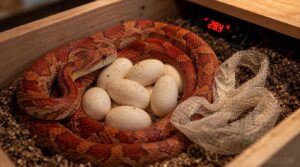
Getting your snakes to mate is only half the job. The real confirmation comes from what happens next — shed cycles, egg timelines, and what you find in the incubator.
What to watch for at each stage.
Post-brumation Signs of Breeding Readiness
After warming, your snakes don’t ease back slowly — they switch on fast. Within days, you’ll see clear signals that hormonal activation is underway.
- Bright head coloration returning within one to two weeks
- Increased tongue flicking reaching 15–25 reps per minute
- Pacing activity surge and midbody swelling in females
Hydration normalization, courtship behaviors, and confirmed breeding readiness all follow within two to six weeks.
Female Receptivity After Shedding
Once your female corn snake completes a post-brumation shed, hormonal activation shifts fast. Watch for the neck-raise posture, post-shed pacing, and a calm response to male proximity — all signs her pheromone surge is underway. Peak receptivity hits within one to five days post-shed, marked by intensified tail-keeper following.
Shedding frequency and breeding maturity align at this stage, compressing the reproductive timeline into a narrow, decisive window. This compressed timeline demands precise observation to capitalize on the snake’s readiness for breeding.
Expected Egg-laying Timeline After Mating
After a successful mating, your reproductive timeline starts ticking immediately. First egg latency averages 7–14 days post-mating, with the full egg-laying window spanning one to three days between deposits.
Clutch interval variability reflects breeding maturity, body condition, and environmental cue timing.
Stable incubation temperature around 82–86°F keeps post-mating behavior on track.
Clutch size averages two to twelve eggs.
How to Identify Fertile Corn Snake Eggs
Not every egg in the clutch is worth incubating. Fertile eggs are bright white, leathery, and plump — shell color alone tells you a lot. Candling patterns confirm the rest.
- Vein Visibility: By day 7–10, embryonic development shows a clear vascular network
- Embryo Milestones: Defined embryo mass appears by day 8–10
- Moisture Balance: Healthy shells feel dry, not tacky or sunken
Egg viability drops fast without accurate reads.
Incubation Conditions for Healthy Hatchlings
Temperature Stability is not optional — it’s the foundation. Maintain incubation temperatures between 80–85°F (27–29°C), ensuring fluctuations stay within 1–2°F to safeguard embryonic development.
Humidity Management requires consistent levels of 80–90% to balance moisture needs and mold prevention. Damp moss serves as an effective substrate for achieving this equilibrium.
Consistent Ventilation Flow is critical to avoid dangerous CO₂ accumulation, which can compromise egg viability.
Careful Egg Handling and Egg Turning preserves embryo health throughout the 55- to 70-day incubation period, minimizing risks of damage or developmental issues.
Frequently Asked Questions (FAQs)
How old do corn snakes have to be to breed?
Most corn snakes hit sexual maturity between 18 and 24 months in captivity, but breeding age guidelines usually recommend waiting until 2 to 3 years for safer, more reliable outcomes.
When do corn snakes reach sexual maturity?
Most captive corn snakes hit sexual maturity between 18 and 24 months. Males commonly arrive earlier — around 18 months — while females usually need closer to 24 months of steady growth.
Is a corn snake fully grown?
Most reach adult size — 4 to 5 feet — between 2 and 3 years. After that, growth plateau sets in. Length-weight ratio stabilizes, and genetic potential is fully expressed.
What factors affect corn snake breeding success?
Everything matters — supplemental calcium, vitamin D3, photoperiod management, microbial load, partner compatibility, seasonal brumation cycles, hormonal regulation, nutritional factors, environmental influences, and genetic diversity all shape whether your pairing succeeds or fails.
How to tell if corn snake eggs are fertile?
Candle each egg around day 7 using a focused light in a dark room.
Fertile eggs show vein visualization, a firm shell, and a growing embryo spot.
Infertile ones stay clear or collapse.
At what age do corn snakes lay eggs?
Female corn snakes can lay eggs as early as 18–24 months, but most need 5–3 years. Breeding maturity depends on weight, length, and condition—not age alone.
How many eggs does a healthy female lay?
A healthy female corn snake usually lays 10 to 30 eggs per clutch. Average clutch size runs 12 to 18 eggs, though size-dependent output means smaller females often produce fewer.
Clutch size aside, timing matters too—see this guide on how long corn snake eggs take to hatch for what to expect during incubation.
Can two males safely cohabitate before breeding season?
It is risky. Two males share space only with proper enclosure partitioning, visual barriers, and no shared hiding spots. Watch for aggression. Stress-induced infertility is real.
Sequential introductions are safer than permanent cohabitation.
How long should males rest between pairings?
Rest at least three days between pairings. Sperm viability drops without adequate rest duration and energy replenishment.
Ideal interval is 3–5 days, supporting stress recovery and sustained reproductive readiness across multiple females.
What lighting schedule supports corn snake reproduction?
A 12-hour photoperiod serves as the baseline. Gradually shift to 10–11 hours in winter to trigger brumation, then extend back to 12–13 hours post-warming.
Consistent daylight timing acts as the light hormone cue that drives reproductive cycling.
Conclusion
Some breeders argue that thriving snakes at 18 months prove early breeding works—but surviving one cycle isn’t the same as thriving long-term. Corn snake fertility age isn’t a marker you push past; it’s a threshold you confirm through weight, condition, and reserves.
Rush it, and you trade years of healthy reproduction for one risky clutch. Get it right, and your snake breeds reliably, recovers fully, and stays productive for a decade.