This site is supported by our readers. We may earn a commission, at no cost to you, if you purchase through links.

Most boa constrictors don’t die from bad heating or wrong feeding schedules—they decline slowly from the air they breathe every day. Stagnant enclosures trap carbon dioxide, fuel bacterial growth, and quietly stress a snake’s respiratory system long before visible symptoms appear. Ventilation sits at the center of boa health, yet it’s treated like an afterthought behind thermostats and humidity gauges.
Getting boa constrictor enclosure ventilation right means understanding airflow as a system: where fresh air enters, where stale air exits, and how enclosure materials affect everything in between. The difference between a thriving boa and a chronically sick one often comes down to vent placement, vent area, and balancing airflow against humidity.
Every section ahead provides specific numbers and practical strategies to achieve this balance perfectly.
Table Of Contents
- Key Takeaways
- Boa Enclosure Ventilation Basics
- Correct Vent Area Calculations
- Best Vent Placement Strategy
- Ventilation by Enclosure Material
- Humidity and Airflow Balance
- Top 10 Boa Enclosure Options
- 1. New Age Pet Ecoflex Reptile Lounge
- 2. Amypet Large Reptile Hide Cave
- 3. ToxiRium Extra Tall Reptile Enclosure
- 4. Phailozoo Stackable 85 Gallon Reptile Terrarium
- 5. Reptile Habitats 120 Gallon Enclosure
- 6. Unipaws Black Reptile Terrarium with Sliding Doors
- 7. Royxen 82 Gallon Glass Reptile Terrarium
- 8. Phailozoo Reptile Terrarium Sliding Door
- 9. Annzoe 80 Gallon Reptile Tank
- 10. ToxiRium Stackable PVC Reptile Terrarium
- Ventilation Monitoring and Maintenance
- Frequently Asked Questions (FAQs)
- What is the 1 to 300 rule for ventilation?
- How to ventilate a snake enclosure?
- What should the humidity be in a boa enclosure?
- Do snakes need a lot of ventilation?
- Can ventilation affect a boas feeding response?
- Do boas need different airflow at night?
- How does room temperature affect enclosure ventilation needs?
- Can poor ventilation spread illness between cohabiting snakes?
- Does enclosure elevation in a room impact airflow?
- Conclusion
Key Takeaways
- Stagnant air is the silent killer in boa enclosures — CO₂ buildup, bacterial growth, and respiratory stress all start long before your snake shows visible symptoms.
- Place low vents on the cool side for fresh air intake and high vents on the warm side for passive exhaust, letting rising warm air do the work without a fan.
- Keep total vent area between 1–2% of wall surface for adults, split across 2–4 openings, and target 55–75% humidity year-round — adjusting vent size seasonally rather than over-misting.
- Your enclosure material shapes everything: PVC holds humidity best, glass screen tops lose it fastest, and melamine quietly warps and molds in any setup that needs consistent moisture.
Boa Enclosure Ventilation Basics

Getting ventilation right is one of those things that quietly makes or breaks your boa’s health. Before you start drilling holes or shopping for gear, it helps to understand what good airflow actually looks like inside an enclosure.
A solid starting point is this guide on boa constrictor housing requirements, which breaks down exactly how airflow and humidity work together inside the enclosure.
Here are the core basics you need to know.
Why Boa Constrictors Need Steady Air Exchange
Steady enclosure ventilation isn’t optional — it’s what keeps your boa breathing well. Boas rely on consistent oxygen delivery and CO2 clearance to support metabolic efficiency, especially during digestion when digestive respiration peaks. Without proper airflow optimization, respiratory health declines fast.
Think of it as your snake’s invisible life support — get the airflow right, and stress mitigation follows naturally. Ensuring the minimum adult enclosure size further assists ventilation and reduces stress.
How Ventilation Prevents Stagnant Air and Odor Buildup
Good airflow does more than just circulate air — it actively manages odor neutralization, mold inhibition, and airborne pathogen control before problems take hold. Stagnant pockets breed bacteria fast.
Five things proper fresh air circulation prevents:
- CO2 buildup from carbon dioxide reduction gaps
- Ammonia concentration from waste
- Mold growth on substrate
- Bacterial hotspots near hides
- Pest management failures from damp air
Consistent ventilation and airflow optimization make odor control manageable.
The Balance Between Airflow, Heat Retention, and Humidity
Keeping heat, airflow, and humidity balanced is like holding three things at once — let one slip and the others follow. Thermal microclimates form naturally when vent-heat synergy works correctly, letting your boa thermoregulate without stress.
| Factor | Too Much | Too Little |
|---|---|---|
| Ventilation | Humidity drops fast | CO₂ builds up |
| Heat | Basking zone overheats | Thermal gradient collapses |
| Humidity | Mold risk increases | Shedding complications rise |
Draft mitigation and smart insulation strategies protect moisture gradient control throughout.
Signs of Poor Ventilation in a Boa Enclosure
When the balance is off, your enclosure will show it fast. Mold growth on cork bark, musty odor that returns after cleaning, and condensation spots on the walls are all red flags. So are inconsistent shedding and signs of respiratory strain, such as wheezing.
Watch for these ventilation warning signs:
- White or green mold spreading across hides or substrate
- Persistent musty odor despite regular spot cleaning
- Nasal discharge or open-mouth breathing indicating respiratory strain
- Stuck shed patches pointing to uneven humidity levels
Why Excessive Ventilation Can Dry The Enclosure Too Quickly
Too much ventilation works against you. When airflow exceeds your enclosure’s moisture output, substrate desiccation sets in within days — coconut fiber turns powdery, hides dry out, and basking spot dryness becomes a real problem.
| Effect | Cause |
|---|---|
| Microclimate collapse | Excess evaporative loss outpaces misting |
| Stress‑induced pacing | Unstable humidity levels disorient the snake |
Smart humidity regulation techniques start with airflow optimization, not more misting.
Correct Vent Area Calculations

Getting the vent area right isn’t guesswork — there’s a straightforward formula that takes the stress out of it.
Whether you’re housing a small juvenile or a full-grown adult boa, the numbers will look a little different, and knowing why makes all the difference.
Here’s how to calculate what your enclosure actually needs.
Using The 1 Sq Ft Per 10 Linear Ft Guideline
Think of this rule as vent area budgeting made simple: for every 10 linear feet of enclosure size, you need roughly 1 square foot of total vent opening. A 4-foot boa constrictor enclosure design targets about 0.4 square feet, spread across both ends.
This guideline scaling keeps ventilation and airflow considerations for reptile cages balanced — enough fresh air without sacrificing heat retention or humidity stability.
How to Estimate Vent Area for Juvenile Enclosures
Juvenile enclosures require a tighter ventilation approach than adult setups due to faster heat and humidity loss in smaller spaces. Utilize the Wall Surface Ratio method, targeting 5–8% of the total interior wall area for ventilation holes.
To implement this:
- Calculate the wall area, then multiply by 0.05–0.08 to determine vent size.
- Distribute the total ventilation area across at least two openings.
- Verify actual vent dimensions using the Template Measurement Method.
- Adjust ventilation proportionally with Proportional Vent Scaling as the enclosure expands.
How to Estimate Vent Area for Adult Boa Enclosures
Adult boas require precise ventilation planning, with a target of 1–2% of total wall area designated as vent space. Distribute this across multiple small vents rather than a single large opening. Vent geometry matters—rounded edges prevent substrate loss and reduce injury risk.
| Enclosure Size | Recommended Vent Area |
|---|---|
| 6 ft × 2 ft wall | 0.12–0.24 sq ft |
| 8 ft × 2 ft wall | 0.16–0.32 sq ft |
| Single vent max | 6 sq inches |
| Vent distribution | 2–4 openings minimum |
| Edge roundedness | Smooth, no sharp burrs |
Ventilation and airflow optimization depend on balance—ensuring sufficient air exchange for air quality control while avoiding overnight humidity crashes.
Why Enclosure Length Affects Ventilation Planning
Longer enclosures change everything about ventilation planning. As airflow path length increases, pressure differential drops across the enclosure, creating stagnant pockets near the far end where your boa likely rests.
That’s why vent distribution scaling matters — doubling enclosure size means increasing vent area by roughly 1.5–2x. Proper longitudinal mixing and stagnant pocket reduction require balanced intake and exhaust vents spread across the full minimum enclosure length.
When Supplemental Vent Holes May Be Needed
Sometimes your existing vents aren’t enough. If your hygrometer shows humidity swings or your thermometer catches temperature spikes despite proper placement, stagnant air pooling is likely the culprit.
A growing boa needs airflow as it matures, requiring adjustments to maintain optimal conditions. Over time, increased ventilation becomes essential to support its development.
Add supplemental vents on opposite sides to restore cross-ventilation, prevent draft issues, and support humidity regulation. This is especially critical during seasonal humidity shifts, when rapid environmental changes demand proactive measures.
Best Vent Placement Strategy
Where you put your vents matters just as much as how many you have. The right placement transforms your enclosure into a self-regulating system—ensuring fresh air in, stale air out, while preserving heat and humidity balance.
Strategic vent positioning allows these elements to work harmoniously, preventing disruptions to your enclosure’s environment. Here’s how to position each vent for optimal airflow and climate control.
Low Cool-side Vents for Fresh Air Intake
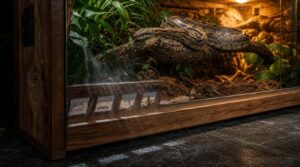
Position low cool-side vents at the base of your enclosure’s cool end, where they can pull fresh ambient air in at ground level without disturbing your boa’s temperature gradient.
Corrosion-resistant materials and filter mesh selection are critical—fine mesh blocks substrate debris while minimizing unwanted drafts.
Seasonal vent adjustment and careful vent size tuning allow you to optimize ventilation and airflow without drying out the enclosure.
High Warm-side Vents for Passive Exhaust
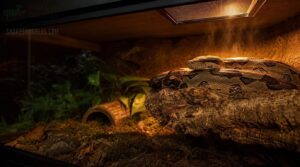
Once fresh air enters from below, you need somewhere for warm, stale air to escape — that’s where high warm-side vents come in. Positioned near the top rear of the warm end, they leverage Heat Driven Flow to exhaust rising air passively, no ventilation fan required.
Proper Exhaust Angle Design — slightly sloped openings — keeps debris from settling and maintains steady airflow.
- Seal Integrity Checks around vent edges prevent heat from bypassing your temperature gradient
- Humidity Buffer Integration through substrate and humid hides offsets any moisture lost through exhaust
- Regular cleaning ensures Ventilation and Airflow Optimization in Reptile Enclosures stays consistent long-term
How Rising Warm Air Supports Cross-ventilation

Warm air rising from your heat source creates a Thermal Plume, a natural upward push called the Stack Effect that drives passive exhaust flow without a ventilation fan. This Vertical Pressure Gradient pulls cooler air in low while Warm Air Lift carries stale air out high, supporting ventilation and airflow optimization in reptile enclosures through your temperature gradient automatically.
Warm air rising from your heat source drives passive exhaust naturally, pulling fresh air in low and pushing stale air out high
Why Vents Should Not Create Direct Drafts
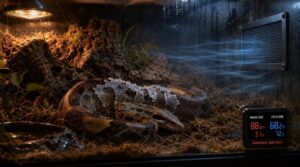
That stack effect works beautifully — until a poorly aimed vent turns gentle airflow into a cold blast. Direct drafts trigger Stress Responses, disrupt Thermal Gradient Setup and Monitoring, and cause Gradient Disruption that tanks Temperature and Humidity Management in boa habitats.
Persistent cold airflow also increases Respiratory Risk and causes Activity Suppression, even leading to Shedding Inhibition when your boa can’t regulate properly.
Placement Mistakes That Cause Heat and Humidity Loss
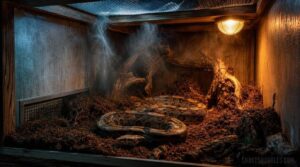
Even small placement errors quietly wreak havoc on Temperature and Humidity Management. Watch for these four critical mistakes:
- Corner eddy zones trap stagnant air, starving central rest areas of fresh exchange.
- Low-side vent blockage by substrate cuts off intake, skewing your Thermal Gradient Setup and Monitoring.
- Mismatched vent area near heat sources drains humidity before Humidity Regulation Techniques can compensate.
- Heat-source venting overhead pulls moisture away from floor level instantly.
Ventilation by Enclosure Material
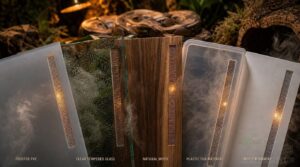
The material your enclosure is made from changes everything about how air moves, heat stays, and humidity holds.
PVC, glass, wood, plastic tubs, and melamine each behave differently — and those differences directly shape how you set up and manage ventilation.
PVC Enclosures and Controlled Airflow
PVC is the most forgiving enclosure type for boa keepers seeking precise control. This plastic enclosure utilizes integrated vent slots and perforated panels to manage airflow while maintaining a temperature gradient. Dust filter integration ensures a cleaner environment, and seam leak prevention locks in humidity. Adjustable airflow allows for fine-tuned ventilation and seasonal air quality control.
| PVC Feature | Benefit |
|---|---|
| Integrated vent slots | Controlled, targeted airflow |
| Seam leak prevention | Stable humidity retention |
| Perforated panels | Draft-free air distribution |
| Dust filter integration | Cleaner enclosure environment |
Enclosure material pros and cons consistently favor PVC when humidity stability matters most.
Glass Tanks and Screen-top Ventilation Problems
Glass tanks are a common starting point, but screen tops create real humidity control challenges for boas. Uncontrolled mesh openings cause rapid humidity loss risks, stagnant air pockets near the substrate, and draft temperature swings that stress your snake during shedding.
Watch for these glass enclosure warning signs:
- Condensation forming on inner walls
- Mesh clogging from dust and debris
- Humidity dropping below 55% consistently
- Uneven heat gradients across temperature zones
- Ventilation and air quality control becoming unpredictable
Wood Vivariums and Moisture-safe Vent Installation
Wood vivariums offer excellent insulation, but moisture control is their biggest challenge. Effective humidity regulation relies on smart wood treatment—seal all panels with VOC-free epoxy or polyurethane before assembly.
Vent frame design is critical: pair stainless steel mesh material with silicone gaskets to ensure corrosion prevention. Sealant selection around joints maintains stable ventilation and air quality control long-term.
| Component | Recommended Material | Why It Matters |
|---|---|---|
| Mesh Material | Stainless steel | Resists rust in humid wood enclosure conditions |
| Sealant Selection | Non-toxic silicone | Stays flexible; aids moisture control |
| Vent Frame Design | PVC or acrylic insert | Rigid backing aids humidity regulation |
Plastic Tubs With Drilled Ventilation Holes
Plastic tubs are a surprisingly practical choice for juvenile boa constrictor cage setups, and proper ventilation starts with smart drilling techniques. Use a step-bit drill for clean holes—6 to 8mm works well for standard tubs. Reinforce holes with thin plastic edging to prevent chipping over time.
Key setup tips:
- Use mesh inserts to prevent substrate from escaping through vents.
- Place lower holes on cool sides for intake, upper holes for exhaust.
- Use vent plugs during dry periods to maintain temperature and humidity levels in boa habitats.
- Space holes 2–3cm apart to ensure enclosure design integrity.
Why Melamine is Risky in Humid Boa Setups
Melamine looks sturdy, but it’s quietly one of the worst choices for humid boa setups. Moisture Delamination starts at exposed edges, where Edge Sealing Failure allows water to wick into the particleboard core, causing Trapped Dampness that remains invisible until damage occurs.
Thermal Cycling Stress cracks aging coatings over time, creating Mold Hotspots that disrupt humidity regulation and ventilation in vivarium environments.
Choose nontoxic materials for enclosure construction instead.
Humidity and Airflow Balance
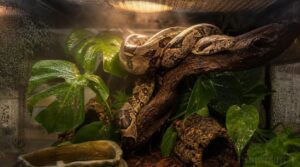
Getting humidity and airflow to work together is where a lot of boa keepers struggle, but it doesn’t have to be complicated. The right habits and tools make it much easier to keep conditions stable without constantly second-guessing your setup.
Here’s what you need to know to get that balance right.
Maintaining 55–75% Relative Humidity With Ventilation
Balancing humidity control with ventilation in vivarium setups is where most keepers struggle. You are aiming for 55–75% — tight enough that your boa stays hydrated, loose enough that mold doesn’t take hold.
- Misting Timing — Mist in the morning so excess moisture evaporates before nighttime cooling.
- Substrate Moisture — Damp coconut fiber holds ambient humidity without soaking the enclosure floor.
- Heat Source Humidity — Position heat sources away from water dishes to avoid uneven evaporation.
- Humidity Microclimates — Use a hygrometer at mid-height to catch accurate center readings.
- Seasonal Humidity Adjustments — Tighten vent openings slightly in dry winter months to retain moisture.
Raising Humidity Safely During Shedding Periods
When your boa enters the pre-shed phase — eyes go blue, skin dulls — bump humidity to the 60–80 range using staged mist increments rather than a single heavy spray. This prevents excessive moisture buildup.
Employ the spot misting technique: target enclosure walls, not the substrate directly, to avoid soggy bedding. Monitor the shedding cycle closely via your hygrometer, maintaining substrate moisture balance while ensuring humidity never exceeds 80%.
Using a Humid Hide Instead of Over-misting
Over-misting creates more problems than it solves. A humid hide is a smart humidity control system—it delivers microclimate benefits right where your boa needs them without soaking the whole enclosure.
Here’s why keepers switch:
- Shedding Efficiency improves as hide humidity reaches 75–95%
- Mold Prevention stays manageable with localized moisture
- Maintenance Reduction means less daily water misting system work
Smart Hide Placement. Cool side, away from direct airflow.
How Large Water Dishes Affect Enclosure Moisture
Your water dish does more than hydrate your boa — it actively shapes the enclosure’s humidity levels through evaporation rate and water volume. A large dish creates a humidity gradient, meaning moisture concentrates near the bowl and drops off further away.
Dish placement near heat sources intensifies this effect, raising mold risk around damp substrate.
Refresh the water every one to two days for reliable moisture control and accurate humidity monitoring.
Avoiding Automatic Misting Spikes Above 80% Humidity
Automatic misters are convenient, but without careful misting timing and airflow synchronization, they can push humidity levels past 80% fast — stressing your boa and encouraging mold growth. Keep mist volume light and use a digital hygrometer to stay within the humidity range 60–80%. Organic moisture control through substrate and a humidity buffer beats over-misting every time.
- Use creating humidity hides and misting systems together, not one alone
- Sensor calibration keeps your readings honest and prevents accidental spikes
- Short, timed mist bursts protect your boa better than long soaking cycles
Hygrometer Placement for Accurate Humidity Readings
Where you mount your hygrometer matters more than most keepers realize. Place it at mid-height in a shaded shelf spot, away from drafts and vents — that’s your vent-free zone for honest readings.
Use a calibration reference like a salt test to verify accuracy. This keeps your reptile humidity gauge trustworthy, ensuring temperature and humidity management in boa habitats stays precise and your monitoring equipment usage actually means something.
Top 10 Boa Enclosure Options
Finding the right enclosure for your boa doesn’t have to feel overwhelming, especially when you know what to look for regarding ventilation, size, and material.
The options below cover a range of builds, from glass tanks to PVC setups, so there’s something here for every keeper and every budget.
Here are ten enclosures worth considering.
1. New Age Pet Ecoflex Reptile Lounge
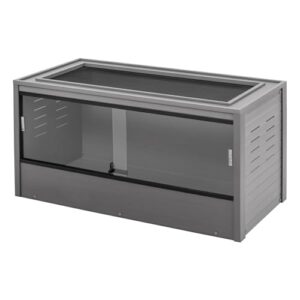
The New Age Pet Ecoflex Reptile Lounge checks several important boxes for boa keepers. Its ECOFLEX composite — a blend of recycled polymers and reclaimed wood fiber — resists moisture and odor better than raw wood, making cleanup noticeably easier.
Vented side panels promote steady airflow while limiting heat loss, and the full mesh top accommodates heat and UVB lamps without restriction.
At 48 inches long, it suits juvenile and smaller adult boas comfortably, though larger individuals over 6 feet will need a bigger setup.
| Best For | Hobbyists keeping juvenile boas or smaller adult reptiles who want an easy-to-clean, eco-friendly enclosure with solid lighting support. |
|---|---|
| Capacity | ~85 gal (48×24×22.8 in) |
| Primary Material | ECOFLEX composite |
| Ventilation Type | Mesh top + vented sides |
| Door Access | Sliding front glass doors |
| Locking Mechanism | Keyed lock included |
| Stackable Design | Yes, with Versa stands |
| Additional Features |
|
- ECOFLEX composite shrugs off moisture and odor, so cleanups are quick and painless
- Full mesh top makes it easy to set up heat and UVB lamps right where your boa needs them
- Assembles in 20–30 minutes with no special tools, which is great if you’re just getting started
- Not sealed for high humidity, so you’d need extra work to make it work for species that need a wetter environment
- No built-in cord ports — you’ll have to drill your own holes to run cables through
- Corner gaps can let substrate escape, and may need a silicone bead to keep things tidy
2. Amypet Large Reptile Hide Cave
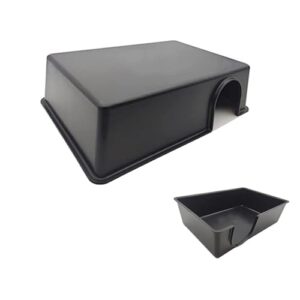
Think of the Amypet Large Reptile Hide Cave as your boa’s personal retreat — a secure spot where it can decompress without feeling exposed.
At roughly 13–14 inches long and 8–9 inches wide, it fits comfortably in 20- to 40-gallon setups and gives mid-sized boas real room to coil.
The resin construction won’t warp from humidity, cleans easily with mild soap and water, and the rock-textured exterior blends naturally into most terrarium layouts without looking out of place.
| Best For | Small reptile owners keeping juvenile snakes, geckos, or lizards in a 10-gallon tank who need an easy-to-clean hide that won’t take over the enclosure. |
|---|---|
| Capacity | Not applicable |
| Primary Material | Rigid plastic |
| Ventilation Type | N/A (hide box) |
| Door Access | Single entrance opening |
| Locking Mechanism | None |
| Stackable Design | No |
| Additional Features |
|
- Non-porous plastic makes cleaning and disinfecting quick and hassle-free.
- Compact size fits neatly in smaller tanks without eating up valuable floor space.
- Retains warmth well on the hot side, helping your reptile regulate its body temperature.
- The entrance opening is small, so larger or fully grown snakes won’t fit.
- Plastic doesn’t have the natural feel of wood or bark, which some reptiles actually prefer.
- Solid black only — it might clash with certain terrarium setups or décor styles.
3. ToxiRium Extra Tall Reptile Enclosure
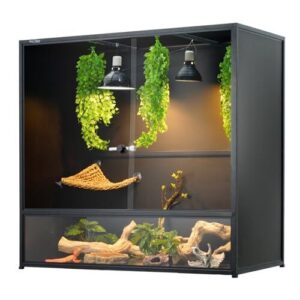
If you’re managing multiple boas or need serious vertical space, the ToxiRium Extra Tall Reptile Enclosure is worth a close look.
Its 96 × 24 × 46-inch PVC build holds heat and humidity far better than glass, and the cross-ventilation design — with lower intake vents and higher exhaust points — creates passive airflow without drying the enclosure out.
Front sliding panels make daily feeding and cleaning straightforward.
The stackable design is a genuine space-saver if you’re running a multi-enclosure room.
| Best For | Reptile keepers who need serious vertical space for climbing species like iguanas or chameleons, or anyone running a multi-enclosure setup that demands good heat and humidity retention. |
|---|---|
| Capacity | 230 gal (48×24×46 in) |
| Primary Material | Aluminum/PVC/glass |
| Ventilation Type | Mesh top screen |
| Door Access | Front sliding glass doors |
| Locking Mechanism | Keyless combination lock |
| Stackable Design | No |
| Additional Features |
|
- At 230 gallons and 48 inches tall, there’s plenty of room for climbing and basking species to actually stretch out and behave naturally.
- PVC side panels hold heat and humidity well, which cuts down on energy costs whether you’re running a desert or rainforest setup.
- Front sliding doors with a combo lock make daily feeding and spot cleaning quick, and you’re not worrying about escapes.
- Assembly instructions are a known headache — most people end up hunting down a video guide just to get through it.
- Tempered glass panels have a track record of cracking, with some users reporting breaks within the first several months.
- The plastic fasteners can strip over time, and once it’s built, moving the enclosure is awkward and the frame can feel less solid than you’d expect for the size.
4. Phailozoo Stackable 85 Gallon Reptile Terrarium
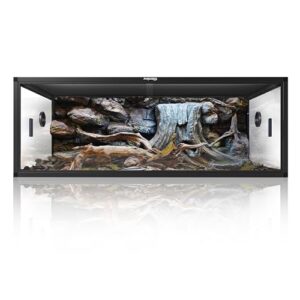
The Phailozoo Stackable 85 Gallon Reptile Terrarium offers a 48 × 24 × 18-inch footprint, providing ample floor space for a juvenile or smaller adult boa to stretch and explore.
Its aluminum frame ensures durability, particularly in humid environments, while the front-opening tempered glass door simplifies feeding and spot-cleaning, minimizing disruption.
The screen top promotes airflow but requires careful humidity monitoring, as it loses moisture faster than PVC alternatives.
Built-in substrate barriers help maintain a tidy interior by preventing debris spread.
| Best For | Reptile owners looking for a spacious, well-ventilated enclosure for bearded dragons, ball pythons, or smaller boas who want easy front-access and room to expand with a stackable setup. |
|---|---|
| Capacity | 85 gal (48×24×18 in) |
| Primary Material | Aluminum/plexiglass |
| Ventilation Type | Screen top (~28% light block) |
| Door Access | Front-opening single door |
| Locking Mechanism | No lock mentioned |
| Stackable Design | Yes, with spacer cabinets |
| Additional Features |
|
- The front-opening tempered glass door makes feeding and cleaning genuinely easy — no awkward reaching from the top.
- At 85 gallons with a wide 48-inch footprint, there’s plenty of room for most mid-sized reptiles to move around comfortably.
- The screen top only blocks 28% of light, so your heat lamps and UVB bulbs work the way they’re supposed to.
- The bottom isn’t watertight, so if you’re planning a bio-active or wet setup, you’ll need to silicone it yourself.
- The plexiglass side panels scratch over time, which can make the tank look worn faster than you’d expect.
- Some users have run into assembly headaches — tight-fitting pillars and potential gaps that need extra sealing before use.
5. Reptile Habitats 120 Gallon Enclosure
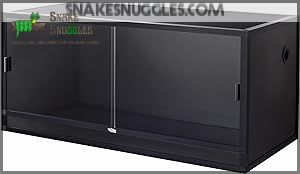
The Reptile Habitats 120 Gallon Enclosure measures 48 × 24 × 24 inches—enough room for a mid-sized boa to move, thermoregulate, and behave naturally.
PVC panels lock in humidity far better than glass, and the 12 built-in wire-through slots make routing heaters and hygrometers straightforward.
Assembly takes under 30 minutes. At $299, you’re getting solid climate control without a premium price tag, though you’ll need to seal the bottom with silicone before adding any moisture-retaining substrate.
| Best For | Reptile keepers housing active mid-to-large species like bearded dragons, ball pythons, or monitor lizards who want a roomy, humidity-friendly setup without a complicated build. |
|---|---|
| Capacity | 120 gal (48×24×24 in) |
| Primary Material | PVC/aluminum |
| Ventilation Type | Heavy-duty screen top |
| Door Access | Front sliding glass doors |
| Locking Mechanism | No lock mentioned |
| Stackable Design | No |
| Additional Features |
|
- 120 gallons of space gives your reptile real room to move, thermoregulate, and actually live — not just survive.
- PVC holds humidity well, and 12 wire slots mean your heating and monitoring gear stays tidy and out of the way.
- Snaps together in under 30 minutes for under $300 — solid value for what you’re getting.
- The bottom isn’t waterproof out of the box — you’ll need to seal it with silicone before adding any moisture-holding substrate.
- No printed manual included, so you’re relying on a QR code and a video, which isn’t ideal if your Wi-Fi’s being moody.
- The all-black interior isn’t everyone’s style, and some side channels may need a little coaxing with a screwdriver during assembly.
6. Unipaws Black Reptile Terrarium with Sliding Doors

The Unipaws Black Reptile Terrarium measures 47 × 23.5 × 23 inches—slightly shorter than the Reptile Habitats model. Its MDF construction effectively retains heat, ensuring a stable environment.
The front sliding glass doors lock securely and feature silicone gap-seal bars, eliminating escape risks. Four rotating cable ports accommodate heaters and thermometers, maintaining a clean setup.
The metal mesh top provides excellent ventilation for drier habitats but requires partial coverage to sustain humidity levels above 55% for boas.
| Best For | Desert reptile keepers who want a roomy, heat-efficient enclosure for adult bearded dragons or large lizards and need clean cable management for their heating and lighting setup. |
|---|---|
| Capacity | 110 gal (47×23.5×23 in) |
| Primary Material | MDF wood/glass |
| Ventilation Type | Metal mesh top |
| Door Access | Sliding glass doors |
| Locking Mechanism | Custom metal lock |
| Stackable Design | Yes, stacker sold separately |
| Additional Features |
|
- The MDF body holds heat really well, so your desert reptiles stay warm without your equipment working overtime.
- Sliding glass doors with a lock and silicone gap-seal bars mean nothing gets in or out that shouldn’t—feeder insects included.
- Four rotating cable ports keep all your cords routed neatly inside without breaking the seal.
- Not a good fit for high-humidity setups like boa enclosures—the edges aren’t waterproof and the mesh top makes holding moisture tough.
- The wooden base doesn’t play well with bottom heating pads, so placement options are limited.
- Assembly kicks up fiberglass dust, so you’ll want to gear up and work somewhere with good airflow.
7. Royxen 82 Gallon Glass Reptile Terrarium
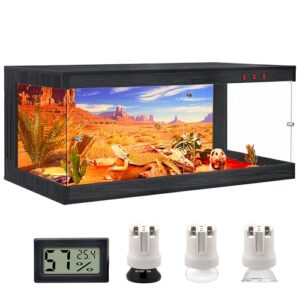
The Royxen 82 Gallon Glass Terrarium offers a clear alternative to solid walls and wood framing. At 48 × 20 × 20 inches, it provides multi-angle visibility that wood enclosures cannot match—ideal for monitoring shedding or feeding behavior.
The vented top enables passive airflow, though you’ll want to cover part of the mesh to maintain humidity above 55%.
Three independent E27 lamp sockets allow precise control over your heat gradient, eliminating the need for extra wiring.
| Best For | Reptile owners who want clear visibility and flexible lighting control for medium-to-large species like bearded dragons or tortoises. |
|---|---|
| Capacity | 82 gal (48×20×20 in) |
| Primary Material | Tempered glass/wood |
| Ventilation Type | Top and side openings |
| Door Access | Front sliding door |
| Locking Mechanism | Central sliding lock |
| Stackable Design | No |
| Additional Features |
|
- Three-sided glass gives you a great view from almost any angle, making it easy to keep an eye on feeding, shedding, or just everyday behavior.
- Three independent E27 lamp sockets let you dial in your heat gradient without running extra wires or buying separate fixtures.
- Ventilation openings on the top and sides keep air moving, which helps control humidity and cuts down on odor over time.
- A few buyers have reported glass breakage and questioned whether it’s truly tempered, which is worth keeping in mind before you commit.
- The sliding door lock leaves a small gap — not a big deal for larger reptiles, but a real escape risk for small or quick-moving ones.
- No heat source is included, so budget for a lamp or heating pad on top of the enclosure price.
8. Phailozoo Reptile Terrarium Sliding Door
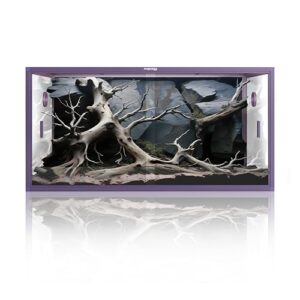
The Phailozoo Reptile Terrarium Sliding Door prioritizes full glass visibility without compromising practicality. Its 48 × 24 × 24-inch dimensions and 120-gallon capacity provide adult boas with ample floor space to establish distinct warm and cool zones. The front-opening tempered glass doors minimize handling stress and simplify daily feeding routines.
A top screen vent ensures passive airflow, though you’ll need to partially cover it to maintain humidity reliably above 55% for your boa. This design balances ventilation and humidity control effectively.
| Best For | Hobbyists keeping bearded dragons, medium-sized snakes, or other mid-size lizards who want front-access convenience and a clean, stackable setup. |
|---|---|
| Capacity | 120 gal (48×24×24 in) |
| Primary Material | Acrylic/aluminum/PVC |
| Ventilation Type | Rust-proof top screen |
| Door Access | Front sliding glass doors |
| Locking Mechanism | No lock mentioned |
| Stackable Design | Yes, Phailozoo V2 only |
| Additional Features |
|
- Front sliding glass doors make feeding and cleaning way less stressful for both you and your animal
- 120 gallons of space gives you plenty of room to build out proper basking, cooling, and hide zones
- Stackable design is a smart space-saver if you’re housing multiple reptiles
- The silicone bottom seal isn’t fully waterproof, so high-humidity setups need extra sealing work
- Door tracks can arrive bent and may need adjustment right out of the box
- Assembly instructions are pretty bare-bones — expect to hunt down a YouTube tutorial to get through the build
9. Annzoe 80 Gallon Reptile Tank
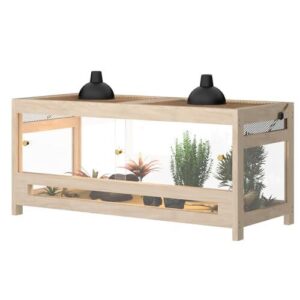
The Annzoe 80 Gallon Reptile Tank offers a 47.2 × 21.2 × 20-inch footprint with four clear acrylic panels and a flip-top mesh lid for ventilation and UVB access.
That mesh lid does the job for airflow, but cover about half of it to hold humidity above 55%.
The wood frame looks clean, but treat it with a VOC-free sealant before adding substrate.
Inspect the acrylic panels on delivery—some units arrive chipped or with misaligned hardware.
| Best For | Reptile owners looking for a spacious, visually open enclosure for active species like bearded dragons, geckos, or medium-sized snakes. |
|---|---|
| Capacity | 80 gal (47.2×21.2×20 in) |
| Primary Material | Acrylic/wood frame |
| Ventilation Type | Flip-top mesh lid |
| Door Access | Flip-top lid |
| Locking Mechanism | Flip latch |
| Stackable Design | No |
| Additional Features |
|
- Four clear acrylic panels give you a full view of your pet from almost any angle—no more crouching to peek through one glass side.
- The flip-top mesh lid lets UVB light through easily and keeps airflow going without any extra work.
- Everything you need to put it together comes in the box, so you’re not hunting for tools or making a hardware store run.
- Shipping damage is a real concern—broken acrylic, snapped dowels, and missing screws show up often enough to warrant a careful unboxing.
- The wood frame can feel thin and may need sealing before use, especially if you’re running a humid setup.
- Internal dimensions run slightly smaller than advertised, so double-check the actual measurements before planning your layout.
10. ToxiRium Stackable PVC Reptile Terrarium
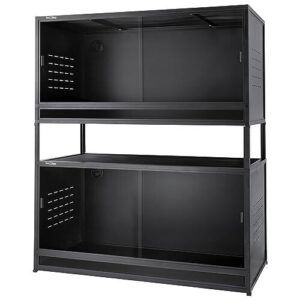
The ToxiRium Stackable PVC Reptile Terrarium measures 44 × 20 × 20 inches and holds roughly 76 gallons — enough floor space for juvenile to mid-sized boas.
PVC walls retain heat and humidity far better than glass, so you won’t fight constant temperature swings.
Integrated side ventilation channels keep air moving without drafts.
One caution: the bottom panel can flex under heavy substrate loads, so stay under the 100-pound limit to avoid warping.
| Best For | Reptile owners looking for a spacious, heat-efficient enclosure for desert species like bearded dragons, ball pythons, or leopard geckos — especially those who want to stack multiple habitats in a tight space. |
|---|---|
| Capacity | ~76 gal (44×20×20 in) |
| Primary Material | PVC/stainless steel |
| Ventilation Type | Stainless-steel mesh top |
| Door Access | Sliding acrylic doors |
| Locking Mechanism | Keyed lock included |
| Stackable Design | Yes, multi-unit stacking |
| Additional Features |
|
- PVC walls hold heat and humidity way better than glass, so your heating setup works less and costs less to run.
- The stacking design is a game-changer if you’re running multiple enclosures — saves a ton of floor space.
- Built-in cable pass and a keyed lock make setup cleaner and keep curious reptiles from escaping.
- The bottom panel is on the thin side and can flex under heavy substrate — you’ll want to stay well under that 100-pound limit.
- Door sealing isn’t always tight out of the box, which means some fiddling to get a proper close.
- Stacking instructions are pretty bare-bones, so first-time assembly might need an extra set of hands.
Ventilation Monitoring and Maintenance
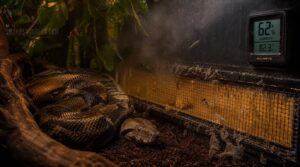
Getting ventilation right is only half the job — keeping it working is the other half.
Over time, vents collect shed skin, dust, and substrate that quietly choke airflow and throw your humidity and temperature readings off. Here’s what to watch for and how to stay ahead of it.
Checking Vents for Shed Skin, Substrate, and Dust
Vents are easy to overlook until they’re blocked. During every shed cycle, loose skin fragments migrate toward airflow openings, causing vent debris spotting that restricts fresh air exchange.
Check vents weekly using visual dust mapping — wipe grilles with a white cloth to gauge buildup.
Substrate dust ingress from burrowing can quietly clog screens, so your inspection frequency and regular cleaning schedule directly protect your humidity levels.
Monitoring Temperatures After Changing Vent Size
Changing vent size shifts your enclosure’s thermal balance fast. Start with baseline temperature logging across both zones before making adjustments. Track post-change delta readings at 15 minutes, 1 hour, and 24 hours using a thermometer array placed at multiple heights.
- Record cool and warm sides separately
- Check for draft sensation assessments near vents
- Confirm stabilization period monitoring shows variations under 0.5°C for 6 hours
- Verify temperature gradient stays within a 26–32°C daytime range
Tracking Humidity Trends After Cleaning or Misting
Humidity shifts faster than you’d expect after cleaning — sometimes within 15 minutes. Use a digital hygrometer with data logging frequency set to every 5–10 minutes, capturing readings for 24–72 hours post-cleaning.
Baseline comparison methods reveal whether spikes are temporary or persistent. This analysis ensures trends are accurately interpreted over time.
Microclimate mapping using two sensors facilitates post-cleaning trend analysis, enabling precise adjustments.
By implementing these strategies, keeping humidity levels reliably within the 55–75% range becomes achievable, safeguarding environmental stability.
Adjusting Airflow During Seasonal Humidity Changes
Seasons shift, and so should your intake-exhaust ratio. Humidity-driven vent tuning keeps levels between 55–75% year-round through incremental airflow shifts — never dramatic changes that stress your boa.
- Summer: increase exhaust, reduce intake to shed excess moisture
- Winter: limit exhaust to retain humidity
- Apply draft minimization techniques by adjusting vents gradually
- Use seasonal vent scheduling guided by your hygrometer readings
Preventing Mold With Proper Substrate Maintenance
Substrate is where mold actually starts, making sterilization essential. Sterilization Protocols require pressure cooking the substrate at 15 psi for 60 minutes before use. Maintain moisture levels at 60–65% through moisture metering with a calibrated device.
| Practice | Target |
|---|---|
| Routine Substrate Replacement | Every 30 days (25–30%) |
| Mold Early Detection Check | Every 48 hours |
Substrate airflow and a consistent substrate cleaning routine prevent fungal growth before it spreads.
Cleaning Vents Safely Without Harsh Chemicals
Use a DIY vent brush — like a soft-bristle toothbrush — to remove microfiber dust from grille fins.
For wiping non-porous vents, prepare a gentle cleaning solution: mix one part white vinegar with three parts water. Maintain a regular cleaning schedule every four to six weeks. Always ensure cleaning products are safe for reptiles and avoid bleach entirely.
Frequently Asked Questions (FAQs)
What is the 1 to 300 rule for ventilation?
The 1 to 300 rule means one square foot of Net Free Area — actual unobstructed opening — for every 300 square feet of floor space.
This provides a reliable Ventilation Ratio tied directly to enclosure size.
How to ventilate a snake enclosure?
Place low vents on the cool side for fresh air intake and high vents on the warm side for passive exhaust, maintaining your temperature gradient while keeping humidity levels stable.
What should the humidity be in a boa enclosure?
Keep humidity levels between 60–80% in your boa’s enclosure. During shedding, push toward the higher end. A reliable hygrometer helps you stay on track without guessing.
Do snakes need a lot of ventilation?
Snakes don’t need a ton of ventilation — they need the right amount.
Steady, balanced airflow keeps humidity levels stable, facilitates temperature regulation, and manages odor control without drying the enclosure out.
Can ventilation affect a boas feeding response?
Yes, ventilation directly affects your boa’s feeding response. Stagnant air disrupts hormonal balance and induces metabolic stress, which dulls appetite cues.
Stable airflow facilitates digestive efficiency and enables reliable prey detection during every feeding session.
Do boas need different airflow at night?
Boas don’t need dramatically different airflow at night, but modest adjustments help.
Slightly reduced night vent sizing aids nocturnal humidity stability, evening temperature buffering, and sleep-time CO₂ control without triggering disruptive nighttime draft reduction.
How does room temperature affect enclosure ventilation needs?
Room temperature quietly reshapes everything inside the enclosure.
Higher ambient heat slows convection rate changes, traps moisture, and strains your temperature gradient, so seasonal adjustments for boa care and consistent temperature monitoring keep conditions stable.
Can poor ventilation spread illness between cohabiting snakes?
Poor ventilation absolutely can. Stagnant air allows aerosol disease spread between cohabiting snakes, while mold-borne pathogens thrive in damp, oxygen-depleted spaces.
Cohabitation density compounds the risk rapidly.
A regular cleaning schedule and stable humidity levels are your best defense.
Does enclosure elevation in a room impact airflow?
Enclosure elevation absolutely affects airflow. Higher placements tap into the stack effect, where warm air rises toward the ceiling. Just watch for cold draft risk from HVAC vents above.
Conclusion
Ventilation looks simple on paper, yet it’s quietly the most complex variable in boa husbandry. Properly designed systems prioritize fresh air flowing in low and stale air exiting high, transforming chaotic humidity into controlled conditions.
This requires more than arbitrary holes—it demands strategic vent placement, moisture-resistant materials, and relentless monitoring. Choose materials that cooperate with moisture and monitor consistently to maintain equilibrium.
Your boa’s respiratory health lives or dies by the daily air quality surrounding it.
- https://www.thebiodude.com/blogs/snake-caresheets/boa-constrictor-care-guide-and-bioactive-terrarium-maintenance?srsltid=AfmBOood72AHMorO6s_05hWXH0mW43vIcSs1xXIOg7sBXTdVutQLNFaQ
- https://www.swiftailvet.com/exotic-pet-care-sheets/boa-constrictor
- https://www.furrycritter.com/pages/articles/snakes/screen_top_ventilation.htm