This site is supported by our readers. We may earn a commission, at no cost to you, if you purchase through links.

A boa constrictor can hit 8 feet and 30 pounds before it turns five. That growth outpaces most first-time enclosures within a year, and an undersized snake cage leads straight to muscle atrophy, stress strikes, and failed sheds.
Getting setting up boa enclosure right from day one protects your animal and your wallet, since replacing a habitat costs more than building it correctly the first time. The five steps below cover sizing, security, thermal gradients, substrate, and hygiene routines, with exact measurements and temperatures you can apply today.
Table Of Contents
- Key Takeaways
- Choose The Right Boa Enclosure Size and Material
- Secure The Enclosure and Add Hides, Branches, and Water
- Create a Safe Temperature Gradient and Lighting Schedule
- Add Safe Substrate and Balance Humidity With Ventilation
- Establish Cleaning, Quarantine, and Equipment Check Routines
- Frequently Asked Questions (FAQs)
- What is the ideal enclosure setup for a boa constrictor?
- How big of an enclosure does a boa need?
- What is the ideal enclosure setup for a rainbow boa?
- How hot should a boa enclosure be?
- How often should I change water bowls?
- Can boas live together in one enclosure?
- What cleaning products are safe for boas?
- Do boas need filtered or tap water?
- How do I know if humidity is too low?
- Can I house two boas together in one enclosure?
- Conclusion
Key Takeaways
- Size the enclosure for the adult snake from day one—adults need 6–10 feet of length and 2.5–3.5 m³ of volume—and PVC is the best material for insulation and humidity control.
- Maintain a precise thermal gradient of 26–32°C with a proportional thermostat, mount UVB 30–40 cm above the basking spot, and replace bulbs every 6–12 months.
- Use coconut fiber or cypress mulch at 4–6 inches deep, keep humidity above 40% with a damp sphagnum humid hide during sheds, and never use cedar or pine.
- House boas individually, quarantine new arrivals for 60–90 days, spot-clean daily, change water every 24–48 hours, and verify thermostats and heat equipment weekly.
Choose The Right Boa Enclosure Size and Material
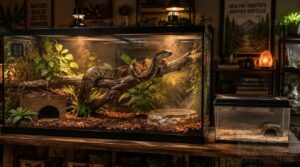
Getting your boa’s enclosure right from the start determines whether it thrives or just survives. Size and material both matter, and the wrong choice at any life stage creates problems you’ll spend months fixing. Here’s what you need to know before you buy. A full red-tailed boa care guide covers heating and enclosure setup in detail, so you can plan the whole habitat before spending a dime.
Before you pick anything, it’s worth reading through a proper boa constrictor substrate guide so you know which bedding options hold humidity without risking your snake’s respiratory health. It’s also worth brushing up on how temperature control affects your boa’s health, since substrate and heat work together to keep respiratory infections at bay. For a complete walkthrough of enclosure setup, feeding, and long-term care, this boa constrictor care sheet covers everything in one place.
Choosing the right boa enclosure from the start determines whether it thrives or merely survives
Size by Life Stage
Three distinct life stages demand three different enclosure sizes. Hatchlings need at least 1.2–1.5 m³ to support early growth. Subadults thrive in 1.5–2.0 m³, with enclosure length matching 1.2–1.5 times their total body length.
Your adult boa constrictor enclosure should hit 2.5–3.5 m³. Always plan your habitat design 10–15% larger than immediate needs so your boa never outgrows its space.
PVC, Glass, or Wood
Once you’ve locked in enclosure size, material shapes every other decision.
PVC excels at insulation and resists moisture, making it the top pick for most boa enclosure setups.
Glass looks clean but transfers heat fast, demanding precise thermostat control and ventilation.
If you’re weighing glass against other materials, a detailed buyers guide for ball python enclosures breaks down the trade-offs in weight, humidity, and cost. Since glass also loses humidity faster, a guide to reptile misting systems for ball pythons covers how to keep moisture levels stable without constant guesswork.
Wood works if you seal it thoroughly, but humidity warps untreated edges.
Match your material to your maintenance habits.
Secure The Enclosure and Add Hides, Branches, and Water
Once you’ve got the right enclosure, your next job is making sure nothing gets out. Boas are methodical escape artists, and a lid without two-handled, keyed locks is a crisis waiting to happen. Seal lid seams with weatherstripping to kill pry force, and add corrosion-resistant corner bracing at every door joint.
Two hides are your minimum: one cool side, one warm. Each should fit your boa’s full body snugly. Boas feel exposed in oversized hides.
Beyond hides, it helps to replicate your snake’s natural habitat, matching terrain, shelter, and seasonal shifts to where boas originate in the wild.
Branches must support your boa’s full weight without flexing. Stagger them vertically but keep placement low to remove the top as a climbing target.
Use a shallow, ramped water dish with edges under 2 cm deep. Clean it daily and add a cool-side secondary station.
Create a Safe Temperature Gradient and Lighting Schedule
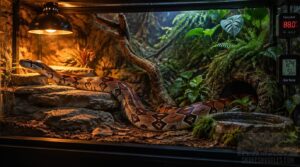
Getting the thermal gradient right is non-negotiable for your boa’s digestion, immunity, and overall survival. Two distinct temperature zones must be established and held with precision—not guesswork. Here’s how to build the heating setup and lighting schedule your boa actually needs.
Heating and Thermostat Setup
Think of thermal zones as dial settings: just one degree off, and your boa suffers.
Place a heat pad under the warm side to build a 26-32°C gradient. A proportional-interrupt thermostat caps your basking spot at 32°C max.
- Wrong temps stop digestion cold
- Burns happen before symptoms appear
- Faulty thermostats create dangerous overnight spikes
- No thermostat means no real control
UVB and Daylight Cycle
Mount UVB lighting 30-40 cm above your boa’s basking spot using a 5.0% bulb. This anchors its circadian rhythm by maximizing UVB exposure and enabling vitamin D synthesis.
| Phase | Photoperiod | UVB Exposure |
|---|---|---|
| Day | 12-14 hours | 5-10 hours |
| Dusk | 30-min fade | Off |
| Night | 10-12 hours | None |
Match your light cycles to this photoperiod schedule above. Replace all bulbs every 6-12 months.
Add Safe Substrate and Balance Humidity With Ventilation
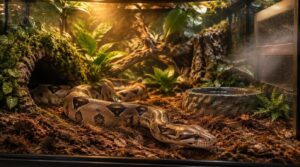
Getting substrate and humidity right is where many setups fail. Two elements determine success here: what lines the floor and how you build moisture control into the enclosure itself. Here’s what you need to cover both.
Substrate Depth and Maintenance
Wrong substrate kills boas silently. Use coconut fiber or cypress mulch, which retains moisture without compacting. Give adults 4–6 inches of depth so they can burrow naturally.
- Spot-clean waste immediately after each feeding
- Fluff the top 1–2 inches weekly
- Check for mold during your weekly inspections
- Complete a full substrate change every 6–12 months
- Never use cedar or pine substrates
Humid Hide for Shedding
Picture old skin lifting like a thin film, clinging wherever moisture is absent. That’s your signal. During each shedding cycle, a humid hide converts a dry microclimate into a loosening chamber.
Pack damp sphagnum inside, position it on the warm side, and keep the entrance clear. Consistent humidity retention through the grey phase matters more than reacting once peeling starts.
Establish Cleaning, Quarantine, and Equipment Check Routines
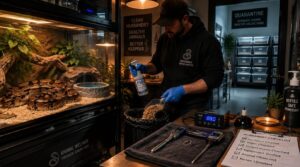
Your enclosure is a bank vault, and your routines are the security system. Skip them, and one contaminated tub wipes out your entire collection.
Spot-clean daily. Remove feces and soiled substrate the moment you see it. Full substrate changes and enclosure sanitization happen monthly, with disinfection of water bowls and hides at every change. Wiping alone won’t cut microbial load; use a proper reptile-safe disinfectant.
Quarantine every new boa for 60 to 90 days in a separate room. Work clean-to-dirty: established animals first, quarantine last. Change gloves or wash hands at every enclosure boundary, and never share tools or supplies between zones.
Run equipment checks weekly. Verify your thermostat actually controls the heat source, inspect heat elements for damage, and confirm your thermometers read plausibly. Regular monitoring plus emergency preparedness, backup heat, spare thermostat, keeps a small failure from becoming a fatal one.
Frequently Asked Questions (FAQs)
What is the ideal enclosure setup for a boa constrictor?
Ironically, the "ideal" boa constrictor enclosure isn’t one perfect product; it’s a system. You need correct enclosure size (120+ gallons for adults), PVC construction, dual temperature gradients, proper substrate choices, and controlled ventilation.
How big of an enclosure does a boa need?
Most keepers underestimate boa constrictor enclosure requirements. Hatchlings need 24–36 inches; juveniles 4–6 feet; adults 6–10 feet long and 2–3 feet wide. Size up before your boa outgrows its habitat setup.
What is the ideal enclosure setup for a rainbow boa?
Over 70% of rainbow boa health issues trace back to poor humidity control. You’ll need a 60–120 L PVC enclosure, a 26–35°C temperature gradient, 50–60% ambient humidity, secure climbing branches, and two hides.
How hot should a boa enclosure be?
Target 28–32°C at your basking spot, with a temperature gradient down to 24–26°C on the cool side. Let nights fall 4–6°C, never below 18°C. Verify with thermal mapping and thermostats daily.
How often should I change water bowls?
Your snake’s water sits untouched for days while you scrub everything else. Change it every 24 to 48 hours, swap it immediately after feces or substrate contamination, and scrub that soaking bowl during weekly cleaning schedules.
Can boas live together in one enclosure?
Think of boas as oil and water: they don’t mix. Cohabitation fails almost every time. Dominant snakes monopolize heat, food, and hides, so single housing is your only safe route to stress reduction and snake health.
What cleaning products are safe for boas?
Like a surgeon’s tray, your cleaning kit should be lean and precise. Use fragrance-free soap, diluted bleach (1:32), 3% hydrogen peroxide, or EPA-registered reptile-safe disinfectants. Rinse thoroughly; residue causes scale rot and olfactory stress.
Do boas need filtered or tap water?
Over 90% of tap supplies meet safety standards, yet chlorine and chloramine still irritate reptiles.
Dechlorinate tap water, or use filtered water if your source runs mineral-heavy.
Either works; prioritize fresh water quality, proper hydration, and clean water bowl placement.
How do I know if humidity is too low?
How do you spot the warning signs? Get a digital hygrometer first. Humidity levels below 40% spell trouble. Watch for wrinkled skin, stuck shed, sunken eyes, reduced appetite, and lethargy. Consistent humidity monitoring prevents chronic dehydration.
Proper hydration works best alongside a balanced diet, so it helps to understand which nutrients ball pythons need to support healthy skin, shedding, and overall energy.
Can I house two boas together in one enclosure?
Wondering if two boas can share one home? Only juvenile boas should cohabitate. Adults require separate enclosures to prevent aggression, competition, and stress. Prioritize stress reduction: plan your boa constrictor enclosure around individual space.
Conclusion
Worried about the upfront cost of a full-size enclosure? Compare it to one vet visit for a respiratory infection or a stuck shed, and the math settles itself.
Setting up boa enclosure right means sizing for the adult snake, locking in your thermal gradient, and running a weekly hygiene checklist.
Build it once, build it correctly, and your boa gets decades of health. Start today.