This site is supported by our readers. We may earn a commission, at no cost to you, if you purchase through links.

A ball python in a bare glass tank with a paper towel floor isn’t thriving. It’s surviving, and that’s a different thing. Snakes evolved over millions of years to read heat, humidity, and cover with startling precision, so a 75°F box with one plastic hide leaves most of that wiring idle.
A snug, properly placed hide gives a ball python the security it craves, and these hide boxes for reducing snake stress show how.
Snake natural habitat replication fixes this. When you match your enclosure to your snake’s native terrain, your corn snake climbs, your sand boa tunnels, and feeding stress drops.
Start with the wild range, then build the gradients, substrate, and hides that turn a tank into a territory.
Table Of Contents
- Key Takeaways
- Match Your Snake’s Enclosure to Its Natural Habitat
- Set Up Species-Specific Heat, Humidity, and Lighting
- Choose Safe Substrates and Plants for Naturalistic Snake Enclosures
- Support Natural Snake Behaviors With Hides, Branches, and Burrowing Space
- Maintain Your Snake’s Habitat With Cleaning and Environmental Monitoring
- Frequently Asked Questions (FAQs)
- Can snakes self-replicate?
- Which smell do snakes hate?
- Is it true if you see one snake, are there more?
- What snake is asexual?
- How do snakes adapt to coastal ecosystems?
- How does a snake change its environment?
- How do snakes affect habitat dynamics?
- Can snakes adapt to new environments?
- What should I do if my snake has a new habitat?
- Where do snakes live in a biodiverse zone?
- Conclusion
Key Takeaways
- Start by researching where your snake comes from in the wild, then match its enclosure’s terrain, shelter, and seasonal conditions to that native habitat.
- Build a heat gradient with an 85–90°F warm side and a 70–75°F cool side on a thermostat, and put a damp humid hide on the cool end so your snake can choose its own microclimate.
- Choose a safe, species-appropriate substrate at a depth that lets your snake burrow (three to six inches for most), and avoid dyed mulch, fertilized soil, gravel, and fine play sand.
- Give your snake two hides, climbing branches where they suit the species, a steady 12-hour light cycle, and a daily and monthly cleaning routine, because consistent upkeep keeps the setup working.
Match Your Snake’s Enclosure to Its Natural Habitat
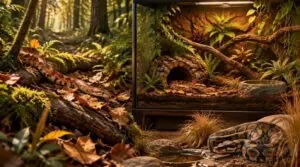
You can’t build a great enclosure until you know where your snake actually comes from. Start there. Look up its native range, then note the terrain, vegetation, shelter types, and seasonal swings it faces in the wild.
Once you know those natural conditions, you can work out whether your snake needs heating and lighting in its tank to copy the temperature gradient it would find outdoors.
This is habitat type matching, and it shapes every choice that follows. A corn snake from leaf-littered woodland needs a very different species specific enclosure than a ball python from humid West African savanna edges.
Next, think about behavior. Does your snake burrow, climb, or cruise along the ground? Build for that. Good naturalistic terrarium design gives it room to stretch out fully and the right space for its habits. Offering a safe loose substrate lets burrowing species dig and tunnel, which helps both exercise and natural behavior.
Set Up Species-Specific Heat, Humidity, and Lighting
Once your enclosure matches your snake’s natural habitat, the environment itself comes next. You’ll tackle three pieces here, starting with thermal gradients, then humidity and ventilation, then lighting and day-night cycles. Get these right for your species and you’ll give your snake a setup that actually works with its biology.
Thermal Gradients and Safe Heating
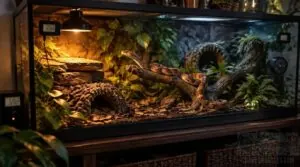
A solid setup starts with thermal gradients, so heat one end only. Aim for an 85–90°F basking zone and a 70–75°F cool side. Ceramic emitters or undertank heaters work really well, but run them through a thermostat.
Once your gradient is dialed in, pair it with a snug, escape-proof lid and a damp sphagnum humid hide, as covered in these corn snake habitat tips.
Then nail your temperature gradient monitoring: probes on both ends, a gap of at least 10°F, plus digital hygrometers for overall room readings.
Humidity Gradients and Ventilation
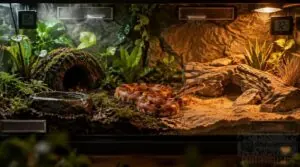
Cooler air holds more moisture, so your cool side becomes the damp end. Pair deep moist substrate there with dry substrate opposite, and add a mossy humid hide. Those microclimates let your snake choose.
Use low intake and high exhaust for ventilation and airflow. Extend temperature gradient monitoring to humidity levels with hygrometers at both ends. Skip humidity control systems; mist.
Lighting and Day-Night Cycles

Humidity and heat are set, so light is next. Your photoperiod cycle tells your snake when to hunt and rest.
An inconsistent light schedule can add stress that shows up at mealtime, so if your snake keeps bringing up meals, this guide on why a ball python regurgitates can help you spot the cause.
- Run 12 hours on, 12 off.
- Shift seasonal lighting for temperate species.
- Skip colored night bulbs.
- Keep nights fully dark.
UVB lighting needs are minimal for most snakes, but diurnal basking patterns still follow your temperature gradient. Nail both today.
Choose Safe Substrates and Plants for Naturalistic Snake Enclosures
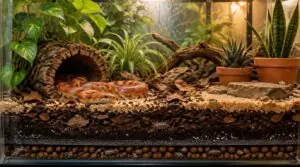
Substrate is the foundation of your enclosure design, so nail it first. Match it to a species-specific habitat: aspen for dry-leaning corn snakes, coconut fiber for boas, a sand-soil mix for sand boas.
If you’re short on space, this guide to snake bedding for apartment living shows which substrates keep odor and humidity in check.
Skip dyed mulch, fertilized soil, gravel, and fine play sand. They’re toxic, abrasive, or an impaction risk.
Want a bioactive substrate? Layer drainage, mesh, soil mix, and leaf litter, then add isopods and springtails.
Pick nontoxic plants and keep these in mind:
- Pothos and spider plants tolerate humid, tropical setups with moderate light
- Haworthia and snake plant suit arid tanks without much fuss
- Rinse every plant thoroughly before planting it
- Anchor pots so burrowers can’t topple them
- Leaf litter doubles as habitat enrichment and a shedding surface
Support Natural Snake Behaviors With Hides, Branches, and Burrowing Space
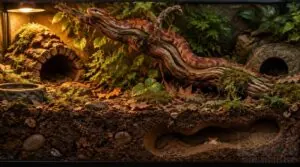
You can nail this part of your naturalistic setup with three simple features. Start with two hides, one on the warm side and one on the cool side. Your snake gets to pick its own microclimate without feeling exposed. Easy win.
Next, add sturdy branches like grapevine or cork oak. Corn snakes love to climb, so give them vertical space and watch activity jump. Arboreal species prefer hides up high, while royal pythons want a fully enclosed one at ground level.
Don’t forget burrowing. Aim for a substrate depth of three to six inches for most species. Sand boas need four to six inches of fine sand to fully disappear, and hognose snakes love loose, diggable mixes. Dig in, literally.
Maintain Your Snake’s Habitat With Cleaning and Environmental Monitoring
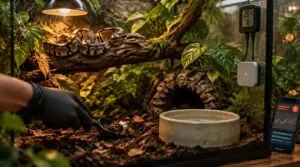
Picture a perfect rainforest floor, then picture it with a week of forgotten waste baking under a heat lamp. Not pretty. Good habitat maintenance keeps your naturalistic setup from turning into a petri dish.
Neglect a snake’s habitat, and even a perfect rainforest floor becomes a petri dish under a heat lamp
Every day, remove uneaten food, shed skin, feces, and urates the moment you spot them, and refill the water bowl with fresh, dechlorinated water. Check your thermometer and hygrometer, especially after cleaning, since a bumped probe can wreck your gradient.
Weekly, scrub the bowl, inspect heaters and thermostats, and swap paper substrate. Monthly, handle substrate replacement: strip everything, disinfect with a reptile-safe cleaner, and start fresh. Add wireless monitoring with phone alerts and data logs, and your environmental control will catch problems before your snake does.
Frequently Asked Questions (FAQs)
Can snakes self-replicate?
Only one snake species, the brahminy blindsnake, reproduces without males every time. Yes, snakes can self-replicate, but most do it facultatively: boas, pythons, and pitvipers occasionally produce half-clone offspring when mates are absent, mostly females.
Which smell do snakes hate?
Picture a ball python bolting for hiding spots after cinnamon spills.
Snakes hate clove, garlic, and vinegar. Keep them out of your secure enclosure; scents spike stress cues. Use environmental enrichment for snake stress reduction.
Is it true if you see one snake, are there more?
Think a lone snake means a nest nearby? Usually not. Most species are solitary, so wild snake behavioral mimicry means one animal per enclosure.
Prioritize snake stress reduction, behavioral enrichment, microhabitat creation, habitat enrichment efficacy.
What snake is asexual?
The Brahminy blindsnake is your answer. It’s the only obligate parthenogenetic snake, and every specimen is female. Copperheads, boas, and pythons can reproduce asexually too, but only occasionally, even with males nearby. That’s facultative parthenogenesis.
How do snakes adapt to coastal ecosystems?
Coastal habitat adaptation goes beyond salt glands. Salt marsh snakes show saltwater tolerance through osmoregulation in reptiles: they skip seawater, drink rain, and get fluids from prey. Mind humidity levels and wetland snake water access.
How does a snake change its environment?
Snakes are environment engineers with world-changing powers! They flatten vegetation, reshape burrows, and spread seeds.
Basking creates microclimates, and hunting shifts prey behavior, so snakes actively rewrite their habitat instead of just living in it.
How do snakes affect habitat dynamics?
A coiled snake is a quiet architect. As environment engineers, your snakes dig and flatten cover, reshaping predator-prey relationships, creating microhabitats, and guiding habitat preservation. Mimic all that with environmental enrichment in a bioactive environment.
Can snakes adapt to new environments?
Snakes, those famously rigid creatures, are surprisingly flexible. As ectothermic organisms, they’ll shift basking spots, diet, and activity when conditions change, within limits. Your job: species specific enclosure, solid climate control, habitat mimicry, environmental enrichment.
What should I do if my snake has a new habitat?
Monitor your snake for two weeks. Spot environmental stress cues, like constant hiding, then confirm temperatures, humidity, and hides match its needs. Support species adaptation, keep enclosure security tight, and tweak enrichment gradually as needed.
Where do snakes live in a biodiverse zone?
A biodiverse zone is a layered book, and snakes read every page. The habitat of a snake spans canopy, riverbank, leaf litter, rock, and burrow.
Microhabitat selection follows thermal gradient and substrate composition. Look there.
Conclusion
Picture a ball python sliding out of a humid hide at dusk, warm belly on a basking stone, cool air brushing its chin. That’s the scene you’re building.
Snake natural habitat replication isn’t about flawlessness. It’s about gradients, texture, cover, and a routine you actually keep. Check your thermometers, spot clean often, and watch how your snake uses the space. Behavior tells you what works.
Do this well and your tank finally becomes a territory.